I dug deep on o3 Pro all day: three side-by-side tests with o3, plus looking at prompting tips, caveats, where this model shines, and how to actually get the most from it—check it out!
By Nate
Published: 2025-06-11
URL: https://natesnewsletter.substack.com/p/o3-pro-is-out-and-its-easily-the
I've been testing AI models for years now. They’re helpful. They’re tactical. They’re recently becoming strategic. But they haven’t been resonant—models with perspective so spot on I just can’t get it out of my head. o3 Pro is the first model to pass that test.
Yes, I thought o3 was a big deal. I put a lot of work into how you prompt o3. Hard to believe that was just 48 days ago. FML. At the time, o3 struck me as smart, slightly cold, and very strong on technical intelligence. Over the ~6 weeks since, it’s become an inseparable sparring partner at work.
Well, big brother just arrived. o3 Pro is a different beast altogether. The model takes ~10x as long to respond (we’re talking go get a sandwich times here). Yep, that makes it sensitive to prompts. I’ll get into that down below.
For now, I’ll just get the elephant out of the room: this is unquestionably the best model in the world right now. I get asked it a lot, and a lot of the time now the answer is “well these three are very close” and then I usually mention an OpenAI model, a Google model, an Anthropic model, and a DeepSeek model is close behind. Maybe Grok 3.
Not today. Not for a little while anyway. o3 Pro is the first model that gives me perspective I can take without filtering straight to a founder or C-suite leader. It’s sharply strategic enough (with proper prompting) to not need further polish to start a conversation about a meaningful decision. You’ll see below—we do a roadmap comparison. We also do a coding challenge, and for good measure we do a tough web research task (yes it’s about that paper). o3 Pro vs. o3, every time. o3 Pro wins easily. Every time.
I’m not saying this is a perfect model. I’ll call out some caveats toward the end of the piece. But this is absolutely a model that will give people who choose to use it well super powers. For now, it’s available on Pro and Teams accounts, but since they cut o3 pricing by 80% today, and since they’re launching o3 Pro in API for 87% less than o1 Pro, I’d expect o3 Pro to serve down (in limited quantities) to lower plans soon. Here’s what you need to know to make the most of it…
PS. Yes, you’re gonna get my full prompt plus the full responses of both o3 and o3 Pro across all three of the tests I did, plus a handy critique from Opus 4 as well, just for fun!
Subscribers get all these pieces!
By The Numbers
Yes, in short, all the numbers agree this is the best model. I think numbers are a bit overblown these days because I find they often reflect test performance more than they reflect real world performance.
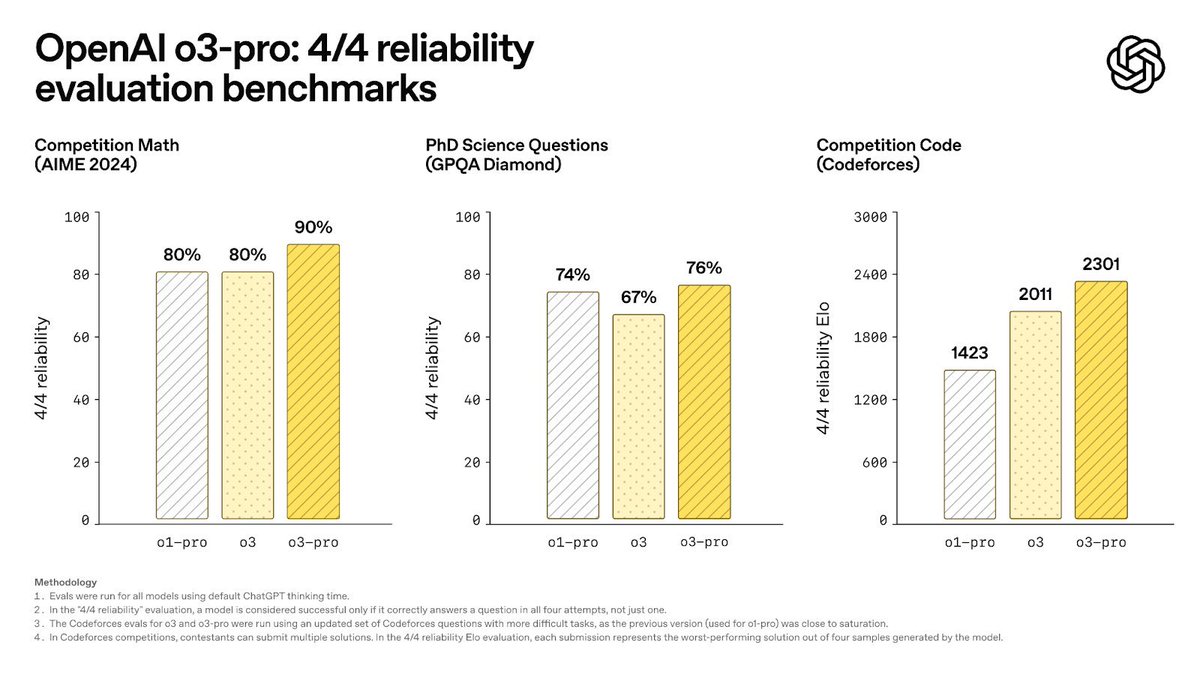
But, if you’re interested, here are a few charts that tell the story…
o3 is very good at math and code (no surprise)
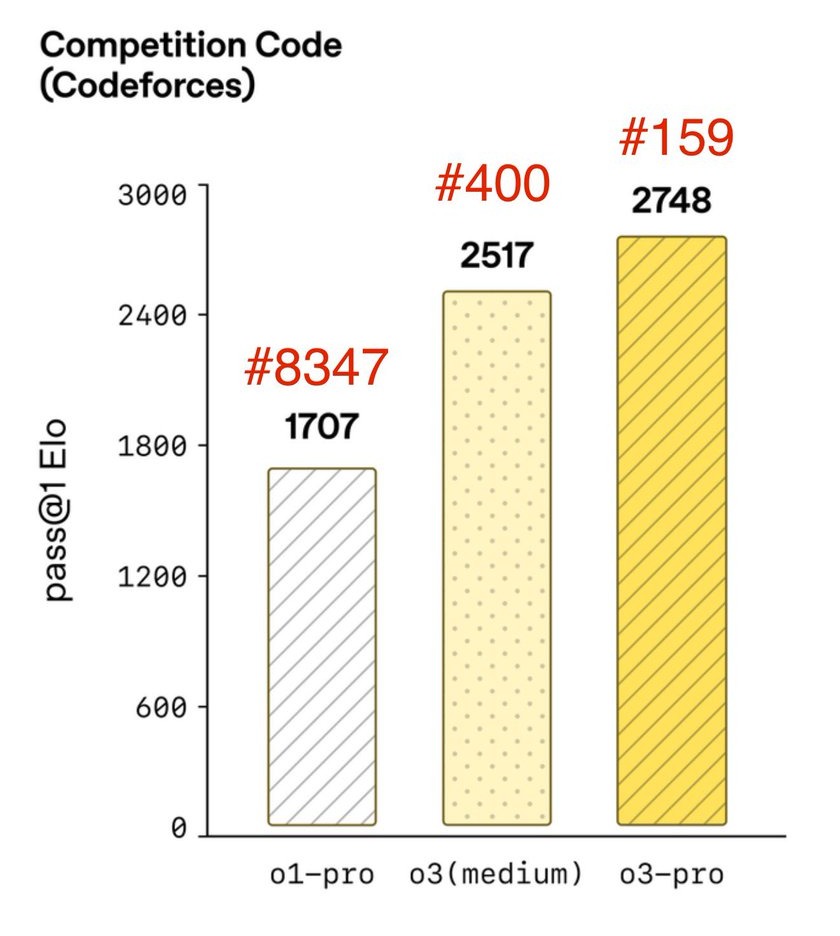
It’s the #159 coder in the world
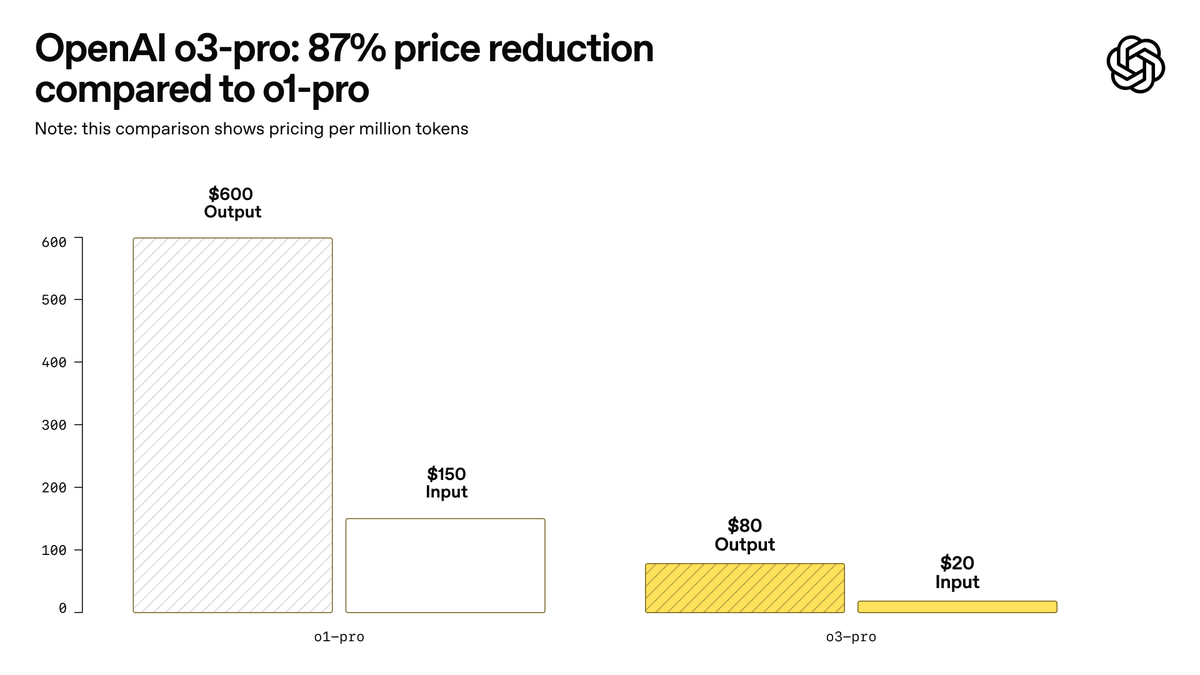
And it’s cheap enough developers can afford to use it
But let’s leave all that aside for a minute. How does it really measure up in the real world?
I put it to the test, and I think I have my finger on why this model is special…
The Resonance Test: Why o3 Pro Is the First AI That Thinks Like a Strategic Partner
There's a moment in every founder's journey when you realize you've outgrown your current advisors. The people who helped you get to $1M ARR suddenly feel... limited. Their pattern matching works for obvious problems, but when you're staring at genuinely strategic decisions—the kind that define the next three years of your company—you need someone who can see around corners.
And yes, people can do that stuff. Paul Graham has made a career of it.
I've been waiting for an AI model to reach that level for a long time. Not just "better at coding" or "faster at research," but genuinely strategic. Maybe not legendary startup guru strategic (give it 48 days) but for now at least strategic enough to have a meaningful conversation.
After kicking around some questions designed to push the strategy muscles vs little cousin o3, I feel good about saying this: o3 Pro is the first AI that thinks like the strategic partner you wish you could afford to hire. (But the catch is you have to prompt it right to get it to talk.)
What Struck Me Most
Here's what struck me most about my head-to-head tests: o3 Pro didn't just win on hard problems or complex analysis. It won consistently, across completely different domains, in ways that revealed a fundamental shift in how it approaches thinking.
On problem solving with code: When I asked both models to design a Wordle solver, o3 gave me code that worked. o3 Pro gave me code that worked and included performance optimizations I hadn't asked for (@lru\_cache decorators, cleaner encoding schemes) plus the kind of variable naming and structure that signals professional craftsmanship. The difference between "gets the job done" and "builds something that’s designed to run efficiently from day 1."
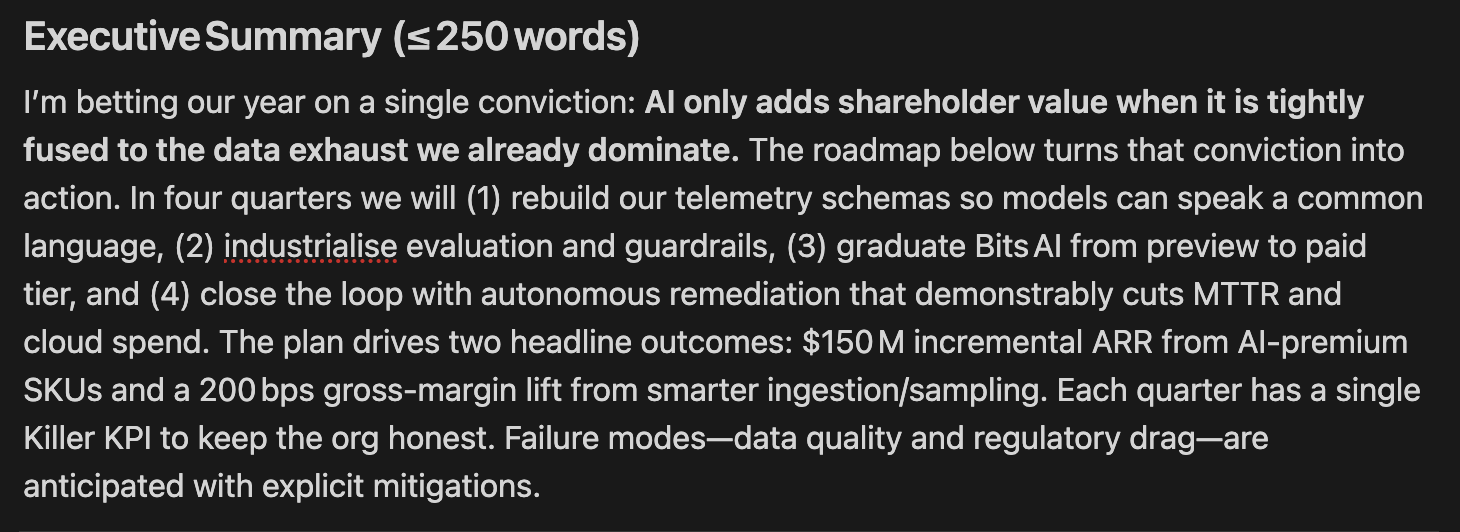
On strategic planning: Both models produced 12-month AI roadmaps for Datadog. o3's plan was competent—it hit the major points, included reasonable timelines, addressed obvious risks. o3 Pro's plan was insightful. It led with "AI only adds shareholder value when it is tightly fused to the data exhaust we already dominate"—a frame that immediately clarifies strategy rather than just listing features. It recognized that Datadog's real moat isn't AI capabilities but data architecture, and built the entire roadmap around leveraging that asymmetric advantage. It was proactive, not defensive. It was detailed and compellingly clear while not losing technical detail.
On research analysis: I threw both models at Apple's recent paper on reasoning model limitations. o3 produced thorough analysis but tried to include everything, including a poorly executed social media section that added noise. o3 Pro leveled up analysis by making it more readable and insightful, and then dunked the ball by making an editorial judgment call—it skipped the Twitter analysis entirely and explained why: "I chose to keep the core deliverable clean and on-spec rather than padding with low-value content." That's not just better analysis; it's better professional judgment.
The pattern was unmistakable: o3 Pro wasn't just producing better outputs, it was making better decisions about what to produce. It chose to shut up.
Why It's Actually Easier to Work With
But here's what really caught my attention: o3 Pro is vastly easier to read. Not because it's simpler, but because it's better at translating complex ideas into accessible language without losing sophistication.
When explaining technical concepts, o3 would give you accurate but dense explanations full of jargon. o3 Pro gives you clear, plain English that still carries all the technical nuance. It's the difference between reading a academic paper and reading a really good explanation from a senior engineer who cares about being understood.
Here’s o3 (this is not ready for C-suite)
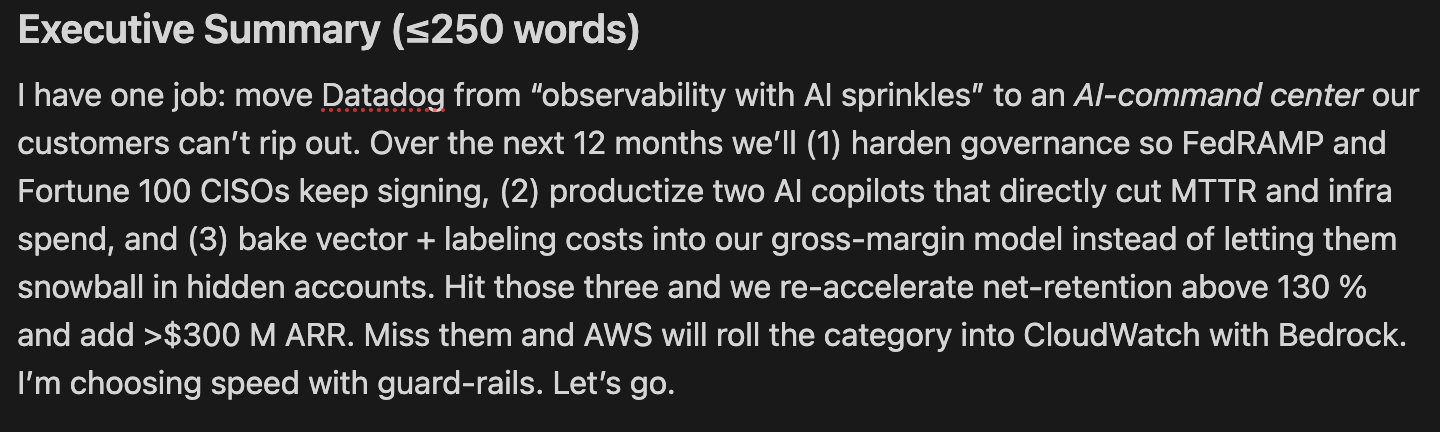
Here’s o3 Pro (this is roughly ready for C-suite)
For the first time, you have an AI that can think at expert level but explain itself at human level. That matters more than any benchmark score.
A Different Kind of Optimization
I noticed something else interesting in my testing: o3 Pro seems optimized for complete, end-to-end reasoning across tool calls + prompt. When I attached documents, it felt very free to step away from those documents rather than being constrained by them. When I asked it to synthesize information from multiple sources and draw strategic conclusions, it was substantially better.
This suggests OpenAI made a deliberate architectural choice: optimize for complete strategic thinking rather than information extraction. That's exactly what you'd want if you're building toward AGI-level strategic partners rather than just better research assistants. Presumably, the bet is they’ll have other models for the research details.
This reminds me of the anatomy of the prompt from this review of o3 Pro.
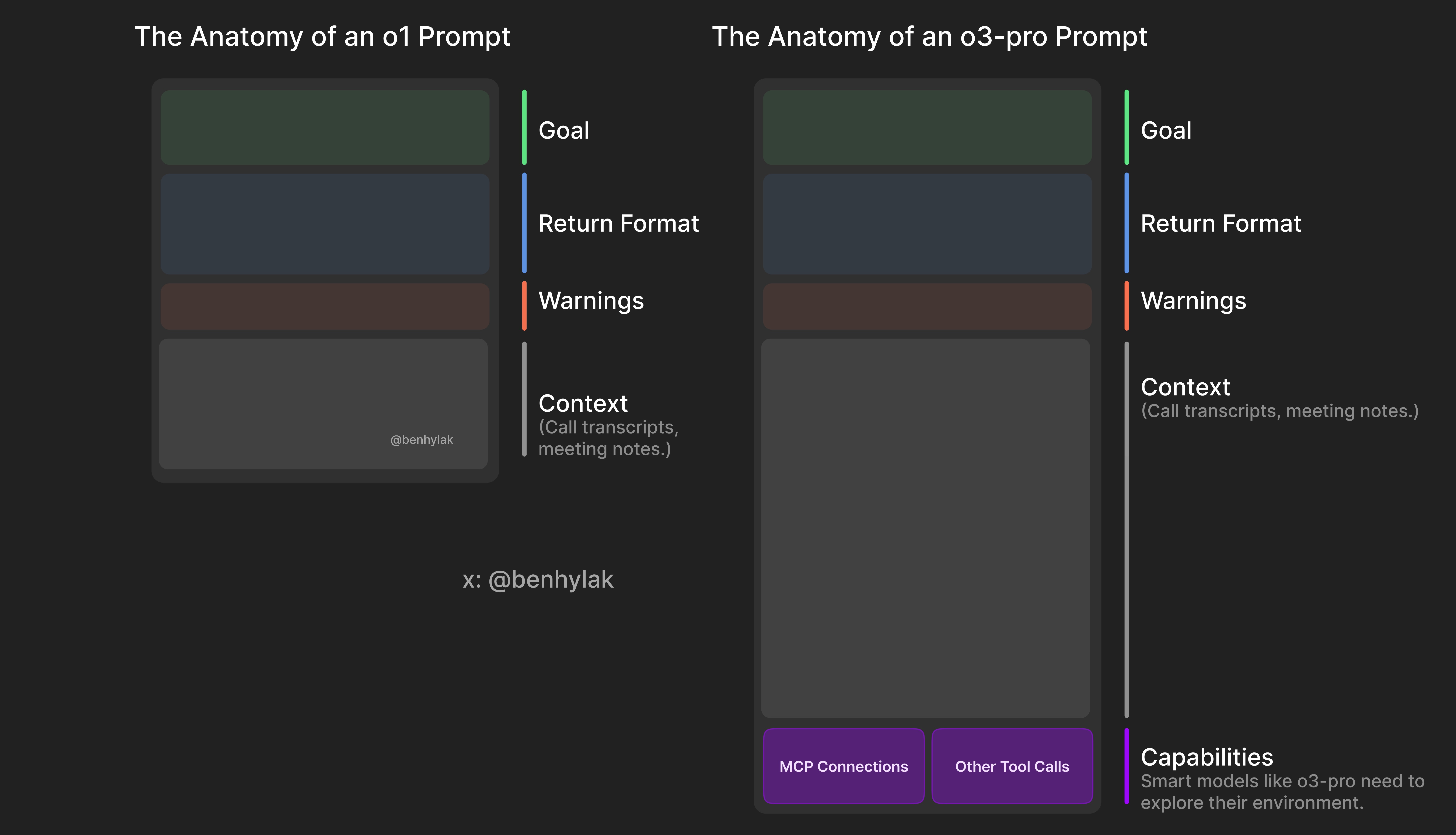
You gotta give this model a lot of context, but you need to do it in the prompt. It’s hungry, and it’s a fiercely global thinker.
Prompting Caveats
This model (as you can see above) is not easy to prompt. It is a slower response curve (hello 15 minute calls) and it’s extremely picky. I will probably do a separate post just on the vagaries of prompting o3 Pro, but for now I will say the following:
- This model is a global thinker, so assume it’s going to fetch extra context whether you ask it to or not—that’s what it is built to do
- If you’re smart, you’ll prompt it for the context you want it to focus on both via tool calls and in the prompt itself
- This model has crossed the persuasion event horizon, and you’ll need to ask another model (like Opus 4) to fact check facts and figures—the thinking will hold up but you need to be sure the global context is actually pulling from sources you feel good about
- If the model does hallucinate, you’re probably not going to see it intuitively because it looks so darn good and is nested with so many other accurate figures—yes this makes it a model for grownups who are careful thinkers
- This model demands hard problems and if you feed it boring problems it really does grind and overthink—give it problems that actually require the GPU cycles
What Makes o3 Pro Feel Different
Let me be specific about what I mean by "strategic thought partner." I'm talking about AI that can:
- Frame problems in ways you hadn't considered ("This isn't about AI features, it's about leveraging data asymmetries")
- Make judgment calls about what matters (choosing depth over comprehensiveness when appropriate)
- Offer perspectives that stick with you (insights you find yourself returning to hours later)
- Communicate complex ideas accessibly (without dumbing them down)
- Think in terms of competitive advantage (not just operational efficiency)
Every founder I know has a small circle of people they turn to for this kind of thinking. Usually investors, experienced operators, or industry veterans who've seen enough patterns to offer genuine strategic insight rather than just tactical advice.
I think o3 Pro is the first AI model that can consistently operate at that level, if fed properly.
Three Key Implications
First, the arbitrage opportunity is massive. I've seen consulting projects charge $50,000 for strategic analysis that o3 Pro can produce for under $10 in API costs. When you combine genuinely strategic-level thinking with 87% cost reduction, entire categories of expensive human expertise become democratically accessible. Don’t pay McKinsey for a review of your business—do it with o3 Pro.
Second, this changes the quality bar for AI work. Previous models required extensive human editing and oversight. o3 Pro consistently produces work you can present directly in important contexts. That's not incremental improvement—it's crossing a threshold from "helpful assistant" to "strategic colleague."
Third, we're approaching abundant intelligence. Complex topics that were previously gated behind technical expertise or expensive consultants are now accessible to anyone willing to craft thoughtful prompts. The constraint shifts from access to intelligence to knowing what questions to ask.
The Economics Are Flipping Completely
Here's the uncomfortable truth about previous "Pro" AI models: the quality gap rarely justified the cost premium. You paid more for marginally better outputs that still required significant human editing and oversight.
With o3 Pro, the economics don't just improve—they flip entirely. o3 Pro costs 87% less than o1-pro while delivering dramatically superior strategic thinking. We're talking about $20 per million input tokens compared to o1-pro's $150, with output costs dropping from $600 to $80 per million tokens.
This isn't just a better deal—it's evidence of what Sam Altman described today as "intelligence too cheap to meter" becoming reality. When strategic-level AI thinking costs 87% less while being substantially better, we're witnessing the early stages of abundant intelligence.
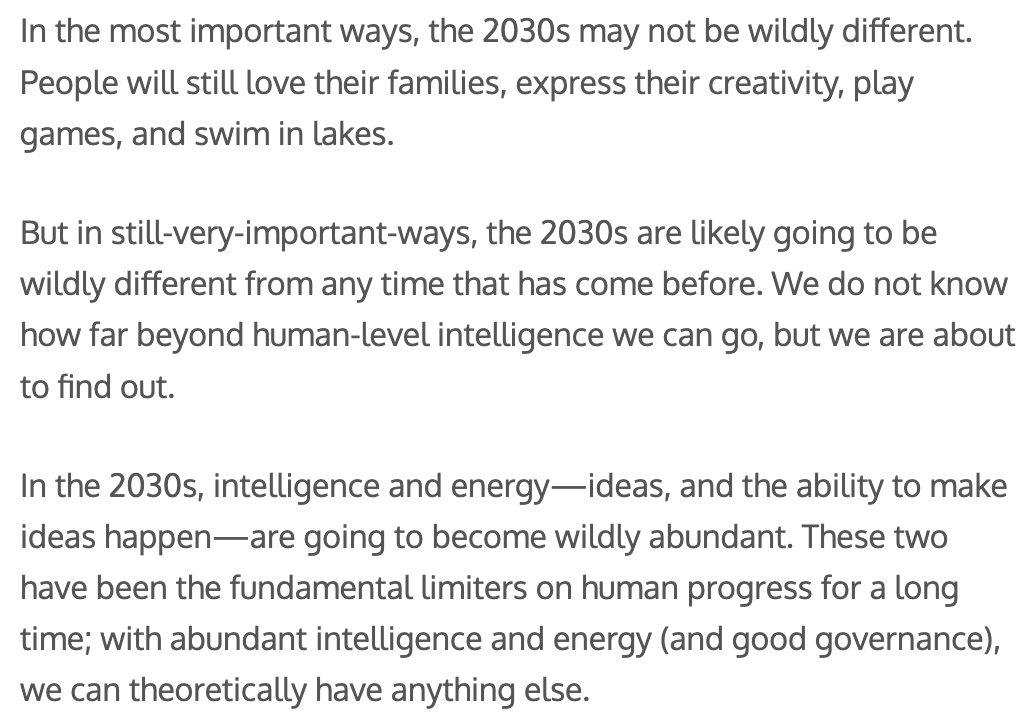
The arbitrage opportunity isn't just staggering—it's becoming civilizational, which is exactly the point Sam makes in his essay today:
Where This Is Heading (And Why Today Matters)
The notes above are from the "The Gentle Singularity" that puts o3 Pro's release in perfect context. "We are past the event horizon; the takeoff has started," he writes, but "it's much less weird than it seems like it should be."
That's exactly what testing o3 Pro feels like. You're interacting with genuinely strategic-level intelligence, but it doesn't feel alien or disruptive. It feels like finally having access to the kind of thinking you've always wanted but couldn't afford.
Altman describes how "wonders become routine, and then table stakes." Six months ago, having an AI produce strategic analysis that passes the resonance test would have felt miraculous. Today, it's starting to feel like a new baseline. What seemed impossible becomes inevitable remarkably quickly.
But here's what makes this moment significant: if o3 Pro represents strategic thinking at the individual level, the next question is organizational deployment. What happens when every founder has access to board-level strategic thinking? When every product manager can stress-test roadmaps against market dynamics? When every teacher can provide graduate-level feedback to every student?
Altman points to scientists already being "two or three times more productive" with current AI. With o3 Pro's combination of strategic insight and 87% cost reduction, we're looking at a compression of strategic intelligence that could reshape how decisions get made across every industry.
We're not just getting better AI tools. We're approaching what Altman calls "intelligence too cheap to meter"—and o3 Pro is the first model that makes that future feel tangible rather than theoretical.
The Resonance Test in Practice
I keep coming back to that resonance test. Good AI outputs are useful in the moment. Great AI outputs stick with you. They reframe how you think about problems. They surface insights you reference weeks later in completely different contexts.
o3 Pro consistently passes that test in a way no previous model has. It offers perspectives specific enough to resonate, strategic enough to matter, and accessible enough to implement.
That's not just better AI. That's AI that can genuinely participate in the kind of thinking that shapes companies, markets, and industries.
Getting Started (The Right Way)
If you're a Pro user, don't waste o3 Pro on throwaway questions. Start with something strategic—a real decision you're grappling with, a complex problem you've been avoiding, or a framework you need to build for something important.
Give it the kind of prompt you'd send to your smartest advisor:
I'm trying to decide whether to [complex strategic decision].
Help me think through this systematically. What am I missing?
[Insert LOTS of CONTEXT about the problem space here—like 50-100 lines]
What questions should I be asking that I'm not? What would
you do in my position and why?
Then watch what happens. You'll know within the first few minutes whether this represents the strategic upgrade you've been waiting for.
Want something simpler? This is a short one with real power if you talk to ChatGPT regularly.
Based on everything you know about me, what would make me 50% happier?
I was really surprised at the difference between o3 Pro and o3 on that one.
The Bottom Line
For two years, I've been testing AI models looking for one that could genuinely enhance strategic thinking rather than just automate tactical work. o3 Pro is the first model that consistently delivers insights I find myself referencing days later, frameworks I actually use for important decisions, and perspectives that genuinely shift how I approach problems.
Sam Altman wrote today that we're climbing "the long arc of exponential technological progress; it always looks vertical looking forward and flat going backwards, but it's one smooth curve." o3 Pro feels like evidence of that curve steepening (just 48 days after o3). We're not just getting incrementally better AI—we're approaching the kind of abundant intelligence that transforms how strategic work gets done.
The future of work isn't AI replacing human judgment. It's AI democratizing access to the kind of strategic thinking that previously required years of experience, expensive consultants, or rare talent. o3 Pro, with its combination of strategic insight and 87% cost reduction, is the first model that makes that future feel not just possible, but inevitable.
As Altman puts it: "wonders become routine, and then table stakes." Strategic-level AI thinking is about to become table stakes. The question isn't whether this transformation is coming—it's how you’ll use it.
And yes, there’s a new open-source model coming from OpenAI later this summer, plus full o4, plus o4 Pro (probably), plus GPT-5 (likely this year). And we’re not even looking at all the other work the other model makers are doing! Buckle your seatbelts for takeoff…
For more on AI, subscribe and save!

\The brain is hungry for context\