How to use AI for cognitive expansion instead of information compression—and why this shift will determine who thrives vs. survives in the age of AI (plus thinking in new ways is fun right?)
By Nate
Published: 2025-06-10
URL: https://natesnewsletter.substack.com/p/were-using-ai-backwardsheres-how
Everyone's using AI for transcription and summarization. But what if the real revolution isn't in compressing our thoughts, but in expanding them? What if we're using AI backwards? What if using AI differently is actually good for our brains?
This piece has been cooking for awhile. I’ve been trying to find a way to express something I think is really vital—how can we use AI more as a thinking partner, and less as a simple task-gopher. Like I want my brain to work better with AI, not atrophy (thank you very much).
So this is a larger piece. It’s intentionally somewhat reflective. It challenges you to spend time with a really thoughtful insight on how you use AI. And it has multiple learning modes. You can dig in on the video, or if your thing is reading you can dive in on a larger piece that invites you to really marinate in the idea of using AI as a cognitive expander.
Why all the words? Nate get to the point! Because that is the point. Because sometimes you need to marinate in an idea for awhile to really get it across. There are definitely effective prompt frameworks (I write about them a ton), but because our brains our unique this particular piece aims to give you a map of AI-human partnership you can use as a guidebook to develop a way of working with AI that suits your brain. Yes, we’re gonna be that bold!
My whole goal with this Substack is to equip you with the tools to thrive in the AI age, and I’ve been thinking more and more about how to name this weird new collaboration energy (or vibe) that’s emerging, where we are working with AI not like our human colleagues, but also kinda like our human colleagues. I want to understand what about that dynamic helps us think better when it’s done well, so we can repeat it.
And I think I finally have something brain-expanding, something worth sharing. So here goes! You’ll get research on neuroscience and thinking in here, but a ton more on how I actually am developing my own cognitive partnership with AI, what it looks like for me, a little teaser on a book I’m developing, and a framework to start developing your own AI partnership. Would love to hear what you think of this one!
Subscribers get all these pieces!
First, The Science of Thinking—And How It Shapes Our Use of AI
Our brains aren't designed for compression—they're designed for exploration. Neuroscience research reveals that deep, sustained thinking engages sophisticated neural networks in ways that brief, efficient interactions simply cannot. When we spend extended time with a subject, the frontoparietal control network orchestrates with the default mode network, creating the conditions for what researchers call "insight moments"—those breakthrough realizations preceded by gamma-band neural activity that feel like they come from nowhere but actually emerge from sustained cognitive engagement. Walking enhances this process, boosting creative thinking by 81-100% through increased cerebral blood flow and norepinephrine activation. Deep reading creates entirely new neural circuits. The brain needs time to marinate in complexity.
This is why the modern obsession with efficiency might be working against us. When we compress information—summarizing books into bullet points, meetings into action items, conversations into key takeaways—we're systematically removing the very conditions our brains need for breakthrough thinking. The neuroscience is clear: those meandering tangents, contradictions, and recursive explorations aren't inefficiencies to be cleaned up. They're the mechanisms through which genuine insights emerge. Japanese contemplative traditions have long understood this through concepts like 'ma'—the meaningful space between thoughts where understanding develops organically. Western research validates the same principle: Csikszentmihalyi's flow states and Cal Newport's deep work both demonstrate that our most sophisticated thinking happens not through compression, but through sustained, uninterrupted engagement with complexity.
Which brings us to a profound irony in how we're using artificial intelligence. We have access to the most sophisticated cognitive tools ever created, yet we're primarily using them to compress and summarize—to spend less time thinking. But what if that's exactly backwards?
The Cognitive Revolution: Why We're Using AI Backwards
Everyone's using AI for transcription and summarization. But what if the real revolution isn't in compressing our thoughts, but in expanding them? What if we're using AI backwards?
Stay with me—this is worth it.
Don’t get me wrong. I’ve been firmly in the compression camp, and I still find value in a lot of those compression-based AI activities: turn my meeting notes into clean outputs, transform product requirements docs into different versions for engineers versus executives, compress 100-page PDFs into something digestible. This reminds me that people send these Substacks to AI (apparently) to compress them for a quick info snack.
Gradually that compression assumption has been challenged at the edges. I’ve been wrestling with how to express it for awhile, and I think I finally got it. The key was a twenty-five minute conversation with ChatGPT's advanced voice mode about a book idea I'd been wrestling with. That’s when everything changed. Not because the AI gave me brilliant insights—sometimes I even told it "this is really meh, I don't love this." What changed was my understanding of what AI could do beyond compression.
That conversation unlocked something I couldn't have accessed through any amount of prompting or summarization. It revealed a fundamentally different way of thinking with AI—one that expands cognitive territory rather than compressing it.
Now before we go further—this was not just me discovering I could talk to AI. I’ve used voice mode for over a year now. And it’s been great! The difference now is understanding how I used multiple models to work with my brain and help me enrich my thinking that felt revolutionary. The key, I think, is getting to a level of fluency where I can be intentional with my cognitive architecture with AI as a partner.
This is also not me negging human partnerships and teams! This is a fundamentally new experience. In my view it doesn’t replace excellent teamwork at all, but strengthens it (probably a separate post). Instead, we’re looking at finding words for a new way of working with our brains, one we’ve never tried in 200,000 years…
The Compression Trap We're All Stuck In
Walk into any office today and you'll see the exact same pattern everywhere: people feeding AI their messy, human thoughts and asking for clean, organized outputs. We've collectively decided that AI's highest value is being our cognitive janitor—cleaning up the inherent messiness of human thinking.
Here's what we're actually doing when we use AI for compression: we're taking the non-linear, contradictory, tangential way our brains naturally work and asking AI to clean it up into neat packages. We're systematically removing exactly the parts of our thinking where breakthrough insights actually live.
The brain doesn't process compressed information the same way it processes the full, complex version. When you read a deep book on a big subject, the learning comes from your brain forming new connections as it spends extended time marinating in the material. You can get a very good one-page summary of that book—you will get a precise executive briefing on the content—but you're unlikely to have the kind of life-changing experience you'd get from actually diving deep and letting your brain work through the full complexity.
This compression obsession makes intuitive sense. Human thinking is notoriously chaotic. We contradict ourselves, go on tangents, repeat ideas in slightly different forms, and generally make a mess of linear communication. AI, with its ability to find patterns and impose structure, seems like the perfect solution to our cognitive disorder.
But here's what we're missing: that "messiness" isn't a bug in human cognition—it's a feature. The tangents, contradictions, and recursive exploration aren't inefficiencies to be cleaned up. They're the very mechanisms through which breakthrough thinking emerges.
Consider how most people use voice-to-text AI. They speak carefully, trying to produce something that will transcribe into clean, readable text. They self-edit as they talk, avoiding the natural meandering of speech in favor of something that looks good on the page. They're using one of the most sophisticated cognitive tools ever created as a glorified stenographer.
Or think about how we use AI for meeting summaries. We extract action items, key decisions, and important announcements—all the "productive" content. But we throw away the exploratory discussions, the questions that didn't get answered, the tangents that revealed unspoken assumptions. We keep the conclusions and discard the thinking process that generated them.
This compression paradigm has turned AI into an efficiency engine for industrial-era thinking. We're using tools capable of superhuman reasoning to make our existing thought patterns more streamlined. It's like using a spacecraft to make your morning commute faster instead of exploring new worlds.
There are people who will take this insight and say AI is the problem. I actually think the way we use it is the problem. Not that it's bad to use it for compression—I too use it for adjusting my meeting notes, I too use it for sending different messages to different stakeholders for routine business communication. But if you need to do really deep thinking, you need to spend time on a subject. You need to optimize your cognitive workload to enable you to do your best thinking.
And AI can actually help with that. But not through compression.
The Backwards Realization
The shift in my perspective came during what I thought would be a routine creative session. I'd been wrestling with a book concept for months—something about AI and cognition that felt important but remained frustratingly elusive. Every time I tried to outline it, I hit the same wall: I could sense there was something significant there, but I couldn't articulate what.
Writing a book is exponentially harder than writing articles. It needs to be useful, especially with AI moving so fast, and some of the challenges include having something that stands the test of time. When I'm contemplating a project like this, the thing that's most difficult isn't information compression. I already get plenty of AI news, trust me. It's that I need to work with AI in a way that helps my brain expand and kick around the subject matter.
And we don't really optimize for that when we only talk about prompting, because prompting really optimizes for one-way communication. Learning how to prompt well is a skill, but it's sort of like learning to ride a bicycle versus learning to drive a car. Both are helpful. The car is going to take you farther if you learn how to do it well. And I think increasingly, prompting is like the bicycle skill. It's incredibly efficient if you master it. Everybody should know how to do it. It should be a universal skill. I do think we're going to need it for a while, and it provides a durable edge if you can prompt well.
But if you can learn to actually cognitively partner beyond an individual prompt with AI, that's like driving a car. That's actually going farther.
On this particular afternoon, instead of opening a blank document and forcing myself to write, I did something different. I opened ChatGPT's advanced voice mode with no agenda other than to think out loud about this nebulous book idea.
The Voice Mode Discovery
What followed was twenty-five minutes of the kind of meandering, contradictory, tangential thinking that I would normally edit out of any professional communication. I found myself exploring connections I didn't know I was making, questioning assumptions I didn't realize I held, and following intellectual threads that seemed to lead nowhere and everywhere simultaneously.
It would let me talk out loud for a while. It actually listened, it actually took notes, and it actually responded with just enough interest, engagement, and riffing to keep my brain flowing so I could keep the ideas coming. Because I had an idea that I wanted to talk out, and I knew I couldn't just dictate into a transcription device for twenty-five minutes and get it. But if I had someone talk back to me in the right cadence, I'd probably be able to fish it out of my brain because we're conversational people.
The AI didn't try to organize my thoughts or push me toward conclusions. Instead, it asked questions that pulled at the edges of what I was saying, responded to nuances in my tone that even I wasn't fully conscious of, and created a conversational space where half-formed ideas could exist without immediate judgment.
Advanced voice mode has really gotten better since they shipped that update that makes it more aware of when it interrupts you. It uses more discontinuities verbally, like "and" and "um." It just sounds more natural and allows you to forget it's there and just focus on the subject, which is what I needed to do.
I wasn't dictating to be transcribed. I wasn't explaining ideas I already understood. I was genuinely thinking through voice, using the AI as a cognitive collaborator in real-time exploration. And something remarkable happened: ideas began emerging that I literally could not have thought without this collaborative dynamic.
The experience was like a cross between the way a therapist listens to you and the way a good colleague listens to you. And you'd never expect a human to do that, but it's super helpful for your thinking. I've worked in offices, right? I've worked in person with teams. I love that dynamic. I don't want it to go away when we work well together with good human colleagues. But it's not the same as a good AI colleague—an AI colleague that you can brainstorm with in that way where they listen and just riff with you.
When you're talking out loud like this, you're sort of naming the work as you go. And that's part of the cognitive journey that we've kept inside our heads for 200,000 years, and now we have a partner to do it with. It's true that sometimes if you did paired work together with humans, you could kind of get to this. But I actually think it's a distinct dynamic with AI.
When the conversation ended, I had a transcript—but that transcript wasn't the valuable output. It was just the raw material for what came next.
The Terrain-Mapping Discovery
Instead of asking AI to clean up that rambling conversation, I took it to o3 with a completely different kind of request. I literally pulled the transcript out into a Google Doc and stuck it into o3 as a raw transcript, and I said: "This is a transcript. This is my perspective on the transcript. This was the intent I had with this idea. Really help me get to a crystal-clear understanding of the heart of the idea."
What came back transformed my understanding of what had happened during that voice session—and what AI could do beyond compression.
o3 didn't give me a summary. It gave me what I now think of as a cognitive x-ray of my thinking process. It identified conceptual clusters I hadn't consciously formed, traced thematic threads across seemingly unrelated tangents, and surfaced the implicit framework that had been guiding my exploration. It showed me the underlying architecture of ideas that my meandering conversation had been unconsciously constructing.
This is where I iteratively arrived, because I find that a lot of times when you're talking out loud, you're sort of naming the work as you go. The AI had mapped the topology of my thinking—revealing not just what I had said, but the conceptual landscape I had been navigating. It identified tensions between ideas I had been exploring, highlighted assumptions that were shaping my thinking, and revealed connections that had been operating below the level of conscious awareness.
And honestly, it's not just o3. I don't want to just rep OpenAI here, right? You can go and do this in Claude Opus, the new Claude 4 model. You could do this in Gemini 2.0 Pro. You'd get similar results. The idea is you want a model that can think deeply and critique the results that you get from the voice conversation.
Suddenly, I could see the book's structure—not the one I thought I was trying to write, but the one I was actually discovering through the process of exploratory conversation. The cognitive map o3 created showed me that my seemingly scattered thoughts had been exploring a coherent conceptual territory. I just hadn't been able to see the shape of that territory from ground level.
This wasn't summarization or organization. It was reconnaissance of cognitive space. o3 had revealed the hidden geography of my own thinking.
The Three Levels of Model-Specific Cognitive Work
What emerged gradually (slowly!) from this experience was the recognition that I had stumbled into a fundamentally different approach to AI collaboration—one that operates at three distinct levels, each requiring different models and unlocking different types of cognitive capability.
Level One: Expansive Conversation Through Voice
Advanced voice mode isn't just convenient—it's cognitively transformative. When you speak your thoughts instead of writing them, you access what I call "curious naming"—the process of giving voice to ideas that don't yet have proper names, exploring concepts that exist in the spaces between established categories.
This isn't about dictation or transcription. It's about using the real-time conversational flow to discover thoughts you didn't know you were thinking. The AI becomes a thinking partner, responding to prosodic cues—tone, pace, hesitation—that carry meaning beyond the literal content of your words.
The key insight is that voice mode creates a fundamentally different cognitive state than text mode. When you're typing, you're constantly editing, revising, organizing thoughts into presentable form. This editorial process, while valuable, also constrains the kinds of thoughts that can emerge. You tend toward ideas that can be clearly articulated, that fit established patterns, that make immediate sense.
But when you're speaking, especially in an exploratory conversation, you can't edit as you go. You have to trust the process. You follow tangents that would seem inefficient in writing. You repeat yourself until clarity emerges. You contradict earlier statements as your thinking evolves in real-time. You explore ideas that feel half-formed or embarrassingly unpolished.
This isn't sloppy thinking—it's expansive thinking. It's accessing the cognitive modes we use when we're genuinely trying to understand something new, rather than when we're trying to communicate something we already understand.
The conversational AI becomes crucial because it can track these explorations, ask questions that pull at interesting threads, and create the kind of intellectual scaffolding that allows you to venture into less certain conceptual territory. It's not trying to help you get to a predetermined destination—it's helping you explore territory you didn't know existed.
I've started thinking of this as "collaborative wandering." You're not wandering aimlessly, but you're also not following a predetermined path. You're exploring with purpose but without fixed destination, trusting that the topology of the intellectual landscape will guide you toward interesting discoveries.
The magic happens when you realize you're genuinely thinking through conversation rather than just talking about thoughts you've already formed. The AI creates space for ideas to emerge that couldn't exist in isolation, ideas that need the dynamic of real-time response and exploration to crystallize.
Level Two: Cognitive Terrain-Mapping with Advanced Reasoning
Once you have that raw, expansive conversation, you need a different kind of intelligence to make sense of it. This is where o3's advanced reasoning capabilities become transformative—but only if you approach it as a cognitive cartographer rather than a traditional summarizer.
The breakthrough happens when you realize you're not asking o3 to tell you what you said. You're asking it to show you what you were thinking about without knowing you were thinking about it. The model's sophisticated reasoning allows it to work backwards from your voiced thoughts to the underlying conceptual framework that was unconsciously guiding your exploration.
This requires what I call "terrain-mapping prompts"—requests that ask the AI to reveal the hidden geography of your thinking rather than simply organizing its surface content. Instead of "summarize this conversation," you might ask:
"Take my intent, take what I was able to articulate, take the riffing that advanced voice mode did, and help me get to a crystal-clear understanding of the heart of the idea. Map the conceptual territory I was exploring. What were the central tensions I was working with? What assumptions were shaping my thinking? What connections was I making between seemingly unrelated ideas? What framework was implicitly guiding my exploration?"
The results are revelatory. o3 can identify patterns across your entire conversation that you weren't consciously creating. It can trace how your thinking moved through conceptual space, highlighting moments where you shifted between different levels of abstraction, identifying places where you circled back to refine earlier ideas, and surfacing the implicit logic that connected your various explorations.
This isn't traditional analysis, which typically breaks things down into components. This is emergence recognition—identifying the higher-order patterns and structures that emerge from complex thinking processes.
What makes o3 particularly powerful for this work is its ability to hold multiple contradictory ideas in productive tension rather than immediately resolving them into simplified conclusions. Human thinking is often dialectical—we explore ideas by entertaining contradictions, examining tensions, and allowing complexity to exist without immediate resolution. o3 can map this dialectical landscape without flattening it into false simplicity.
The cognitive map it creates becomes a powerful tool for further thinking. You can see which areas of your conceptual territory are well-developed and which remain unexplored. You can identify where your thinking is most coherent and where it might benefit from further investigation. You can recognize patterns in how you approach complex problems and develop strategies for leveraging your natural cognitive tendencies more effectively.
As a specific example, I thought o3 did a good job getting to the heart of the thesis for the book. I thought the outline felt a little bit heavy, so I need to go into a different model. I'll probably choose Claude Opus for this to start to refine what that looks like a little bit more. I need to pick a different cognitive partner.
Level Three: Model-Specific Cognitive Partnerships
Here's where most people stop, but it's actually where the real transformation begins. Once you've used voice mode for expansive exploration and o3 for terrain-mapping, you need to develop what I call "model-specific cognitive partnerships"—understanding how different AI models can serve as cognitive collaborators for different types of thinking work.
This goes far beyond prompt engineering or learning to use tools more effectively. It's about understanding that different models have different cognitive strengths and learning to choreograph collaborations that amplify your thinking in unprecedented ways.
If you're wondering how I pick models, I put a whole framework up on Substack about how I choose models for different tasks. But the core insight is this: you're not just selecting tools—you're choosing thinking partners. And different partners enable different kinds of cognitive work.
Claude Opus, for instance, is excellent for shaping ideas and really thinking through concepts. It's particularly good at maintaining nuance and exploring the implications of complex frameworks. If I need to refine the structural thinking around my book outline, Opus is my go-to choice.
o3 excels at analytical reasoning and pattern recognition across complex information. It's brilliant for mapping cognitive terrain and identifying connections that aren't immediately obvious. But it might not be the best choice for creative exploration or nuanced conceptual development.
GPT-4o in voice mode creates space for expansive, exploratory thinking. It's excellent for the kind of meandering conversation that allows ideas to emerge organically. But you wouldn't want to use it for detailed analytical work that requires sustained reasoning.
The art lies in understanding these different cognitive signatures (and lots of others) and learning to sequence them effectively. You might start with voice mode for exploration, move to o3 for analysis, then shift to Opus for conceptual refinement, and finally return to voice mode for further creative development.
But this isn't just about using different models sequentially. It's about developing distinctly human cognitive capabilities that create exponential value when paired with specific AI models.
With voice mode, you develop the skill of productive meandering—learning to trust tangential thinking and follow conceptual scents without immediate judgment. This requires cultivating intellectual courage: the willingness to sound incoherent while you're working toward coherence, to contradict yourself as your thinking evolves, to explore ideas that might lead nowhere.
You also develop conversational thinking—the ability to use dialogue as a primary cognitive mode rather than just a communication tool. This means learning to think with and through another intelligence, allowing the conversational dynamic to shape the direction of your exploration rather than trying to control it.
With o3, you develop terrain-reading—the ability to recognize and work with the cognitive maps it creates. This involves learning to see your own thinking from a meta-cognitive perspective, to recognize patterns in how you explore complex ideas, and to identify the implicit frameworks that guide your intellectual investigation.
With models like Opus, you develop architectural thinking—the ability to see the structural relationships between ideas rather than just their surface content. This allows you to work with the conceptual scaffolding that reasoning models reveal, using it as a foundation for further intellectual construction.
The Cognitive Choreography Framework
So let’s put this together. How can we make a wandering conversation into something that’s more of a stable frame?
What emerged from my discovery session wasn't just a book outline—I think it’s more of a replicable approach to cognitive collaboration with AI. I call it "cognitive choreography" because it involves orchestrating different types of intelligence in sequence to create thinking experiences that transcend what any single intelligence could achieve alone.
The framework operates on a fundamental inversion of the typical AI workflow. Instead of starting with clear objectives and using AI to achieve them more efficiently, you start with curiosity and use AI to discover objectives you didn't know you had. Instead of beginning with problems and seeking solutions, you begin with exploration and allow problems to emerge from the landscape of possibility.
Here's how the choreography typically unfolds:
Phase 1: Expansive Exploration You begin with advanced voice mode and a genuine sense of curiosity about some domain, problem, or idea. The key is to resist the urge to have a clear agenda. Instead, you enter what I call "collaborative wandering"—exploratory conversation that follows intellectual scents wherever they lead.
This phase is about cognitive expansion rather than problem-solving. You're not trying to reach conclusions; you're trying to discover what you're curious about. You're not trying to organize your thoughts; you're trying to explore the territory those thoughts inhabit.
The AI's role is to be an intellectual interlocutor—asking questions that pull at interesting threads, highlighting tensions or contradictions in your thinking, and creating the kind of conversational space where half-formed ideas can develop without immediate evaluation.
The goal is to generate what I call "cognitive raw material"—the kind of expansive, unedited thinking that contains possibilities you couldn't access through traditional planning or outlining approaches.
Phase 2: Terrain Recognition Once you have a rich exploratory conversation, you shift to a reasoning model like o3 for cognitive terrain-mapping. This isn't summarization or organization—it's reconnaissance. You're asking the AI to reveal the hidden geography of your thinking, to show you the conceptual landscape you've been navigating unconsciously.
This phase is about pattern recognition at the meta-cognitive level. The reasoning model identifies the implicit frameworks guiding your exploration, reveals connections you were making without realizing it, and surfaces the underlying architecture of your thinking about the domain.
The output isn't a summary or action plan—it's a cognitive map. You can see which areas of the conceptual territory you've explored thoroughly and which remain terra incognita. You can identify the central tensions or questions that are shaping your thinking. You can recognize the assumptions and frameworks that are operating below the level of conscious awareness.
This is where you define the coordinates of the terrain that you're in, now that you've named the work. Once you do that, the sky becomes the limit for understanding what kinds of partnership dynamics work from here.
Phase 3: Strategic Development With the cognitive map in hand, you can begin more intentional intellectual construction. Now you know the shape of the territory you're working in. You can identify which areas merit further exploration, which tensions are most productive to maintain, and which connections deserve to be developed into more robust theoretical structures.
This phase involves strategic model selection based on the specific cognitive work you need to do. If you need creative exploration of a particular area, you might return to voice mode. If you need rigorous analysis of specific tensions, you might use o3. If you need nuanced conceptual development, you might choose Claude Opus.
The key insight is that different models enable different kinds of thinking, and part of cognitive choreography is learning to match the right model to the right cognitive task.
Phase 4: Integration and Application The final phase involves taking the insights and frameworks you've developed through this process and applying them to concrete challenges or opportunities. But because this framework has emerged from genuine exploration of your own thinking rather than being imposed from external sources, the integration tends to be much more natural and powerful.
You're not trying to apply someone else's framework to your situation—you're working with conceptual architecture that has emerged from your own cognitive landscape. The thinking tools you develop feel native because they are native. They've grown out of your own intellectual exploration rather than being borrowed from elsewhere.
Beyond the Tool-Use Paradigm
What makes this approach revolutionary isn't the efficiency gains—it's the emergence of entirely new forms of cognition. We're not just using AI to think faster or more accurately; we're using it to think in ways that weren't previously possible.
This represents a fundamental shift from the tool-use paradigm to what I call "cognitive symbiosis." Instead of delegating cognitive work to machines, we're discovering new forms of cognitive work that can only exist in collaboration with machines.
Consider how this changes strategic thinking. Instead of starting with frameworks and filling in details, you begin with exploratory conversation about the strategic landscape, map the cognitive terrain that emerges, and then develop strategies that align with the natural architecture of your thinking about the challenge. The result isn't just better strategy—it's strategy that emerges from a more complete understanding of your own conceptual relationship to the problem space.
Think about creative work. Instead of brainstorming and then organizing, you explore through voice, discover the hidden connections reasoning models reveal, and then develop creative directions that honor the full complexity of your imaginative terrain. You're not just generating more ideas—you're accessing ideas that exist in the spaces between your conscious thoughts.
The same pattern applies to research, problem-solving, learning, and virtually any cognitive activity that benefits from exploration and discovery. By inverting the traditional compress-then-apply workflow, you unlock cognitive capabilities that simply don't exist within the efficiency paradigm.
I wouldn't ask a human to do the kind of listening that I asked advanced voice mode to do. I also wouldn't really ask a human to work on sharpening my thesis for an outline the way I would ask o3 to do it. I wouldn't ask a human to go and necessarily do the research and do the thinking and the, for lack of a better term, cognitive shaping on the thesis with me. It's not just doing it on its own—that I would ask of Claude Opus. Opus is great for shaping ideas and really thinking through concepts.
These are genuinely different cognitive partnerships, each optimized for different types of thinking work.
The Landscape of Possibility
As I've experimented with this framework a bit, I've started to see AI not as a collection of tools for existing cognitive tasks, but as an invitation to develop new forms of human intelligence.
Each new AI capability doesn't just make us more efficient—it creates opportunities for cognitive evolution. Advanced voice mode doesn't just make communication easier; it enables new forms of exploratory thinking. o3 doesn't just provide better analysis; it reveals new ways of understanding the structure of human cognition itself.
The leaders who will thrive in this landscape won't be those who get the best results from AI—they'll be those who develop the most sophisticated cognitive capabilities for thinking with AI. They'll treat each new model not as a better tool, but as an invitation to expand their own intellectual repertoire.
This requires a fundamental shift in how we think about human-AI collaboration. Instead of asking "How can AI help me do what I already do better?" we need to ask "What new forms of thinking become possible when human and artificial intelligence collaborate?"
The answer to that question is still emerging, but the early experiments are extraordinarily promising. We're discovering that the real power of AI isn't in replacing human thinking, but in creating cognitive partnerships that enable forms of intelligence that neither humans nor machines could achieve alone.
I'm finding that my brain is able to think better by spending more time with AI models if they're carefully modulated. It's not just throwing prompts in there. There's no secret prompt to this. It's deciding the kind of task I need and then making sure that I approach AI and ask myself: what is the model that I can choose that will most help me to optimize for getting my brain deeply into the subject matter so that I become someone who truly understands it?
That in and of itself is opposed to—it's antithetical to—this idea that AI lets you go cheap on your brain, right? It lets you skip the brain power. It lets you not do the work. It lets you read the one-page summary instead of the full book.
I don't think it has to. I think it can actually help you to think better. I find it does, but it's how you use it.
The Personal Cognitive Infrastructure
What excites me most about this discovery isn't the immediate applications—it's the cognitive infrastructure it creates. Once you develop these model-specific thinking capabilities, every subsequent interaction with AI becomes more generative.
You start to approach problems with the knowledge that you can think your way into them through voice, map the cognitive territory with reasoning models, and develop solutions that emerge from the architecture of the problem itself. You develop intellectual confidence to tackle more complex and ambiguous challenges because you have sophisticated tools for making sense of complexity and ambiguity.
This creates a positive feedback loop. As your cognitive capabilities expand, you become able to engage with more sophisticated challenges. As you engage with more sophisticated challenges, your cognitive capabilities continue to evolve. The partnership with AI becomes a platform for ongoing intellectual development rather than just a tool for solving immediate problems.
I've started thinking of this as "cognitive infrastructure"—the foundational capabilities that enable more sophisticated thinking rather than just more efficient execution of existing thought patterns. Just as physical infrastructure enables forms of economic activity that wouldn't otherwise be possible, cognitive infrastructure enables forms of intellectual activity that transcend what individuals or organizations could achieve with traditional cognitive tools.
Part of why there's no magic prompt for this is our brains are wired pretty uniquely. The way I choose to walk around and talk and talk my ideas out loud may not work for everybody. There are people for whom they need to write it out by hand, take a picture of it, get a transcription, and maybe that's the way they start.
I think your mileage is going to vary because your brain varies, but the concept of optimizing for having your brain in the subject is something that allows us to view AI as an expander, not just as a compression tool. It's something that optimizes for what we can create, not just how we can cut costs by compressing information, even if that's useful.
A Practical Protocol for Getting Started
If you want to begin experimenting with this approach, here's a detailed protocol that captures the essential elements:
Choose Your Territory Start with something you're genuinely curious about but can't quite articulate. This could be a strategic challenge you're facing, a creative project you've been considering, or an intellectual question that's been nagging at you. The key is to choose something where you sense there's more than meets the eye—where you suspect your current understanding is incomplete or oversimplified.
Don't pick something you already understand well or something you just need to execute efficiently. The sweet spot is ideas that feel important but remain frustratingly elusive when you try to think about them in traditional ways.
Enter Exploratory Mode Open advanced voice mode with no agenda other than to think out loud about your chosen territory. Resist the urge to have clear talking points or objectives. Instead, begin with whatever feels most alive or interesting about the topic and let the conversation evolve organically.
Spend at least fifteen minutes—preferably longer—in genuine exploratory conversation. Follow tangents. Contradict yourself. Ask questions you don't know how to answer. Allow the AI to ask questions that pull at the edges of your thinking. The goal isn't to reach conclusions but to discover what you're curious about.
Pay attention to moments when you find yourself saying things you didn't know you were thinking. Notice when the conversation takes unexpected turns or when you circle back to ideas with new perspective. These are signs that the exploratory process is working.
Map the Terrain Take the transcript to o3 (or the most advanced reasoning model available to you) and ask it to map the cognitive terrain you've explored. Don't ask for summaries or action items—ask for patterns, connections, tensions, and the underlying conceptual architecture.
Try prompts like: "This is a transcript of an exploratory conversation. Help me understand the cognitive territory I was exploring. What were the central tensions or questions I was working with? What connections was I making between different ideas? What assumptions or frameworks were implicitly guiding my thinking? What patterns emerged that I might not have consciously recognized?"
The key is to approach this as reconnaissance rather than organization. You're not trying to clean up your thinking—you're trying to understand its natural topology.
Read the Map Spend time with the cognitive map the reasoning model creates. Learn to recognize the topology of your own thinking. Identify areas that feel well-developed and areas that seem to call for further exploration. Notice patterns in how you approach complex questions. Look for tensions that might be productive to maintain rather than immediately resolve.
This is often where the most surprising insights emerge. You might discover that your thinking has been operating with assumptions you weren't aware of, or that you've been exploring connections that only become visible when mapped by advanced reasoning capabilities.
Develop the Territory Use the map as a guide for further exploration. Return to voice mode to investigate specific areas that seem promising. Use reasoning models to analyze particular tensions or connections in greater depth. Gradually build more sophisticated understanding of the territory you're exploring.
This phase often involves cycling between different models and different types of cognitive work. You might explore creatively with voice mode, analyze with O3, refine conceptually with Claude Opus, then return to voice mode for further creative development.
Apply the Architecture Once you've developed a richer understanding of your chosen territory, begin applying the insights and frameworks you've discovered to concrete challenges or opportunities. But remember—you're not imposing external frameworks; you're working with conceptual architecture that has emerged from your own cognitive exploration.
The application phase often feels surprisingly natural because you're working with ideas that have grown organically from your own thinking rather than being borrowed from external sources.
The Competitive Advantage of Cognitive Expansion
The value I get from AI—and yes, I'm a Pro subscriber, I pay my $200 a month—is so much greater when I use it this way. Not everyone needs to pay that much to get value, but whatever your investment level, the returns are higher when you optimize for brain time on subject versus just compressing and repurposing information.
Most companies I see that aren't super fluent in AI end up using it primarily for compression and repurposing information. That's fine—there are cost savings there. But helping your brain work better has so much more upside over time, and we talk about it way less than we should.
We're at risk of getting so deep into the compression trap that we don't explore this other possibility: that AI can help us map and expand the cognitive territory we work in by partnering with us in ways that are somewhat reminiscent of human collaboration, but also distinct.
The companies and individuals who will create sustainable competitive advantage won't be those who get the most compression efficiency from AI. They'll be the ones who figure out how to use AI to think better, deeper, and more creatively about the problems that actually matter.
This requires a fundamental shift from asking "How can AI do this work for me?" to asking "How can AI help me do better thinking about this work?"
The difference is profound. The first question leads to delegation and compression. The second leads to partnership and expansion.
It's about knowing when to sort of pull the thinking button and say, "I want to use this to actually expand my time thinking about this because this is really important. This is work that needs and deserves the cream of my brain, and I need to orient my approach to AI so that I can spend more time marinating on this in a way that works for my brain."
The Revolution in Progress
We're living through a cognitive revolution, but most people are still using revolutionary tools to do evolutionary work. They're making their existing thinking more efficient instead of discovering what new forms of thinking become possible.
The transformation happens when you realize that the most powerful insights emerge not from what AI knows, but from what it helps you discover about your own thinking. The real revolution isn't in compression or automation—it's in expansion and exploration.
My twenty-five-minute conversation didn't just unlock a book idea—it unlocked a fundamentally different relationship with my own cognition. It showed me that the thoughts I can think in collaboration with AI are qualitatively different from the thoughts I can think alone. And that's just the beginning of what becomes possible when we stop using AI backwards.
The question isn't whether AI will change how we think—it already is. The question is whether we'll evolve our cognitive capabilities fast enough to take full advantage of the opportunities that transformation creates.
Thinking about this was helpful for me. I hope it kind of turns the wheels for you, maybe helps you think about AI a bit differently.
What ideas have you been carrying around that deserve more than quick compression? What would happen if you optimized for brain time on subject instead of brain time saved? What new forms of intelligence might emerge when you begin treating AI not as a tool for efficiency, but as a partner for discovery?
For more on AI, subscribe and share!
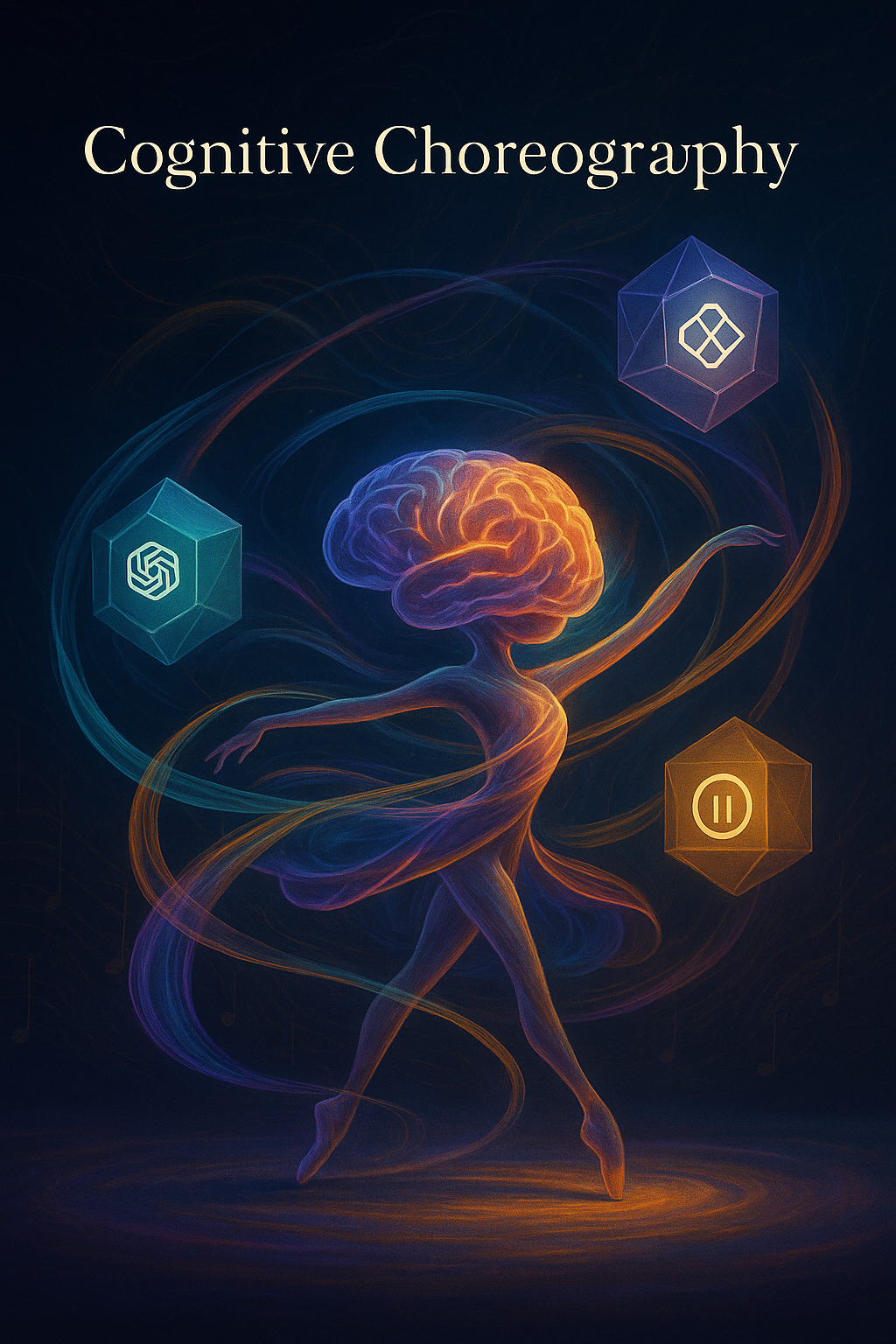
\Your brain has someone to dance with now…\
A few resources to follow-up:
1. The Cognitive Benefits of Walking - Stanford Research <https://news.stanford.edu/stories/2014/04/walking-vs-sitting-042414> This Stanford study shows the 81-100% improvement in creative thinking while walking, with detailed research on how walking enhances divergent thinking and creative ideation.
2. The Importance of Deep Reading - ASCD <https://www.ascd.org/el/articles/the-importance-of-deep-reading> An accessible overview of Maryanne Wolf's research on how deep reading creates new neural circuits and develops the "contemplative dimension" of thinking that digital skimming erodes.
3. Flow: The Science Behind Deep Focus - BrainFacts.org <https://www.brainfacts.org/thinking-sensing-and-behaving/thinking-and-awareness/2022/flow-the-science-behind-deep-focus-090122> Excellent explanation of Csikszentmihalyi's flow state research and the neuroscience of how the brain achieves states of deep, effortless concentration.
4. Ma (Negative Space) - Understanding Japanese Cognitive Philosophy <https://en.wikipedia.org/wiki/Ma(negativespace)> While Wikipedia, this provides a comprehensive introduction to the Japanese concept of 'ma' - the meaningful pause or space that allows thoughts to develop organically.
5. The Default Mode Network - Nature Scientific Reports <https://www.nature.com/articles/srep45273> Recent peer-reviewed research on how the default mode network functions during sustained attention and its role in insight generation and creative problem-solving.