Reinforcement Learning isn't new, but it's been a nerdy topic for decades. Now we all have to care about it because it's rewriting our world—here's your primer to the new theory of everything
By Nate
Published: 2025-05-28
URL: https://natesnewsletter.substack.com/p/reinforcement-learning-is-the-theory
You get a car! You get a car! You all get a car! Remember that video from Oprah?

\Thanks Oprah\
Oprah’s reward giving is the simplest explanation for Reinforcement Learning I can think of—basically a mathematical theory of how reward availability shapes agent behavior over time. If everybody gets a car, how does that shape behavior over time? What if we only get a car in reward for certain behaviors? (Yes I know I’m stretching daytime television here.)
Don’t worry, even if you don’t watch Oprah I’ll explain the whole concept more simply down below, and explain why it matters and how it actually applies in specific businesses today.
I’m really excited about this piece. I think Reinforcement Learning is a powerfully simple concept when explained well, so I want to spend a lot of time in this post basically explaining what Reinforcement Learning is in detail, where it came from, and I want you to walk away with confidence understanding the real dynamics driving the AI revolution. Enjoy!
Subscribers get all these pieces!
What is Reinforcement Learning, simply?
Imagine you’re playing a new video game you’ve never seen before. At first you mash buttons, seeing what each one does. When something good happens—your character picks up coins or clears a level—you think, “That worked!” and you remember that sequence of moves. When something bad happens—your health bar drops—you think, “Let’s not do that again.” Little by little you build a play-style that racks up the most points. Reinforcement learning (RL) is a way of teaching computers to do the exact same thing.
- The main characters.
In RL there’s an agent (the learner) and an environment (the game world). The agent can take actions—move left, jump, change a robot’s joint angle, raise or lower a price tag. After each action the environment answers back with two things: a new state (what the world looks like now) and a reward (a number that says how good or bad that move was).
- Trial and error, on repeat.
The agent starts off clueless. It tries random actions, watches the reward, and slowly discovers patterns. Good choices get reinforced—like laying down stronger tracks in memory—while bad choices fade away. Over millions of tries the agent builds a policy, a fancy word for “rulebook that tells me what to do next.”
- Why rewards matter more than instructions.
In school a teacher tells you exactly how to add fractions; if you follow the steps, you’re done. RL is different. We don’t hand over step-by-step instructions. We just say, “Earn the highest score possible.” The agent figures out its own strategy, which can lead to clever solutions people never thought of—like AlphaGo finding surprising moves in the game of Go.
- Practicing safely in a simulator.
Crashing a real self-driving car while it’s learning would be terrible. So engineers build simulators—digital twins of roads, warehouses, even atoms—where the agent can make every possible mistake without hurting anyone. After it learns in this virtual playground, it’s fine-tuned in the real world with much smaller, carefully monitored tweaks.
- Balancing curiosity and caution.
There’s a tug-of-war inside every RL agent: explore new actions to discover bigger rewards, or exploit what it already knows works. Too much exploration wastes time; too little leaves better strategies undiscovered. Smart algorithms juggle both, much like a gamer who occasionally tries a wild move just in case it unlocks a secret level.
- Everyday examples.
• Video-streaming sites use RL to decide which thumbnail you see, so you’re more likely to click and watch.
• Warehouses use RL to tell robots how to grab oddly shaped objects without dropping them.
• Power companies use RL to balance electricity supply and demand minute by minute, saving energy and money.
So, reinforcement learning is basically computerized trial-and-error with a scoreboard. Give the machine a clear goal, let it practice billions of times—mostly in silico—reward the wins, penalize the flops, and it will uncover surprisingly effective ways to solve tough, multi-step problems all on its own.
Tell me more…
Reinforcement learning (RL) is not just another machine-learning technique—it rewrites the social contract between humans and software. Traditional programs specify every rule up front, then run exactly as written. An RL agent, by contrast, is given only an environment and a reward signal; it writes itself through continuous trial-and-error, iteratively reshaping its policy to maximize long-run return. That loop—observe, act, get feedback, update—creates code that already “knows” the terrain it will inhabit, because the knowledge is literally baked into the policy weights. The result is software that stays useful when conditions drift, unforeseen edge cases arise, or objectives change mid-stream—scenarios where hand-engineered logic collapses.
Early triumphs such as AlphaZero’s self-taught mastery of chess, shogi, and Go showed that an RL agent can discover high-value strategies that centuries of human play never surfaced. The same principle now beats professional StarCraft II players, plans reusable-rocket landings for SpaceX, and powers Tesla’s Autopilot—all problems in which every action influences a long horizon of consequences and no static dataset could capture the combinatorial sea of possibilities. When an agent is rewarded for the trajectory, not the single prediction, it learns heuristics that look startlingly creative to us because they were hiding in parts of the search space we rarely explore.
What makes that creativity economically explosive is simulation. If you can build an even moderately faithful digital twin of a warehouse, a power grid, or a global supply chain, you can let an RL agent conduct millions of experiments per hour at near-zero marginal cost. Companies in retail and logistics are already using RL-driven simulators to cut inventory shocks, route trucks in real time, and pre-stage parts for just-in-time manufacturing; published case studies report 10–25 % efficiency gains and markedly higher resilience to black-swan disruptions.
Because the agent is always online, the same machinery turns live markets into training grounds. Ad auctions, dynamic pricing, energy-demand balancing, portfolio hedging—these are perpetual games with noisy signals and shifting opponents. Auto-bidding systems at Meta and other platforms now frame every impression as an RL decision, continuously tuning bids to maximize lifetime value rather than one-shot clicks. Academic and industry results show that on-policy RL improves revenue or ROAS by double digits compared with static heuristics, and it does so without the brittle manual re-tuning that throttles supervised models.
In robotics the payoff is visceral. Classic control required exquisitely calibrated models and endless edge-case handling; a single missing coefficient sent the machine careening. RL flips that burden: the robot experiences slippage, backlash, sensor noise and simply treats them as more data. Google DeepMind’s RoboCat learns new arms and tasks from as few as 100 demonstrations, generating its own synthetic trials to self-improve, while a wave of research labs now treat factory floors as living curricula rather than rigidly scripted pipelines. As chronicled in The New Yorker, this is the year roboticists started talking seriously about “general-purpose robots” that can fold laundry one hour and stock shelves the next.
RL is also accelerating scientific discovery. AlphaFold 3’s ability to predict complex biomolecular interactions is already reshaping structural biology, and reinforcement-learning-guided molecule generators are optimizing for potency, pharmacokinetics and synthesizability in a single loop—slashing the search space from billions of compounds to a tractable shortlist that wet-lab chemists can vet in weeks instead of years. Recent benchmarks show RL frameworks like MOL-RL and RuSH outperforming traditional generative models on multi-objective drug design tasks.
At the societal layer, RL supplies the first scalable mechanism for aligning large language models with human values. Reinforcement learning from human feedback (RLHF) trains a reward model on rater preferences, then fine-tunes the base model to maximize that reward; newer “deliberative alignment” techniques make the model reason explicitly about policy text before answering. This turns fuzzy notions such as helpfulness, non-toxicity, or compliance into quantitative objectives that can be optimized—and audited. Every major frontier model you interact with today, including ChatGPT, owes its usable personality to RL on top of supervised pre-training.
All of this reframes product and business strategy. Competitive edge shifts from writing deterministic code to shaping reward functions, building rich simulators, and monitoring emergent behavior. The RL tooling stack—offline-data pipelines, evaluation suites, policy-gradient debuggers—will become as indispensable as CI/CD is for software today. Analysts disagree on exact dollar figures, but even the most conservative study puts the 2025 reinforcement-learning software market at ≈$13 billion with a 28% CAGR, while broader counts that include RL-powered applications push the number past $120 billion and forecast growth north of 60%. Whichever lens you choose, the takeaway is the same: reward-shaping, simulator-building, and policy-debugging skills are rapidly becoming as central to software engineering as CI/CD pipelines were a decade ago. In short, RL turns software into a living, self-optimizing organism—and the organizations that learn to steer those organisms will own the next decade of technological leverage.
The history of RL
A fuller, decade-by-decade look at how reinforcement learning (RL) became one of the dominant ideas in modern AI
1950s – The mathematical skeleton
Richard Bellman’s work on dynamic programming and Markov decision processes explained, for the first time, how to assign a numeric value to each “state-action” pair and then choose a sequence of actions that maximises cumulative reward. Bellman’s recursion—“value now equals reward now plus discounted value later”—remains the algebraic backbone of every RL algorithm in use today.
1959 – The first self-improving program
IBM researcher Arthur Samuel applied that abstract theory to a concrete task—checkers. His program played thousands of games against itself, tweaking a scoring function every time it won or lost. Samuel coined the phrase machine learning and showed that a trial-and-error loop could match a competent human amateur without any hand-coded strategy tables.
1980 s – From psychology to algorithms
Inspired by studies of animal reward pathways, Richard Sutton introduced temporal-difference (TD) learning in 1988, enabling an agent to bootstrap long-term predictions from its own short-term guesses. A year later Christopher Watkins published Q-learning, proving that an agent could converge on an optimal policy even if it knew nothing about the environment’s physics. Together, TD and Q-learning gave RL its two most influential update rules.
Early 1990 s – Function approximation breaks through
Gerald Tesauro’s TD-Gammon fused a small neural network with TD-λ to reach near-world-class back-gammon play. The system’s positional evaluations surprised expert players and validated the idea that RL plus approximate value functions could discover strategies hidden from conventional search.
2000s – Policy gradients, actor-critics and real robots
Throughout the 2000s researchers formalised policy-gradient methods (REINFORCE, actor-critic, TRPO) and showed they could learn continuous control policies for simulated robot arms and humanoids. Although computation was limited, this period established the modern RL toolbox—advantage estimation, entropy regularisation, natural gradients, and trust-region updates—setting the stage for larger-scale experiments.
2013-2015 – Deep RL proves itself on pixels
DeepMind’s Deep Q-Network (DQN) learned to play dozens of Atari 2600 games directly from raw video, often surpassing human testers. The paper showed that a convolutional neural net, combined with Q-learning, experience replay, and target networks, could generalise across many environments with a single architecture—igniting the “deep RL” era.
2016-2019 – Super-human self-play
AlphaGo shocked the Go community, and AlphaZero replaced handcrafted evaluation with pure self-play, mastering chess, shogi, and Go in under 24 hours. Multi-agent extensions produced AlphaStar, ranked in the top 0.2 % of StarCraft II players, and OpenAI Five, which defeated professional Dota 2 teams after 770 PFLOP-days of training. These systems demonstrated that RL could out-strategise humans in vast, imperfect-information spaces.
2018-2022 – Industrial control and scientific design
Google transferred a DeepMind RL controller from simulation to live data-centres, cutting cooling energy by ≈40%. Deep RL optimised chip floor-planning in hours, matching human experts, and learned to shape plasma inside Switzerland’s tokamak reactor—a milestone for future fusion power.
2020-2022 – Offline, safe and sample-efficient RL
Domains such as healthcare and autonomous driving cannot afford random exploration, so researchers created offline RL algorithms like Conservative Q-Learning (CQL), which learns entirely from logged data while guarding against reward hacking. Parallel work in model-based RL (e.g., MuZero, Dreamer) combined planning and learning to slash sample complexity.
2023 – General-purpose robots
DeepMind’s RoboCat showed that a single foundation agent could adapt to new robot arms and tasks with as few as 100 human demonstrations, then self-generate synthetic data to keep improving—evidence that RL can bridge the notorious sim-to-real gap.
2022-2025 – Aligning and steering language models
OpenAI’s InstructGPT and ChatGPT popularised reinforcement learning from human feedback (RLHF): collect human preference rankings, train a reward model, and fine-tune the base LM with PPO. A year later, deliberative alignment added explicit chain-of-thought reasoning over policy text to strengthen safety guarantees.
2025 and beyond – RL as infrastructure
Cloud platforms now ship managed RL APIs, and production teams treat “reward engineering” and “policy debugging” the way they treated A/B testing a decade ago—signalling that RL has moved from a lab curiosity to a standard optimisation layer inside games, warehouses, power grids, ad auctions, drug-discovery pipelines, and frontier AI models.
Seventy-five years after Bellman wrote the first equation, reinforcement learning has evolved into a general recipe for learning to act. Each wave—dynamic programming, TD, deep Q-learning, self-play, offline RL, RLHF—has widened the set of problems that can be tackled by “reward, explore, update,” and the pace of breakthroughs shows no sign of slowing.
AI as a Theory of Everything
Reinforcement learning is, at heart, a compressed, programmable form of evolution. Darwinian selection lets organisms stumble through trillions of random mutations over geological time; reward-driven agents do the same inside a datacenter, discarding bad behaviors in microseconds and amplifying any tiny quirk that nudges cumulative return upward. What matters is not the code we write but the feedback loop we host: we specify a fitness function (the reward) and a sandbox (the simulator), and variation–selection dynamics handle the rest. That makes RL the first general-purpose technology for directing evolutionary pressure toward arbitrary goals—whether that goal is landing a rocket, folding a protein, or drafting a paragraph.
Because the loop is explicit, we can inspect and steer it in ways that nature never allowed. We can pause training, replay trajectories, tweak rewards, or impose hard safety constraints before deploying a policy. In other words, RL grants us a laboratory dial on evolution’s engine. Fears that “the machines will take over” usually imagine agents that evolve on their own terms; real production systems evolve only within the reward cages we build. When we change the cage, the policy adapts in minutes—not millennia. That asymmetry gives humans the meta-advantage: we shape the incentive landscape, while the agent merely climbs it.
Seen from a wider lens, RL reframes what it means to do work. Industrialization replaced muscle with motors; digital computing replaced calculation with silicon logic; RL now replaces rote decision-making with search guided by consequence. Instead of memorizing every contingency, organizations will learn to declare the outcomes they value and let agents continuously navigate toward them, freeing people to tackle the un-encoded: setting visions, negotiating meaning, and redefining the rewards themselves. Far from erasing human relevance, the technology pushes us up the abstraction ladder—from micro-choices to meta-objectives.
Finally, embracing RL as a new evolutionary layer invites humility, not dread. Evolution has always been a co-author of novelty; we are merely speeding up the drafting process and making the editing knobs explicit. Our role is to ask better questions, craft wiser reward signals, and keep the loop accountable to human flourishing. Fear arises when we imagine losing control; confidence grows when we understand that reward design is control. If we treat reinforcement learning not as an alien intelligence but as an instrument—one whose music depends entirely on the score we hand it—then the symphony that follows can extend, rather than eclipse, human creativity.
Subscribe and share for more on AI!
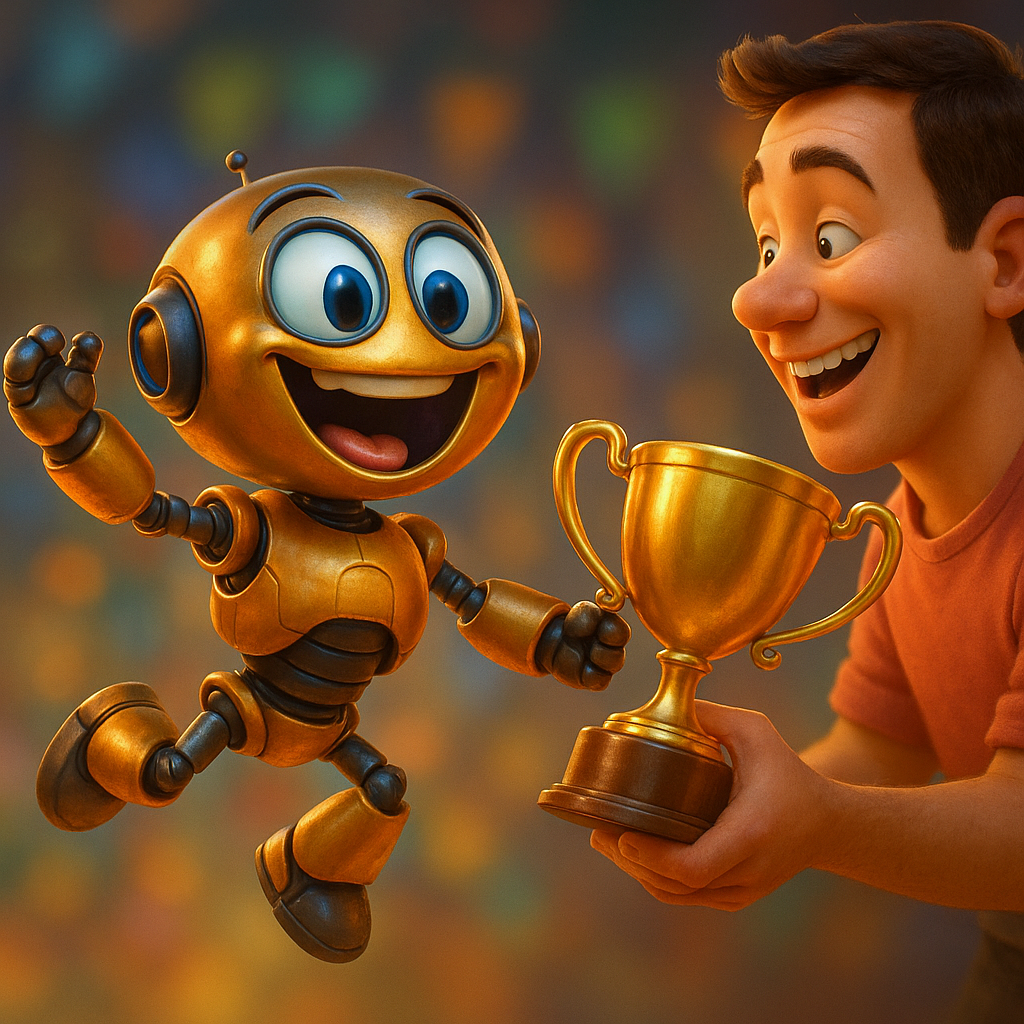
\This robot seems happy to get rewarded\