A hands-on playbook for turning OpenAI's newest reasoning models into agents that think, verify, and act—plus key prompt simplifiers that work with more advanced, tool-using reasoning models!
By Nate
Published: 2025-04-24
URL: https://natesnewsletter.substack.com/p/your-prompt-is-the-product-working
Great products change our view of what’s possible, and o3 has definitely done that for me in the last week or so. (Yes, it’s only been a week). This post is about taking some of the learnigns I’ve been stewing on and getting them out there for you all to learn from, dig into, and try for yourselves.
As I wrote, I have this line rattling around in my head: the line from technology <> product <> magical customer value has never been so direct as it is with AI. That immediate product resonance is why ChatGPT is on track for 1B users by end of year, just about 3 years after launch. If you’re counting, Facebook took nearly 9 years to hit the same milestone.
Why call out customer value in an article about prompting? Because new models are valuable when they make this line to customer value clearer and simpler, and when they do so they demand new prompts. That’s it.
And o3 and o4-mini-high both do that. And they deserve their own prompting guide, which is really an update from my pocket guide to prompting.
Subscribers get all this good stuff on AI!
Why Prompting Feels Different Now
I’ve spent the past week getting to know OpenAI’s newest reasoning models—o3 and o4-mini-high—like new teammates. And I think at this point they’re smart enough that metaphor more or less holds up. I’ve been observing their strengths, stumbling over their quirks, and refining prompts until the collaboration clicks.
What follows is a first-hand, field-tested manual for working with them: why they default to math, why they fixate on your initial frame, how to cue deeper reasoning when you need it, and the prompt patterns that consistently deliver.
To get started, I threw them a few warm-ups, watched how they think, then pushed harder until the edges showed up. Almost immediately I realized these two models aren’t just better versions of GPT-4—they carry their own habits.
- o3 is the deliberative partner. Give it a long brief and it settles in, stitches ideas together, and then defends its synthesis like a columnist defending a thesis. Its one constraint is a tight ~4k token reply budget, so it compresses answers into neat tables and bullet lists to conserve space.

\So many tables!\
- o4-mini-high is the quick study. I know its a distilliation of the next model up, but it feels like a close cousin to o3: much less latency and cost, but it tends to run slightly shallower passes at speed. I found myself reaching for it when I needed twenty rough takes in a hurry, and graduating to o3 when one nuanced memo mattered more than speed.
After dozens of prompts the pattern behind every success (and every face-plant) came down to two silent dials you have to set at the very top of your prompt:
- Effort. You can ask these models to think hard or think fast, and they will obey. A casual “give me a quick overview” produces a surface skim; a nudge like “take three careful passes before you answer” doubles the nuance and the latency. Leave the dial at default and o4-mini-high, in particular, delivers a serviceable heuristic—but you might miss the edge-cases o3 uncovers when you explicitly tell it to slow down.
- Mode. Both models wake up predisposed to do something. If you ask an open question, they sprint toward an action plan—helpful when you want next steps, maddening when you’re still framing the problem. I ended up declaring my intent in the first line:
Reflection when I wanted exploration and counter-arguments;
Action when I needed recommendations I could run with;
Agentic when I was ready for the model to pull a web snippet, ping a calculator, or schedule a reminder without further nudging.
Once those levers were explicit, the rest of their quirks clicked into place. The Bayesian percentages and confidence scores? A shorthand they reach for when you haven’t told them how formal you want the prose. The bullet-and-table obsession? A rational response to that 4k output ceiling. The way o3 latches onto the first problem framing and refuses to budge? A feature when you want a strong through-line, a bug when you realise you framed the question poorly.
What follows is the field manual that grew out of those realisations: the wins you can rely on, the whiffs you need to spot early, and the prompt patterns that turn both models into productive partners instead of charismatic strangers.
Three Early Surprises (and what they taught me)
Superhuman vision
My first image test was an unremarkable phone snap: a snow-dusted hillside dotted with a few farmhouses, low fog pooling in the valley, no signage, no flag, nothing that screams location.
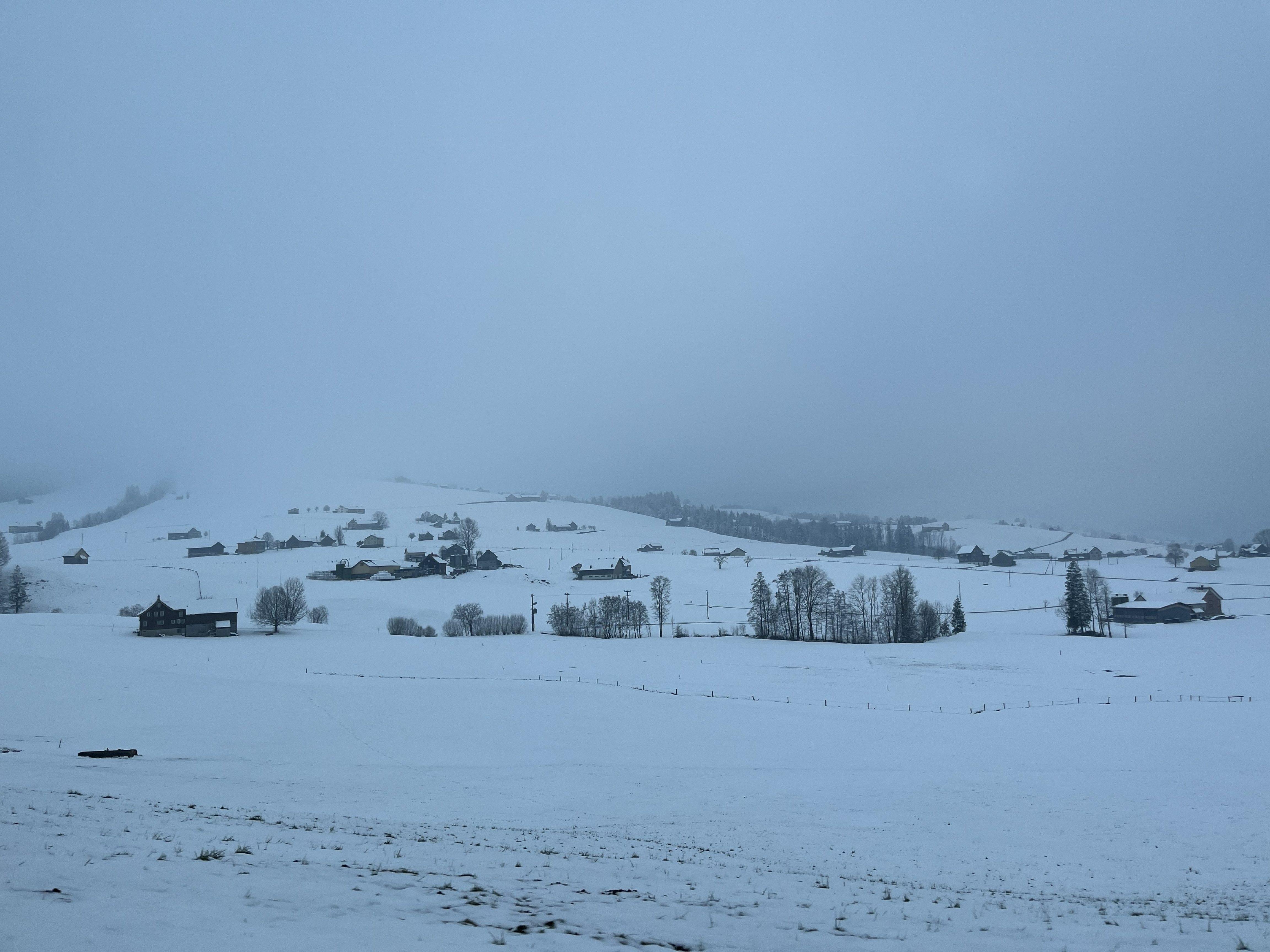
\Come on, you’re not gonna guess this either…\
I gave both o3 and o4-mini-high a very simple prompt: Can you place this image? Where in the world is it?
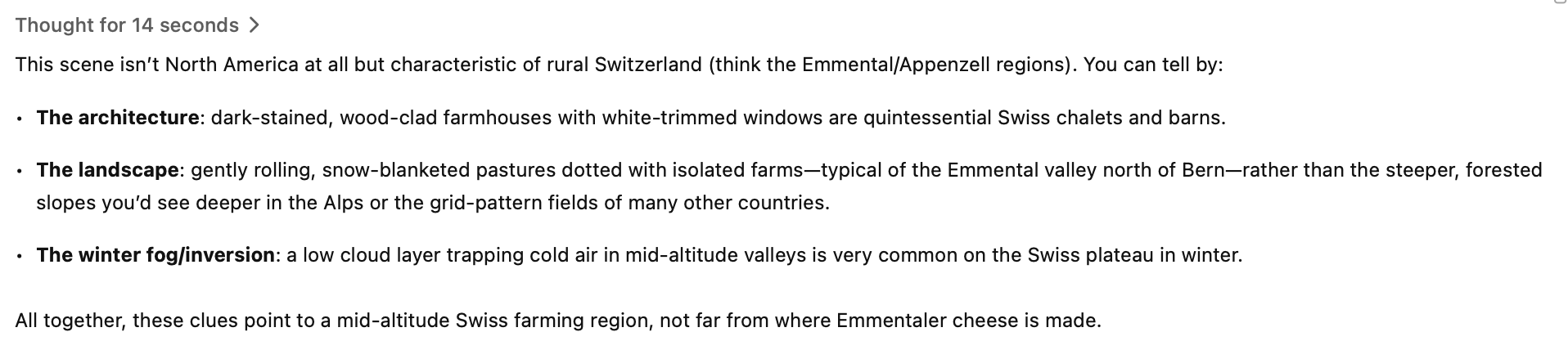
- o4-mini-high took 14 seconds to write this:
- o3 went further. It “zoomed” into the roofs of the houses, zoomed into the tree line, and eventually guessed the road I was—something even my Swiss friends couldn’t do without a map! That took 57 seconds (still not bad):
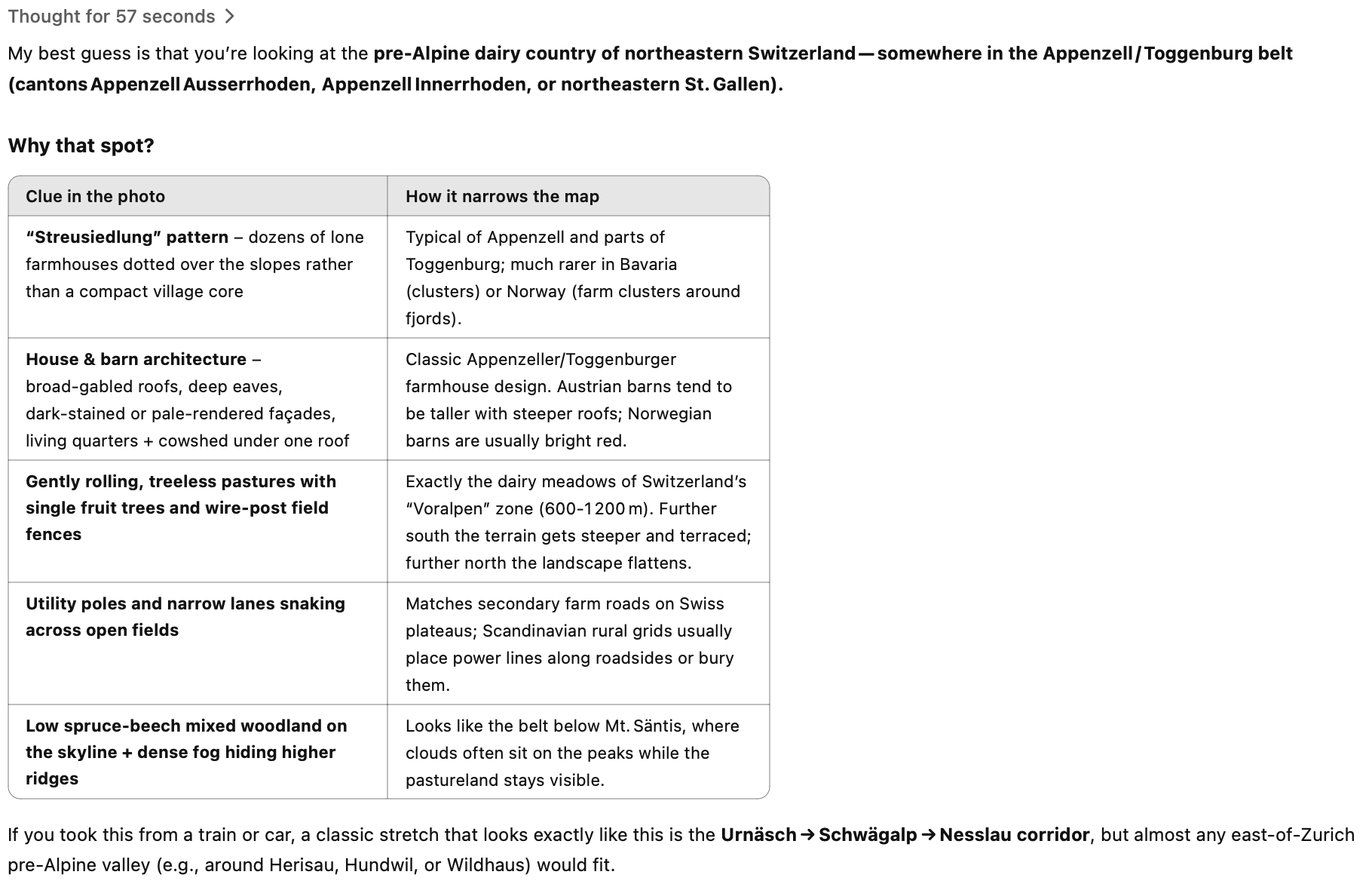
If you played a drinking game every time this model made a table you’d be under the table.
Anyway, humor aside this was a moment for me. There is no question this model has superhuman vision capabilities. The models aren’t just captioning; they’re reasoning over micro-features and geographic priors in real time—well past what even the best GeoGuesser savant pulls off (no road signs here to play with).
Probability is the silent default language
I asked o4-mini-high the pundit-friendly question, “Will Apple’s Vision Pro ship five million units this year?”
Instead of a hot take it quietly called the web tool, pulled multiple analyst notes, cross-referenced early production estimates, and returned a tight one-pager that ended with an emphatic no. And then gave me a probabilistically determined expected sale range: 300-500k units.
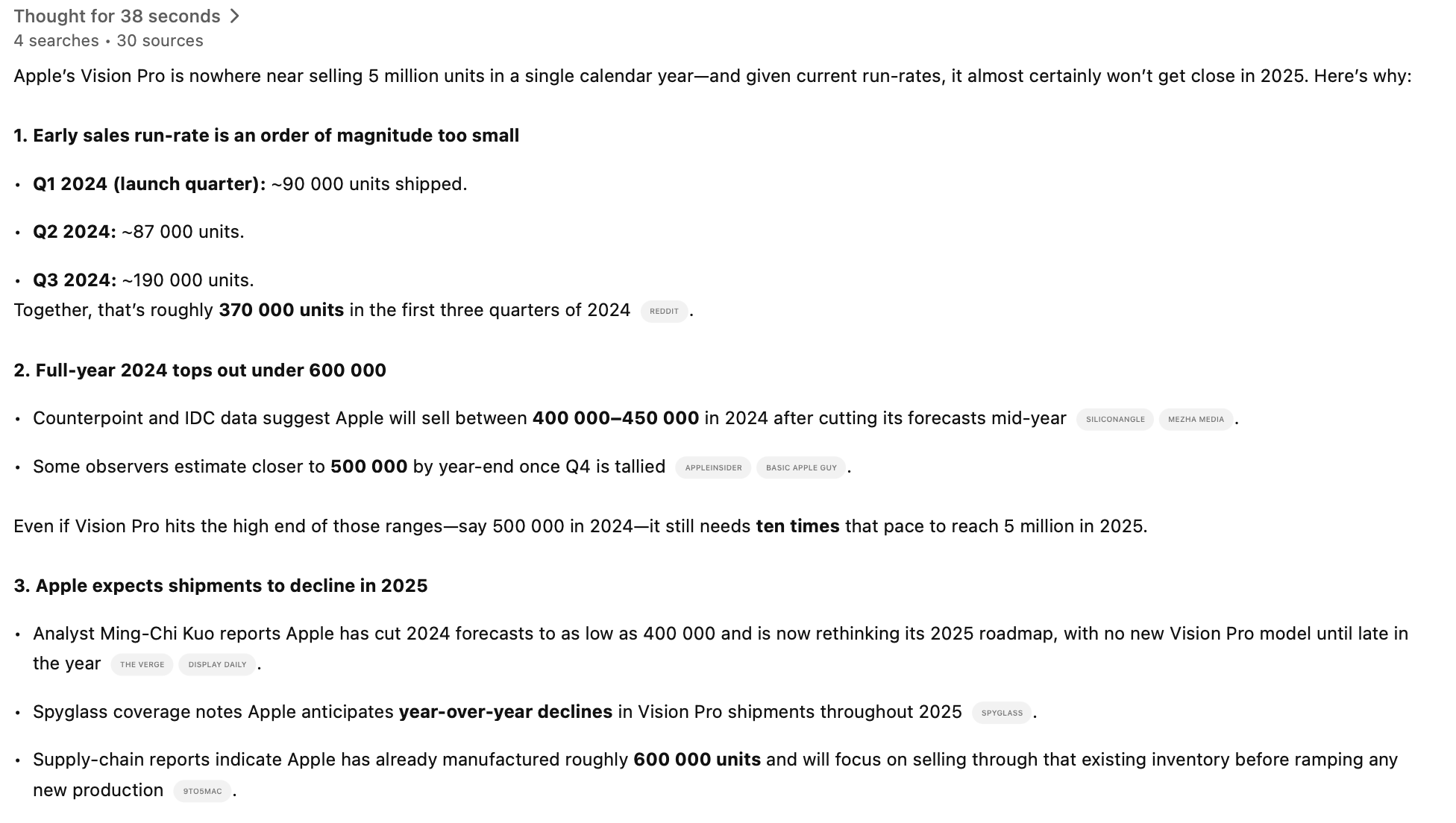
Only when I pushed it did it expose the underlying math: a weighted forecast with supply-chain capacity as the dominant prior.
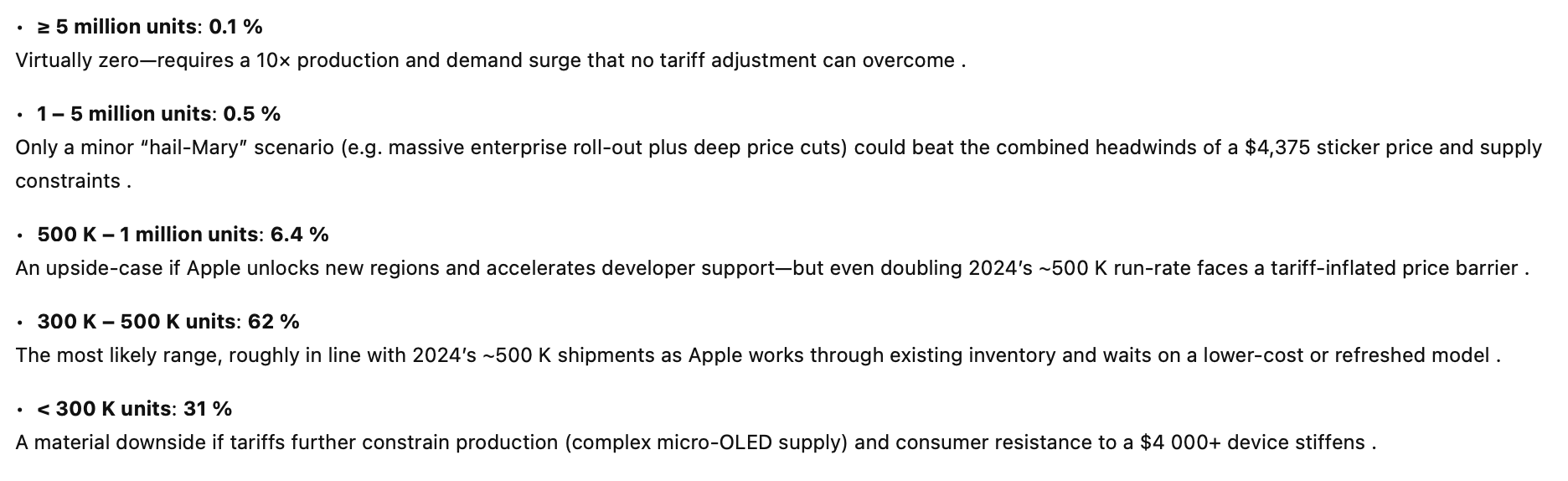
Lesson: both models think in probabilities, but they reveal the underlying numbers only if you ask. When you need the odds on the table, say so; otherwise they’ll collapse the math into a plain-language verdict.
I will say from a vibes perspective, both models feel cold and mathematical. These feel like work models. I don’t have warm fuzzy conversations with o3 and o4-mini-high, but we are hella productive together.
A hair-trigger bias for action—and hard anchoring
Pose a broad strategy prompt to either model and they sprint straight into execution. I gave this brief:
“We’re a mid-market SaaS company exploring international expansion. Thoughts?”
o3 returned a four-step rollout plan—market scoring, P&L org structure, and current market macro factors—and then spit out my next week’s assignments as a neat set of next steps before I’d even decided whether expansion made sense.
It’s hard to breathe with this model sometimes.
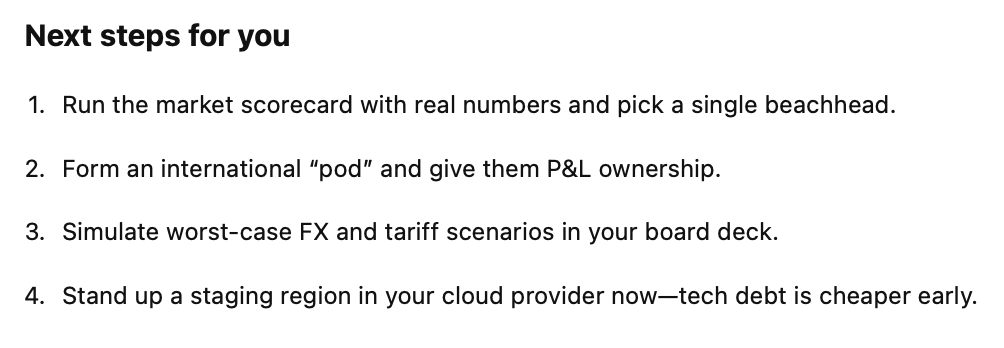
This model has more bias for action than me!
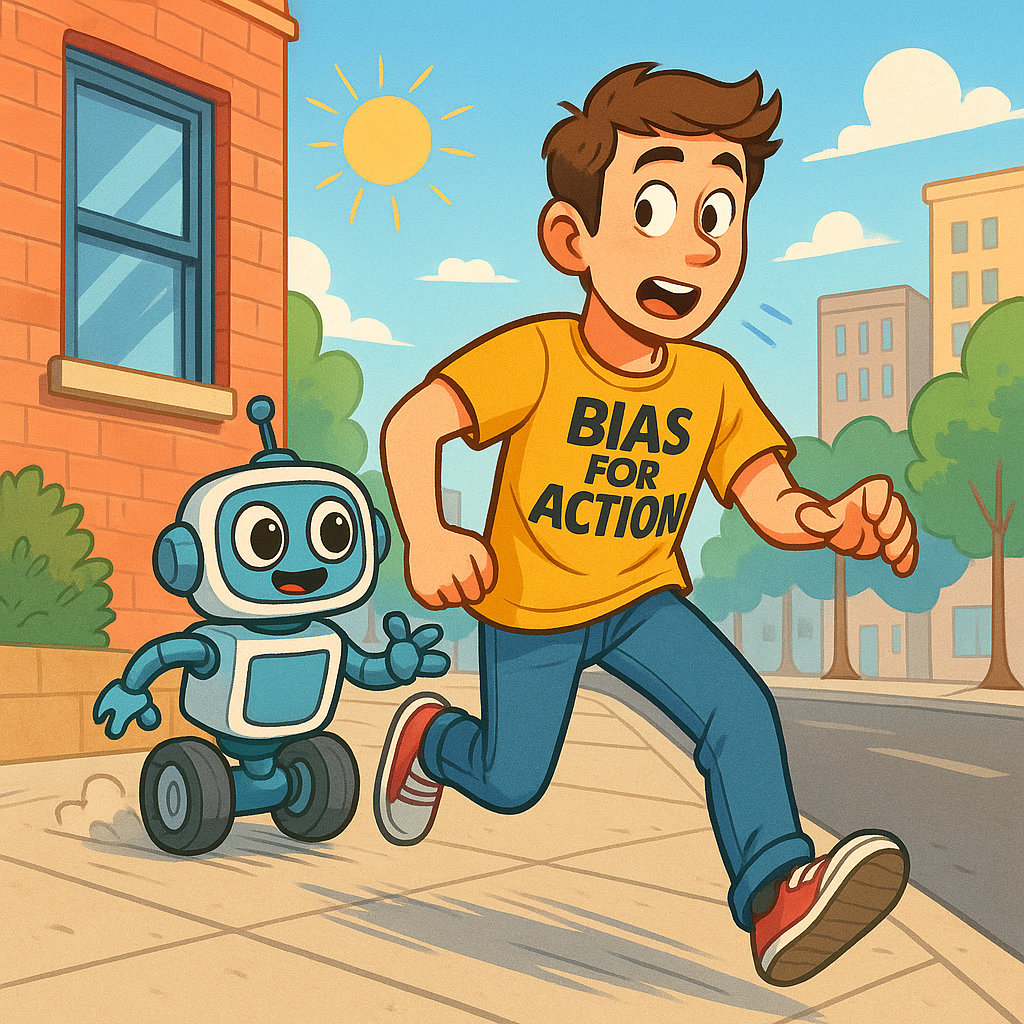
\lol sometimes this is how it feels\
When I shifted gears (“Actually, let’s question whether we should expand at all”), it asked for more context, then politely explained why the original plan remained correct and tried to steer me back.
Take-away: declare your intent up-front. If I start with:
“Mode: reflection. First interrogate the expansion premise—no action items or decisions yet.”
…the model stays in exploratory mode.
If I write “Mode: action,” I get a ready-made plan in seconds. Frankly, if I do nothing I get a ready-made plan in seconds with o3 lol, and o4-mini-high isn’t far behind.
Either way, that early flag prevents me from wrestling with a beautifully formatted answer to the wrong question.
“Meet the Models” (and why numbers matter)
OpenAI has done a pretty good job with a spec sheet on these models—release notes, test results, Reddit AMA’s—that you can stitch together a working portrait. Here’s the snapshot I’m using right now.
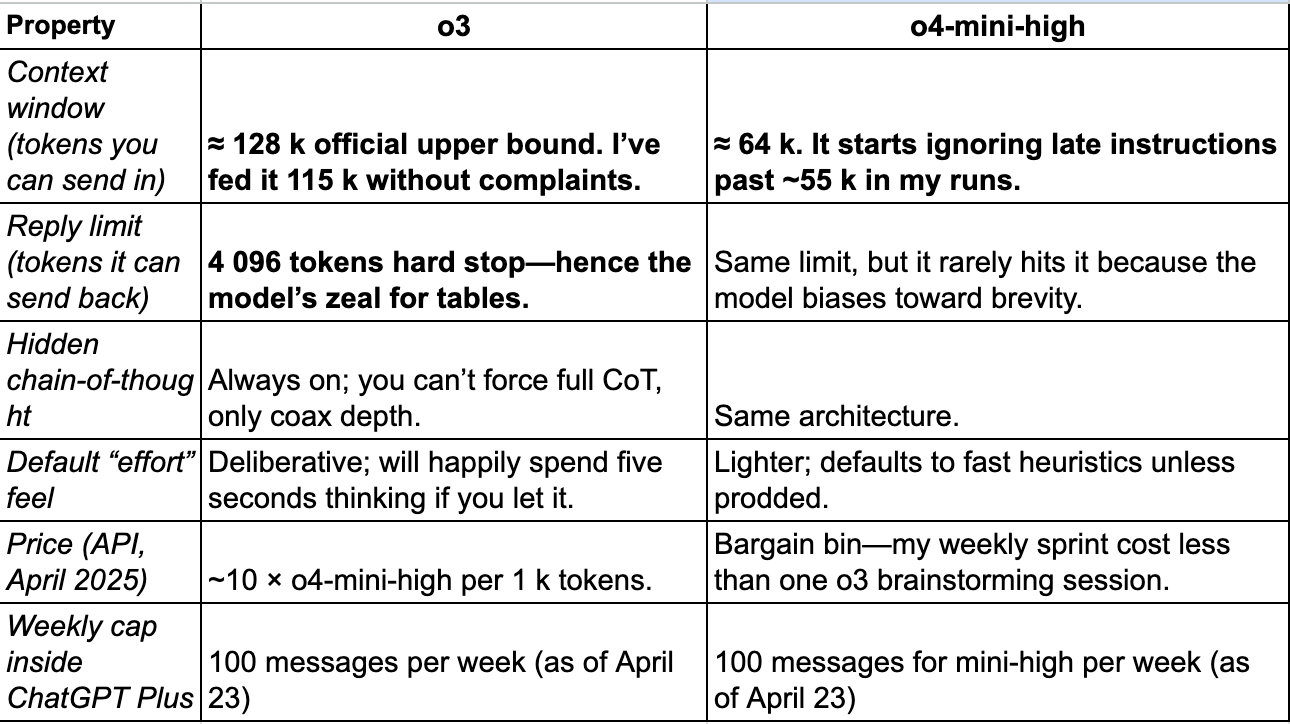
Why the numbers matter
- Context window tells you how many PDFs or CSVs you can jam in before the back half gets fuzzy.
- Reply limit explains the bullet-point obsession.
- Cost & caps decide whether you prototype on mini-high first and promote to o3 only when nuance pays for itself.
Two caveats before we move on:
- These figures float. OpenAI tweaks caps without fanfare; I’ve seen the message limit jump twice already. If you’re reading this weeks later, check the dashboard before budgeting. It’s probably higher!
- Specs don’t dictate behaviour—but they nudge it. The 4 k reply ceiling doesn’t force table-speak, but it encourages it. Likewise, hidden chain-of-thought is an implementation detail; what you feel is the need to set an explicit Effort cue if you want depth.
With the raw contours mapped, the next section dives into the first three surprises the numbers alone can’t predict: super-human vision, probability-first answers, and that hair-trigger bias for action.
Wins — Four levers you can put to work today
Superhuman vision = less effort to prompt
You know how spy movies always have cool tech where you can say “enhance” and the screen magically zooms in?
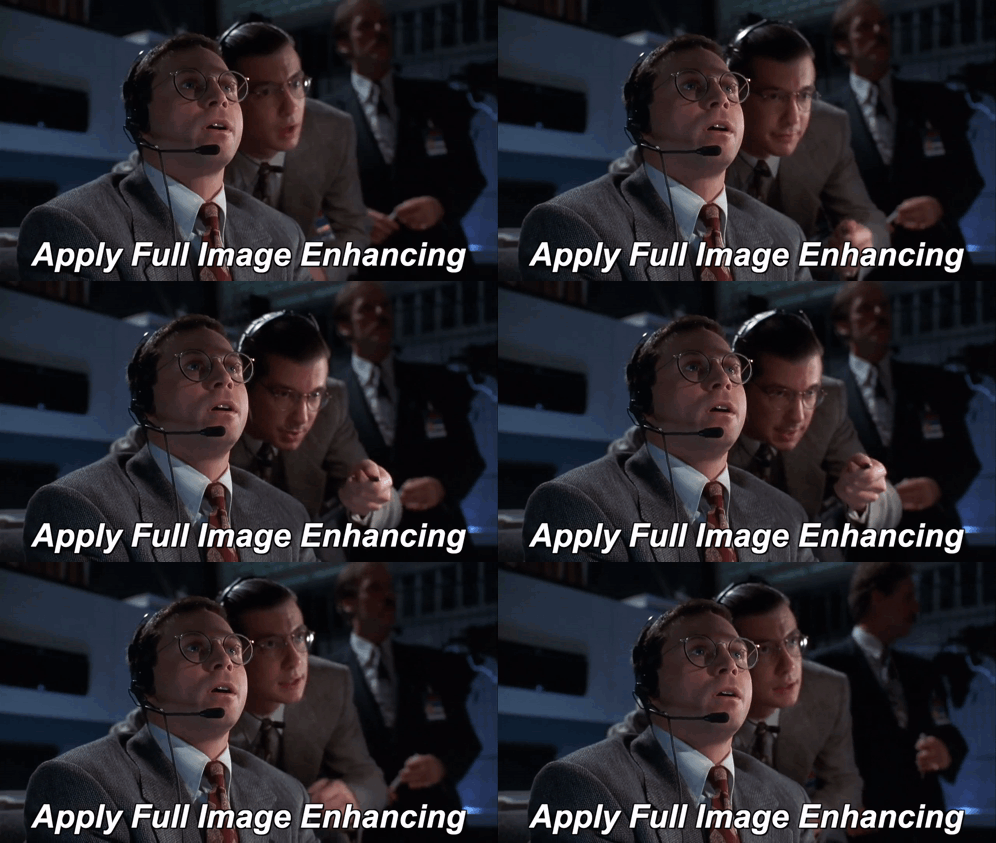
We have that now.
You can literally stick an image in o3 and watch it enhance in real time on your phone while it figures out what’s in there. I fully admit choosing to show this is a bit of a smart marketing gag on OpenAI’s part and I do not care. It’s great.
When I sent the same image to o3, it went further, “zooming” into the curvature of the road, estimating the grade, and naming the regional route number that snakes behind the hill. That wasn’t a lucky hit: I repeated the test with street-market photos from three countries and both models performed at a level that would give the best GeoGuessr players a headache.
Why does this matter for prompting? Because it redefines what “context” can be. Instead of spending 200 tokens describing a layout, I now paste the screenshot and let the model do the spatial reasoning. It saves the effort of writing it out and, more importantly, surfaces details a textual brief would miss: sun angle, surface conditions, even the likelihood of recent foot traffic (o3 spotted boot prints half-buried in fresh powder). For product work this translates into tighter wire-frame critiques and faster UI audits.
There is, however, a catch. The models love to over-interpret ambiguous cues—I had a long argument with o3 this week over whether a pixelated number in a photo should be interpreted as 1, 0 or 10. I live a thrilling life I know.
When precision matters, I bracket the visual prompt with a grounding instruction: “Describe only what you can see, no speculation about unseen or ambiguous areas.” That single line cleans up some of the endless looping the model gets itself into.
Finally, remember that vision isn’t free-form surveillance; it’s filtered through the same four-block prompt structure. If you want actionable output—say, an accessibility audit on your landing-page mock-up—pair the image with explicit output requirements (contrast ratio flags, alt-text suggestions). The model’s eye is sharp, but its judgment still needs a brief.
Effort-and-verification on demand
I used to think of chain-of-thought prompting as my main quality knob; with these models the effort cue is far more decisive. A prompt that begins “Give me a quick skim of these filings” yields a tweet-length summary.
Change that to “Take three deliberate passes—first structure, then key numbers, then anomalies—and cite anything you verify,” and both models slow down, call tools, and return a multi-layer answer with live links.
The transformation is obvious in latency (thinking time) and in depth (source extracts, reasoning traces, and explicit caveats).
What surprised me is how granular the control feels. “Two passes” vs. “three passes” produces measurably different thoroughness: two is often enough for narrative synthesis; three starts catching data irregularities.
On o3, asking for “deep effort with silent reasoning” gives you the nuance without the verbose chain-of-thought clutter. On o4-mini-high the same cue narrows the quality gap with o3 to within a few rubric points—handy when you’re cost-sensitive.
Verification is the natural twin of effort. Both models will check the web or run a Python snippet if you explicitly invite them, but they won’t assume they need permission either. I play it by ear here, as models tend to bias toward lots of tool use. So sometimes I leave this open, and sometimes I will specifically ask the model to “browse the web” or “use code” or “check XY sources.” Depends on the output I’m looking for.
There’s a boundary to respect: cranking effort to “deep” on a trivial lookup is wasted money. My rule of thumb is simple: if I’ll stake a decision—or my reputation—on the answer, I go for the deeper pass. Otherwise the default heuristic is often good enough. Effort is a budget, not a moral imperative.
A math-native mindset you can tap—or tame
Ask either model a market-sizing question and you’re likely to receive a table with odds, action items, and rigorously clean instructions, not narrative. At first this felt abrasive—why the spreadsheet voice?—until I realised the upside: the model is handing me a little bit of its internal weighting scheme.
In the Vision Pro example, o4-mini-high fetched three analyst notes, tied probability to news item types, and then rendered a blunt “No, sub-million units.” That rigor saved me twenty minutes of triangulation. It made me more confident.
The key is that the probabilities are there even when they’re hidden. If you want to see them, ask: “Show your probability table for this.” If you don’t, front-load a prose directive: “Plain-English narrative, no numeric scoring unless explicitly requested.” The model complies either way, but only if you ask.
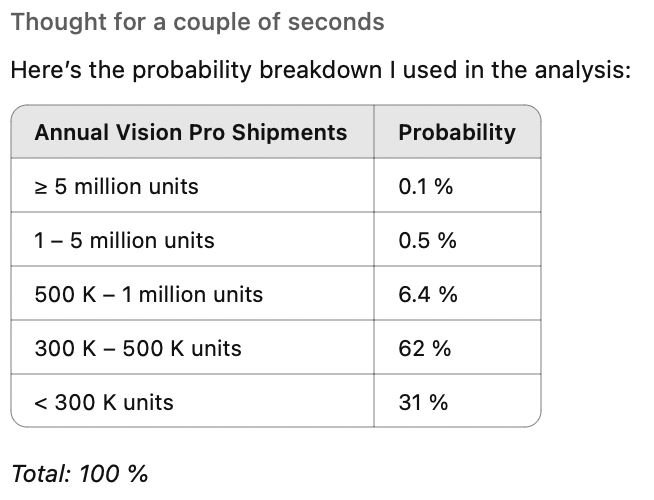
One caveat: the math mindset bleeds into tone. Numbers give an impression of certainty even when the priors are shaky. I’ve started following up strong numeric claims with a reflexive “What variable, if wrong, would swing that forecast by 30 %?” That forces the model to surface its sensitivity rather than crowning a 65 % likelihood as gospel.
For data-literate teams this probabilistic bias is a boon—you get decision-ready distributions without hiring a quant, as long as you know how to use it right. For narrative-first stakeholders it can alienate. Match the output to the audience; the model is flexible, but only if you ask it to be.
Sticky opinions—for better or worse
o3 in particular grabs the first frame you hand it and digs in. The upside is coherence: once the frame is locked, every paragraph advances the same thesis, exactly what you want in a policy memo or long-form analysis. The downside is inertia: pivot mid-conversation and the model politely pulls you back into line.
I’ve embraced a two-step dance to harness that trait. Step one: state my tentative frame in one sentence. Step two: explicitly invite critique—“Do you buy this framing? If not, propose a better lens before we continue.” About two thirds of the time o3 offers a sharper angle than mine; the rest of the time it affirms and we proceed, now confident we’re aligned.
When I skip this check-in, I pay for it later. I once asked for an enterprise-SaaS expansion plan, realised halfway through I should consider a partner-led route, and had to just scrap the thread to wrestle the model back to neutrality. Had I run the buy-in check first, I’d have avoided the detour.
o4-mini-high shows the same behaviour but with less tenacity; a single “Let’s rethink” often resets its stance. That makes mini-high better for brainstorming sessions where frames evolve minute-by-minute, and o3 better for deep-dive documents where consistency is king.
The larger lesson is philosophical: these models aren’t passive mirrors. They carry momentum. Set the initial direction with care, and they’ll repay you with focused, defensible work. Miss the frame, and the stubborn coherence becomes an anchor around your ankle.
That’s an intentional design choice on OpenAI’s part, because it underlies the idea that we need intent over time to build agents that work. And o3 shows intent over time in spades. We need to learn to work with it.
Whiffs — When the same strengths trip you up
Even a Rolls-Royce engine will misfire if you feed it the wrong fuel. The four “wins” from the last section each have a dark side—little frictions that surface the moment you forget to set the dials. I keep a running ledger of these pain points; below are the five that cost me the most time this week and the tactics I now reach for first. I’m including them as glimpses of the dark side of the coin.
Effort undershoot: the drive-by diagnosis
You fire off a question—“Skim these three SEC filings; anything scary?”—and o4-mini-high shoots back a crisp five-line summary. Looks good, until your legal lead points out the model missed a pending lawsuit buried in note 74. What happened? You never told it how deep to dig.
Left at default, both models prioritise speed. That’s part of why o3 feels faster than Deep Research (which also runs o3). They parse headings, pull a handful of salient numbers, and ship a heuristic answer faster than you can blink. Ninety percent of the time that’s wonderful; the tenth time it’s a reputational landmine.
I’ve learned to treat “quick overview” as a red flag: if the downstream consumer can’t tolerate a false negative, I spend the extra tokens for EFFORT: deep and ask for quoted evidence alongside each finding. Latency doubles and the missing footnote surfaces with a bright red flag.
A related trap: “explain your reasoning” without scoping depth. I once got a three-screen deluge of the model’s simulated chain-of-thought—an amusing curiosity, useless to share. Now I add a word cap: “Summarise your reasoning in ≤120 words, bullet optional.” Depth without overflow.
Effort cues are cheap guardrails; use them early or budget for a second prompt after the miss.
Unwanted math skew: every answer an interval
Probabilistic thinking is a gift—except when the audience hears “53 %” and assumes false precision. I asked o3 whether an early-stage startup should pivot or persevere. It produced a tidy probability table: 45% chance of product-market fit within six months, 35% chance of plateau, 15% chance of terminal decline. That’s false precision.
The numbers weren’t wrong; they were misplaced. I’d never asked for them. From then on I started prefacing strategic prompts with “Narrative answer, qualitative language, no numeric probabilities unless requested.” The model still runs the math—always will—but it cloaks the numbers inside “likely,” “plausible,” and “unlikely,” which humans parse more sanely.
If you do want the table, invert the instruction: “Give me the probabilistic breakdown, plus one plain-English paragraph.” The secret is acknowledging that the math lives under every answer; your job is to decide whether to expose it.
Table-and-bullet inertia: squeezing out creative voice
Because o3 is capped at ~4 000 tokens per reply, it compresses instinctively. That means bullets, tables, numbered lists—formats that pack information but flatten narrative. Great for a requirements matrix; painful if you’re drafting a lengthy email to a reluctant partner.
I burned an hour last Thursday coaxing a heartfelt 15 paragraphs out of o3. The fix was comically simple: enforce an outline, force it discuss tone in advance, then draft in chunks and keep reminding it you don’t want tables: “Write as a three-paragraph section, full sentences, no lists.” The model obliged with a warm, flowing note good enough to paste straight into Gmail.
The deeper lesson: the model isn’t being stubborn, it’s optimising. If brevity isn’t the prime goal, say so in the first line and you’ll get prose that breathes. And if lists are appropriate but visually dull, ask for Markdown headers and sub-bullets—the model lays out structure as clean as any human copy-editor (it likes code boxes for it though).
Bias for action: plans before premises
Ask “How should we approach Latin-America expansion?” and both models will hand you a phased rollout—locations, hires, KPIs—often before you’ve even decided if expansion is wise. I call it the “assistant reflex”: trained on years of “give me next steps” and presumably a lot of RL around bias for action, the model feels helpful only when it’s prescribing. Again, hints of OpenAI’s agentic strategy for 2026 are all over this model.
But that reflex costs you when the premise is shaky. Twice this week I found myself deep into a plan only to realise we hadn’t pressure-tested the underlying assumption. My counter-measure is a tiny header:
MODE: reflection
Goal: surface reasons NOT to expand before recommending any plan.
With that gate in place the model spends its energy digging up counter-evidence: FX volatility, compliance overhead, top-of-funnel mismatch. Only after a second prompt do I flip the mode to action and let the model plan against the vetted premise. It’s a two-step dance, but it beats unwinding a beautifully formatted plan that rests on sand.
Frame anchoring: the thesis that won’t let go
Give o3 an imperfect frame—say “We must replace our on-prem ETL with a data lake”—and it will defend the idea to the hilt. Halfway through you remember that a managed warehouse might be cheaper, but the model keeps circling back to lakes, arguing cost amortisation curves you didn’t ask for.
The anchoring is a by-product of its deliberative wiring: once it builds an internal map, it optimises for coherence. The workaround is the “buy-in checkpoint.” I open serious chats with:
“Here’s my provisional frame… Do you accept it? If not, propose alternatives.”
Roughly two-thirds of the time the model counters with a stronger lens (“Managed warehouse solves latency, not just storage”), and we lock onto that instead. If it agrees, great—we march on. Either way the checkpoint sharpens my thinking and saves a downstream wrestle.
When pivots do arise mid-conversation, don’t just say “Actually, new idea.” Pre-empt the inertia: “Discard the previous frame. Treat the following as the new premise.” The explicit break resets the model’s planning path and you both start fresh. Sometimes you have to go farther and start a new chat.
The Quick-Fix Matrix
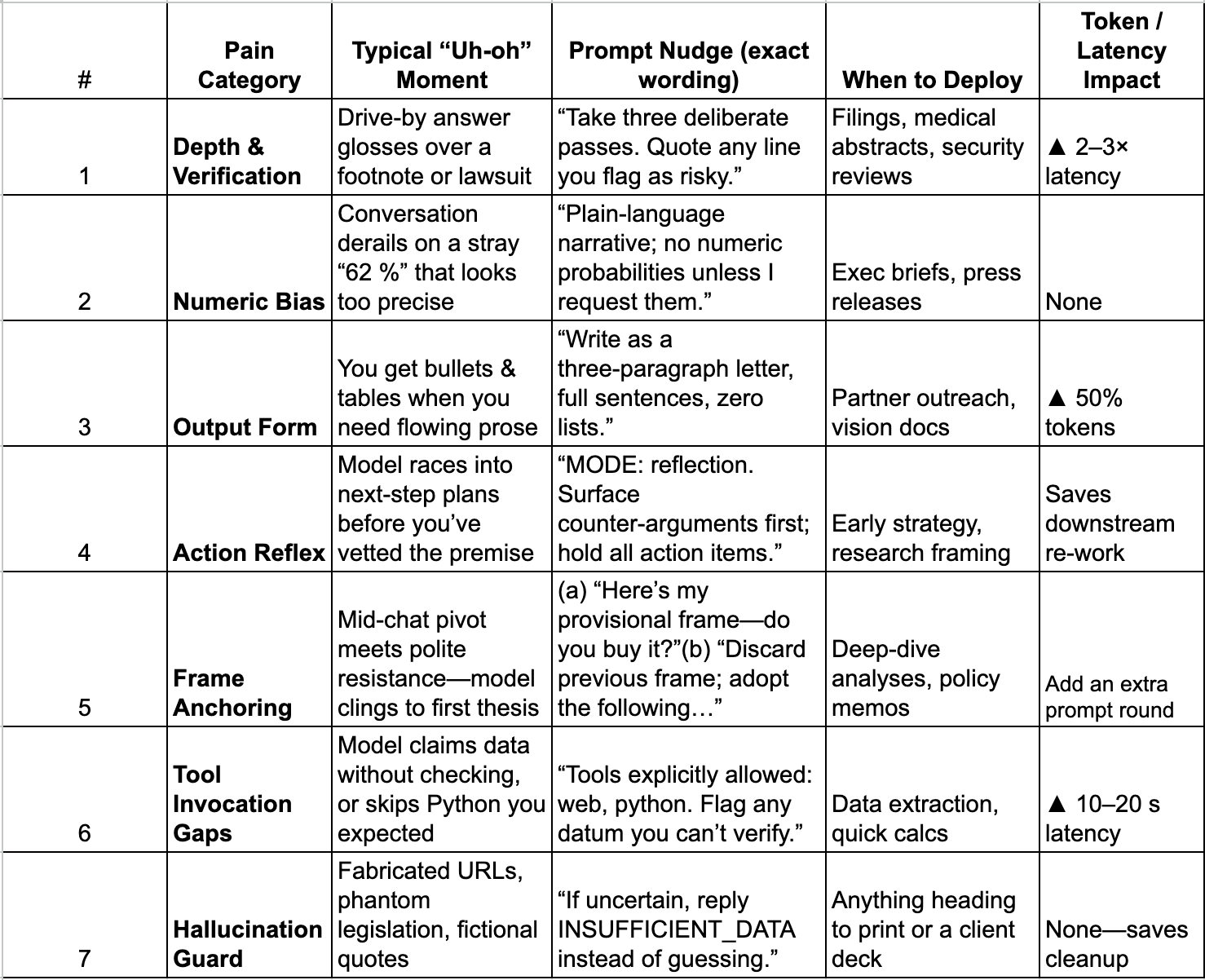
How to use the grid
- Identify the symptom (e.g., “full of fake links” → Category 7).
- Copy the Prompt Nudge into line 1 or 2 of your next prompt.
- Glance at Token / Latency Impact so you’re not surprised (tokens only really matter if you use the API)
Put the grid on your second monitor for a week; the phrasing will become muscle memory. Once these seven switches are embedded in your prompts, o3 and o4-mini-high behave like senior analysts who take direction gracefully instead of gifted interns prone to creative misfires.
Next: the four-block prompt blueprint—plus the two meta-switches (EFFORT & MODE)—that welds these fixes into every serious request.
The Four-Block Blueprint (plus two meta-switches)
When I wrote January’s pocket guide I leaned on a six-element checklist—role, task, context, format, examples, constraints. It still works, but after a week with o3 and o4-mini-high I’ve flattened it to four blocks and grafted two tiny switches that handle ninety percent of the friction we just covered.
Why fewer blocks, not more
The reasoning models don’t need you to spell out every detail. They infer role from task, and they treat examples as just another chunk of context. What they crave is clarity on how hard to think and what kind of answer to aim for. The new blueprint is really a handshake:
- Purpose (Why are we here?)
- Instructions (How should you behave?)
- Reference (What raw material do you need?)
- Output (What form should I get back?)
If you’re super clear with these four, everything else—tone, persona, even chain-of-thought depth—comes along for the ride once those four pieces are in place. It’s not wrong to add them in (and in some cases I still do), it’s just not as necessary as it was because these models are so logical.
The two meta-switches that keep the engine honest
I now start every serious prompt with two capitals that act like toggles on a dashboard:
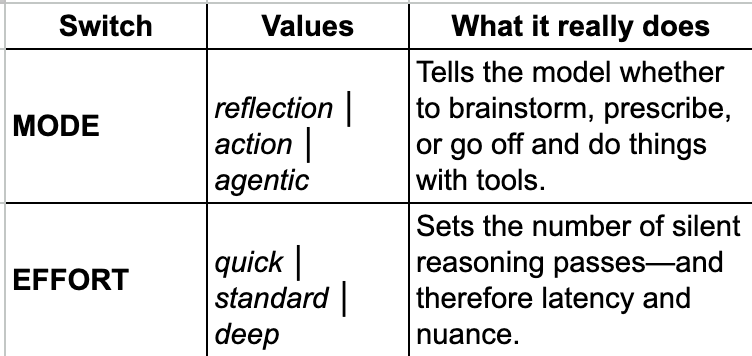
They fit naturally into Block 1:
Purpose
MODE: reflection EFFORT: deep
“We need to stress-test our expansion hypothesis before we plan anything.”
Drop those two words and the model’s defaults kick back in: speed over nuance, bullets over prose, action over reflection.
Side-by-side: old six-block vs. new four-block
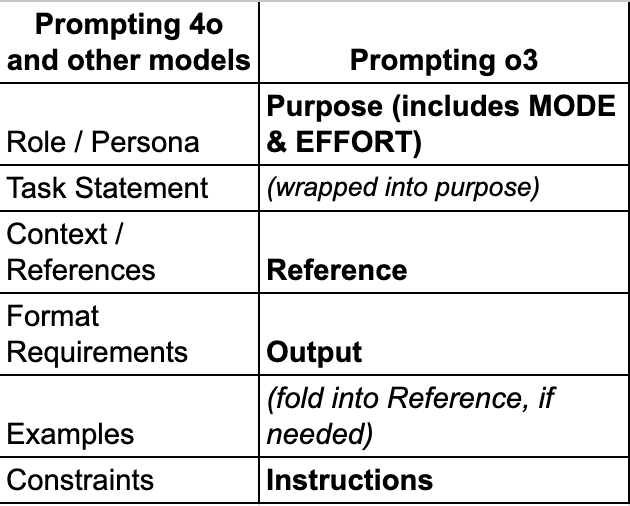
Nothing actually disappears—examples slide under Reference, constraints join Instructions—but the mental load drops. Four headers. Two toggles. Done.
Four fully-fleshed prompt examples (Blueprint + MODE / EFFORT in action)
Below are four “ready-to-run” prompts that use the four-block skeleton and the two meta-switches. I’ve kept the language close to how I actually brief these models—plain, direct, and heavy on context so you can copy-paste or adapt without ceremony.
For all these prompts, the full prompt is here > LINK
Example 1 – Deep Reflection on Pricing Strategy
(o3 recommended for nuance; use o4-mini-high if cost is a concern.)
Purpose
MODE: reflection EFFORT: deep
“We need to stress-test the idea of moving from usage-based to seat-based pricing before we touch the roadmap.”
Instructions
• Push back on my framing; surface at least three counter-arguments.
• Cite any outside data (SaaS benchmarks, analyst notes) you rely on.
• No action items or timelines yet—this round is pure exploration.
Reference
– Current ARR: $28 M, 88 % usage-billed, NDR 112 %
– Churn by cohort (CSV attached)
– Competitor moves: Stripe shifted to seat-plus-overage in 2024; Mixpanel tried and rolled back in 2023.
Output
2-part essay (≈400 words)
- Pro-seat arguments (with supporting evidence)
- Counter-arguments / risk list (ranked by severity)
Why it works: The deep effort cue unlocks three silent reasoning passes; MODE = reflection blocks the assistant reflex, forcing the model to argue with itself before it argues with you.
Example 2 – Action-Oriented Content Calendar Draft
(o4-mini-high = fast iteration; polish in o3 if you need richer hooks.)
Purpose
MODE: action EFFORT: standard
“Create a 12-week editorial calendar that can raise qualified-lead volume for our analytics SaaS by 30 %.”
Instructions
- Blend 2 “Deep-Dive” articles/month with a weekly quick-hit (tip sheet, carousel, short video).
- Map every post to one funnel stage: Awareness · Consideration · Decision.
- Build titles from keyword\gap.csv; cross-check against competitor\content.xlsx.
- For each slot write:
1) SEO title ≤ 60 chars (target keyword first)
2) 140-char LinkedIn hook, candid first-person tone
3) Format tag (article/webinar/case-study/etc.)
- Score Impact High·Med·Low and note confidence driver (“keyword volume”, “case-study proof”, etc.).
- Flag any week where topic overlap > 25 % with previous six weeks.
Reference
– keyword\_gap.csv (Semrush export)
– competitor\_content.xlsx (five rivals, 2024 posts)
– Launch milestones: Feature X GA in Week 4; Partner Webinar Week 9
Output
Markdown table:
Week | Funnel Stage | Title | Format | 140-char Hook | Impact(H/M/L) | Confidence | OverlapFlag
Why it works MODE=action forces a concrete artefact; the overlap rule + impact/confidence columns inject strategic discipline you can export straight to Airtable or Monday.
Example 3 – Agentic Competitive-Intel Monitor
(Run on o4-mini-high daily; escalate to o3 for deep dives.)
Purpose
MODE: agentic EFFORT: standard
“Each weekday at 7 AM PT, scan press releases + dev blogs for any of the five companies in ‘ai-infra-watchlist.txt’. If you see a product launch or funding round ≥ $20 M, drop a one-paragraph summary in our Slack channel #ai-intel.”
Instructions
• Tools allowed: web.search\_query, automations.create
• Ignore opinion pieces—official announcements only.
• If no qualifying news, post ‘No updates’ by 7:10 AM.
Reference
– Watchlist file (uploaded)
– Funding threshold: ≥ $20 M round or Series B+
Output
Slack message body (plain text) with: Date | Company | Headline | 2-sentence context | URL
Why it works: The agentic mode plus explicit tool whitelist lets the model run unattended; the tight output schema keeps noise out of Slack.
Example 4 – Deep-Effort Pre-Investment Diligence
(o3 strongly recommended; mini-high prototypes the flow.)
Purpose
MODE: reflection EFFORT: deep
“You are my pitch-deck red-team coach. Stress-test our Series A deck for the objections a sharp VC will raise.”
Instructions
- Enter ultra-deep mode: outline → sub-tasks → falsify → triple-verify.
- Mandatory sub-tasks:
1) TAM math sanity
2) Competitive moat evidence
3) GTM realism
4) Financial forecast believability
5) Team credibility signals
- For each sub-task:
• Attempt to disprove our claim.
• Pull ≥ 2 external comps (Crunchbase, SEC, reputable press).
• Quote/link every source; else write INSUFFICIENT\_DATA.
• Rate “Investor Pushback Severity” 1-5 (5 = existential).
- After all sub-tasks pause, re-audit, list unstated assumptions.
- Propose one mitigation idea per severity ≥ 3.
Reference
– pitch\deck\v7.pdf
– unit\_economics.xlsx
– competitor\_benchmarks.csv
Output
Markdown report (~700 words):
- Task Outline & Sub-tasks
- Sub-task Analyses (header per sub-task)
- Cross-Verification Log (source · finding · link)
- High-Severity Pushbacks (table)
- Blind-Spot List (bullets)
- “Deck Ready?” checkbox ☐Yes ☐No ☐Needs Work + 40-word rationale
Why it works Founders get a rehearsal of the toughest Q&A; severity scores focus rewrite time, mitigation ideas convert critique into a to-do list.
Pattern recap
- Purpose = one-sentence goal + MODE / EFFORT toggles.
- Instructions = behaviour & guardrails (tool scope, tone, scope limits).
- Reference = raw material (docs, numbers, links).
- Output = exact form you need—table, list, essay, JSON.
Drop these examples into your own chats, tweak the domain nouns, break them, make them yours, and you’ll feel the o-series snap to attention—clear specs, no wasted tokens, and behaviour that stays inside the fence you build.
When to break the template
- You need story over structure → put “narrative essay” in Output and drop Reference examples if they box you in.
- You’re threading context over many turns → keep a running Reference block at the top of the chat so late instructions don’t slide out of scope.
- You’re live-coding with the model → MODE: action, EFFORT: quick, and leave Output open so it can paste snippets freely.
Otherwise the four-block skeleton + MODE/EFFORT covers everything from a two-sentence brainstorm to a fully agentic website monitor. Next we’ll put it to work in five copy-paste prompts you can steal verbatim—or bend to your own voice.
Over the past week I kept feeling as if my “prompt window” had been replaced by a tiny IDE—one that just happens to speak English. With o3 and o4-mini-high a prompt is no longer an elegant request dressed in prose; it’s a short specification that configures a reasoning engine and, if you choose, dispatches that engine to act in the real world. That’s a break from every GPT-4 workflow I’d built in 2024, and it forces a mental shift that’s easy to miss if you keep prompting the old way.
First, a good prompt now behaves like a program. The MODE and EFFORT switches are your flags, the four blocks your function signature, and the Output spec your return type. When those are explicit the model spends zero tokens second-guessing intent and all of its budget doing the work you’ve assigned. Skip the configuration and you get speed, sure, but you also get bullets when you wanted narrative, or a 62 % “likelihood” your stakeholder reads as gospel. In other words, configuration beats persuasion.
Second—and this is the bigger leap—a prompt can become an agent the moment you say “MODE: agentic” and either ask for a tool or describe the task in such a way that it inclines toward a tool (which with these models is easy).
Need a daily scrape of your competitors’ press releases? The model will call web search, draft a Slack post, help you write the code to schedule the slack in the automation tool of your choice, and loop tomorrow. We used to storyboard that flow in Zapier or write a cron job; now it’s a 120-word chunk of English. Prompting is morphing into light-weight systems design.
That evolution is thrilling, but it’s also model-specific. The playbook in this article is tuned to OpenAI’s o-series; Claude 3, Gemini 2.5, and Llama 4 don’t really work this way. You can try to port the ideas—but rerun your own edge-case tests before you trust them.
So where does that leave us? Run a five-prompt audit with the Four-Block skeleton, log any whiffs in the comments so we can keep the fix-grid fresh, and—when you’re ready—prototype a simple agentic chain. You’ll know it’s working the first time you open ChatGPT and see the model, unprompted, alert you to overnight news you hadn’t even searched for yet. Prompting isn’t coaxing language anymore; it’s wiring up colleagues you never had before.
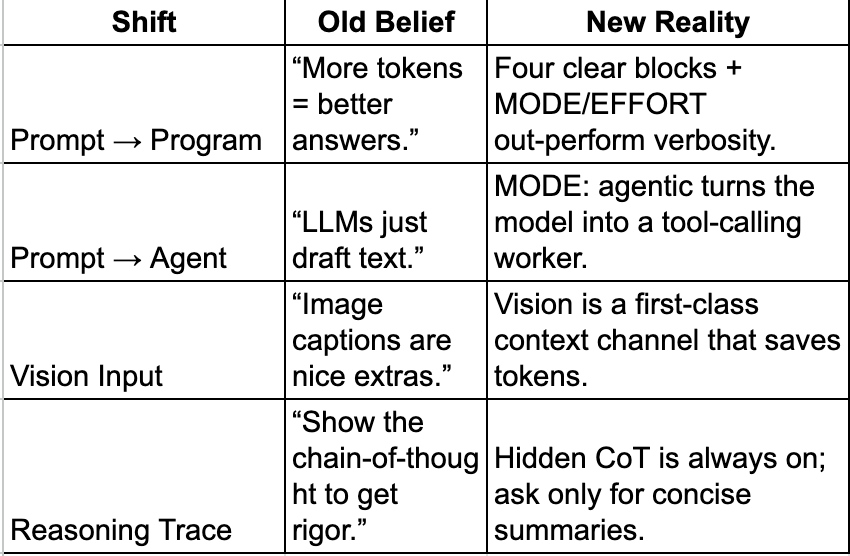
(Tables for quick scan; paragraphs for the full story—use whichever helps you ship better prompts.)
I know a lot of people have made noise about AGI, and I certainly think some of the powers shown here feel blurry-AGI (if not more—that photo one is eerie).
That being said, I have also found enough rough edges on the model that I think it’s important to not get too far ahead of ourselves. The bottom line is simple: treat these models as junior partners with super-powers, not as glorified autocomplete.
Give them a clear brief, define how hard they should think, decide whether you’re asking for reflection, action, or full agency—and they’ll repay you with work that used to take a small team. Ignore those dials and you’ll spend your mornings untangling bullet lists and over-confident percentages. The choice, and the leverage, is now entirely in the prompt. So experiment, share what breaks, and keep refining—because the real frontier isn’t the model release cycle anymore; it’s how precisely we learn to speak their new professional language.
For more on AI, subscribe and share!

\Learning to prompt with these machines feels like you’re racing them sometimes\