An Executive Strategy Primer on How Distribution, Tokenization, and Reward Shape AI Leverage in 2025
By Nate
Published: 2025-04-18
URL: https://natesnewsletter.substack.com/p/why-the-pipes-suddenly-matter
Look, I know most of us are not CTOs or CEOs. The last time I did a strategy Substack I noticed it kind of flopped, and I am perfectly fine with that. Don’t worry, there will be lots of articles aimed at a wider audience coming up.
Here’s why I wrote this one:
I think periodically stepping back and understanding the real drivers shaping AI distribution dynamics is highly valuable.
Because at the end of the day understanding the real drivers of AI strategy is the key to not getting surprised in 2025. Solid reading of the fundamental drivers in AI ultimately shapes reliable future planning and investment.
TLDR; we all live in this world, so we should at least understand it.
I’d underline from the video: if you plan to operate at the mid-senior level or above in AI anywhere in the next 5 years, you need to be at least fluent in C-suite strategic dynamics like this to be successful longterm.
The alternative is not engaging strategically, not letting the future happen to us one token at a time. And I for one would prefer to actually think about where I’m going.
This one is deliberately crisp and executive readable. You can get through it in 10 minutes. But you’re going to chew on it for the next two days, and it’s going to haunt you when you read the news tomorrow.
Paid subscribers get all these AI strategy posts!
From Macro Tension to Tactical Levers
You need a framework to make budget allocation decisions this year, and the key is Distribution, Tokenization, and Rewards.
On April 7, I wrote The Best of Times, The Worst of Times. That memo made two board-level points:
- Capital squeeze — IPOs are frozen, venture capital is cautious, and CFOs want AI projects that show margin improvement this fiscal year.
- Capability surge — Models keep getting better (o3 just this week), but deployment is lagging due to poor tooling, brittle data pipes, and inconsistent evaluation.
That memo framed the problem space.
This one enters the solution—and negotiation—space.
It answers a narrower question CEOs now face:
When vendors pitch “turn-key AI,” how do I know who can deliver margin—and where the lock-in risk hides?
As we’ll discover, the key here is understanding the interrelationship between Distribution, Tokenization, and Rewards (D-T-R Framework).
Before we dive into the D-T-R framework and how it shapes investment strategy, let’s set up the vendor context.
Context Compression — Why Ingest Stacks Replace Moonshots
Here’s the picture:
January 2025: boardrooms approved “AI moonshots” for growth.
April 2025: the same boardrooms are cutting discretionary spend and demanding margin this fiscal year.
Capital has frozen faster than models have improved. The result:
Intelligence is abundant; deployment is scarce.
To bridge that execution gap, vendors now ship turn‑key ingest stacks—memory layers, file vaults, recall screens, code panes—so enterprises can rent context instead of building infrastructure.
Owning the pipe delivers three advantages:
- Adoption friction collapses — Pre‑approved ingest layers cut security review from months to days.
- IT can flip on Copilot Recall in the M365 admin console instead of running a separate vendor risk assessment.
- Learning loops accelerate — Persistent context plus automated feedback retrains the model at negligible cost.
- Every unit‑test a developer runs in Windsurf becomes a fresh reward signal for OpenAI’s code model within 24 hours.
- Pricing leverage appears — Once your data lives in a vendor’s pipe, exit means costly reconstruction.
- Migrating two years of ChatGPT “Projects” files to another platform requires re‑embedding and re‑permissioning—easy for the vendor to price as a premium retain‑or‑pay fee.
Bottom line: Whoever owns the ingest pipe owns the margin. We need a simple three-lever scorecard to understand who is winning.
The D‑T‑R Scorecard — Three Levers That Predict Vertical Integration
The ingest race looks chaotic because the headlines arrive out of order. Strip away product names and every vendor bet reduces to three structural levers:
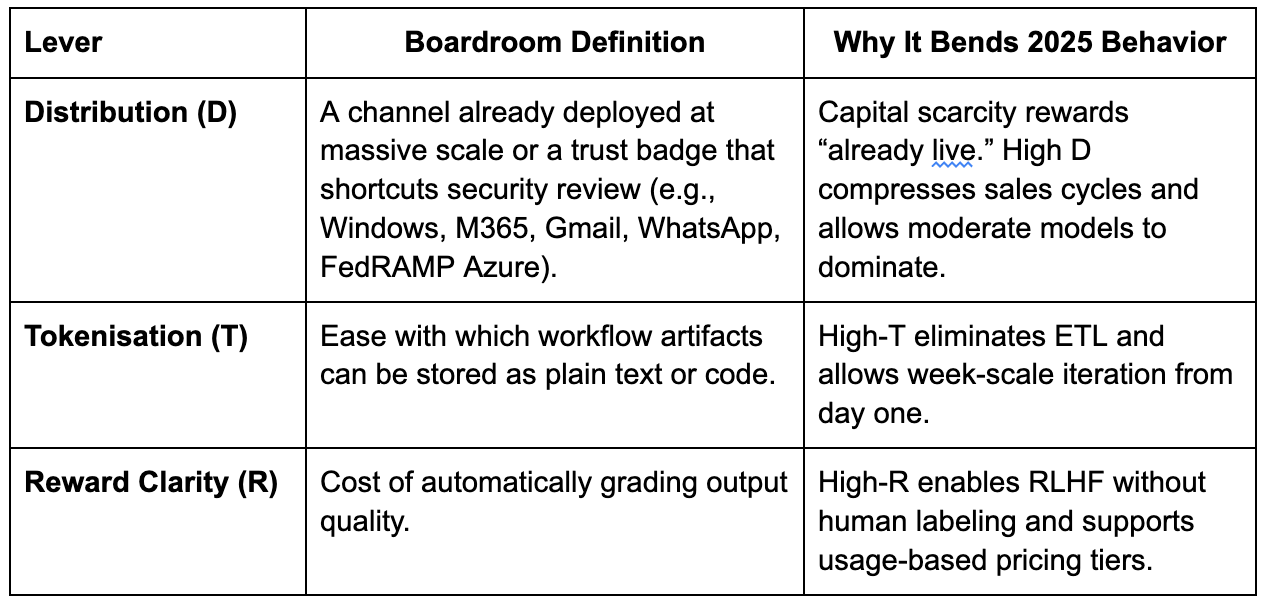
What each lever looks like in practice
- Distribution (D) — Channel control or compliance shortcut
- Examples: Microsoft drops Copilot onto every Windows 11 desktop; Google toggles Gemini for 3B Gmail accounts; AWS wins public‑sector deals via FedRAMP.
- Key point: If the software is pre‑installed—or already cleared by the CISO—sales friction collapses and the vendor can monetize even a “good‑enough” model.
- Tokenisation (T) — Data already lives in model‑friendly formats
- Examples: Git repositories, legal contracts in DOCX/PDF (easy to parse), protein sequences as text strings, WhatsApp message logs.
- Key point: When artifacts are UTF‑8 text or JSON‑like structures, no extra sensors, OCR, or ETL pipelines are required; models can start learning and shipping features in weeks, not quarters.
- Reward Clarity (R) — Outputs can be auto‑graded
- Examples: Unit tests pass / fail for code assistants; click‑through‑rate deltas for marketing copy; protein‑binding scores for drug discovery.
- Key term: Reinforcement Learning from Human Feedback (RLHF) = a loop where the model’s answers are scored and fed back to improve the next version. When scoring is automatic, RLHF runs continuously and cheaply, enabling usage‑based pricing tiers tied to measurable outcomes rather than seat counts.
One final note: Token cost per watt amplifies, but doesn’t replace, these levers.
The Extreme-Axis Rule
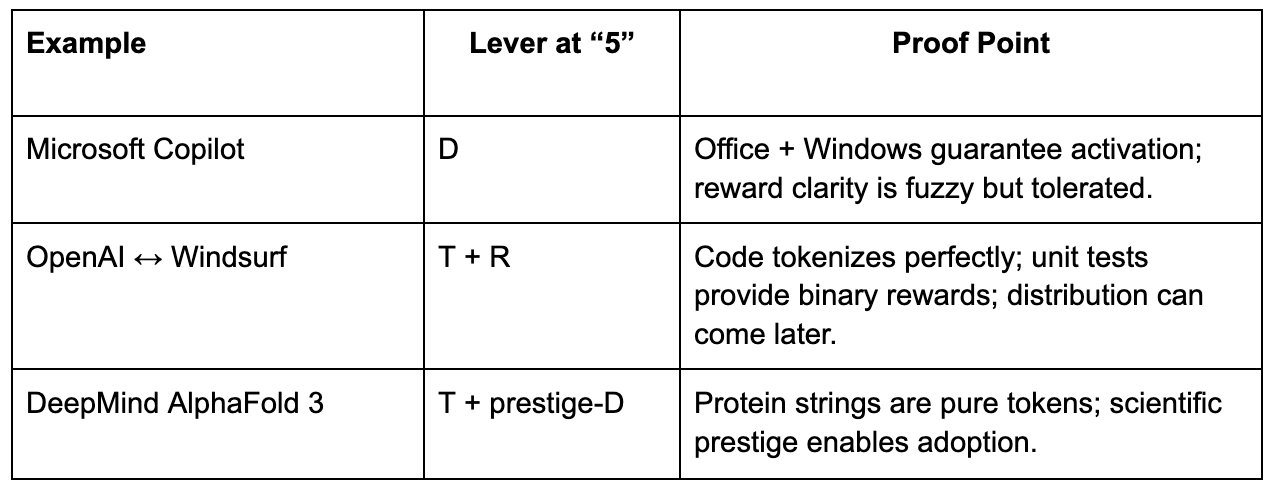
A “5” on any lever creates economic pressure to own the full stack—even if the other two are weaker.
Why CEOs Should Care
Why the levers matter for the bottom line
- Short‑cycle ROI — High D crushes procurement timelines
- Microsoft Copilot: flips on inside the M365 admin console; security review piggy‑backs existing Office contracts, cutting rollout from ~9 months to < 3 weeks.
- Google Vertex‑inside‑Gmail: no new vendor onboarding, so the CFO sees pilot‑to‑production in a single quarter.
- Compound stickiness — High T + R create self‑improving loops
- OpenAI ↔ Windsurf: every unit‑test result flows back as an automated reward; the code model gets smarter each sprint without fresh labeling budgets.
- DeepMind AlphaFold 3: lab assay scores stream into the model pipeline, improving fold accuracy and making it harder for a new entrant to match without the data history.
- Pricing gravity — Extreme levers shift billing from per‑seat to per‑corpus
- Claude Code Pro: charges by “private‑repo tokens” rather than headcount; cost scales with the customer’s codebase, not users.
- ChatGPT Projects: storage tiers price on file volume and retention window—once your docs live there, churn means paying to re‑embed everything with a competitor.
Next we’ll map Google, Microsoft, and OpenAI. You’ll see why their roadmaps diverge.
Where the Giants Sit — A One‑Glance Map of 2025 Tactics
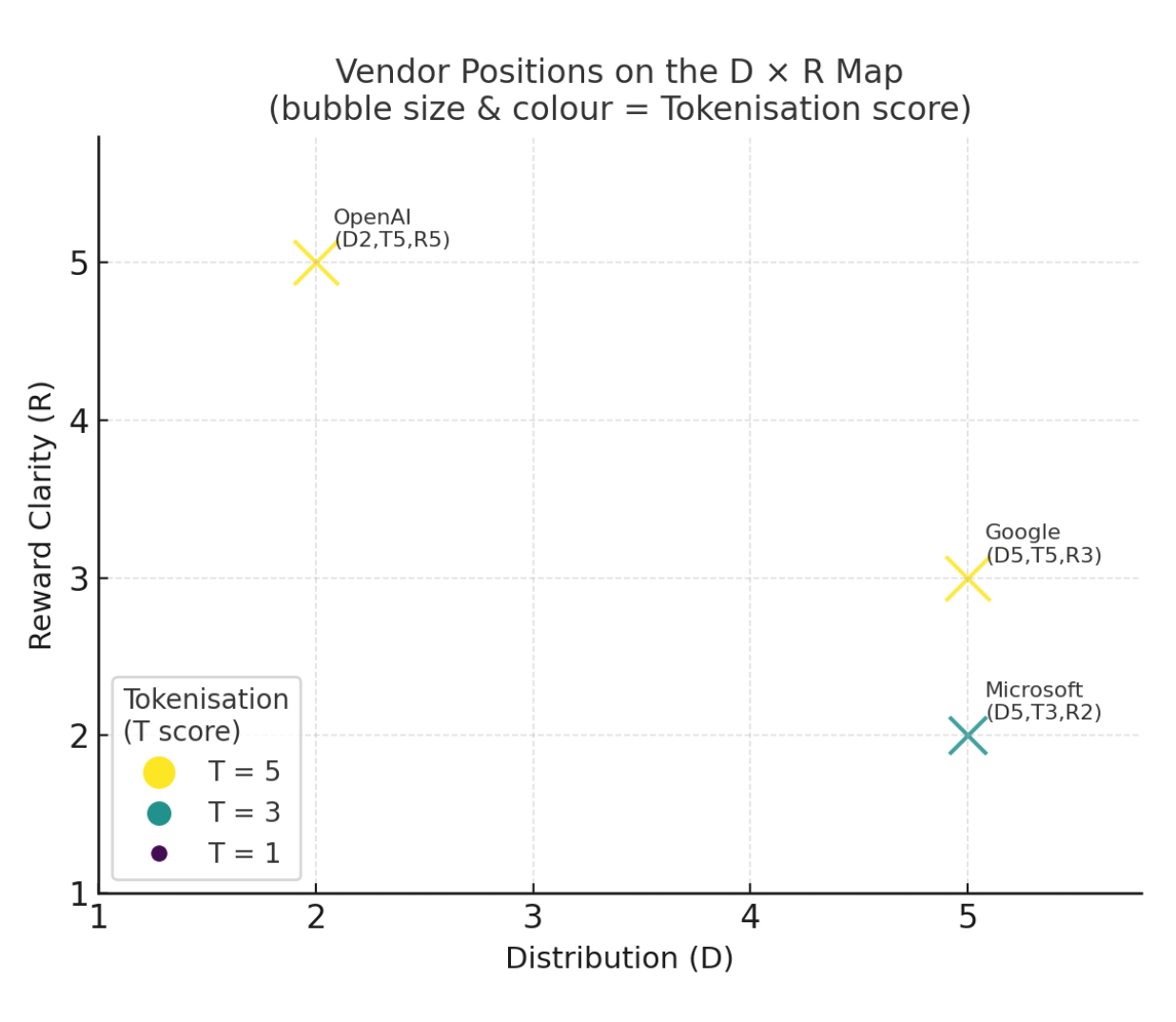
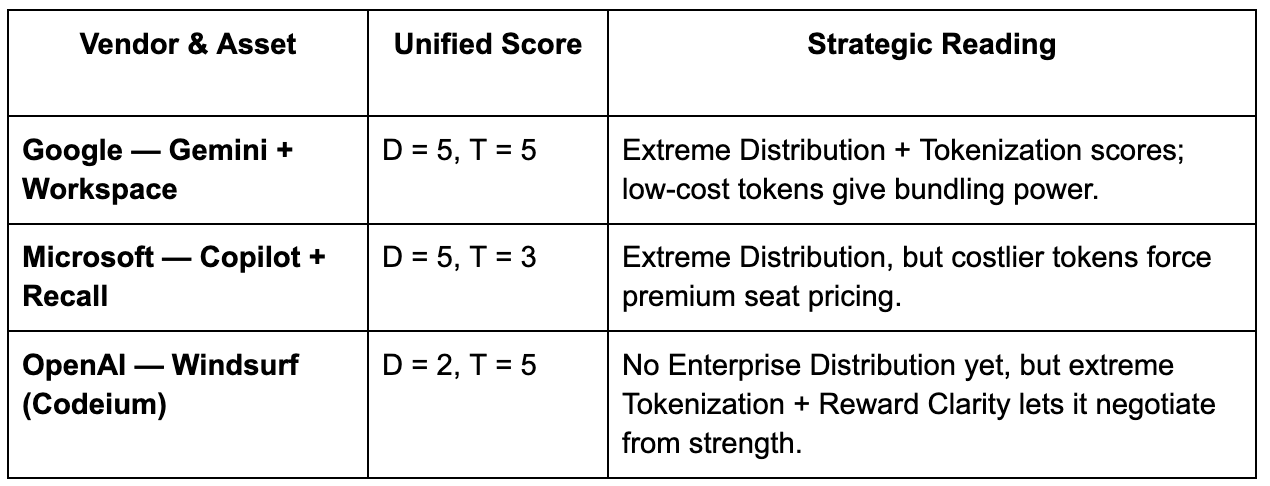
Key Pattern Callouts:
- Upper-right quadrant is empty — No one yet combines Office-scale Distribution with unit-test-grade Reward Clarity.
- Google vs Microsoft is a cost duel — Google bundles; Microsoft charges.
- OpenAI flips leverage — Starts with high Tokenization + Reward Clarity, adds Distribution later.
Board takeaway: Map your workflows to this same chart. If you’re near a vendor’s bubble, negotiate now or prepare to pay tolls later.
Sidebar | Hardware Economics in One Minute
Inference costs to generate 1M tokens (directional, not list prices)
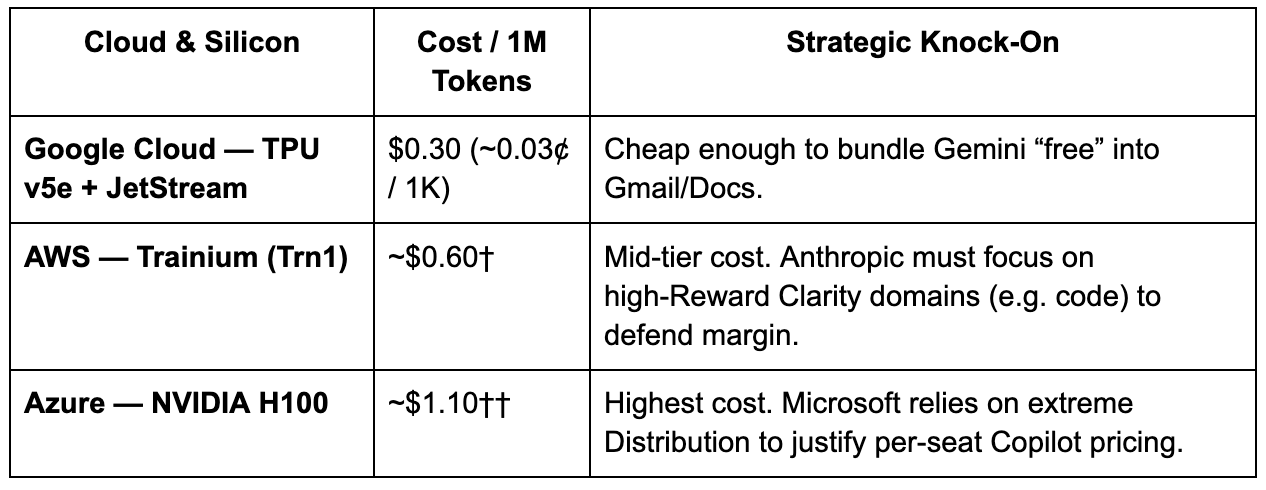
Amplifier Effect: Cheap tokens widen gaps. They don’t create new levers—but they magnify existing ones.
If Apple delivers < $0.30 / 1M on‑device tokens at WWDC, mobile Distribution could flip the D‑T‑R map overnight.
Footnote – NVIDIA Blackwell outlook:
NVIDIA’s B100 / GB200 “Blackwell” GPUs promise up to 30× lower inference TCO than H100, but they are not yet in general‑availability instances at Azure, AWS, or Google Cloud.
Early CoreWeave previews ship late‑2025, with hyperscale volume and production pricing expected in 2026. Budget decisions for the next 12 months should therefore benchmark against H100‑class costs; update models when Blackwell rates are published.
Board-Level Checklist — Protect Your Leverage Before You Sign
1. Map Every Workflow to D‑T‑R
Why it matters: You can’t measure lock‑in risk without a baseline.
Action: Score each data stream on:
- D: Is the channel pre-approved?
- T: Could 95% of artifacts be stored as UTF‑8?
- R: Can success be auto-graded?
Flag any “5” — that’s a future toll road.
2. Bake in Export & Re‑Ingest Rights
Why it matters: Corpus migration later is 10x costlier.
Action:
- Contract for 30‑day export (Parquet, Git, JSONL)
- Require vendor-paid re‑ingest if you exit
- Change-of-Control Clause: If vendor is acquired by a “5” scorer on D-T-R,
you may:
- terminate + re-ingest, or
- freeze pricing for 24 months
3. Fund Only Reward‑Clear Pilots
Why it matters: Fuzzy ROI projects are easy cuts.
Action: Only green-light pilots with auto-generated metrics (unit tests, CSAT delta, etc.). For subjective cases, require proxies like CTR lift.
4. Price Against Token Economics
Why it matters: Discounts hide divergent OPEX.
Action:
- Ask which silicon backs your region.
- Model 3-year spend using marginal token cost.
- Insert a compute-index clause to float pricing down when cheaper silicon is adopted.
5. Audit Lever Shifts Quarterly
Why it matters: One release can flip a weak lever to “5.”
Action: Track:
- Press releases (new channels = D)
- Ingest tooling (T)
- Auto-grading advances (R)
Re-score contracts before a vendor monetizes a new lever.
Micro‑Indicators to Track in H2 2025
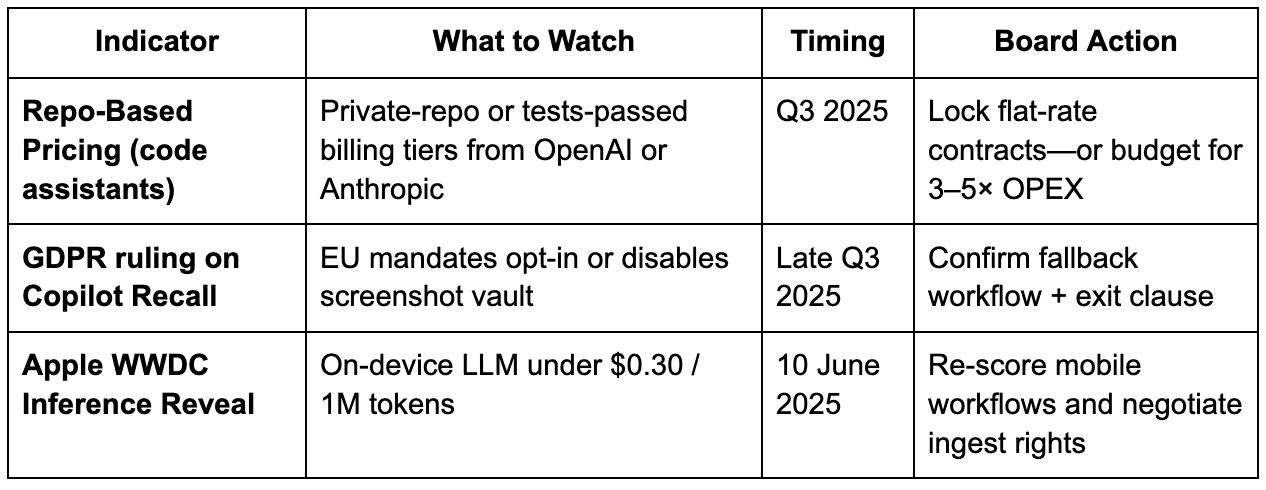
These events move at least one vendor lever to “5.” Track them and renegotiate the week they drop.
Final Takeaways
- Leverage lives in the pipes. Model quality converges; context ownership doesn’t.
- One extreme lever is enough. Expect vertical stacks + per-corpus pricing.
- Cheap tokens widen gaps. TPU wins = bundling. H100 = premium.
- Negotiate before ingestion. Export rights + silicon clauses are cheap now, expensive later.
- Re-score quarterly. One keynote can flip the map.
In 2025, the scarce asset isn’t IQ—it’s the pipeline that turns tokens into margin.
If you ran across an acronym that didn’t make sense in this briefing, ask ChatGPT or your LLM of choice. It knows!
Substacks like this are a labor of love. Share and recommend to people who need to read it!

\This turned out slightly creepy but we’ll go with it\