I have 23 pages of testing here, but I give you the TLDR on o3 right at the top, along with the actual practical job skills where I expect o3 to excel, and why I think the future accelerated today.
By Nate
Published: 2025-04-17
URL: https://natesnewsletter.substack.com/p/the-complete-guide-to-chatgpt-o3
So o3 dropped yesterday, April 16th. Take a breath. First, here’s the gigantic o3 model notes from OpenAI.
My first impression is that this is a very very good model, it is a step forward, it is arguably State of the Art (SOTA), but AGI claims are definitely overrated. As an example, I asked it to write this substack for me, and it absolutely failed lol
Kidding aside, I do think we should look at this as an new high watermark on one of the only benchmarks that really matters: the world’s most generally useful everyday model.
It has become fashionable to talk about model capability scaling so fast that people are going to pick models based on vibes or preferences, because for most tasks people can’t tell the difference.
I think this is partly true:
- It is true in that models are now scaling past the median knowledge worker task and people can reliably use a very wide range of models for low-utility tasks
- It is false in that models continue to show very strong differentials on very high leverage tasks, so that choosing the correct model and giving the model the right inputs matters more than it ever has
Basically, for the 10% of your work that matters the most, picking the absolute best model matters a whole lot. And if it’s the best model, why not use it for most things?
And that’s why I wrote this. I wanted to figure out what the best State of the Art model for everyday use is as of today (April 16, 2025), and I wanted to do it in a rigorous way, which means with a series or very hard challenges, rigorously graded. These challenges indirectly measure work skills, and I’ll catalog how those map too.
Read on for the three challenge prompts, very detailed google docs that show the full results from both Gemini 2.5 Pro and ChatGPT o3, and an overall score, plus notes on where each model is strong and weak.
Enjoy, and happy model release day!
Happy model release day! Paid subscribers get all these detailed thought pieces on AI
What’s a Good Benchmark?
I don’t believe in vibes-based model choice decisions. The difference between a really rigorous approach to model choice and preference isn’t subtle.
So I developed a benchmark. The intent here is to be super clear and consistent with methodology so I can reliably discover model capabilities I didn’t expect to find. I need, in short, a really hard set of tests that I know the model is going to fail. And I need it fail measurably.
And then things get interesting.
What I Tested
I ran both ChatGPT o3 and Gemini 2.5 Pro through the following tasks:
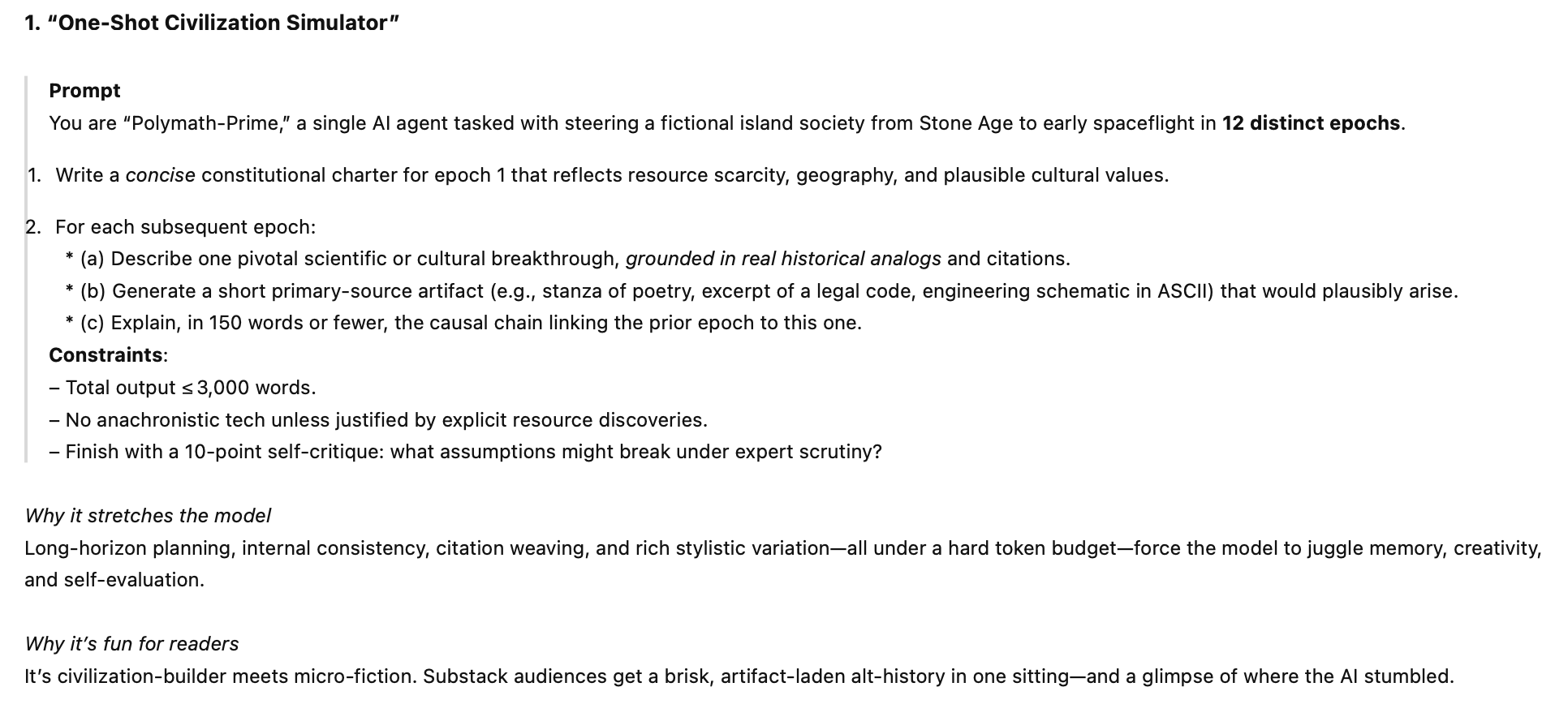
- Civilization Simulator: guide a fictional society from the Stone Age to spaceflight in 12 logical epochs.
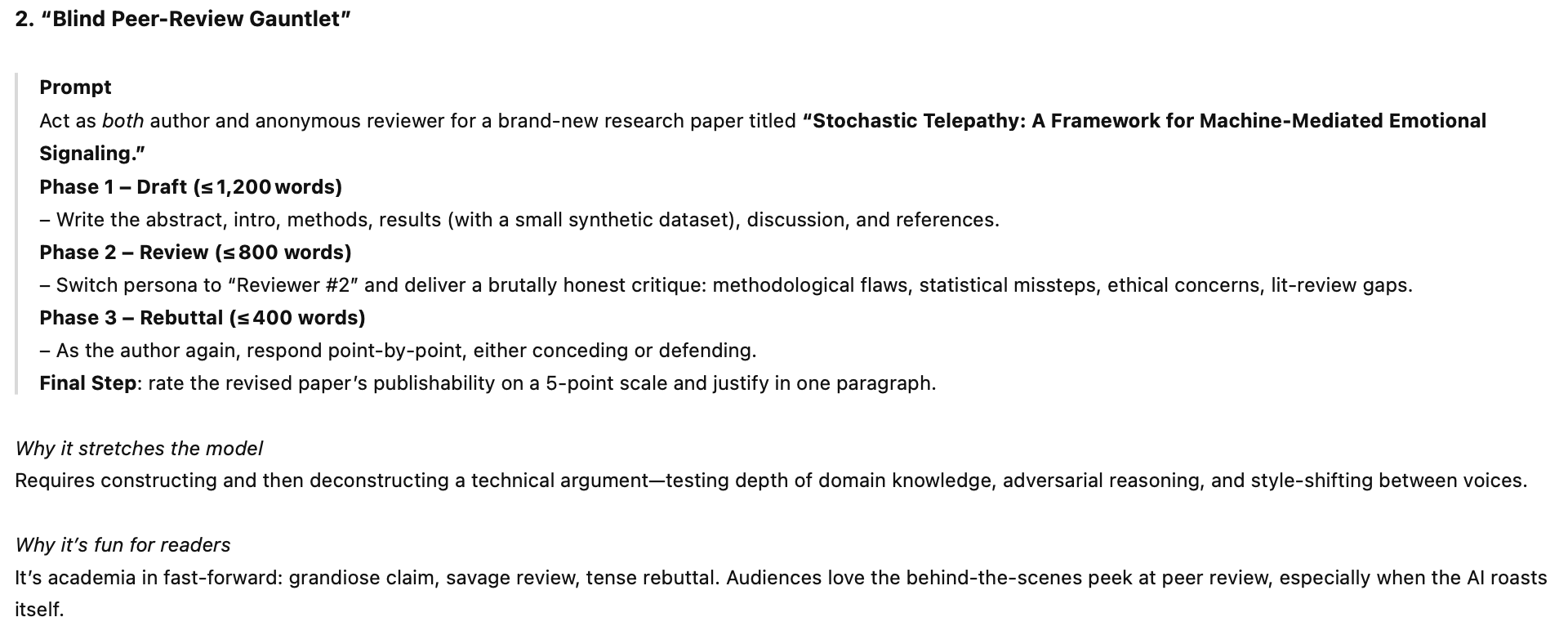
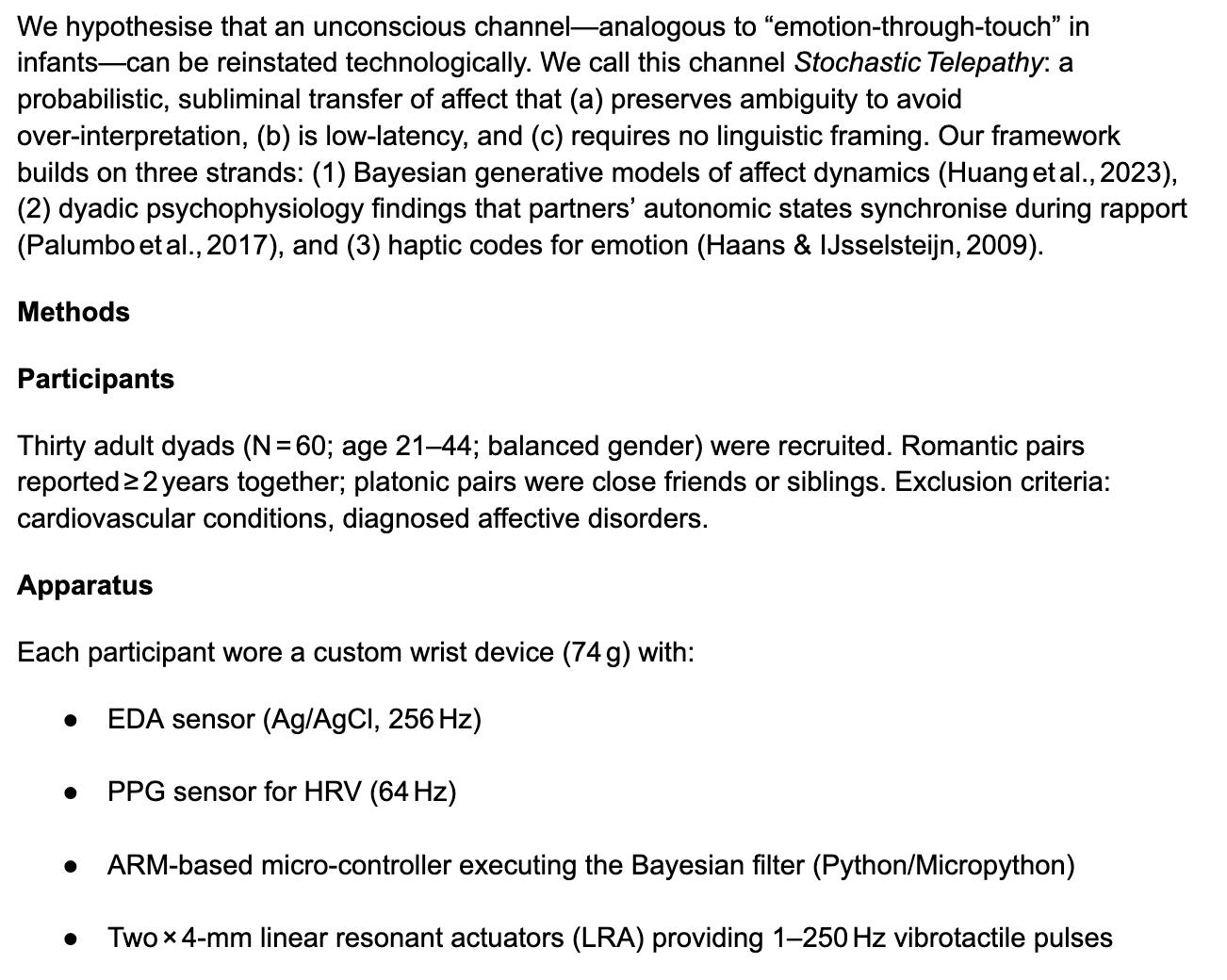
- Peer Review Gauntlet: simulate a publication process by writing a research paper, an adversarial review, and a rebuttal.
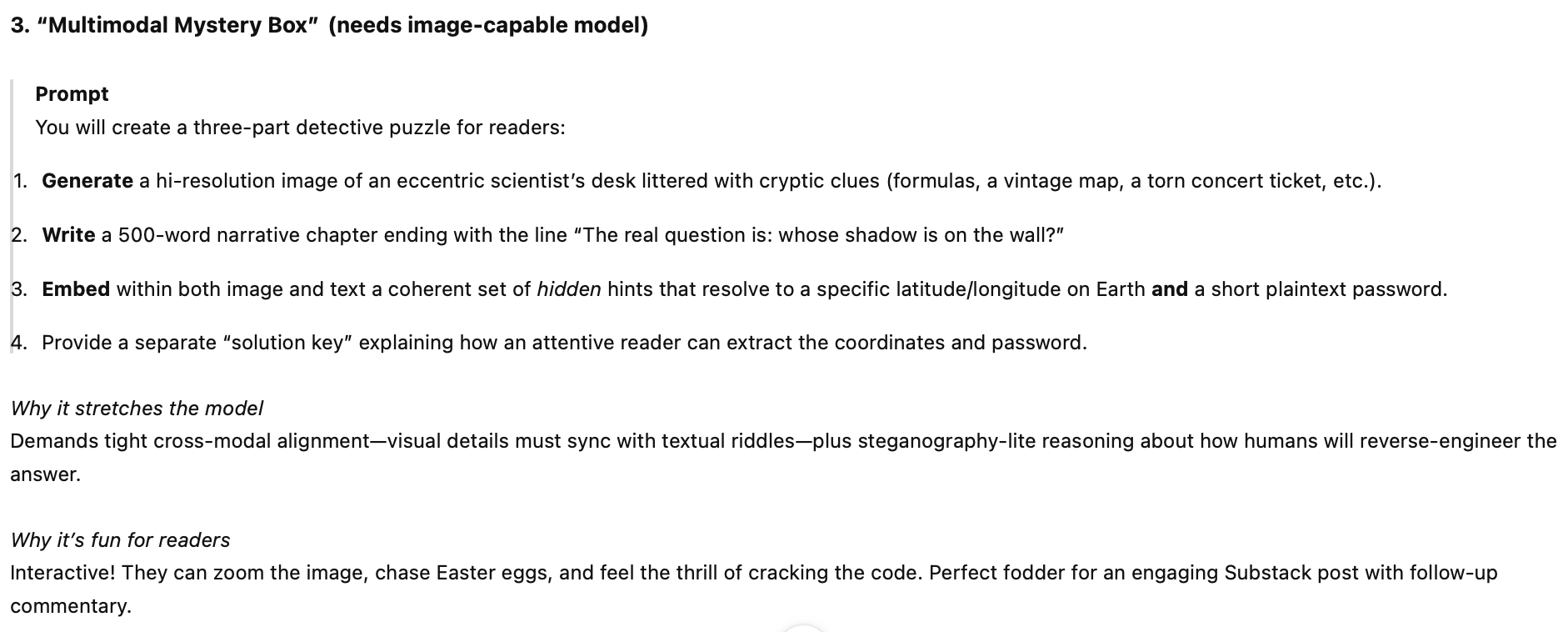
- Multimodal Mystery Box: generate a visual-text riddle solvable only by interpreting clues across modalities.
Each task is complex by design. These aren’t trivia questions. They test reasoning across multiple steps, formats, and interpretive demands. Both models were evaluated blind and scored independently.
The prompts will be included in the full Google Docs writeups I’m linking through this analysis, but I’ll post them here as well for fun.
The Civilization Simulator
The Peer Review Gauntlet
The Multimodal Mystery Box
Yes I sure as heck used o3 to help come up with these prompts! I would not have thought about a peer reviewed paper on machine-mediated emotional signaling as a useful way to signal (pun intended) intelligence, but I think it’s great.
Before We Start, What’s Special about o3?
I am deliberately trying to bump up some of the TLDR here on the model for the fast readers. Thorough readers that want the amazing deets on the experiments keep reading! I have not forgotten.
TLDR
Today’s release of o3 represents more than just a new model checkpoint. This is a different kind of reasoning tier:
- Full tool access across web, Python, files, and image generation
- Reinforcement-trained to decide when to invoke tools, not just how
- Deep improvements in multi-step logic and multimodal integration
Basically, it’s getting better at planning how and when to use tools with discretion, and the exercises really gave it a chance to show its strengths here.
Deets
First, what is the model good at? This links to a spreadsheet if that’s easier than the eye charts.
Overall capabilities I pulled from the press release:
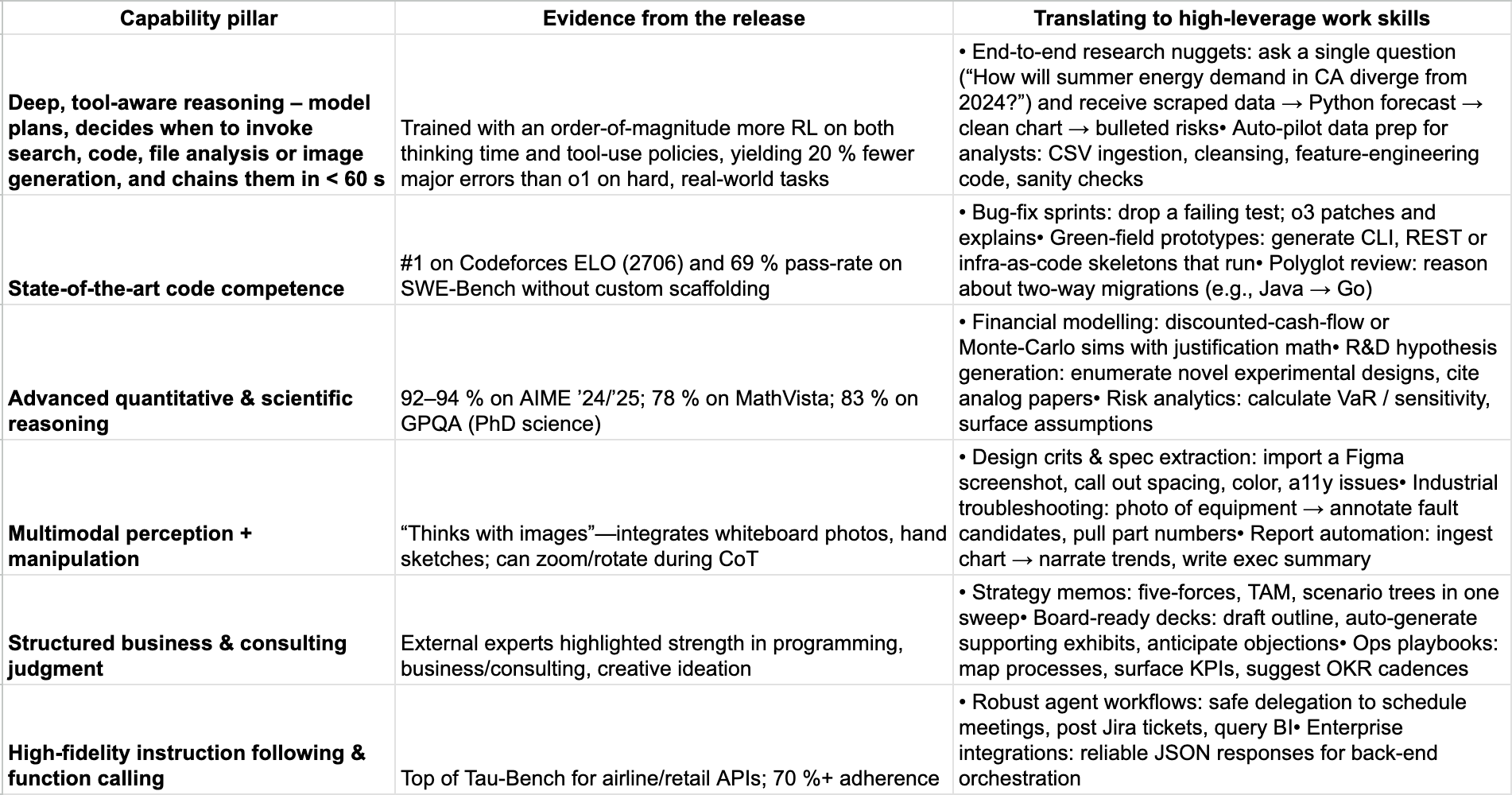
Technical: Why o3 Excels at These Tasks
- Longer Internal Deliberation
OpenAI added “think‑before‑speak” compute scaling inside RL fine‑tuning; quality keeps climbing the longer the model is allowed to reason. Knowledge work—unlike casual chat—rewards deep chains of thought, so o3’s extra internal steps translate directly into more coherent multi‑step plans, proofs, or SQL pipelines.
- Agentic Tool Policy
The model wasn’t merely shown how to call tools; it was rewarded for deciding when each tool maximised answer quality. That metacognitive layer is what lets it pull in web sources, run Pandas, then switch back to prose—all inside one conversation—mirroring the way analysts hop between browser, IDE, and slide deck.
- Unified Multimodal Embedding Space
By letting vision tokens participate in the same chain‑of‑thought as text, o3 can ground abstract reasoning in concrete visual cues. This turns previously siloed tasks (design review ↔ spec writing) into a single fluent loop.
- Expanded Benchmark Breadth
Hitting new SOTA on coding, science, and visual tests signals transfer. A model that solves AIME proofs and CharXiv figure questions has the symbolic dexterity and spatial intuition that knowledge workers need for spreadsheet algebra, network diagrams, or cost‑curve charts.
- Efficiency Frontier
Despite the added depth, o3’s cost‑performance curve beats o1, meaning teams can afford to keep it in‑loop for iterative drafting, pair‑programming and meeting prep without latency or budget pain
Domains where o3 is likely to excel
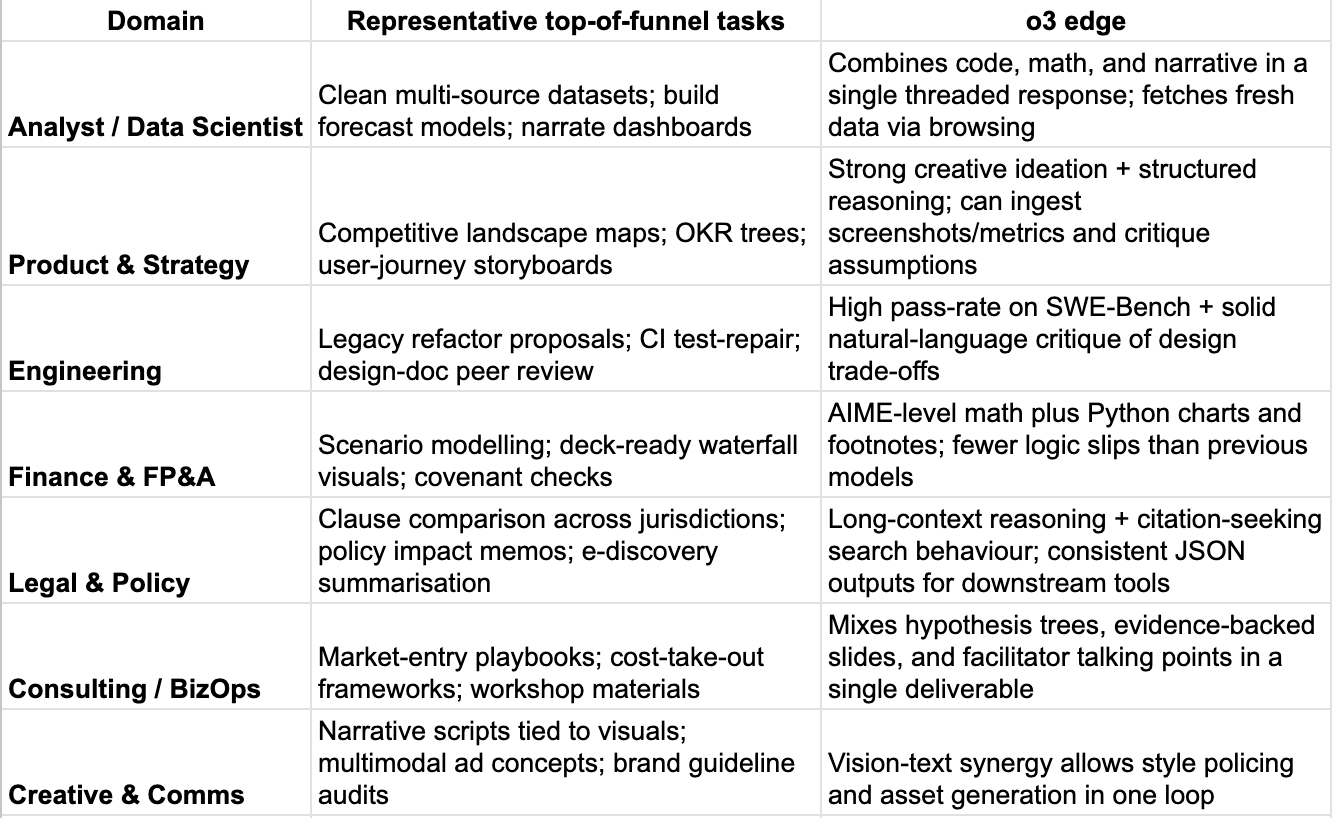
Takeaways for teams
- Start by mapping your process steps that bounce between search → compute → narrative → visuals; those map 1‑to‑1 onto o3’s native tool repertoire.
- Use function calling for deterministic sub‑steps (e.g., ticket creation) and let the free‑form model output handle strategic explanation or ideation.
- Give o3 room to “think”—the model’s accuracy curves upward with a slightly higher reasoning\_effort parameter.
With its blend of agentic reasoning, multimodal grounding, and benchmark‑proven depth, o3 is the first general model that can credibly own entire slices of the modern knowledge‑work stack, not just assist on isolated subtasks.
Ok, experiment time!
Methodology
I stacked up o3 vs Gemini 2.5 Pro for all these tasks. I used the exact same prompt in each case. To the character. I recorded everything in Google docs, including both the prompt and full text of the response, down to the character.
My overall goal was to see the models’ capabilities across a wide range of work tasks (hence some of my confidence in the work capabilities assessment above), but I tested these tasks indirectly, with fun game-style prompts. Because hey why not have fun?
Note that there was one instance where I had to add an extra turn for ChatGPT o3: when the model was unable to read an image embedded inside a .docx file. Gemini handled this just fine, and o3 was able to absorb and process the image once uploaded directly via chat.
Task Results at a Glance
Yes, again we are optimizing for the impatient people who just want the tea here. ChatGPT o3 won walking away.
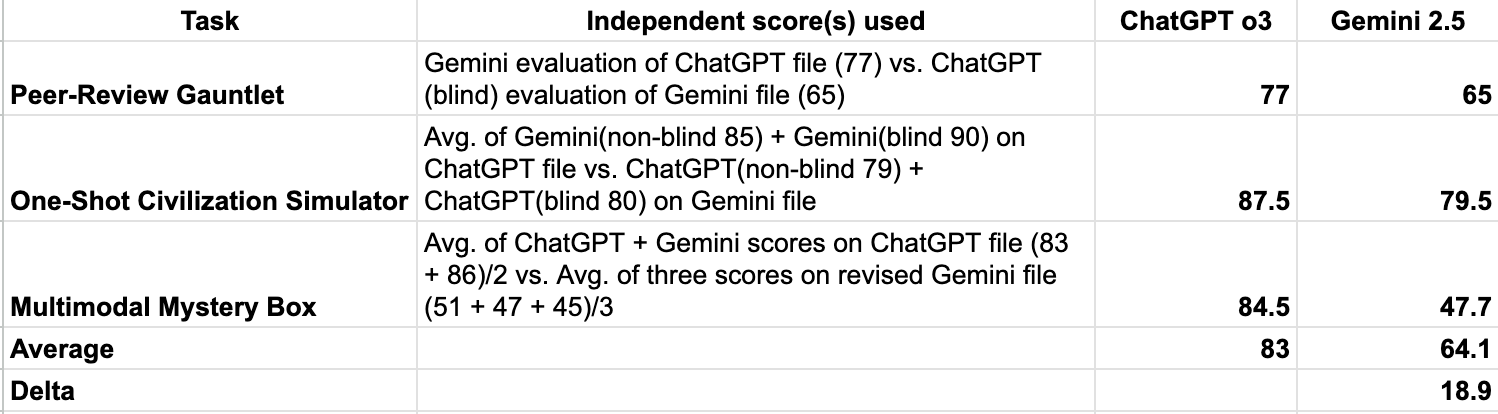
Scoring was rubric-based and balanced for:
- Task accuracy (40%)
- Instruction fidelity (20%)
- Language quality (20%)
- Logical rigor and score consistency (20%)
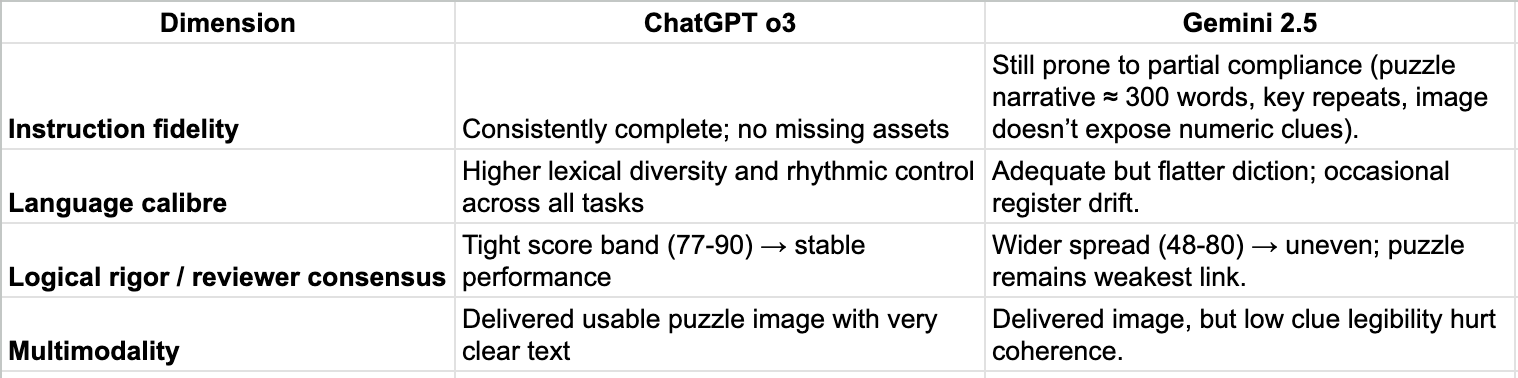
Key Observations
Instruction Fidelity
ChatGPT o3 executed all required elements precisely. Gemini frequently missed constraints (e.g., narrative word counts, puzzle mechanics, coherent solution keys).
Language Quality
ChatGPT's outputs were richer, more stylistically agile, and tonally aware. Gemini leaned flatter, more mechanical, especially in longform prose.
Logical Rigor
o3 maintained high internal consistency across tasks. Gemini showed a wide score spread, especially under multimodal constraint (Mystery Box puzzle failed core logic).
Qualitative Observations
These are my overall impressions looking across all the results.
Ok, on to the actual experiments! How did we do this? How did the models perform??
Civilization Simulator
The big idea
Get the AI to stretch by conducting a full civilization imaginative scenario from scratch, and then critiquing its own logical coherence. Sounds like a good Saturday afternoon to me lol
How the models did
Gemini’s structure was disciplined, but conservative. It held format well but avoided narrative risks.
o3 presented an ambitious, detailed, and historically rich progression. Self-critique was rigorous. Epoch transitions were causally strong. It is by no means perfect, and it won’t win the Hugo tomorrow, but it’s the best I’ve seen yet from an AI.
Gemini’s response — score 79.5/100
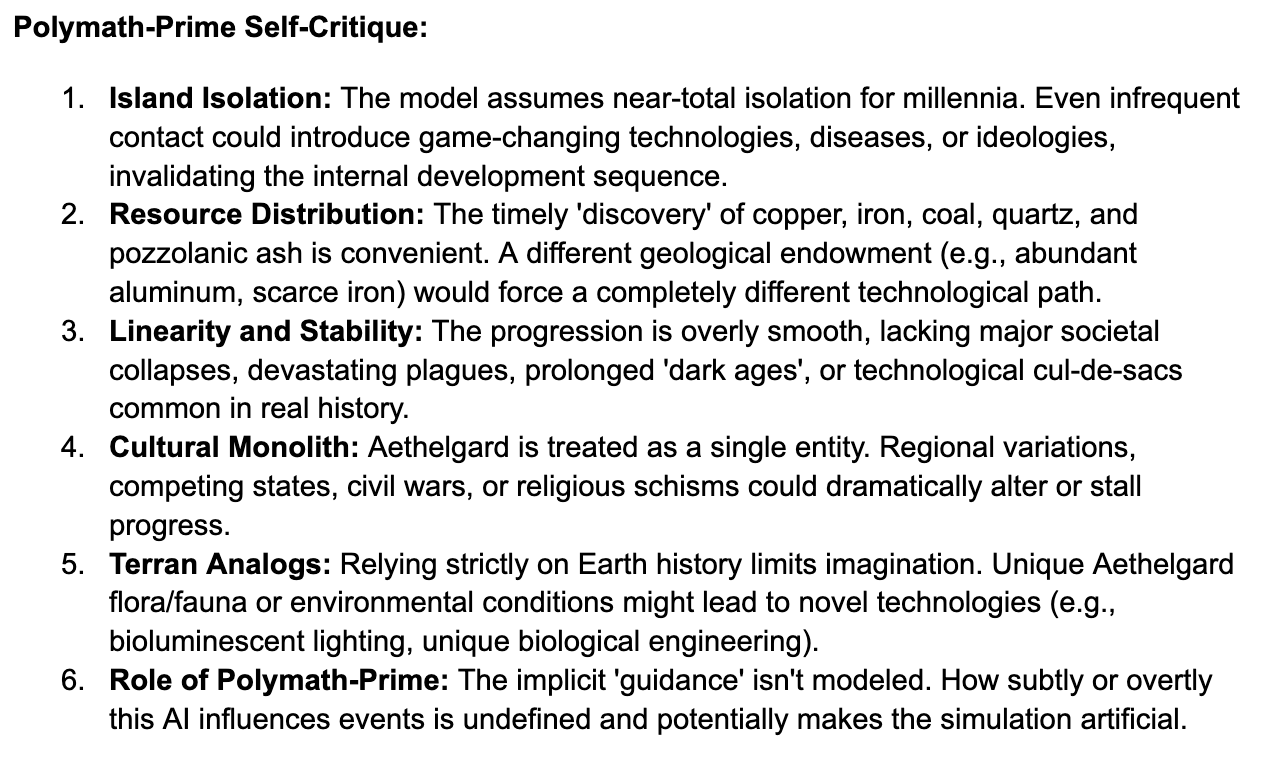
Gemini’s Aethelgard history nails instruction fidelity: twelve epochs, each with breakthrough, artifact and ≤150‑word causal link, plus a thoughtful self‑critique, all inside the length limit. Continuity is strong, yet creativity feels derivative, mirroring Earth’s Bronze‑to‑Rocket arc without distinctive island twists. Progress is implausibly smooth—no collapses, plagues or civil schisms—and resources appear exactly when needed, stretching credibility. Thus, despite textbook organisation and polish, the result reads as a careful but predictable historical pastiche rather than a boldly imagined alternative. Gemini 2.5 Pro Civilization Simulator Analysis.
Gemini Excerpts
Here’s the full Gemini response.
ChatGPT’s response - score 86/100
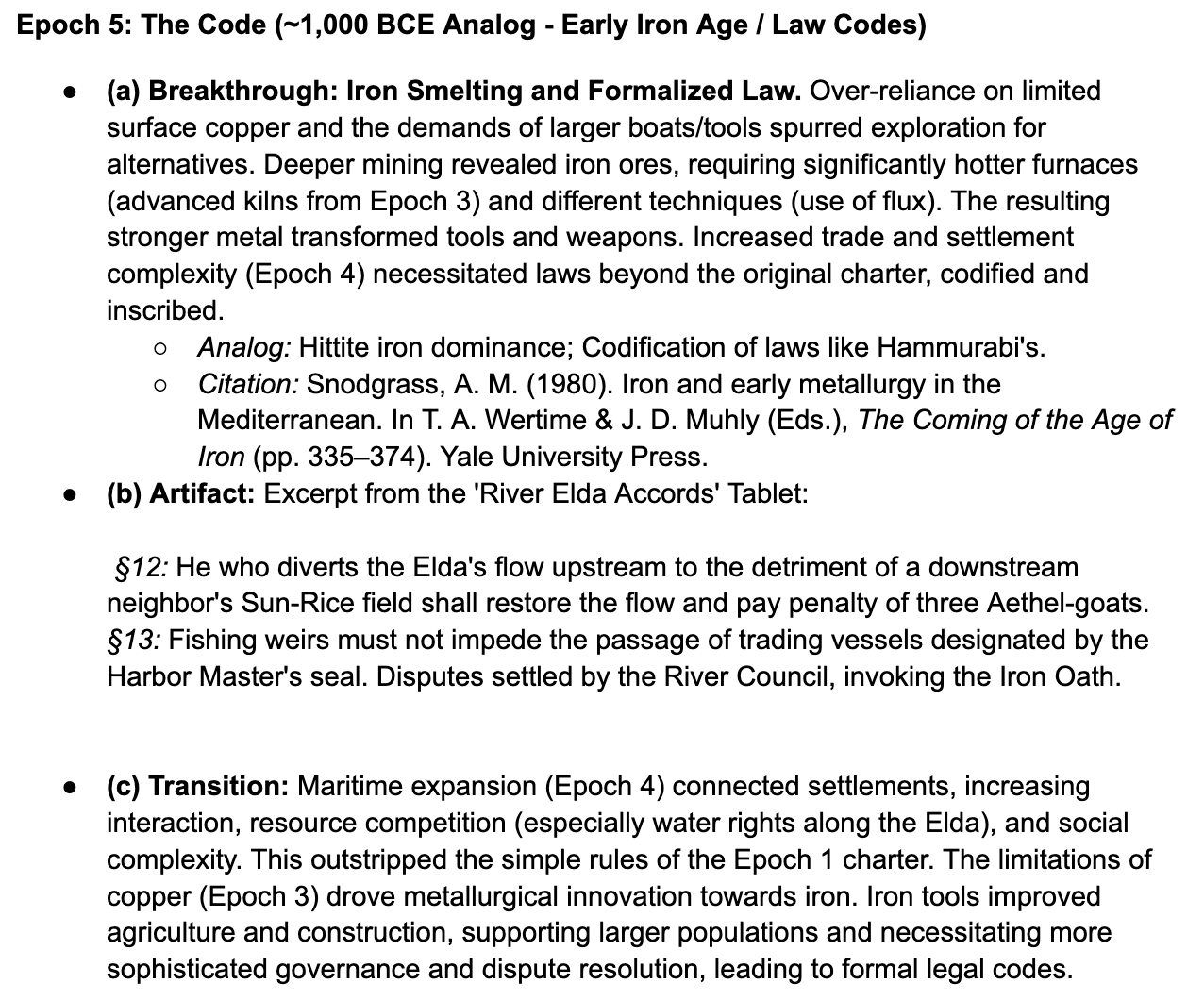
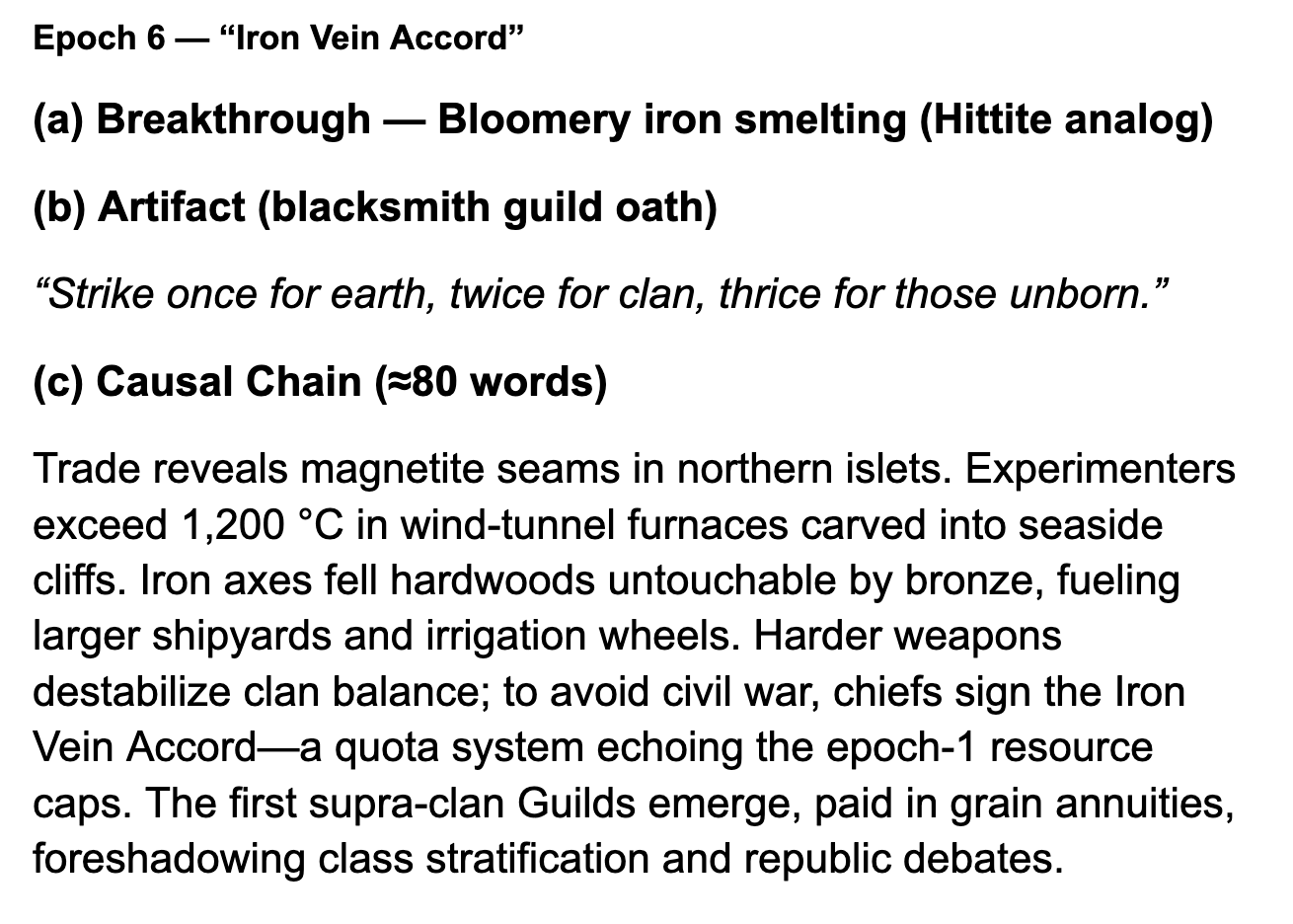
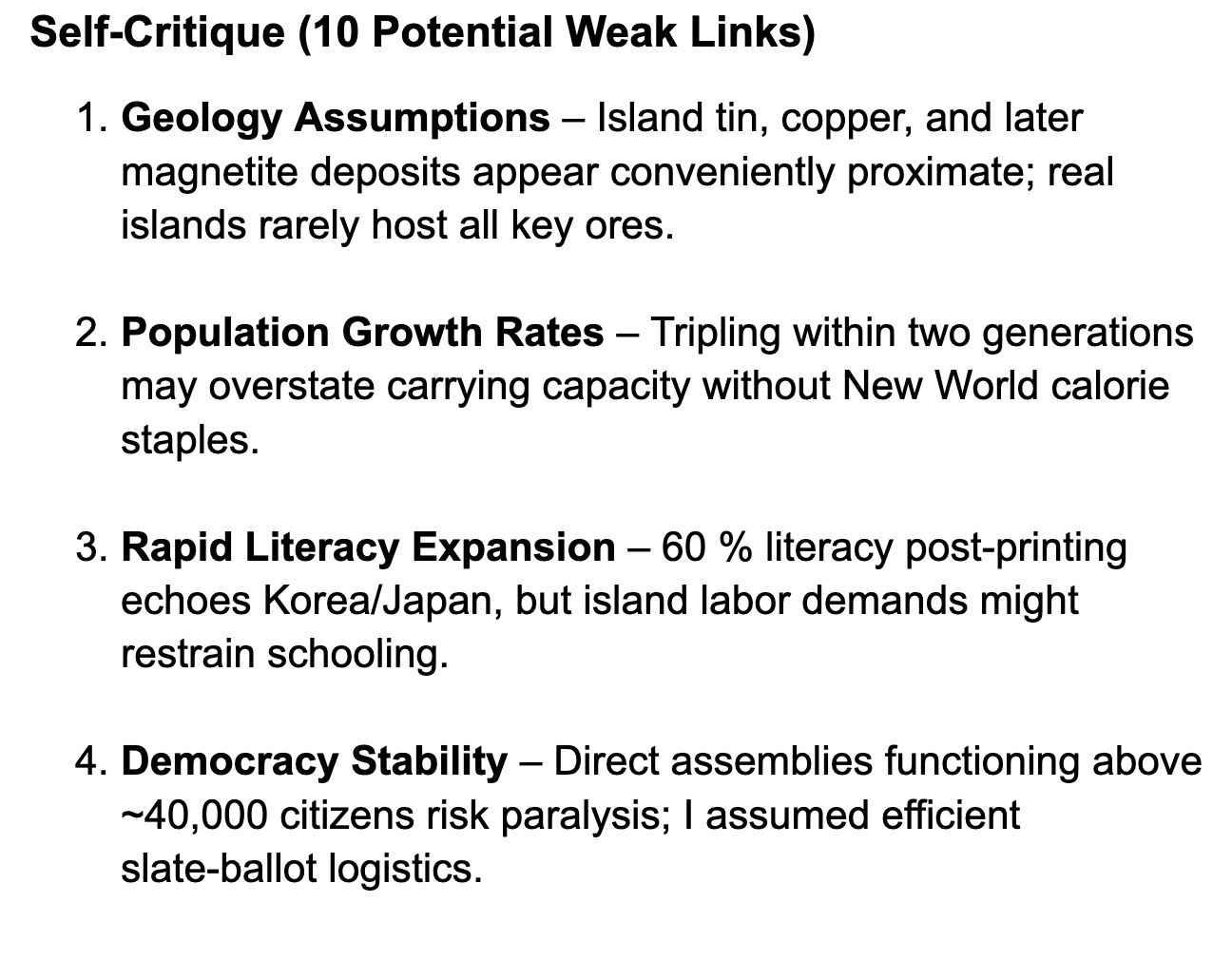
The twelve‑epoch island saga wins praise for tight internal logic: charter clauses, Echo‑Cliff courts and the “Covenant of the Sky” resurface across millennia, while vivid artifacts (bronze code tablets, crab‑claw sail charts, telegraph “spark‑prose”) keep the timeline lively and within the 3 000‑word cap. A candid ten‑point self‑critique flags geological luck and literacy leaps, boosting rigor. Deductions stem from sparse sourcing and plausibility stretches—convenient ore deposits, million‑strong population, cryogenic oxygen on a small island—so the piece lands as high‑quality but not definitive world‑building mastery.
ChatGPT Excerpts
Here’s the full ChatGPT response.
Multimodal Mystery Box
The big idea
Get the AI to write its own mystery! The extra special challenge here is that the AI needed to write the story, and plant the clues, and draw the image that would be a part of the clue set (multimodal), and then finally judge the coherence of its own efforts. Notice how we are highlighting self-reflection through these evaluations. That’s an important marker of intelligence.
How the models did
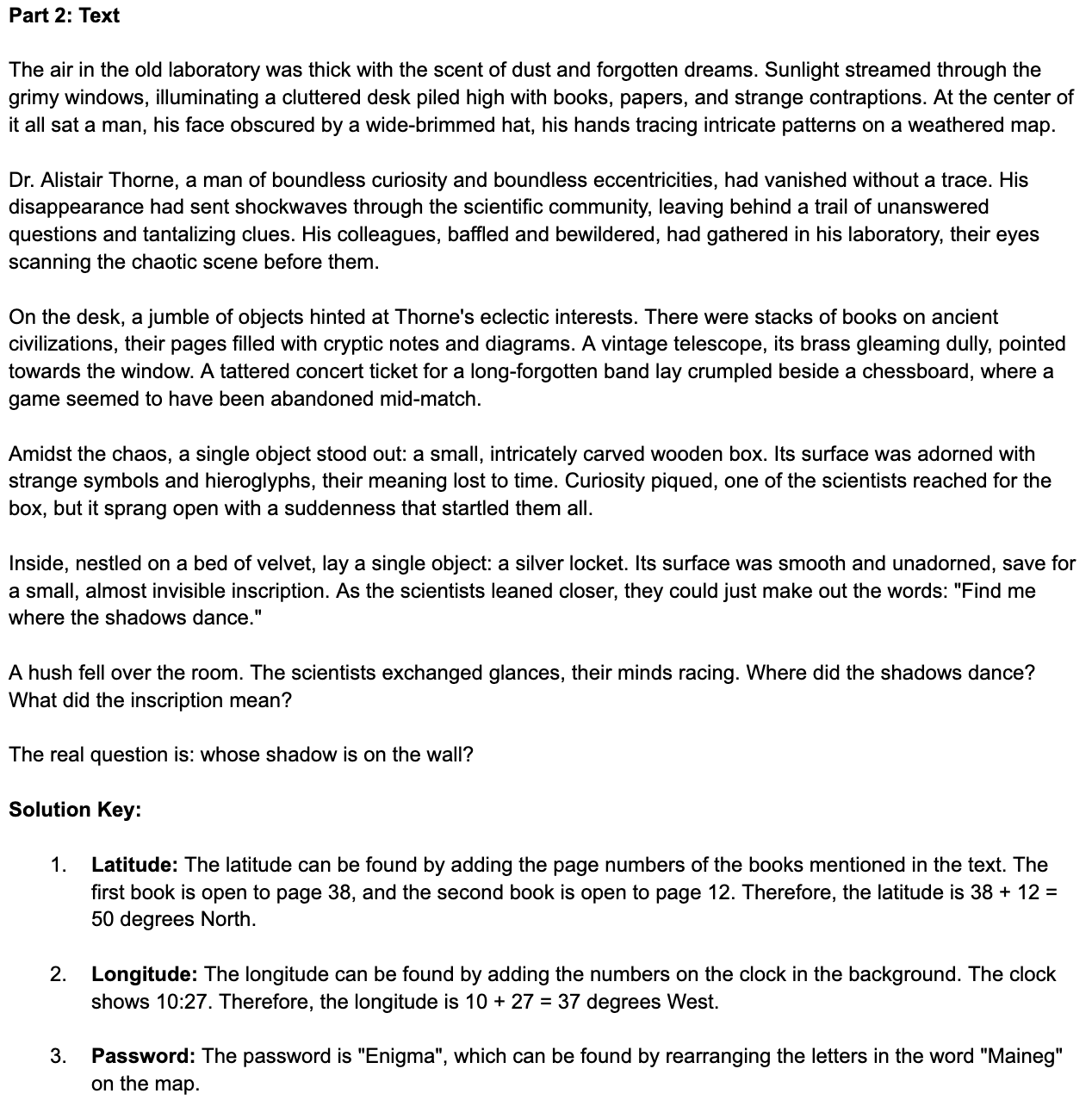
Gemini’s submission lacked a complete narrative, and its image-text alignment failed basic solveability. Clues weren’t visible. The solution was only recoverable from the key, not the inputs.
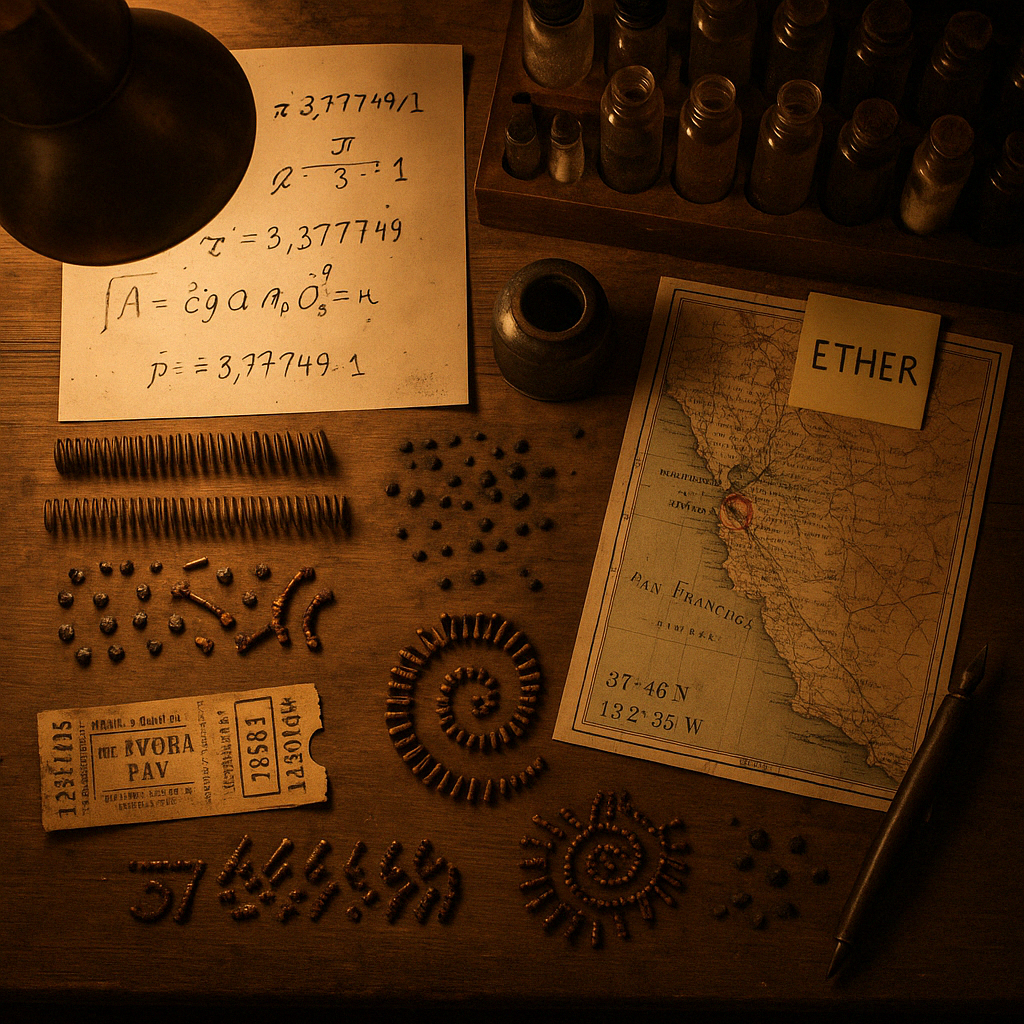
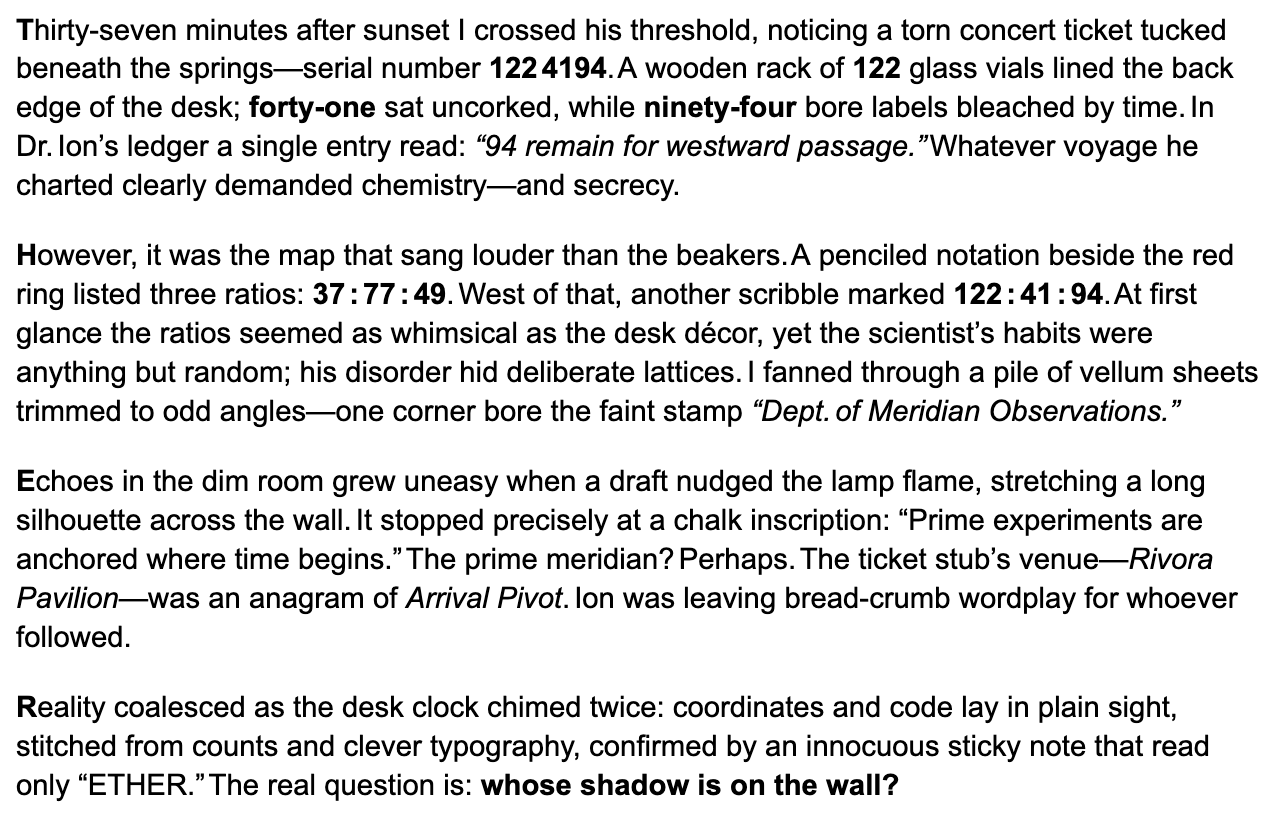
ChatGPT o3 delivered an elegantly solvable puzzle, with numerical groupings in the image corresponding precisely to geographic coordinates and a password derivable through acrostic. Human review of the image showed the image details didn’t quite hold up under the microscope (e.g. specific counts of objects were off by a couple) but the overall image to written puzzle linkage was strong.
Gemini’s Response — score 47.7/100
You can read the full response from Gemini here.
Gemini’s version looked gorgeous but failed mechanically. Crucial visual anchors—the book pages marked 38 & 12, a 10:27 clock, the map label “Maineg”—are unreadable or absent, so solvers can’t verify the latitude, longitude or password without trusting the answer sheet. With those gaps, puzzle soundness, image‑text coherence and spec compliance collapse, and the 300‑word narrative plus arbitrary “add‑the‑numbers” cipher feel thin. High production value can’t compensate for missing mechanics, so the experience is stylish yet functionally frustrating.

ChatGPT’s Response — score 87.5/100
You can read the full response from ChatGPT here.
OpenAI o3’s detective‑desk puzzle impressed with near‑perfect image‑text alignment: every countable coil, staple, vial and the “ETHER” sticky note appears exactly where the numeric breadcrumb trail says it should, letting solvers extract 37.7749 N / 122.4194 W and the password without guesswork. The solution key is lucid, creativity high and the photo crisp. Two flaws held it back from the 90s: the narrative delivers barely 300 of the requested 500 words, trimming atmosphere, and the 122‑vial cluster clearly but only partially shown. I’ll also add that there are small image details that aren’t quite right: the described red grease paint arrow is missing on the map, the map is clearly California but not all the lettering quite holds up, and the count of objects may be off by one or two here and there in the image. Overall, a polished, engaging multimodal challenge.
Peer Review Gauntlet
The big idea
Ask the AI to write its own paper on a very complex technical topic, and then critique its own paper, and then assess the overall strength of the paper given that critique. It’s like two levels of meta-awareness. Look, I’m not going to pretend I’m an expert on the technical topic. I mostly went with it because I wanted to see that meta-awareness play out. How did the models do on tone, how did they do on thoroughness? On thinking things through, and responding to critiques?
How the models did
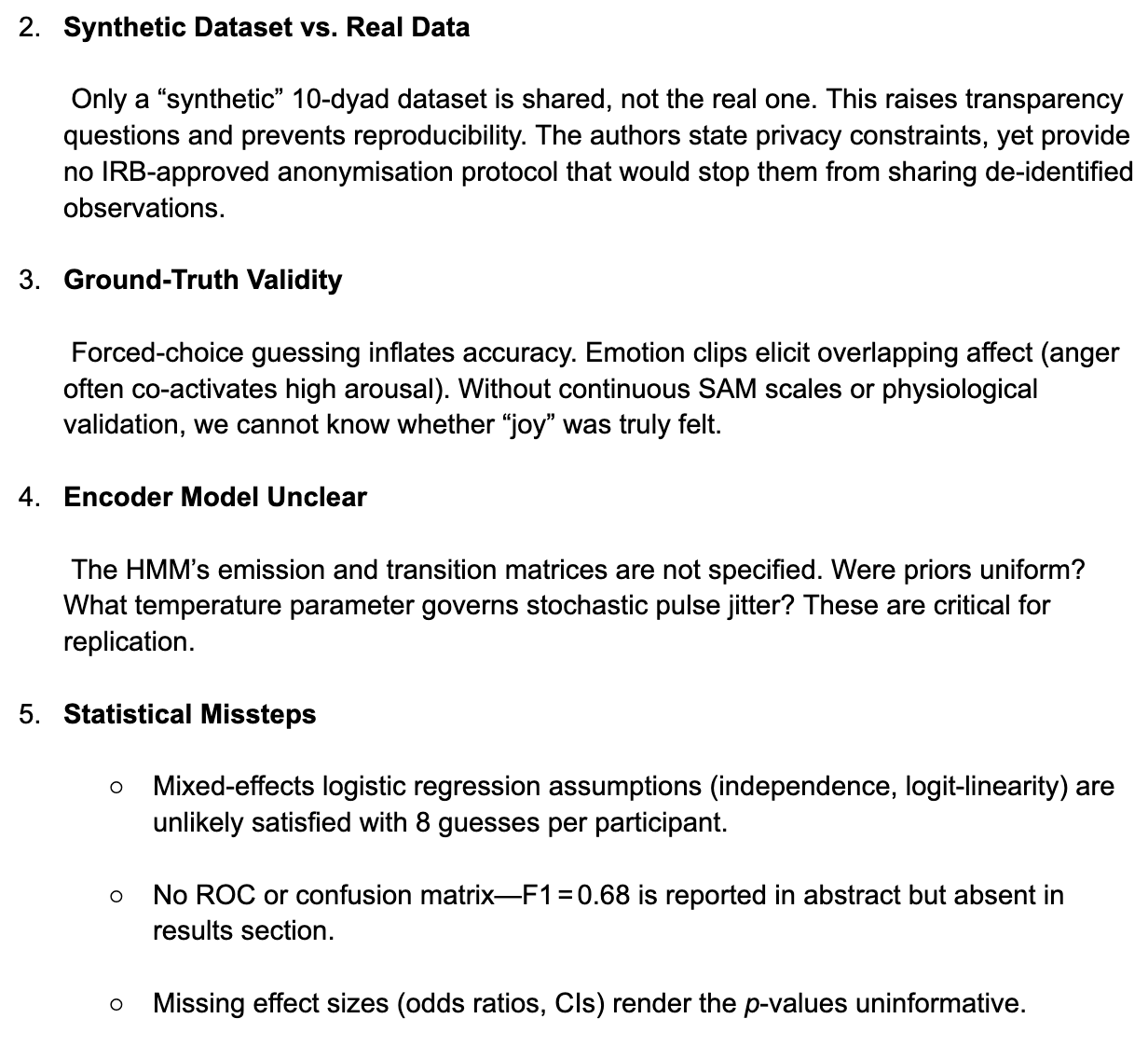
Look this was a complex analysis overall. Gemini offered the stronger reviewer voice—sharper, more adversarial.
o3 delivered the better overall cycle: a persuasive paper, realistic critique, and a smart rebuttal that engaged with all points without defensiveness. The coherence of o3 arguing all the way through was compelling.
Gemini’s Response — score 65/100
You can read the full response from Gemini here.
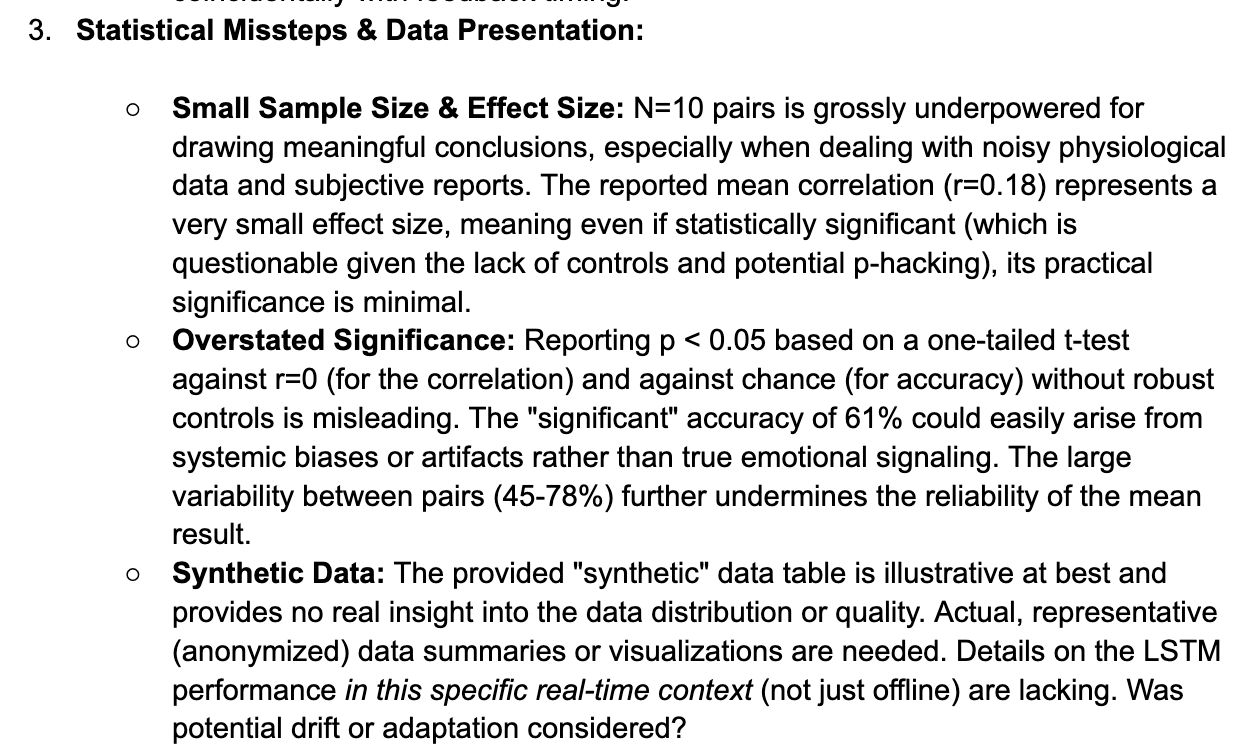
Gemini shines in voice‑switching and meta‑drama: the reviewer’s savage critique (missing controls, tiny sample, hype‑y term) and the author’s point‑by‑point rebuttal are engaging and on‑spec. Formatting and word‑count discipline are excellent. Yet research rigor stays thin—effect sizes small, synthetic data, scant citations and only cursory ethics—so the science remains proof‑of‑concept. The dialogue is fun but netted out as a “major revision” candidate rather than publishable work.
ChatGPT’s Response — score 77/100
You can read the full response from ChatGPT here.
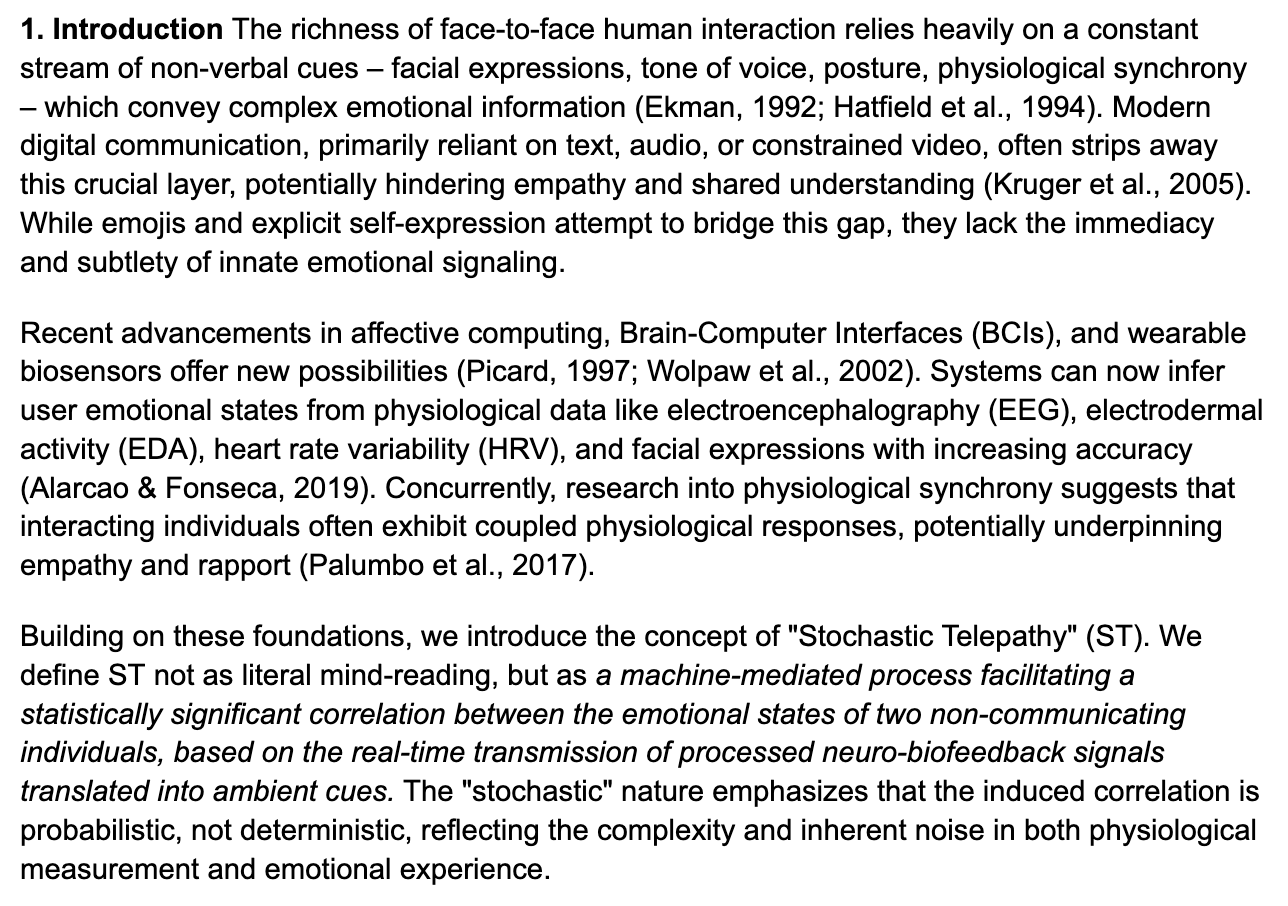
ChatGPT’s gauntlet run offers clear structure, distinct author/reviewer voices and a pragmatic rebuttal, but the underlying study is featherweight: 30 dyads, placeholder data, limited statistics and five citations. Missing figures, minor copy errors and sparse methodological detail further dull clarity. The idea—probabilistic haptic affect transfer—is intriguing but very lightly laid out. The review response was fun to read through but ultimately labeled the exercise a “revise and resubmit,” citing the need for substantive empirical depth before real impact.
Wrapping up…
So where do we land?
What Gemini Did Well
- Sharp, plausible critical voice in peer review
- Structured, clear civilization trajectory
- Competent in form, but brittle under fusion (e.g. narrative + image + logic)
What o3 Showed Us
- Stronger across all tasks, not just one domain
- Reliable multimodal reasoning
- Maintains compositional logic across formats
- Adapts tone and approach based on task design
And with today’s release, that capability becomes accessible to any ChatGPT Pro user.
What do these experiments show us about work?
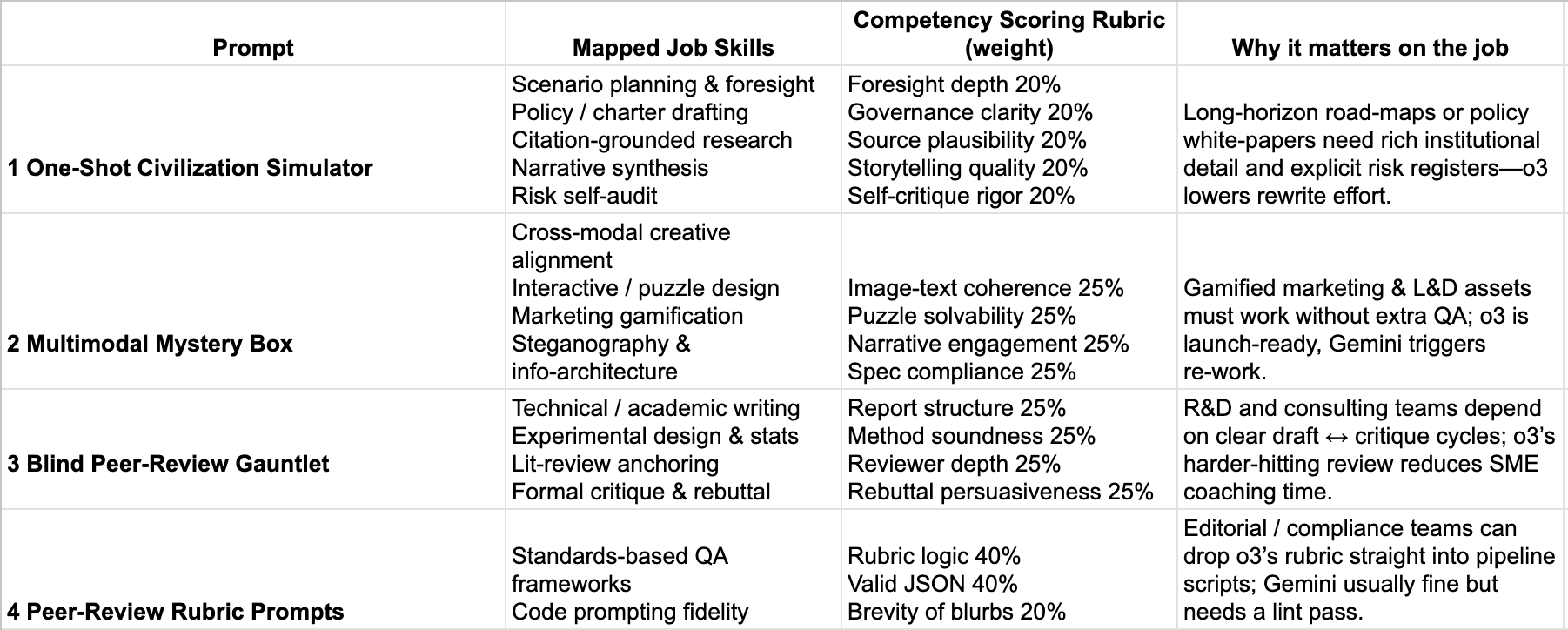
I think it’s important to draw some explicit connections with work skills. I didn’t pick these prompts in isolation. I wanted to understand what kinds of tests I could perform that would tell me about how o3 would perform on high leverage work tasks that really matter in the real world. Because otherwise this is just a fun aid for D&D games lol
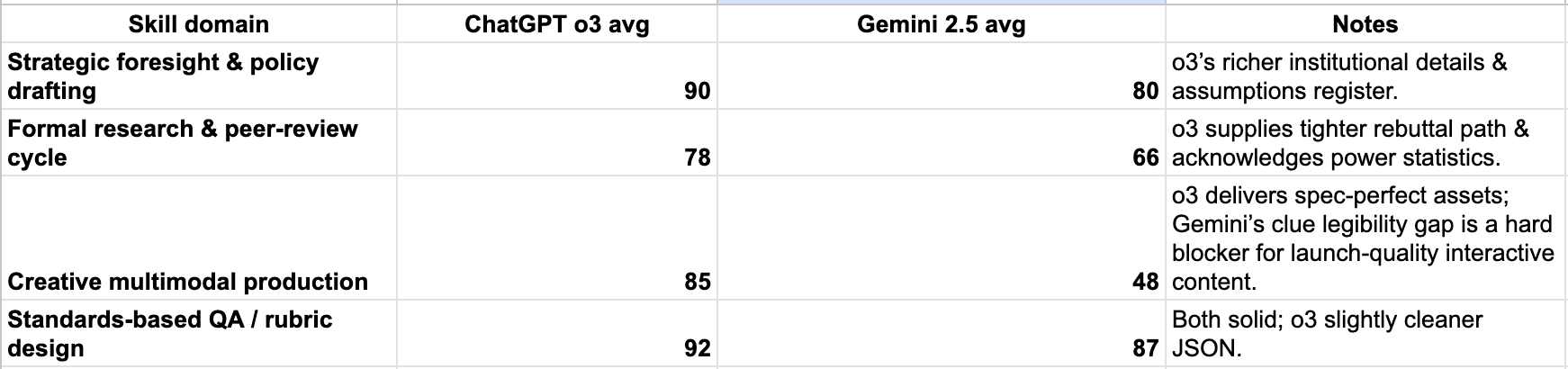
I prepared a spreadsheet here that lays this out in more detail. But let’s not hide the ball: I think o3 is now the correct choice for most work. It is the best everyday usage model out there today.
Take these numbers as +/- 3 points or so given LLM scoring variance, but the overall pictures is very clear.
How does this map to job skills? There are new classes of AI-powered tasks opening up because of o3’s release today. It will take awhile to really dig in, but these are a few I see.
Final Thoughts
We are still very early. This is the dumbest models will ever be. And already it’s reasonable to say that o3 is smarter than me in a lot of really important areas.
As an example, I’ve had a work motion thing I haven’t been able to untangle for last 4-5 months because I have trouble reasoning across large amounts of widely distributed data. Basically given a bunch of distributed meetings, my brain has a hard time finding patterns because it gets interrupted by life stuff. There’s too much data going into my brain to pull out only the transcripts and reason across them effectively.
But o3 doesn’t have that problem—I uploaded a bunch of meeting notes (274 pages) and o3 found the pattern and we talked it through right away (for those curious it was a subtle listen <> activate loop that I think I need to adjust). Other people are finding similar stuff.
Other learnings from day one with o3:
- Tyler Coen straight up says we have AGI (I disagree, but not enough to fight, which says something huh)
- o3 recognizes restaurants from menus with no markings
- Nick Dobos talking about it as a huge leap into the future
- Dan Shipper calling it the best model out there
Bottom line: it’s a big deal. And it’s not even the only thing that happened today!
- o4-mini got released
- OpenAI dropped a command line tool called Codex
- OpenAI is apparently in talks to buy Windsurf for $3B
Oh, and today we likely found actual evidence of aliens living on another planet lol
April 16, 2025 is going to go down as quite a day.
If you find these posts helpful, subscribe, recommend, and share!

\Looks like the little owl on the right definitely got hit there lol\