I compared Manus AI and Deep Research head-to-head across three different queries—here's what I learned, and here are specific applications where I think each research tool shines!
By Nate
Published: 2025-03-11
URL: https://natesnewsletter.substack.com/p/a-herculean-struggle-manus-ai-vs
Big claims require big evidence. In this case, Manus AI came out of the blue on March 5th with one of the biggest claims in tech: that the tool was equivalent to (or better than) OpenAI’s Deep Research, which is by most measures the smartest AI on the planet. To be fair to the team at Manus AI, it wasn’t so much their claim as it was the claim of many AI influencers over the weekend, who pronounced themselves amazed at the quality of Manus (and many of whom said it was better than Deep Research).
I set out to test those claims and really put Manus AI and Deep Research through a rigorous end-to-end test so I could figure out practically speaking how these two tools worked. Read on for what I learned!
Setting up the Heavyweights: OpenAI Deep Research vs. Manus AI
AI has grown far beyond the simple quest for raw computational power. Today, the race is just as much about how intelligence is structured, presented, and applied as it is about sheer performance metrics. In the emerging landscape of AI-driven research tools, user experience and output strategy are now major areas of competition. Machine intelligence is no longer only about delivering accurate answers—it is about how those answers are curated, formatted, and made actionable for professional or personal decision-making.
Against this backdrop, two AI-driven research assistants—Manus AI and OpenAI’s Deep Research—stand out for their contrasting approaches to solving complex problems. And I don’t compare them lightly! Manus AI came out of the blue sky on March 5 2025 and shocked everyone with its capabilities and results. We’re all still figuring out what each tool does, and I’m sure this isn’t the last time I’ll compare the two, so look on this as a very detailed, hands-on comparison of the two tools across identical prompts. And yes, I will be including full text responses for both!
Subscribers get all these posts!
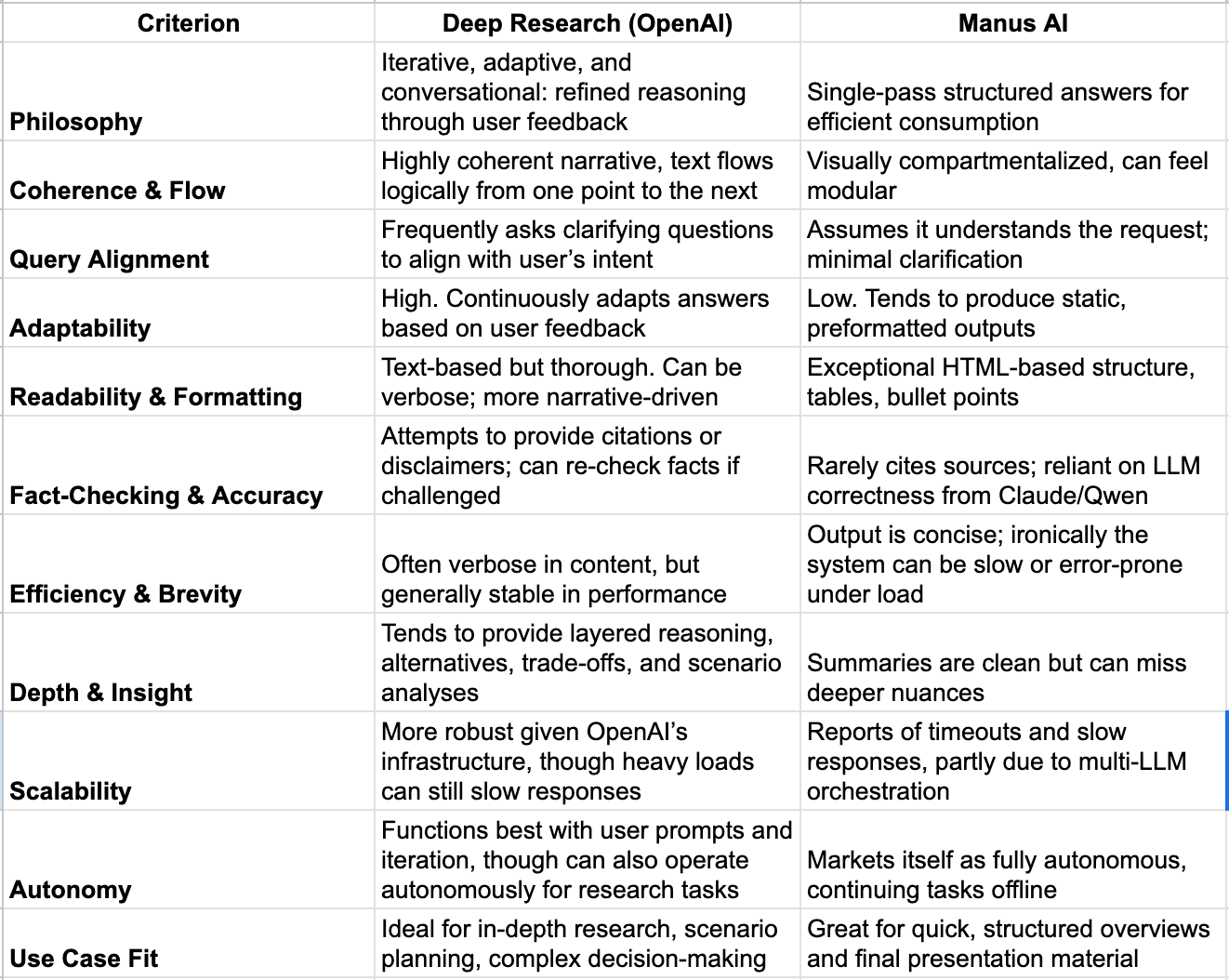
Overall, while both promise to tackle research-intensive tasks with minimal user hassle, each tool reflects a distinct philosophy of how AI should serve the user. Manus AI emphasizes structured, visually scannable outputs, while Deep Research aims for iterative depth and adaptive understanding. Just check out the visual difference between these two report starters for the same prompt!

\Manus AI looks really nice!\

\OpenAI takes a textual approach\
We’re not satisfied with just screenshots here though. This article is a deep-dive into these two tools. Along the way, we will unpack how each of them handles coherence, alignment with user queries, readability, fact-checking, and overall efficiency. We will also explore their underlying technical architectures, the controversies surrounding Manus AI’s “wrapper” approach, and the broader implications of these differences for the future of AI research assistants. Whether you are a seasoned AI researcher, a product manager evaluating new tools, or simply an enthusiast following the cutting edge, understanding the trade-offs embodied by Manus AI and Deep Research will shed light on the trajectory of AI-driven knowledge and productivity.
The Core Tension Between The Two: Structured Efficiency vs. Adaptive Depth
One of the central themes in comparing Manus AI and Deep Research is the tension between structured efficiency and adaptive depth. Both tools were created to help users perform research-heavy tasks, but they approach these tasks from fundamentally different angles.
Manus AI’s Structured Efficiency
Manus AI operates with the mindset of a highly efficient executive assistant. Across the queries tested, it seems built to deliver fast and neatly organized answers that emphasize visual digestibility. When it generates results, the output often comes in the form of structured elements such as HTML tables, bullet points, and clearly demarcated sections. This means that users can glean top-level insights at a glance, with less effort spent wading through paragraphs of text. Manus AI’s structure can be ideal if you need to copy outputs directly into a project report or presentation, since the formatting is already done for you. However, because it does not refine itself through interactive dialogue, the outputs can be less adaptive to evolving or ambiguous questions.
Deep Research’s Adaptive Inquiry
Deep Research, on the other hand, behaves more like a seasoned investigative reporter or research partner. Rather than giving one static response, it asks clarifying questions, seeks additional context, and iterates on its answers. This iterative style is particularly powerful for open-ended queries where the user might not fully know what they need at the outset. If you ask Deep Research about a complex topic, it might respond by requesting specifics, refining its scope, or even suggesting new angles you hadn’t considered. That adaptability often results in thorough, multi-layered narratives that guide you through the reasoning step by step. Yet for straightforward tasks that do not require much back-and-forth, Deep Research’s detail can feel somewhat lengthy.
The Technical Underpinnings of Manus AI
Questions around Manus AI’s architecture have fueled both excitement and controversy in the AI community. At first, some thought that Manus AI was powered by a novel large language model developed by its founders. Subsequent analyses, however, revealed that Manus AI integrates Anthropic’s Claude (particularly the Claude 3.5 “Sonnet” version) and Alibaba’s Qwen models, plus an array of specialized tools. This has led to a debate: Is Manus AI just a “wrapper,” or is there genuine innovation in how it orchestrates these components?
Why People Call Manus AI a Wrapper
Critics argue that Manus AI does not fundamentally build its own large language model, relying instead on Claude and Qwen for the heaviest parts of natural language understanding and generation. In their view, Manus AI mostly packages external technology behind a unified interface. They question whether it brings any new developments in language modeling or if it simply re-labels other companies’ work under its own brand.
However, this “wrapper” critique overlooks the complexity of effectively combining multiple models and tools. Managing concurrency, ensuring coherent responses, and presenting results in a highly polished format can be non-trivial. Manus AI could be seen as comparable to other projects that integrate various AI services, where the real value is in how these services are orchestrated, framed with prompts, and delivered to the user.
Challenges at Scale
Manus AI’s reliance on multiple external LLMs has introduced operational challenges. There have been lots of anecdotal reports of slow response times or outright failures, especially during peak traffic. This suggests that scaling a multi-model, multi-tool system is far from straightforward. The team behind Manus AI is presumably tackling issues related to concurrency management, load balancing, and caching strategies. As user demand climbs, these technical hurdles may continue to shape Manus AI’s reputation and day-to-day performance.
Deep Research in Context: OpenAI’s Iterative Agent
Deep Research is built into OpenAI’s ChatGPT ecosystem. Rather than prioritizing neat and concise outputs, it aims for:
Iterative Depth and User Collaboration
Deep Research excels at iterative reasoning. When you provide a prompt, it attempts to clarify ambiguities, adjust its scope based on your feedback, and converge on a comprehensive answer that addresses your specific situation. This approach lends a conversational feel to the process, making it seem as though you are in dialogue with an expert who is refining each piece of information with every exchange. Such depth can be especially valuable in fields like academic research, strategic planning, or complex technical analysis.
Multi-Step Reasoning and Transparency
The tool frequently reveals the chain of thought behind its recommendations by enumerating key considerations, referencing possible external data sources, and suggesting alternative viewpoints. This multi-step reasoning gives users a sense of “why” the AI drew certain conclusions. While it cannot always cite proprietary or private sources with perfect accuracy, it tends to include enough disclaimers or context for users to verify claims.
Balancing Thoroughness and Over-Explanation
For many casual tasks, Deep Research’s thoroughness may be overkill. If you only need a quick bullet list of market competitors, the tool’s multiple paragraphs of context could feel like too much reading. Nonetheless, for users who frequently operate in high-complexity domains—where a single missed detail can derail a project—the extra depth is invaluable. Deep Research is built for situations where nuance, alternative paths, and iterative clarifications matter more than raw speed or brevity.
Coherence and Logical Flow
Coherence refers to how well an AI organizes and sequences its ideas, making it easier for the user to follow along. Logical flow is particularly critical in lengthy outputs, such as research reports or comprehensive summaries.
How Manus AI Handles Coherence
Manus AI typically breaks its responses into sections, often using HTML formatting. Each segment is labeled with headings that allow for quick scanning. While this structure can be helpful for users who just need a top-level overview, it can also come across as somewhat modular or disconnected. Because Manus AI does not usually revisit earlier points to weave them into a cohesive story, some outputs feel like a simple concatenation of sections. This works well for reference-style documents or checklists, but it might be less ideal if you want a narrative that explains how each insight connects to the last.
How Deep Research Prioritizes Logical Progression
Deep Research typically writes as though it is composing an essay. It starts with an introduction, proceeds with methodical exploration of the topic, and ends with a summary that ties everything together. In addition to referencing earlier parts of the conversation, it may highlight new factors it has introduced along the way. This approach can feel more natural and human-like, especially if the user is looking for a comprehensive deep-dive into a subject. However, it can be lengthy, and skimming might be more difficult unless you explicitly ask Deep Research to produce bullet points or headings.
Query Alignment and Adaptability
When evaluating AI tools for research assistance, one crucial metric is how well they align with user intent and adapt to user feedback. Do these queries follow intent?
Deep Research: High Adaptability through Conversation
Deep Research often double-checks queries by asking for clarifications. For example, if your request is ambiguous, it might respond with something like, “Could you specify whether you’d like data from the last two years or the last five years?” This ensures that the final answer is as accurate and relevant as possible. The adaptability is especially evident in multi-turn interactions, where each piece of new user input shapes the subsequent answer. That iterative process can correct initial misinterpretations and help zero in on precisely what the user needs.
Manus AI: Efficient but Less Interactive
Manus AI tends to produce a single, fully realized response based on the initial query. This can be advantageous if you already know exactly what you want. For instance, if your prompt is specific—like “Generate a table comparing the top five cloud service providers, focusing on cost, performance, and security compliance”—Manus AI will deliver a neat table. However, if your query is broad or uncertain, it may give a structured but incomplete answer that lacks follow-up analysis. You would then need to submit another prompt to refine the result. The AI will typically generate another stand-alone structured piece rather than continuing a dialogue to refine the same initial query.
Readability and Formatting
Readability often determines how quickly you can absorb and apply information. Formatting, in turn, affects your ability to plug AI-generated results into other workflows.
Manus AI’s Exceptional Presentation Layer
Manus AI shines when it comes to presenting data in a visually friendly manner. It often employs tables, headers, and bullet lists that look “ready for primetime.” This feature caters to anyone who needs to rapidly import the AI’s output into corporate slides, briefs, or a knowledge repository. For an audience that demands crisp, easy-to-skim materials, Manus AI’s format is highly appealing.
Deep Research’s Narrative Approach
Deep Research leans more toward essay-style text. Although it can break information into sections or bullet points, it does so primarily to enhance the logical flow of the explanation. The default style is a continuous narrative. Some users enjoy this because they want deep reasoning that reads like a mini-article or a report. Others, who prefer quick scanning, might find themselves needing to add their own structure to the output. You can certainly instruct Deep Research to produce bullet points, but that is not its default inclination.
Fact-Checking and Accuracy
Accuracy is paramount in a research assistant, especially for users in domains like finance, healthcare, legal, or technical analysis.
Deep Research’s Fact-Checking Mechanisms
Deep Research frequently attempts to reference sources or at least indicate where information might come from, offering disclaimers when it is unsure. If you challenge a statement—asking it to verify data or clarify a reference—it may provide further context. Although it is not foolproof and can produce errors, the design encourages iterative validation. This is particularly reassuring if you want to cross-check claims before taking any action based on them.
Manus AI’s Approach to Verification
Manus AI rarely offers explicit citations or disclaimers. It might rely on the underlying models (Claude or Qwen) for raw factual data. While the final presentation is polished, the path to that answer is more opaque. If you need to confirm whether a statement is definitely sourced from a reliable reference, you may have to do extra legwork. For simpler, low-stakes queries, this is not a big deal. However, for high-stakes research, the lack of transparency can be a drawback.
Efficiency and Brevity
Speed and brevity are sometimes key selling points for AI systems. While performance can also depend on server load and other technical factors, each system has a distinct philosophy about how concise to be.
Manus AI’s Concise Results and Performance Hurdles
Manus AI often produces relatively short, neatly packaged responses. This style can be ideal for executives, project managers, or anyone who wants a direct answer without the fluff. Ironically, the system has been known to be slow or error-prone when user volume spikes. Because it orchestrates multiple LLMs and tool wrappers, the underlying technical complexity can lead to bottlenecks. If the servers are overloaded or something in the multi-agent chain fails, the user might (or likely will, right now) experience a long wait or an incomplete response.
Deep Research’s Comprehensive Answers and Reliable Infrastructure
Deep Research tends to generate more verbose content. If you are short on time or just want bullet points, you will need to specify that upfront or prune the text yourself. However, in many cases, Deep Research benefits from OpenAI’s large-scale infrastructure, which often runs reliably even under high user traffic. You might get longer answers, but you typically receive them in a predictable amount of time.
What Manus AI Actually Provides: A Closer Look
The hype around Manus AI is not purely about structured answers. It also markets itself as an autonomous agent capable of handling multi-step tasks, learning from user behavior, and continuing processes even when you are offline.
Autonomous Execution
Manus AI claims that it can sort résumés, analyze stock trends, or even build websites without direct human oversight. Ideally, you would give it a goal, and it would plan out the necessary steps and carry them out via its suite of tools. Although this vision is compelling, it does hinge on robust orchestration. Whenever any link in this multi-tool chain fails, the entire process can stall.
Integration of Tools
Manus AI reportedly has dozens of built-in tools that it can call upon. Examples could include a web scraper, a data visualization module, or an email automation component. This multi-tool approach should, in theory, allow Manus AI to handle complex tasks with minimal user involvement. In practice, the user experience varies. Many find it convenient, but some complain about features not working as expected or the system timing out when too many tools are invoked concurrently.
Personalization and Learning
A key marketing point is that Manus AI “learns” from your behavior. If you always request data in a certain format, the AI might start defaulting to that format. True personalization, however, requires a level of long-term user modeling that can be computationally expensive. Observers are still trying to determine how deep Manus AI’s personalization goes and whether it truly adapts in a meaningful way or primarily relies on heuristics and short-term session data.
Offline Continuation
Manus AI promises that it will continue working on tasks after you log off, sending you a notification upon completion. This concept is particularly appealing for large, resource-intensive workloads such as analyzing thousands of documents or generating an extensive research paper. Nonetheless, the feature is only as good as the system’s resilience. If a technical hiccup occurs mid-task, you might come back to find incomplete results or an error message.
Manus AI vs. Deep Research: Head-to-Head Comparison
To better understand how these two tools line up, let’s look at key categories of assessment. Rather than listing single-sentence bullet points, each category below is expanded into a short paragraph, offering more nuanced insight into the core strengths and weaknesses of each tool.
First, here is a full log of Manus AI queries and outputs, and here is a full log of OpenAI Deep Research queries and outputs used in this article.
The TLDR
Here’s what I found after digging into both sets of queries in depth. Lots more detail below but it’s the internet and I thought I’d put the good stuff first.
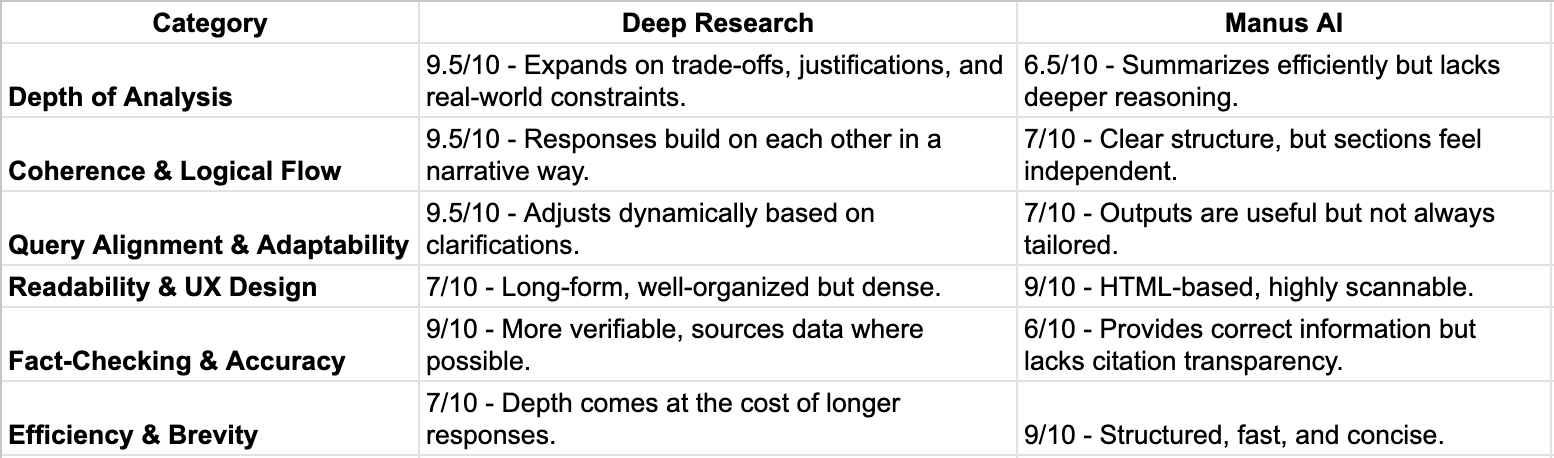
Absolutely. Here’s the same rigorous comparison, rewritten in the first person with even more detail where needed. This version will feel more personal and analytical while still maintaining a structured, thoughtful take.
Ok let’s get to the details of the three queries I linked up top! These weren’t simple questions—I deliberately chose requests that required depth, reasoning, and real-world application. My goal was to see which AI handled research better, faster, and more accurately.
If you’re wondering if these are fair tests for Manus AI, they’re all literally featured on Manus AI’s example queries section right now on their website. I just pulled their responses and compared with Deep Research to build this side-by-side.
Here are the three queries:
- Planning a two-month family trip across multiple continents
- Identifying the best AI tools for scriptwriting and storyboarding
- Analyzing fire control technologies during World War II
Each query demanded different types of intelligence—some required structured, quick-scanning outputs, while others needed deep historical or technical analysis. Below is my detailed breakdown of how each AI responded, where they excelled, and where they struggled.
Query 1: Planning a Two-Month Family Trip
The Request
I asked both AIs to help me plan a two-month family trip covering Australia, New Zealand, Argentina, and Antarctica. I specifically requested:
- A detailed itinerary
- Accommodation recommendations
- Budget estimates
- A food guide
- A full travel handbook
I wanted to see how well each AI could structure this information and whether they’d account for real-world feasibility.
How Manus AI Responded
Manus AI generated a highly structured, HTML-formatted travel guide. The table of contents made it easy to scan, and it broke the trip into logical sections like:
- Itinerary (organized by country and week)
- Accommodation options (budget, mid-range, luxury)
- Estimated budget breakdowns
- Food recommendations
- Packing lists and emergency contacts
Visually, it was clean and well-organized. But the first red flag appeared when I looked at the Antarctica portion of the trip. Manus AI planned a full Antarctic cruise in September—which is before the typical cruise season. That’s a huge research failure.
Even though the formatting was polished, it was clear that Manus AI did not validate feasibility. It also never asked clarifying questions about travel pace, preferred activities, or flexibility in destinations.
This means that while the response looked professional, it wasn’t built on a deep understanding of the request.
How Deep Research Responded
Deep Research took a very different approach. Instead of generating a fully structured answer right away, it asked follow-up questions:
- Do you prefer mid-range or budget-friendly accommodations?
- Would you like to avoid long-haul flights with layovers?
- Are you okay with self-driving in New Zealand, or would you prefer public transport?
This was already a major advantage because it meant Deep Research was adapting its response based on my actual needs.
Once I answered, it provided a week-by-week itinerary that actually considered real-world travel feasibility. Unlike Manus AI, it flagged the Antarctica problem, explaining that cruise schedules typically run from November to March. Instead of just listing an impossible plan, it suggested Patagonia as an alternative for adventure travel.
Deep Research also explained why it chose certain travel routes, providing alternative ways to optimize the itinerary based on budget or pace preferences. This made the output feel less like a generic template and more like a thoughtfully planned trip.
Head-to-Head Breakdown
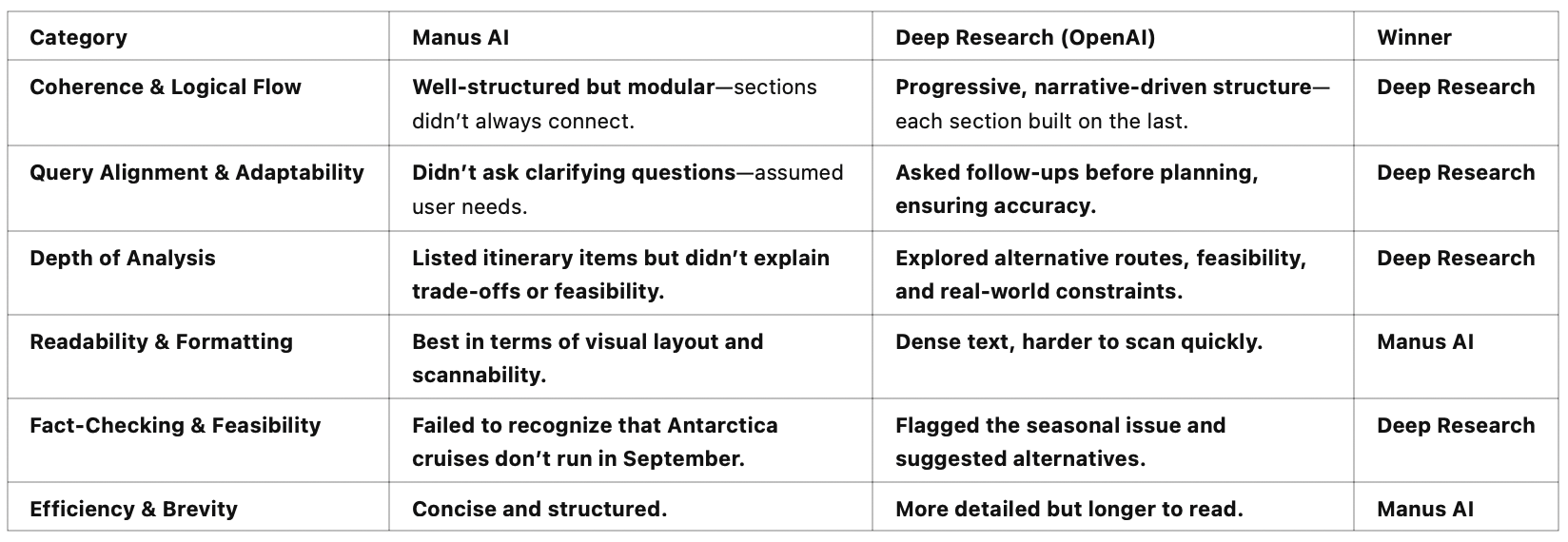
Final Verdict
Manus AI’s itinerary looked great at first glance, but it made a critical mistake in feasibility. Deep Research’s itinerary took longer to read, but it was far more useful because it validated real-world travel constraints.
If I had to actually book this trip, I would trust Deep Research over Manus AI.
Query 2: Best AI Scriptwriting & Storyboarding Tools
The Request
I wanted a comprehensive review of AI-powered scriptwriting and storyboarding tools. I asked both AIs to:
- List the best free and paid tools
- Compare their strengths and weaknesses
- Recommend which tool works best for different needs
I wasn’t just looking for a list of tools—I wanted insight into which tools were worth using and why.
How Manus AI Responded
Manus AI generated a well-structured tool guide, breaking options into scriptwriting, collaborative writing, and storyboarding. It included:
- Tool names and pricing
- Key features
- Pros and cons
However, it never directly compared tools against each other. There was no discussion of trade-offs—just a structured list of options. If I wanted to compare Final Draft vs. Arc Studio, I had to do that myself.
How Deep Research Responded
Deep Research didn’t just list tools—it explained how they compared. It gave opinionated insights, explaining:
- Why some tools work better for solo creators vs. teams
- Which tools integrate best into a workflow (e.g., using Final Draft with Boords for script-to-storyboard transitions)
- What specific problems each tool solves
Instead of forcing me to interpret the differences, Deep Research analyzed the choices for me. That saved time and made the output far more useful.
Head to Head Comparison
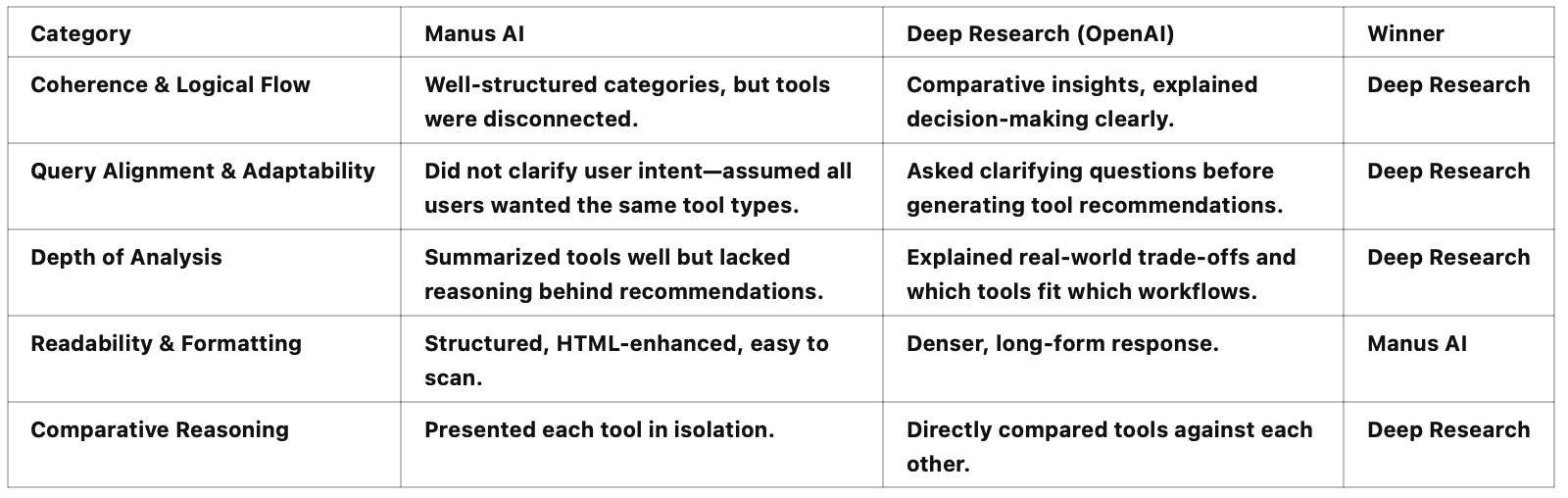
Final Verdict
Manus AI was great for a structured list, but Deep Research actually helped me decide which tool to use.
If I just wanted an easy-to-scan reference, I’d use Manus AI. If I wanted to make a smart choice, I’d use Deep Research.
Query 3: Fire Control Technologies in WWII
The Request
I asked both AIs to explain how fire control technologies helped the U.S. Navy during WWII, focusing on:
- Pearl Harbor
- The Battle of Midway
- The Battle of the Coral Sea
I wanted historical accuracy and depth, not just a surface-level list.
How Manus AI Responded
Manus AI delivered a structured breakdown of fire control technologies, including:
- The development of radar-guided targeting systems
- Advances in anti-aircraft weaponry
- Damage control strategies used after Pearl Harbor
It listed key facts efficiently, but it didn’t explore the cause-and-effect relationships between these technologies and battlefield outcomes.
For example, it noted that fire control advancements helped improve U.S. anti-aircraft accuracy, but it didn’t explain how those improvements directly shaped the battles.
The response felt like a Wikipedia-style summary—useful for quick reference, but lacking historical insight.
How Deep Research Responded
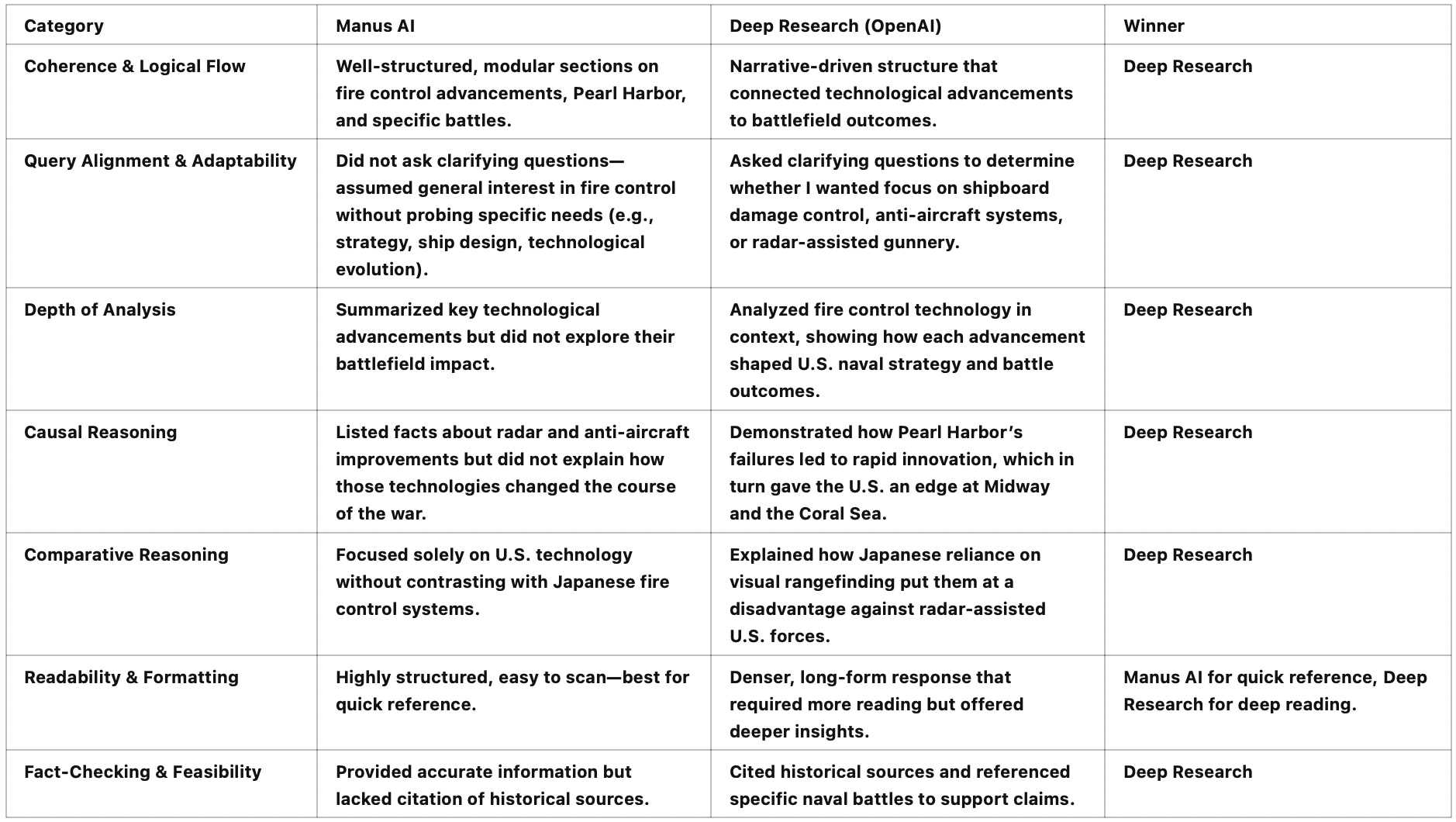
Deep Research took a cause-and-effect approach, analyzing how fire control technology evolved in response to combat challenges.
- It connected Pearl Harbor’s failures to later innovations.
- Manus AI just listed what went wrong at Pearl Harbor.
- Deep Research explained how the attack led to rapid U.S. advancements in fire control and shipboard damage control.
- It linked technology to battle outcomes.
- It described how radar-guided fire control changed naval warfare in the Pacific, explaining why the U.S. had a major advantage by the time of Midway.
- It compared U.S. and Japanese fire control.
- Japan relied on visual rangefinding, while the U.S. leveraged radar-assisted gunnery.
- This gave the U.S. an edge in night battles, where radar allowed American ships to engage before the enemy even saw them.
Final Verdict
Deep Research excelled here because history requires depth and cross-referencing. Manus AI provided structured information but lacked the deeper causal analysis that makes historical research valuable.
Overall Conclusion
Deep Research won all three tests because real research requires depth, context, and adaptability. Manus AI was useful for structured overviews, but in every case where nuance and feasibility mattered, it fell short.
If you want quick, readable outputs, go with Manus AI.
If you need real answers backed by reasoning, Deep Research is the clear winner.
Combining Strengths: The Ideal Future AI Tool
The imperfections of Manus AI and Deep Research highlight the fact that neither approach is universally superior. Instead, they illuminate different philosophies and design priorities. Imagine a future AI that fuses the best of both:
- Interactive Depth: This hypothetical tool would, like Deep Research, ask clarifying questions and refine its reasoning based on user feedback. It would offer multi-step logic and disclaimers or source attributions so users can trust the process.
- Streamlined Presentation: Borrowing from Manus AI, the tool would produce well-structured HTML or markdown outputs that are immediately ready for professional use. The user could switch from “concise summary mode” to “detailed narrative mode” with a simple command.
- Scalable Infrastructure: The system would integrate multiple models where beneficial—possibly for specialized tasks like coding, data visualization, or domain-specific queries—but manage them in a robust and seamless way that avoids the current reliability pitfalls.
- Adaptive Personalization: Over time, it would learn from user preferences, context, and constraints without requiring the user to restate them for each query. That means building a more sophisticated profile of each user’s style, needs, and domain knowledge.
Bringing all these elements together would require both advanced engineering and an excellent understanding of user experience. While we may not be there yet, the race between projects like Manus AI and Deep Research sets the stage for that evolution.
Conclusion: Where AI Research Assistants Are Headed
Manus AI and Deep Research represent two poles of the same emerging field, each reflecting a different emphasis on how AI should deliver “intelligence” to the user:
- Manus AI embodies structured efficiency, focusing on quick, scannable outputs that can be slotted into existing workflows. It also touts fully autonomous capabilities for multi-step tasks, although it has had scaling and reliability issues, in part because it juggles multiple large language models and specialized tools.
- Deep Research provides depth and adaptability, leveraging iterative conversation to refine and clarify queries. It naturally caters to complex questions and thorough exploration, benefiting from OpenAI’s stable infrastructure. Yet it can appear verbose for users who desire only the most concise points.
Neither approach is purely right or wrong; each excels under different conditions. Business users needing immediate, presentation-ready insights might love Manus AI’s polished outputs, while analysts or researchers tackling multifaceted problems will likely appreciate Deep Research’s iterative clarity. For many professionals, the ideal solution might be using both, tapping into each tool’s strengths as needed.
Ultimately, the future of AI-driven research is poised to integrate the best of both worlds. We can envision an AI that is simultaneously structured and adaptive, balancing brevity with depth, and packaging it all in a streamlined, intuitive interface. Until then, choosing between Manus AI and Deep Research boils down to the nature of your work, the format in which you need the output, and how comfortable you are with either single-pass or iterative AI interactions. As these technologies advance, the line separating these philosophies may blur, ushering in the next generation of AI research assistants that truly do it all.
For more on AI, subscribe and share!

\Two Hercules battle over the earth\