Thanks to TikTok for the topic! I break down OpenAI Deep Research, DeepSeek R1 with Internet Search, and Google Deep Research. Folks, we have a clear winner besides the word DEEP.
By Nate
Published: 2025-02-04
URL: https://natesnewsletter.substack.com/p/a-deep-dive-into-openai-deep-research
TikTok picked this topic. I asked folks in the comments to like the question they most wanted me to ask, and overwhelmingly the favorite was a research question around AI automation impact on various industries by 2030. I guess we’re worried about our jobs these days, so we’re asking the AI to think about it (the irony).
Well it did a pretty good job! And just for good measure I looked at DeepSeek and Google Deep Research too, and I built a comparison framework between them so you could check out the strengths and weaknesses of each. Check it out and enjoy!
First, the Prompt
I admit, I slightly modified and expanded this from TikTok to make it more interesting. Here’s my final prompt:
Based on current trends in artificial intelligence, which industries will see the highest growth in AI-driven automation by 2030. In your response, please discuss government policy options to prepare for this automation, please discuss options for individuals in affected industries to prepare for AI-driven automation, and please include recommendations for employers to upskill teams to better leverage AI for productivity.
Subscribers get all these posts!
What did the models say?
Below is a comparative review and grading of the three reports. Each write-up addresses the same prompt—AI and automation trends—but they differ notably in length, level of detail, structure, and the breadth of research/data they include. I’ve evaluated them along several dimensions:
1) o3 with Deep Research
Yes, this is really o3! Not o3 mini, not o3 micro, not o3 high. The real OG o3. I have trouble showing in a screenshot how extensive this report actually is, and yes I’m linking it here.
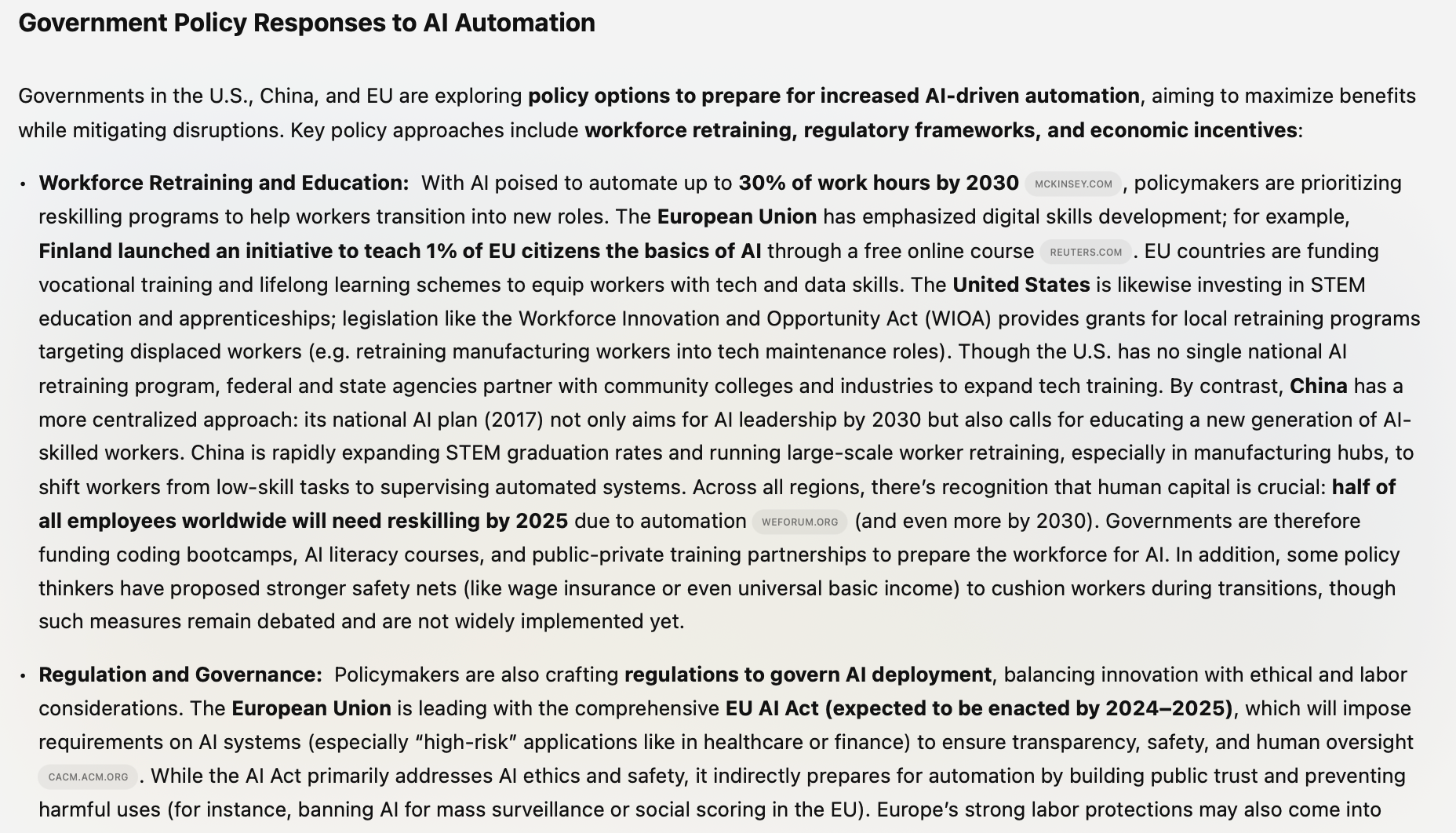
Approximate Word Count: ~5,000+ words (significantly longer and more in-depth than the others)
Key Strengths
• Depth & Thoroughness: This report is exceptionally detailed. It breaks down AI-driven automation trends by sector (tech, manufacturing, finance, healthcare, leisure/travel) and by geography (U.S., China, EU). Includes extensive data points, statistics, and projections from multiple credible sources (McKinsey, PwC, IFR, etc.).
• Well-Structured & Readable: Clear headings, subheadings, bullet points, and bold highlights. It flows logically from an introduction, to industry deep-dives, to policy options, to guidance for individuals and employers, and finally a conclusion.
• Global Perspective & Specifics: Combines global macro figures (e.g., potential AI contribution of $15.7 trillion to GDP) with granular examples (e.g., how many industrial robots China installed in 2022). Discusses each major region’s approach to AI (regulatory stances, adoption levels, etc.).
• Actionable Guidance: Offers concrete suggestions for both policymakers (e.g., EU AI Act, U.S. workforce retraining grants, China’s centralized approach) and for individuals/employers (upskilling, lifelong learning programs, role restructuring).
• Utility & Relevance: Extremely useful as a standalone reference. Someone looking for an in-depth overview of AI adoption and readiness strategies could rely on this alone.
Potential Drawbacks
• Length / Density: The irony! Because it is so comprehensive, it may feel too lengthy or technical for readers seeking a short, high-level brief.
• Complex Reading Level: Again, this is like calling your attention to detail a weakness in the job interview. The level of detail is quite high, so some readers might skim for key takeaways.
Overall Assessment
• Complexity: High
• Quality & Utility: Very high (provides both breadth and depth)
• Structure & Clarity: Excellent, logically organized, easy to navigate
• Score: A+ (or 9.5/10). A standout, scholarly-style report with significant practical value.
2) “DeepSeek R1 Deep Thinking”
It did not think very deeply guys. Here’s the full answer, and yes I’ll include the chain of thought there because it’s fun. The full response is here.
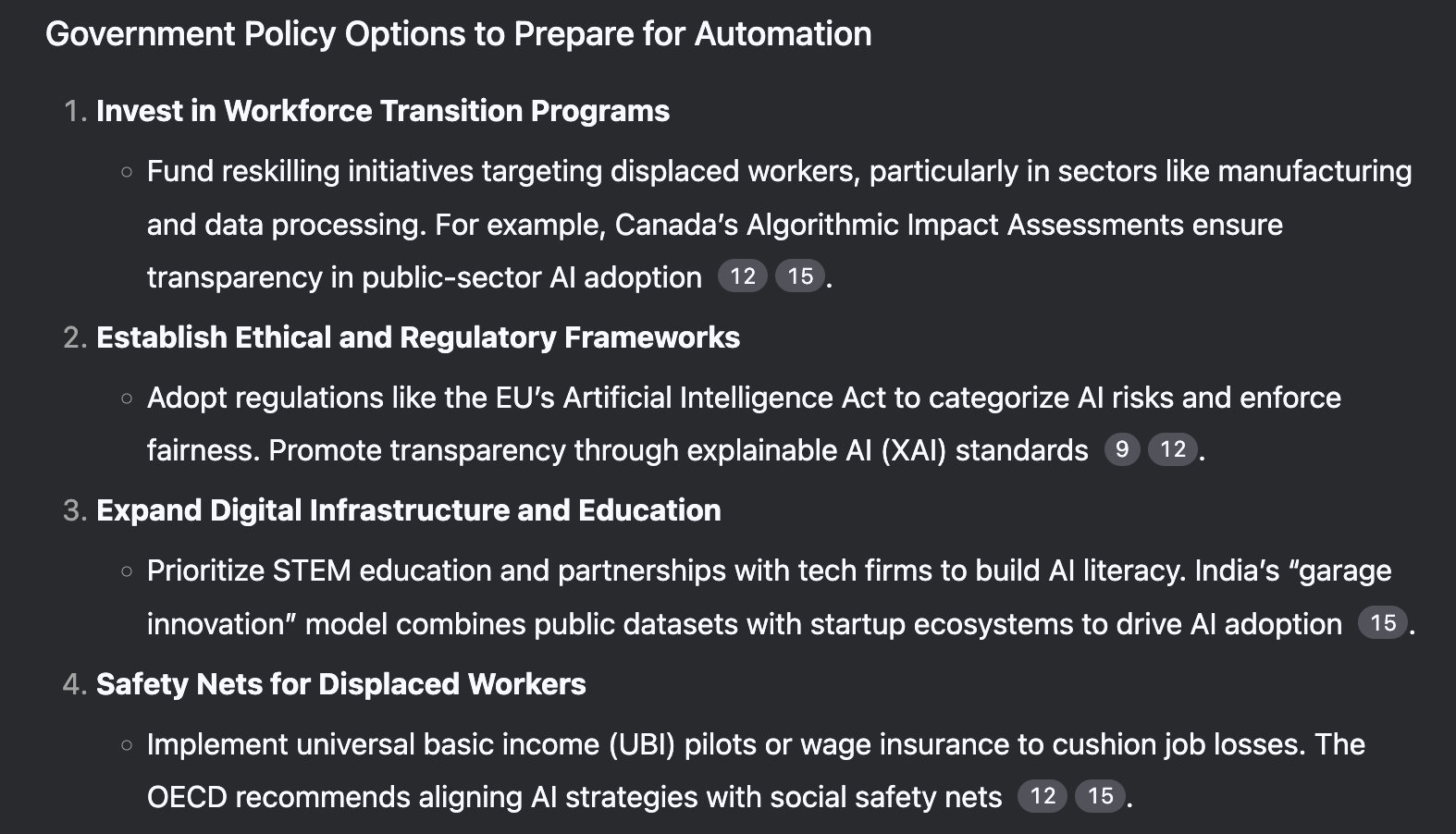
Approximate Word Count: ~700 words (like close to 10x shorter than o3)
Key Strengths
• Conciseness: Delivers a compact overview of industries to be impacted by AI—healthcare, manufacturing, retail, finance, transportation, and the public sector.
• Quick Policy Pointers: Mentions government policy directions (e.g., ethical and regulatory frameworks, social safety nets) and short recommendations for displaced workers (reskilling, upskilling).
• Basic Employer/Employee Guidance: Suggests adopting “human-AI collaboration” models, continuous learning, and ethical AI deployment.
Potential Drawbacks
• Limited Depth and Data: Again, it all is in what you want! While R1 highlights broad trends, it lacks the richer data points, sources, or examples present in more extensive reports. References to specific stats are brief or missing, making it less authoritative for readers who want detailed evidence.
• Structure & Flow: It is organized as a bulleted list of highlights rather than a fully fleshed-out analysis. A lot of sections could use more elaboration.
Overall Assessment
• Complexity: Medium (some nuance on policy but less granularity)
• Quality & Utility: Fair to Good—helpful as a quick read, but not as robust
• Structure & Clarity: Acceptable, but lacks deep supporting details
• Score: B (or ~7.5/10). Good primer if the reader wants a short summary, but it doesn’t offer extensive research or stats.
3) Deep Research by Google
This one is in the middle, which should make it a Goldilocks response but I just found it annoying. It was too long to be a quick read, and if I’m investing that extra time I want the detail of o3. Here’s the full response.
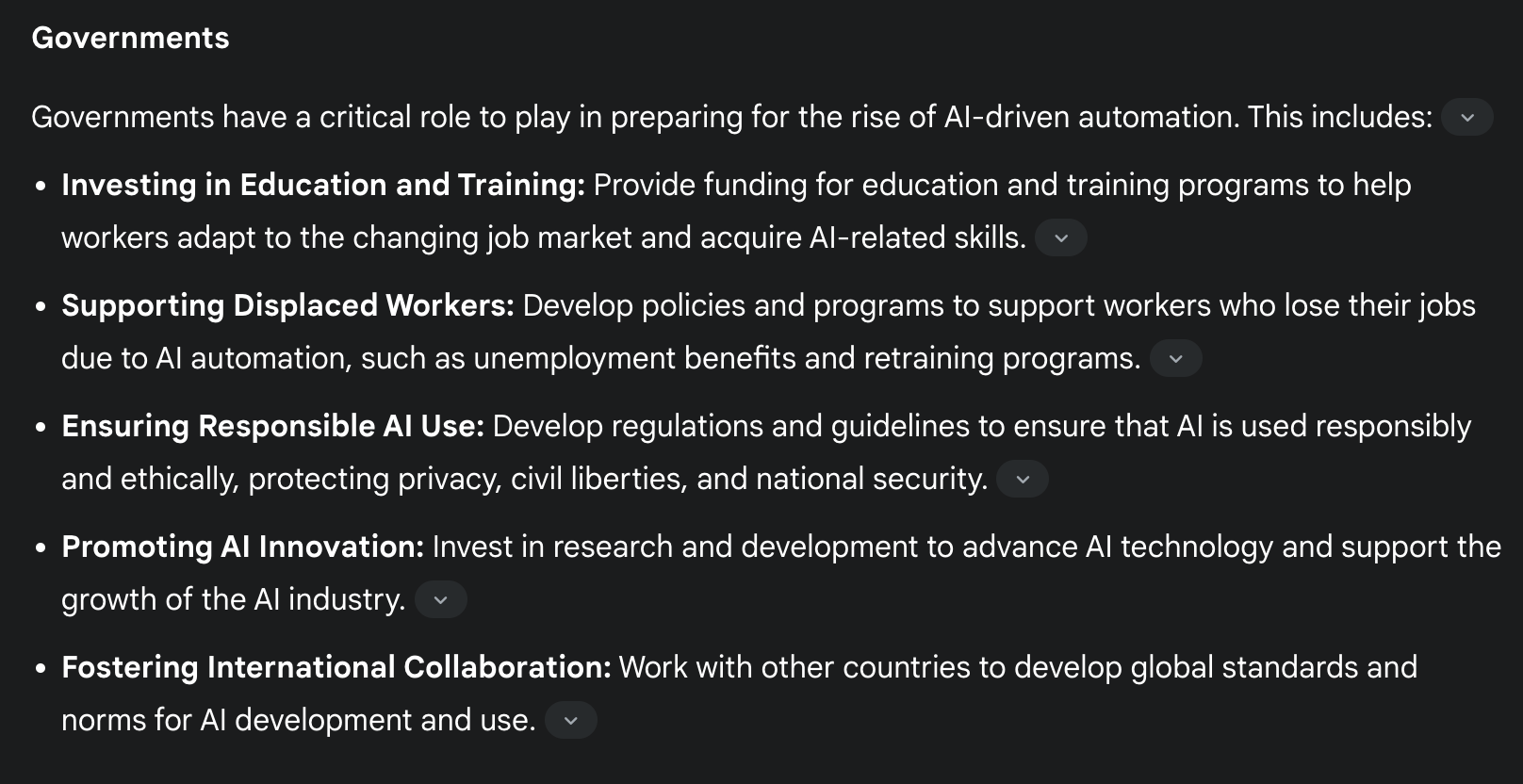
Approximate Word Count: ~1,800–2,000 words
Key Strengths
• Balanced Overview: Outlines key AI technologies (machine learning, NLP, computer vision) and their impact across various industries (healthcare, finance, manufacturing, transportation, education, agriculture, energy, real estate).
• Mention of Government Role: References how U.S. federal agencies (NIST, DHS, DoS) and executive orders address AI regulation and R&D. Provides policy guidance for governments around education, ethics, and regulations.
• Covers Worker & Business Implications: Offers practical advice for workers (skills like data analysis, machine learning fundamentals, adaptability) and business strategies (responsible AI, investing in training).
• Readable, Decent Structure: Has an introduction, then sections on AI adoption rates, tech fundamentals, high-growth industries, government policy, and concluding remarks.
Potential Drawbacks
• Less Granular than #1: While it’s more detailed than #2, it still doesn’t provide as many specific statistics or breakdowns by region and sector as the first report.
• References Not as Comprehensive: It cites some studies (BCG, Visual Capitalist) but fewer direct numeric/statistical sources than the first report. Most examples are mainstream or well-known (e.g., self-driving cars, chatbots).
Overall Assessment
• Complexity: Medium-High
• Quality & Utility: Good—a solid overview, bridging general explanations of AI’s core technologies with real-world examples.
• Structure & Clarity: Strong narrative, logically arranged.
• Score: A- (or ~8.5/10). A well-rounded report with a suitable balance of explanation, industry coverage, and policy/skill recommendations.
But how do they compare? Did the extra detail matter?
So TLDR the difference really emerges in the level of detail o3 gives, and I’ll lay that out here, showing where they agree and where they differ. Despite being framed around the same core prompt—AI and automation and their impact on industries, workers, and policy—they have notable nuances in emphasis, depth, and specific takeaways.
Points of Agreement (Shared Themes)
1. AI’s Transformational Impact on Key Industries
• All three predict major, ongoing disruption and opportunity from AI across sectors such as manufacturing, finance, and healthcare.
• They consistently cite machine learning and related technologies (e.g. predictive analytics, robotics, autonomous systems) as core drivers of automation.
2. Importance of Upskilling and Workforce Transition
• Each highlights that workers must adapt, either through continuous learning or by moving into roles requiring distinctly human skills (creative thinking, problem-solving, interpersonal communication).
• All endorse employer-based training and public policy interventions (like reskilling programs or social safety nets) to ease the transition for displaced workers.
3. Need for Government Policies and Ethical Frameworks
• Each report underlines the importance of governance, regulation, and standards that encourage responsible AI use.
• The notion of balancing innovation with protections for workers and consumer privacy runs through all three. They differ in specific details, but the consensus is that policy and oversight are needed as AI automates more tasks.
4. Global Scope
• All three note that the U.S., China, and Europe play outsized roles in AI adoption, albeit with different policy priorities or adoption speeds. Each recognizes that advanced economies are leading on automation, while others might lag or have different focus areas.
Points of Divergence (Where They Differ)
1. Level of Detail and Data - I will keep saying it because it matters!
• Report #1 (“o3 with Deep Research”): Far more extensive data, statistics, and sources (McKinsey, PwC, IFR, healthcare and finance adoption rates, etc.). It also goes deep into region-specific strategies (China’s “Made in China 2025,” U.S. workforce programs, EU AI Act).
• Report #2 (“R1 Deep Thinking”): Very concise—touches on industries and policy options in bullet-list style, but with minimal supporting statistics or extended analysis.
• Report #3 (“Deep Research by Google”): Mid-range detail—some references (BCG, NIST frameworks, etc.), more substantial than #2 but less granular than #1 in citing numeric projections.
2. Breadth of Industries Covered
• Report #1 highlights five main industries (technology, manufacturing, finance, healthcare, leisure/travel), and also references cross-cutting trends.
• Report #2 focuses on a short list—healthcare, manufacturing, retail, finance, transportation, public sector—without as much narrative detail.
• Report #3 includes a broader set—healthcare, finance, manufacturing, transportation, plus education, logistics, agriculture, energy, real estate—but doesn’t go as in-depth per industry as #1.
3. Focus on Specific Regional Policies
• Report #1 devotes significant attention to regional comparisons (U.S. vs. EU vs. China) in detail: how each is preparing in terms of regulation, workforce training, and incentives.
• Report #2 references broad government measures (ethical frameworks, reskilling, UBI pilots) but not as thoroughly segmented by region.
• Report #3 discusses U.S. federal agencies (NIST, DHS, White House executive orders) more concretely than it does the EU or China—though it still acknowledges global collaboration.
4. Depth of Employer/Workforce Guidance
• Report #1 devotes large sections to actionable strategies for employers (corporate training, AI centers of excellence, role redesign) and for individuals (AI literacy, pivoting to higher-value tasks).
• Report #2 summarizes “human-AI collaboration” but keeps it high-level (e.g. “adopt continuous learning,” “use micro-credentials”).
• Report #3 gives decent advice on skill sets (programming, data analysis, critical thinking) and a short list of action steps for businesses (responsible AI, measuring AI ROI), though it’s not as detailed as #1’s organizational restructuring framework.
5. Stylistic / Structural Choices
• Report #1 is more like a mini-white paper or an extended research article (with headings, sub-sections, detailed bullet points).
• Report #2 is a quick “bullet-point” style briefing or short summary.
• Report #3 reads like a middle-ground between the two—longer narrative than #2, but not as reference-heavy as #1.
Overall Takeaways
• The common ground among all three is that AI-driven automation is accelerating, certain core industries will see the largest transformations, there’s an urgent need for upskilling and policy intervention, and governments must craft frameworks balancing growth and ethics.
• The key distinctions lie primarily in how in-depth each response is, how region-specific they get, and how many data points they provide.
• In sum, they largely agree on the big picture—which industries will be most affected, that AI adoption is surging, and that proactive adaptation (both at a policy and workforce level) is critical—even though they provide different scales of evidence and emphasis.
Last but not least, any juicy o3 tidbits in the detail?
Yes! There’s some stuff only o3 and a full report will give you. A few examples here:
1) China’s Dominance in Factory Robotics Installations
• Insight: China installed over 290,000 industrial robots in 2022, which was 52.5% of all new robot installations globally that year.
• Why It’s Unique: Neither of the other two reports quantifies China’s share of newly deployed industrial robots so specifically.
• Why it matters: Robots are going to be one of the key question marks and trends in the next half decade. o3 catching it and calling it out without being explicitly asked to is a nice touch that shows completeness.
2) U.S. Hospital AI Adoption vs. “Real” Implementation Gap
• Insight: Although 90% of U.S. hospitals say they have an AI strategy, only about 6–7% have truly scaled AI across their operations.
• Why It’s Unique: Other reports mention healthcare’s AI potential but do not include stats distinguishing stated adoption from deeper, organization-wide implementation.
• Why it matters: Underscores the difference between AI “piloting” vs. full operational integration, which is one of THE biggest themes of the next 2-3 years. Again, o3 did this without being asked.
3) Region-Specific AI Economic Projections
• Insight: AI could contribute $15.7 trillion to the global economy by 2030, with China potentially seeing a 26% GDP boost, and North America around 14.5%, jointly capturing ~70% of AI’s global impact.
• Why It’s Unique: While other reports mention automation’s big-picture impact, Report #1 provides granular region-by-region breakdown and the comparative scale of potential gains.
• Why it matters: I like to say AI adds value in the specifics, and I think this is a good example. Knowing where we expect to see regional AI impact shapes investment and upskilling expectations. In fact, I may ask Deep Research to look at US regions as well!
Is o3 Deep Research worth it?
Yes. Like unquestionably yes. I don’t view it as replacement for labor per se (although Sam Altman said he thought it did a single digit percentage of the world’s work). Instead, I see the value as being primarily additive: I am asking this thing questions I never would have had time to get done, and I’m getting incredibly useful answers that are enriching my thinking and helping me work better.
While right now it’s in Pro, Sam says shortly you won’t have to pay $200 for it! Apparently even the free tier is going to get a few queries (use them wisely).
I think the biggest thing I walk away with is the visceral sense that the world changed yet again. This thing is very good, very smart, and the thought that this is the dumbest AI is every going to be is kind of blowing my mind.
For more on AI, subscribe and share!

\The robot will go to the library now\