We pushed all the chips into the middle of the table, but it is not at all clear what America is betting on, what winning looks like, or how other players at the table may shift strategies now.
By Nate
Published: 2025-01-22
URL: https://natesnewsletter.substack.com/p/stargate-americas-500-billion-gamble
This long-form exploration integrates on-the-ground reporting, historical comparisons, expert commentary, and policy analysis to offer a panoramic view of Stargate’s promise and peril. Whether you view it as a vital moonshot or an overreaching experiment, Stargate’s massive scope demands that we look past the excitement of groundbreaking ceremonies to ask hard questions about governance, ethics, and sustainability. The answers will define not only America’s AI trajectory, but the shape of the global digital era to come.
I. A New American Dawn—or a Day of Reckoning?
Imagine this: It’s 6:00 a.m. in Central Texas. In the gray light of dawn, a line of bulldozers rumbles across a dusty expanse once filled with scrub and mesquite. Hard-hatted crews maneuver steel beams into place, forming the skeleton of what will soon be one of the largest data centers on Earth. Cranes rise above the horizon like futuristic obelisks, and every clang of metal against metal signals the forging of something far bigger than mere infrastructure.
This is the Stargate project’s first major site. Announced by President Donald Trump on January 21, 2025, Stargate is a half-trillion-dollar initiative—yes, $500 billion—that aims to transform America’s standing in artificial intelligence, data infrastructure, and technology at large. Over four years, the U.S. government and a select group of corporate giants plan to build a sweeping network of AI “power plants” across the country. By year’s end, ten of these facilities will dot the Texas landscape alone, with more slated for other states.
In the White House’s telling, AI represents “the new oil,” and this accelerated investment is vital to securing America’s future. But such a profound pivot comes with seismic risks. Skeptics argue the project is overambitious, under-regulated, and ominously centralized. Amid the grinding whirr of machinery at this Texas site, the question looms: Is Stargate the dawn of a new American century, or the prelude to a cautionary tale of colossal overreach?
For more on AI, subscribe and share!
II. Historical Context: Echoes of Manhattan, Apollo, and the Interstates
To grasp the magnitude of Stargate, it helps to look back at the mega-projects that shaped modern America. Each was a bold gamble that fused federal might with industrial capacity, forging legacies that changed not just the nation’s trajectory, but the world’s.
The Manhattan Project: Harnessing the Atom—at a Price
In the darkest days of World War II, the U.S. launched the Manhattan Project, spending about $2.2 billion in 1940s dollars (around $30 billion now) to develop the world’s first atomic bombs. The project’s success delivered a swift end to the war in the Pacific—but also ushered humanity into the nuclear age. The parallels with Stargate are evident: breakneck speed, mammoth resource mobilization, and the capability to alter geopolitics in one fell swoop. Yet the Manhattan Project also stands as a warning: revolutionary breakthroughs can spur uneasy moral reckonings and spark new arms races.
Apollo: A Decade to the Moon
Between 1961 and 1972, the U.S. spent roughly $28 billion—equivalent to over $280 billion today—to land astronauts on the Moon. Apollo showed what a unifying national goal could accomplish. It spurred spinoff technologies, cultivated an entire generation of scientists and engineers, and cemented America’s global prestige. But even then, NASA took a decade to achieve its crowning moment in 1969. By contrast, Stargate expects to outspend Apollo (even adjusted for inflation) in under half the time. It’s an audacious sprint without a single “moonshot,” but rather a constellation of targets.
The Interstate Highway System: Decades of Infrastructure Building
In the mid-20th century, the U.S. embarked on another long-term venture: the Interstate Highway System. Construction costs tallied up to around $500 billion in today’s dollars—nearly the same amount pegged for Stargate. Yet those highways were laid over multiple decades, fundamentally reshaping commerce, suburban growth, and national culture. Stargate aims to accomplish a similarly sweeping transformation—only compressed into four years instead of forty.
In short, from atom bombs to moonshots to highways, America has undertaken massive bets before. But never has it tried to channel such immense capital in so short a timeframe to build infrastructure for something as intangible yet all-encompassing as artificial intelligence.
III. Partnerships: OpenAI, Oracle, SoftBank, and More
Stargate is more than just a federal announcement; it’s a coalition. At its heart lies a partnership uniting some of the world’s most influential tech and investment powerhouses.
- OpenAI – The operational linchpin, responsible for designing and guiding the initiative’s AI blueprint. Having evolved from an independent research lab into a global AI pioneer, OpenAI has spent nearly a decade honing large language models, robotics approaches, and general-purpose AI research.
- SoftBank – Helmed by visionary billionaire Masayoshi Son, SoftBank provides the financial artillery, leveraging deep global investment networks. This ensures that Stargate can marshal vast sums quickly and flexibly.
- Oracle – Already at work on ten data centers in Texas, Oracle’s role is crucial for enterprise-grade data management and cloud solutions. These new “AI campuses” are the tangible backbone for computing at extraordinary scale.
- NVIDIA, Microsoft, and Arm – Each brings essential hardware, software, or cloud infrastructure expertise. NVIDIA’s GPUs remain central to AI training. Microsoft’s Azure platforms extend OpenAI’s operational reach. Arm contributes low-power chip architectures that can reshape how data centers are designed.
Collectively, these partners command trillions in market capitalization and decades of research pedigree. Yet concerns loom that by concentrating resources in such a powerful cartel, Stargate may warp the competitive landscape—potentially sidelining startups or alternative research models that can’t match its scale.
IV. Trump’s Political Chessboard: Deregulation and National Security
Stargate’s unveiling wasn’t an isolated event. The day prior, President Trump revoked Executive Order 14110, which mandated AI developers to disclose safety test results to the federal government. While the order had aimed to ensure responsible AI deployment, its scrapping signaled the administration’s pivot toward speed and global dominance over caution.
In a televised address, Trump bluntly stated “AI is America’s new oil”—and used that frame to reinforce his claim to American leadership in AI. Harkening back to the era of industrial booms, the president also vowed to use emergency declarations to expedite data center construction and power plant expansions. That sense of urgency echoes the Manhattan Project’s wartime fervor, with the White House treating AI infrastructure as paramount to national security and global leadership.
Critics caution that removing guardrails could hasten mishaps. Critics are right to ask about accountability, noting that advanced models can carry profound risks if they lack transparency or robust testing. Nonetheless, the Trump administration’s stance is clear: the geopolitical stakes are too high to be hampered by red tape.
V. Inside the Stargate Vision: Infrastructure, Tech, and Power
Monolithic Data Centers—or “AI Power Plants”?
At ground level, Stargate’s immediate ambition is to construct dozens of massive data centers, each demanding gigawatt-scale energy, sophisticated cooling, and advanced networking. Dubbed by some insiders as “AI power plants,” these facilities aim to support computational loads so large they resemble national-scale utilities.
By year’s end, Oracle will complete ten such campuses in Texas. Rumors swirl of further expansions in states like Utah, Georgia, and Ohio, each chosen for a mix of energy availability, land costs, and proximity to tech talent hubs. The White House estimates 100,000+ immediate jobs—in construction, semiconductor manufacturing, and AI research—will flow from this deployment. Yet I wonder: could automation eventually swallow a significant chunk of these roles, leaving communities in flux once the building phase ends? It seems plausible.
Training vs. Inference: The Emerging Divide
A critical internal debate centers on training (where massive computational resources create sophisticated AI models) versus inference (where those models run routine tasks at scale). Stargate’s architecture initially caters heavily to accelerated training, consistent with OpenAI’s heritage of building ever-larger, more complex models.
But as inference solutions become cheaper and more power-efficient—some mention models like Deepseek R1—there’s a risk that Stargate’s gargantuan training clusters could be overshadowed by nimble rival deployments. Some early adopters note that real-world AI services (voice assistants, recommendations, healthcare diagnostics) need more distributed inference computing rather than monolithic training behemoths. If breakthroughs in inference hardware outpace Stargate’s approach, the question arises: Will this half-trillion-dollar network have invested heavily in yesterday’s AI paradigm?
Healthcare as a Poster Child
Both Larry Ellison and OpenAI CEO Sam Altman cite healthcare as an exemplar use case. The promise is that advanced models could accelerate personalized medicine—from early cancer detection to dynamic drug discovery. Politically, it’s a winner: saving lives via AI garners bipartisan appeal, potentially deflecting concerns over job displacement or data privacy.
Yet the same infrastructure enabling healthcare breakthroughs could also train autonomous weapons or invasive surveillance systems. In other words, Stargate is no single-purpose tool; it’s a multipurpose engine that might benefit society in profound ways—and it is not at all clear that goals as stated will be goals as pursued.
VI. Game Theory and Geopolitics: Crowning a Winner—at a Cost
Crowning the “Champion”
By funneling $500 billion and the lion’s share of public-private investment into a few tech heavyweights, the U.S. might inadvertently stifle smaller players. Critics liken this to prematurely “crowning a champion,” which can distort market competition and shape the AI research agenda to the priorities of a handful of corporations. Historically, multiple R&D paths can foster more resilience and innovation; a single-lane AI superhighway might limit diversity and create lock-in. Anthropic, for instance, can’t be happy with the announcement today. Amazon likely isn’t either.
China’s Response
China has long been investing in AI, with a $1.4 trillion blueprint to spearhead advanced tech sectors. Stargate’s hyper-accelerated timeline could force Beijing’s hand, spurring an arms-race dynamic where each side scrambles to stay ahead. This scenario raises concerns about hastened rollouts, under-tested innovations, and the risk of an AI “Cold War,” complete with competing standards and reciprocal trade restrictions.
Europe’s Balancing Act
Across the Atlantic, the European Union has taken a more cautious, ethics-driven approach to AI. Leaders in Brussels emphasize data privacy, accountability, and public trust. But if Stargate rapidly advances American capabilities, Europe risks lagging behind. Will the EU double down on responsible AI, hoping international norms coalesce around its values—or will it seek deeper collaboration with the U.S. to stay relevant in a world where scale might trump (haha) all? Either way, the stakes are getting higher for leaders in Brussels.
VII. Silent Risks: When There’s No Single Finish Line
One defining difference between Stargate and, say, Apollo or the Manhattan Project is the absence of a singular mission. Apollo had “land on the moon before the decade is out—and return the astronauts safely”; the Manhattan Project, “build a functional atomic bomb.” Stargate, by contrast, aims to “build an unparalleled AI infrastructure” for a myriad of use cases. This ambiguity is bad goaling (frankly), and leads to several silent risks:
Mission Creep: Each stakeholder—OpenAI, Oracle, SoftBank, the White House—may have unique priorities, risking overlap, redundancy, or conflicting agendas.
Dilution of Effort: Without a unifying “moonshot,” the project could sprawl into sub-initiatives that devour funding and managerial focus without delivering the promised revolutionary outcomes.
Ambiguous Societal Consequences: From labor displacement to massive energy consumption, the downstream effects of hyper-accelerated AI might blindside communities and policymakers. In a drive for scale, are we investing enough in thinking about the world we’re creating?
These concerns underscore how the very breadth that makes Stargate visionary can also fracture its execution.
VIII. A Fork in the Road for American Innovation
By 2029, Stargate hopes to have spent $500 billion building a nationwide AI backbone—fusing the audacity of the Manhattan Project, the inspirational pull of Apollo, and the infrastructural permanence of the Interstate highways into one compressed, four-year blitz.
But the jury is going to be out for awhile on whether this works.
If Stargate ushers in a renaissance of technological breakthroughs—pioneering medical cures, revolutionizing transportation, and fortifying national security—it could be hailed as one of America’s greatest leaps forward.
If, however, the race to outbuild rivals births a gold-plated boondoggle or triggers unintended consequences on a vast scale, it could be remembered as a tragic miscalculation that cost a half-trillion dollars and shattered public trust in AI.
At its core, Stargate reflects the tension between boundless ambition and the cautionary lessons of history. In forging ahead, America is staking its global clout on a technology that few fully understand yet. The coming years will reveal whether that gamble will propel the country to new heights—or remind us that even with seemingly infinite resources, the future is never guaranteed.
For more on AI, subscribe and share!
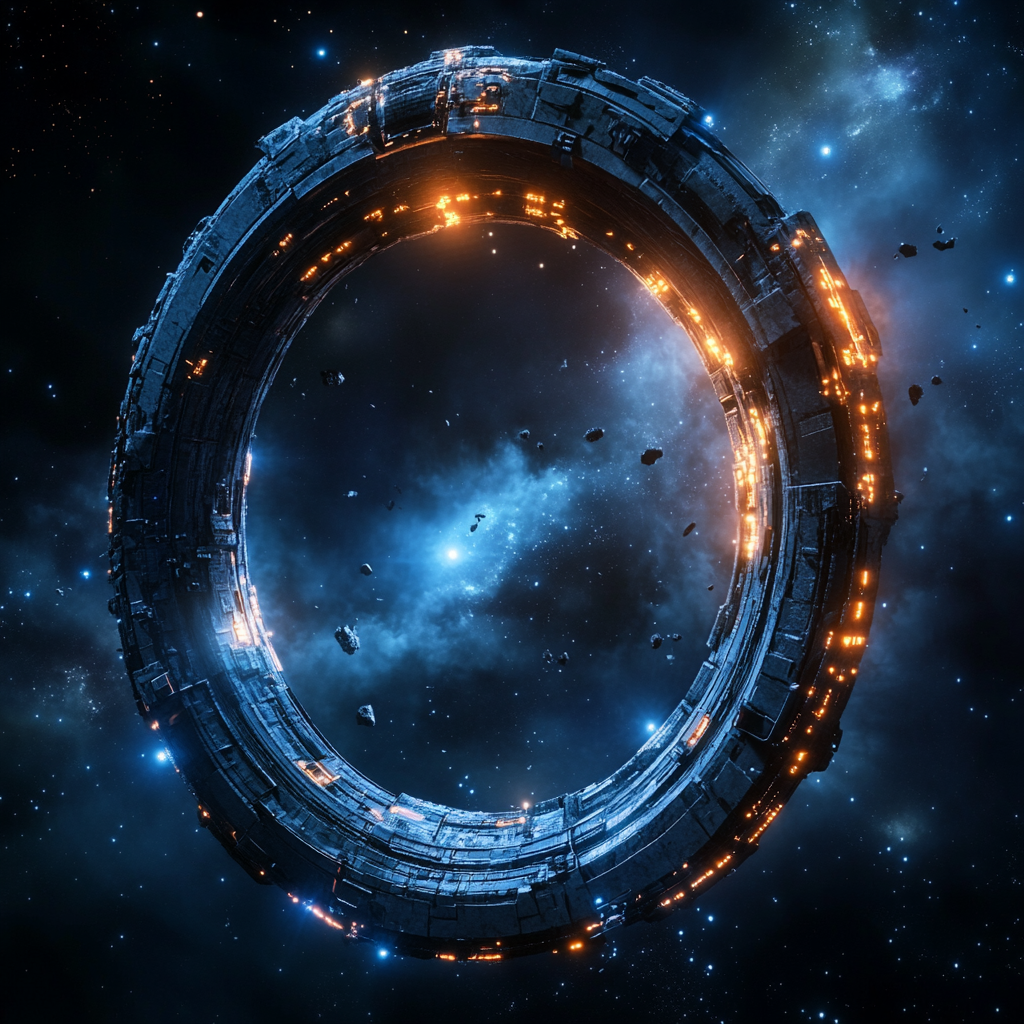
\This stargate like the one ring, and that’s somewhat concerning..\