At CES 2025, Jensen Huang reveals how Blackwell, Digits, and new scaling laws rewrite the AI rules for the decade ahead.
By Nate
Published: 2025-01-07
URL: https://natesnewsletter.substack.com/p/nvidias-next-frontier-ai-robotics
Ok, Jensen Huang’s keynote gave me SO much to work on that I need to break this article into a few pieces. First, in case you missed it, I’m going to list out all the releases Jensen talked about at CES last night, January 6th. Then I’m going to get into the real meat of the article: why these releases? Why now? What does this tell us about NVIDIA’s strategy, and about where AI is going over the next decade? There’s a ton to unpack here, so stay with me!
First: 15 Releases from Jensen Huang’s CES 2025 Keynote
1. GeForce RTX 50 Series (Blackwell Architecture)
A new consumer GPU lineup highlighted by the RTX 5090, which features 92 billion transistors, 4000 TOPS, and GDDR7 memory. DLSS 4 can predict up to three future frames, showcasing deeper AI integration in graphics. Prices for some SKUs have dropped, while others rose, bucking the usual trend of uniform price hikes.
Why It Matters:
These GPUs reinforce the convergence of AI and gaming, where neural networks now handle tasks once limited to traditional shader pipelines. By embedding AI so deeply into rendering, NVIDIA extends its reach into how games are built and played, making advanced graphical techniques more accessible to everyday gamers.
2. RTX 5000 Series for Laptops
Mobile versions of Blackwell-based GPUs, with the RTX 5070 starting at $1299.
Why It Matters:
Machine learning, content creation, and gaming all benefit from high-performance hardware in a portable form factor. NVIDIA’s push here aligns with CEO Jensen Huang’s vision of enabling AI development on mainstream Windows PCs without forcing users to switch to specialized hardware or software setups.
3. Nemotron Language Models
Fine-tuned Llama-based models (Nano, Super, and Ultra) optimized for NVIDIA GPUs.
Why It Matters:
Enterprises often need out-of-the-box solutions, not just raw hardware. Nemotron minimizes the complexity of training large language models from scratch. By offering pre-optimized enterprise-scale models, NVIDIA situates itself as a solution provider rather than just a chip vendor.
4. Cosmos World Foundation Model
An AI system that generates photorealistic synthetic environments, trained on 20 million hours of video. Open-licensed and designed to accelerate robotics and AV development.
Why It Matters:
Simulations let developers safely train autonomous vehicles and robots before real-world deployment. Cosmos pairs with Omniverse to create detailed virtual testing grounds, cutting costs and risks for industries that need extensive trial-and-error.
5. AI Agents
A vision of “digital colleagues” that require onboarding, much like new hires.
Why It Matters:
If AI agents become widespread, their resource needs—especially for adaptive, real-time computations—could be huge. NVIDIA’s hardware and software stack positions the company to supply that compute power, potentially shaping how AI is integrated into everyday workplace tasks.
For more on AI, subscribe and share!
6. Windows Subsystem for Linux (WSL2) for AI PCs
Bringing advanced Linux-based AI tooling to Windows.
Why It Matters:
Developers usually build deep learning solutions on Linux. WSL2 removes a barrier by letting them access familiar tools on Windows, broadening the developer base for AI applications and making NVIDIA GPUs more convenient to use across different environments.
7. Blackwell NVL72 Superchip
A new datacenter accelerator focused on high performance-per-watt, a crucial metric in AI scaling.
Why It Matters:
Large-scale model training already challenges the physical limits of data centers. By ramping up efficiency, NVIDIA aims to remain a top choice for hyperscalers and large enterprises chasing bigger, more sophisticated models.
8. Project Digits (DGX GB110)
A desktop AI supercomputer for $3,000, powered by the GB10 Grace Blackwell Superchip. It’s compact, runs off a standard outlet, and can handle models with up to 200 billion parameters. Two Digits systems can be linked for up to 405 billion parameters.
Why It Matters:
This system democratizes AI supercomputing. Researchers, small teams, and even ambitious hobbyists can run substantial models locally. The approach parallels how consumer GPUs initially spurred broader adoption of GPU computing. Now, a new generation of developers can tap into an AI platform that scales from a desktop box to full-blown datacenters.
9. Partnership with Toyota
Integration of NVIDIA’s Orin SoCs and DRIVE OS in Toyota’s next-generation self-driving vehicles.
Why It Matters:
Automakers are under pressure to deliver advanced driver-assistance or full autonomy. By partnering with Toyota, one of the world’s largest car manufacturers, NVIDIA embeds itself in a major segment of the emerging autonomous vehicle market.
10. NVIDIA DRIVE Thor Platform
A single SoC that delivers 20× the performance of Orin, consolidating cockpit, ADAS, and potential self-driving capabilities.
Why It Matters:
Unifying multiple car systems into a single platform reduces cost, complexity, and power consumption for automakers. Once a manufacturer adopts Thor, it’s easier to stay with NVIDIA for software updates and expansions, strengthening a long-term business relationship.
11. DRIVE OS Certification (ASIL-D)
Highest-level automotive safety certification for an AI-powered system.
Why It Matters:
Safety remains a crucial factor in autonomous driving. Achieving ASIL-D certification signals to automakers that NVIDIA’s tech meets stringent reliability standards, potentially accelerating adoption.
12. Humanoid Robotics with Isaac Groot
Demonstrations of tele-operation and synthetic data training for robots.
Why It Matters:
As service robots and factory automation expand, the ability to train complex motion through simulation could give developers a faster route to market. By marrying real human motion data with synthetic variations, NVIDIA supports a wider array of robotics applications beyond industrial arms.
13. Scaling Laws and Test-Time Scaling
NVIDIA’s discussion on how model size and token costs grow, and how to manage them.
Why It Matters:
The largest models require more compute at inference time. If on-demand “test-time scaling” becomes mainstream, data centers need flexible hardware to handle spikes in computation. NVIDIA aims to provide that through hardware optimizations and targeted software features.
14. Physical AI
The concept of AI that understands and reacts to the physical world, facilitated by tools like Cosmos.
Why It Matters:
Advances in self-driving cars, drone navigation, and general-purpose robotics hinge on accurate physical modeling. NVIDIA is betting that robust simulation, tied to large-scale training infrastructure, is the fastest path to safe real-world deployment.
15. Omniverse Integration
Expanded capabilities for digital twins, reinforcement learning, and pairing with Cosmos for deeper virtual-world fidelity.
Why It Matters:
Omniverse is NVIDIA’s collaborative 3D design and simulation hub. Integrating AI capabilities means developers can go from modeling a factory floor to simulating robot movement to training an AI in a single environment. The more versatile Omniverse becomes, the stickier it is for companies designing complex systems.
Second: What Jensen’s keynote tells us about Nvidia’s strategy and the future of AI in the next decade
Nvidia’s Blueprint for the Next Decade
When Jensen Huang took the stage at CES 2025, it was clear that he wasn’t just unveiling GPUs or bragging about specs. He was articulating a worldview—a vision of how everything from your gaming PC to a fleet of humanoid robots might evolve under AI’s ever-expanding influence. NVIDIA’s announcements, while diverse, sketch out a blueprint that reaches far beyond this year’s product cycle. They reveal how the company aims to shape the entire ecosystem of computing, from simulation-based robotics to large language models that power digital “colleagues.”
This keynote can be understood best by looking at how NVIDIA embraces three deep strategic pillars: the scaling of AI compute, the convergence of digital and physical worlds, and the packaging of chaotic invention into cohesive products. Underlying each announcement is Jensen’s belief that AI isn’t just a layer on top of computing—it’s the very substrate of future innovation.
From Messy Invention to Consumer Reality
Technological revolutions have always felt messy in the early stages. It took decades for the transistor to go from Bell Labs curiosity to the beating heart of modern electronics. Huang’s keynote hinted that AI stands at a similar inflection point. NVIDIA’s role, as he sees it, is to smooth out that chaos by delivering both the “raw leaps” in AI performance and the “final flourish” of usable products.
The GeForce RTX 50 series, for instance, goes beyond incremental GPU improvements. It’s a step toward real-time neural rendering, allowing games to render entire worlds that hinge on AI predictions. That shift from static graphics to AI-driven generation feels like the same upheaval that microprocessors once brought to mainframe computing. By the same token, Project Digits—a $3,000 desktop AI supercomputer—places HPC-like capability within reach of individuals and startups. Once upon a time, entire labs were needed to house computing power that now fits on a desk.
These leaps aren’t just about feeding consumers faster frame rates. They’re about embedding AI so deeply that it becomes an invisible partner in creativity and problem-solving. Instead of leaving the tech in a half-baked “invention-first” stage, NVIDIA is using platforms like Digits, Nemotron, and Cosmos to wrap AI’s messy potential in cleaner, more accessible software stacks.
Scaling Laws and Physical AI
One of Huang’s recurring themes is the concept of new scaling laws. Traditional Moore’s Law scaling—more transistors, smaller lithography—still matters, but AI’s exponential growth is beginning to hinge on token-level economics. As large language models expand, the cost per token at inference becomes a bottleneck. NVIDIA’s Blackwell architecture, which powers the RTX 50 series, datacenter chips like NVL72, and the Grace Blackwell Superchip, is engineered to reduce those token costs by enabling ultra-efficient math (FP4) and faster memory (GDDR7).
It’s no accident that these scaling improvements parallel what’s happening in “physical AI.” Cosmos, an AI that can generate photorealistic environments, and Isaac Groot, which lets developers train robots on synthetic data, are direct responses to the fact that real-world data collection is slow and pricey. Instead of physically driving millions of miles or building countless robotic prototypes, developers can run millions of simulations in a fraction of the time. This synergy between large-scale AI compute and robot simulation is where Huang sees the future heading: build robust models in a safe virtual world, then seamlessly transition them to real-world operation.
In practice, that might mean a factory robot learns how to handle complex tasks without risking real materials or human safety. Or a self-driving car explores tens of thousands of crash scenarios without a single actual fender-bender. NVIDIA’s platform—Omniverse, Cosmos, and DRIVE—stitches simulation, model training, and hardware deployment into a single continuum.
Blurring Lines: From Consumer Gaming to Automotive Autonomy
Perhaps the most intriguing aspect of Jensen’s keynote is how the same architecture shows up in your $1,299 RTX 5070 laptop and in Toyota’s next-generation self-driving cars. On the surface, these products seem wildly different. Under the hood, they rely on the same fundamental building blocks: advanced GPU cores, optimized AI frameworks, and an emphasis on performance-per-watt.
This convergence isn’t accidental. NVIDIA’s strategy is to unify the industry under a consistent compute philosophy. A developer working with AI upscaling on a GeForce RTX 5070 might later adapt those same AI techniques to accelerate autonomous driving algorithms on a Thor SoC. Consumers who get used to AI-accelerated experiences in gaming are primed to embrace AI-enabled features in cars—like real-time occupant monitoring or path planning.
It’s not just a hardware story. The Toyota partnership and the DRIVE Thor platform highlight NVIDIA’s play for software-defined vehicles. Car systems—from infotainment to ADAS—become layers on top of a unified AI hardware stack, delivering new features via over-the-air updates. As we’ve seen in consumer electronics, software is what transforms a piece of hardware into an ever-evolving product. For automakers, building around NVIDIA’s stack could be the difference between quick feature rollouts and a slow, disjointed engineering process.
Taming the Chaos for Long-Term Dominance
NVIDIA’s approach—offering not only chips but also integrated solutions like Nemotron for language models or Cosmos for environment simulation—suggests the company recognizes the messy, invention-first stage AI finds itself in. Developers often juggle multiple frameworks, unpolished user interfaces, and half-documented features. By consolidating these under user-friendly packages, NVIDIA aims to guide AI from chaotic lab experimentation to mainstream adoption.
But behind the user-friendliness is a deeper strategic move: once developers and enterprises adopt NVIDIA’s ecosystem—be it Nemotron for enterprise LLMs or Omniverse for digital twins—they become reliant on its specialized hardware acceleration, libraries, and future updates. This is classic platform thinking: reduce friction so that more teams join in, and once they do, offer them a roadmap that keeps them upgrading within your ecosystem.
Project Digits exemplifies this. A personal AI supercomputer that can handle 200–400 billion parameters is a dream come true for data scientists and smaller AI labs. It also plants the seeds for more complex work—work that will inevitably need to scale to data-center or automotive-grade systems. Since it’s all based on Blackwell architecture, moving up the chain feels natural and cost-effective.
The Decade Ahead
Over the next ten years, Jensen Huang’s bet is that AI will saturate not just computing, but every dimension of human-machine interaction. Robots will navigate the real world thanks to millions of simulated hours. Cars will run advanced AI software seamlessly on a single SoC that also handles infotainment. Gaming PCs will tap neural networks for everything from graphics to character dialog. And personal AI systems, like Project Digits, will fit on your desk rather than in a dedicated server room.
While it’s tempting to view each CES announcement as a discrete offering—new GPU, new automotive chip, new robotics platform—the real story is how each piece links into a broader mosaic. NVIDIA is leveraging the chaos of AI’s messy invention stage and packaging it into products, software, and entire workflows that promise consistency, speed, and a path forward for anyone building next-gen applications.
The question isn’t whether these individual efforts will succeed in isolation. It’s whether this grand unification of AI computing can outpace rival ecosystems and remain compelling in a field that changes with dizzying speed. History shows that whichever platform simplifies invention into a stable product often reaps enormous rewards. NVIDIA’s leadership understands this deeply, leaning into simulation, efficiency, and user-friendly packaging as the keys to bridging the gap.
That bridge—between raw potential and polished outcome—is precisely where transformative technology finds its footing. Just as Apple polished Unix into macOS, or transistor labs eventually birthed the modern CPU industry, NVIDIA sees itself knitting together the final shape of AI. If their roadmap stands, the next decade of robotics, autonomous vehicles, and AI-accelerated computing could very well evolve along the tracks Jensen Huang has laid down. And rather than a flashy, short-term pitch, that vision is built on the long arc of how innovation truly matures: from chaotic lab demos to the day we can’t imagine life without it.
For more on AI, subscribe and share!
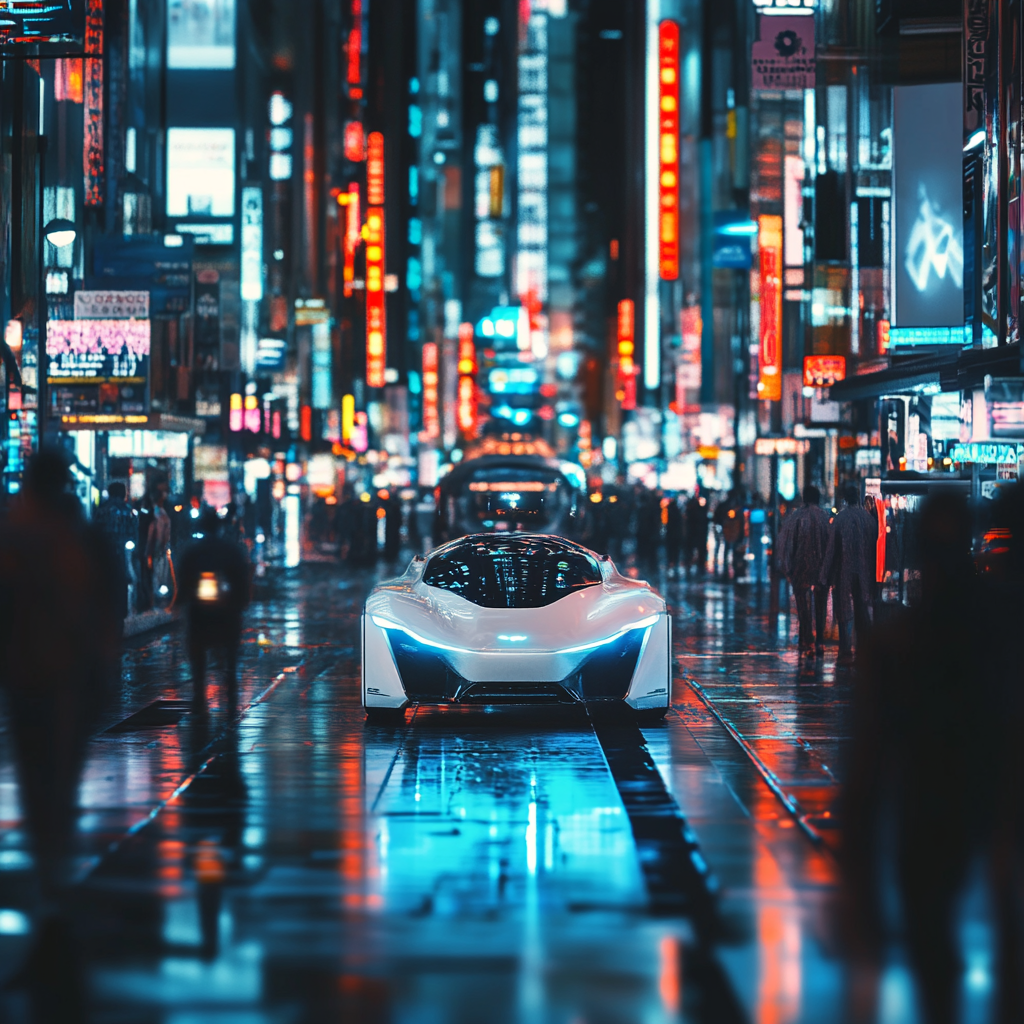
\Jensen’s future vision is so multi-faceted I had trouble picking an image. I went with autonomous cars because ultimately he seems to love them so much.\