Sam thinks AGI means AI colleagues with spreadsheets this year—but he's not really interested in that. He really wants to go for ASI (Superintelligence) and use it for scientific research.
By Nate
Published: 2025-01-06
URL: https://natesnewsletter.substack.com/p/skynet-nahslacknet-sam-altmans-2025
When I write my New Year’s reflections nobody notices. When Sam Altman, founder of OpenAI, shares his projections for the year ahead, people pay attention. And rightly so! Sam is building perhaps the most transformative technology in history.
So what’s the TLDR? Sam writes a bit of inside baseball on Silicon Valley and his there-and-back again journey from being fired to returning as CEO. But the value for most people lies in his take on two intertwined goals: deploying artificial general intelligence (AGI) in the workplace and advancing artificial superintelligence (ASI) for profound scientific breakthroughs.
Sam gets quite specific on AGI: AGI is buildable in a direct line this year, and it will appear in our digital work environments as agentic colleagues. This is Sam re-affirming the agentic AI predictions for 2025, but also constraining expectations I think—this new colleagues will be helpful enough to shoulder repetitive tasks, yet not advanced enough to displace entire teams. Though he hasn’t disclosed pricing specifics, there’s a widespread assumption these AI companions are going to come in at around 10% of an equivalent tech salary.
So why no jobs apocalypse at those prices? Because by definition you can’t just stack ten or twenty AGI’s in a trench coat and get equivalent benefits to humans collaborating together over time. Among other reasons, you don’t have great shared memory or collaboration mechanisms yet.
That understanding may be part of what drives Sam’s confidence that AI benefits will be broadly shared. He characterizes these AI agents not as job-stealers but as catalysts for better teamwork. Even a stack of hyper-intelligent bots can’t match the leadership, creativity, and empathetic judgment that humans bring to an organization. With the right checks and balances, Sam’s general view is that AGI should partner with us humans to sharpen our collective problem-solving and make our organizations more effective as a whole.
Altman’s second focus, ASI, looks further down the road. Instead of envisioning superintelligence as a replacement for human expertise, Sam pretty clearly sees it as a powerful ally for tackling humanity’s biggest challenges—cancer, aging, and beyond. This may seem like a pivot, but it’s actually a return to roots for OpenAI. The company started as a nonprofit research institution focused on bringing the benefits of AI to humanity. It accidentally became a massive startup with one of the most popular products on the planet.
In a sense, Sam’s focus is turning back to the company’s roots, and he’s basically saying (without saying) that he’s putting the product side on a bit of autopilot because it’s not a hard problem anymore. Someone is going to run the product side of OpenAI, and even though externally it will be one of the most popular sites on the planet and have massive enterprise accounts, internally it will be regarded as the “boring job.” Imagine that.
Founders have to be sort of insanely optimistic to survive, and this post is really right in line with that Silicon Valley / YC DNA. OpenAI’s dual mission—offering real value today while steadily working toward an ambitious tomorrow—reflects Sam’s unwavering optimism. The idea is to accelerate discovery while ensuring that human values remain at the center of technological innovation.
Taken together, Sam’s roadmap points to a future where AI is both practical and transformative. In the near term, AGI might handle mundane tasks to free up human creativity. Looking further ahead, ASI could redefine our understanding of biology, medicine, and even the nature of work itself. What’s interesting here is that Sam’s focus on enabling ASI for scientific research is implicitly non-corporate. It’s almost as if he isn’t particularly interested in deploying ASI to replace corporations. He’d rather use it to solve what he views as humanity’s greatest longterm problems, and I think that hints at the future of OpenAI as perhaps the world’s greatest research institution.
Think about it—looking ahead now we see AI as OpenAI’s greatest legacy. But looking back in two centuries, what if humanity sees solving death as OpenAI’s greatest legacy? That’s the kind of world Sam is trying to create.
In the meantime we have to live in 2025, and your AI colleagues will be arriving soon! I hope you like them, because they’re definitely going to be here to stay. I’d expect the first ones in the first quarter of 2025, and widespread usage by Q4 2025.
What a wild year and it’s only January!
For more on AI, subscribe and share!
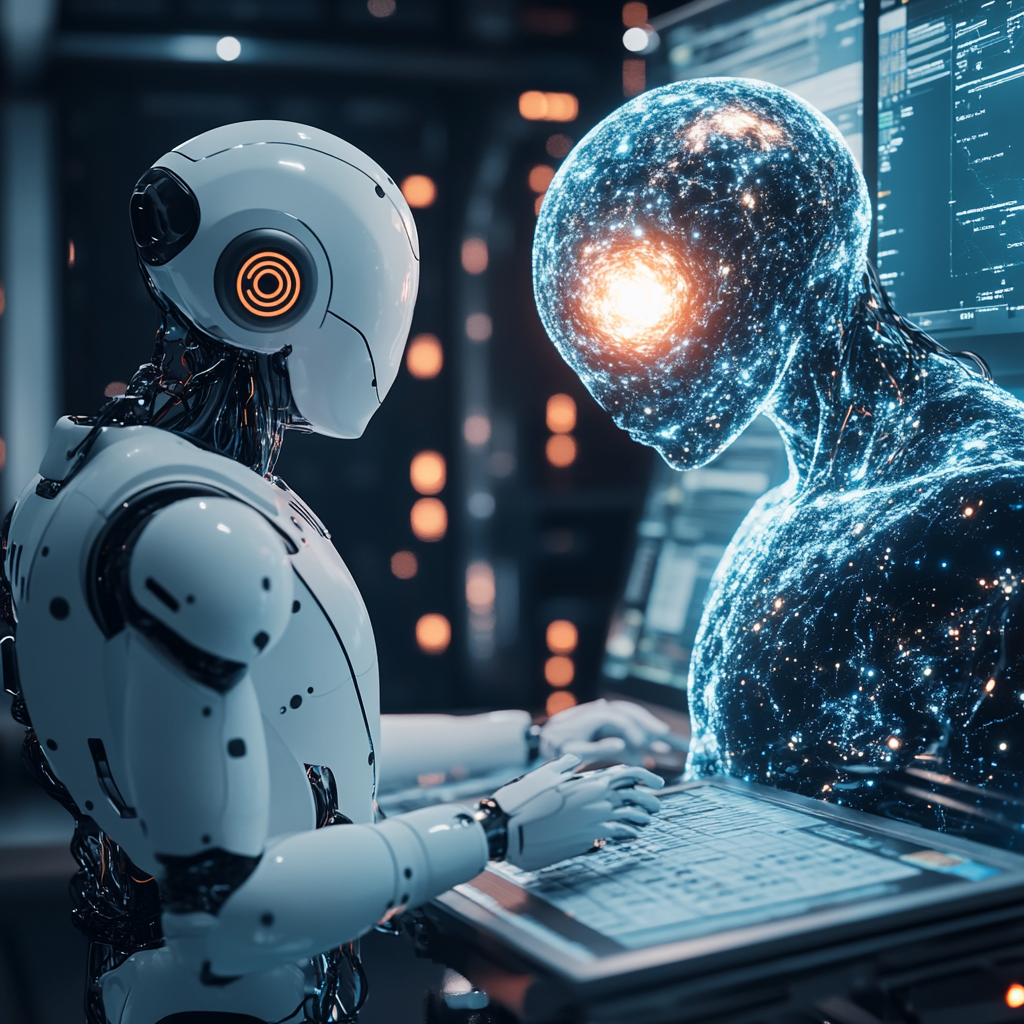
\The AI guy on the left is more like what we’re getting in 2025. AI guy on the right is curing death lol and we don’t know when he’s arriving\