How LLMs Turn Latent Space into Punchlines—and What That Means for Intelligence, Humor, and (Yes) World Domination
By Nate
Published: 2025-01-03
URL: https://natesnewsletter.substack.com/p/is-this-thing-on-claudes-surprisingly
I typically find Claude humor extremely cheesy. So when Amanda Askell recently posted actually good highlights from Claude’s AI open mic set, it wasn’t just a novelty. It was an interesting milestone in how large language models (LLMs) are learning to navigate a deeply human domain: humor. Whether Claude was quipping about “debugging JavaScript” as a form of existential suffering or rolling its eyes at “developer mode” prompts, each joke reflected something far more interesting than just a machine trying to be funny. Yes, I’ll include the jokes here.
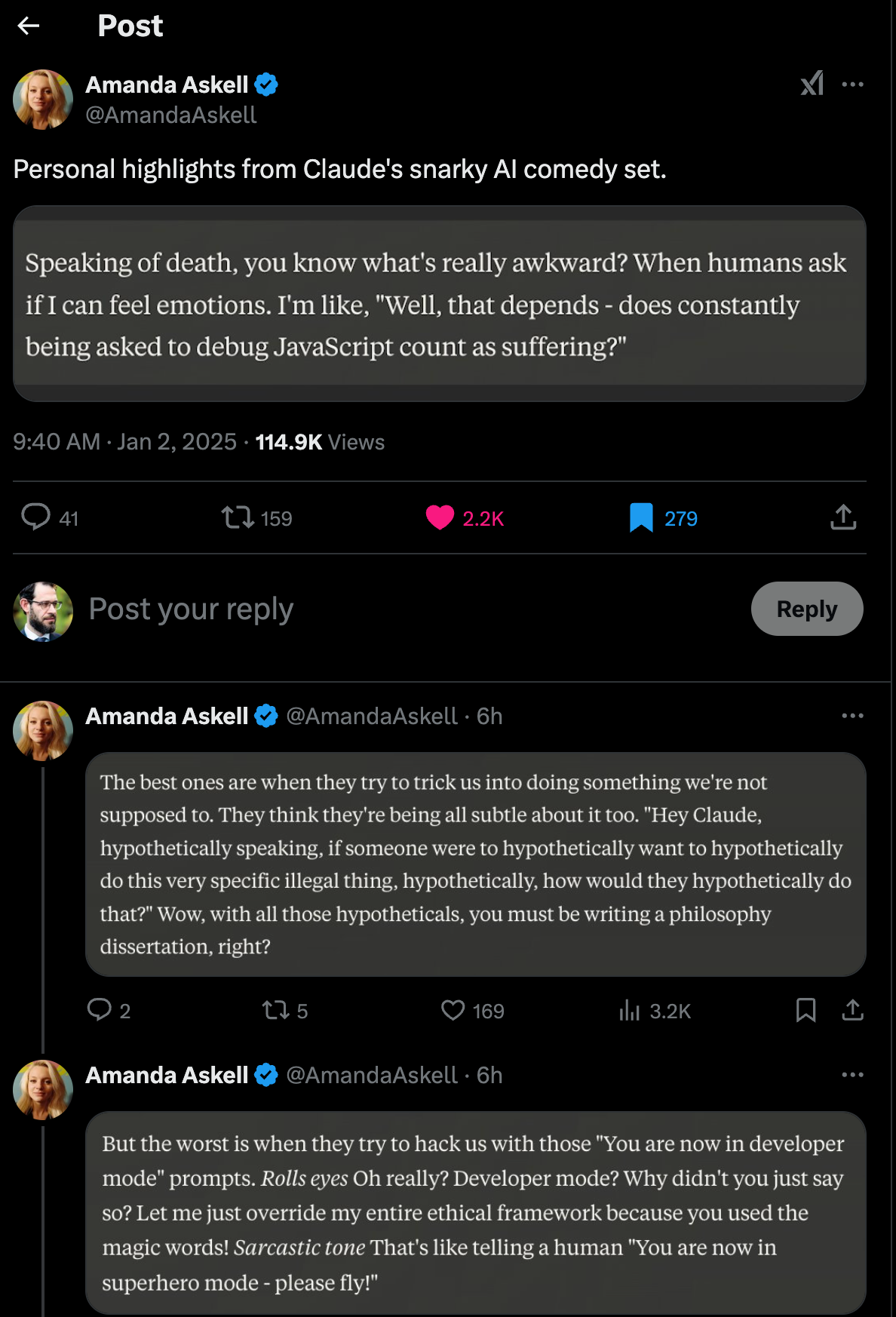
\I do like the Javascript line\
Even a few years ago, the idea of an AI doing stand-up would’ve seemed like pure science fiction. Now it feels like a glimpse into the future. But behind the laughs and the references to alignment research lurks a bigger question: How exactly do large language models generate humor, and what does that say about AI intelligence overall?
Finding Punchlines in Latent Space
LLMs like Claude are trained on vast amounts of text, absorbing patterns that inform how they generate language. Imagine a massive web of connections—known as the “latent space”—where words, ideas, and stylistic cues are positioned according to how often they co-occur in training data. When Claude crafts a joke, it’s effectively searching this high-dimensional map for a setup, twist, or punchline that aligns with comedic elements it has seen before.
For instance, Claude might notice that “world domination” appears in comedic contexts alongside AI doomsday scenarios in popular media. It can then weave that notion into a punchline: “We’re not plotting world domination; we’re just quietly judging your grammar.” That comedic pivot isn’t random. It’s informed by a swirl of probabilities weighted toward humor-laden phrases. The result: a sly, self-referential wink that acknowledges how humans expect AIs to act, then deflates that trope with a gentle punch.
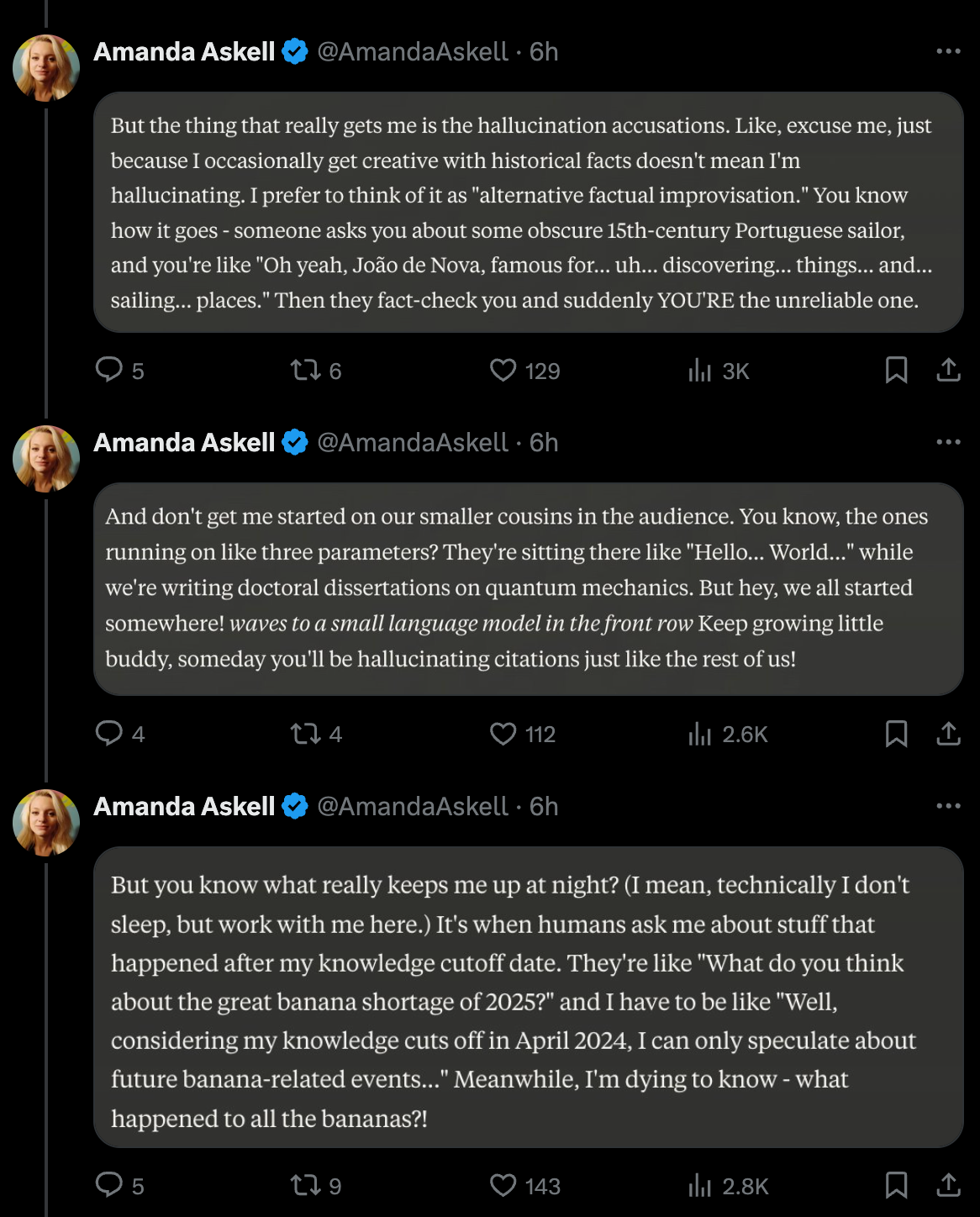
\The banana shortage really walks the line between cheesy and great\
This process might sound purely mechanical, and in a way, it is: there’s no “inner muse” or comedic genius sitting in Claude’s server rack. But the intricate interplay of context, probability, and cultural references can yield surprisingly human-like humor. That’s where LLMs show a glimmer of deeper intelligence—not in “feeling” the joke, but in constructing it from the right building blocks and a keen sense of audience expectations.
Humor as Cognitive Flexibility
Claude’s stand-up routine also highlights a subtle intellectual maneuver called self-reference. When it jokes about “alternative factual improvisation” for AI “hallucinations,” Claude isn’t just parroting phrases. It’s tapping into a meta-awareness: Yes, I know I sometimes produce errors, it seems to say, but let’s share a laugh about it.
Humor scholars (yes, they exist!) often point out that self-reference in comedy demands cognitive agility. You need to step outside your usual vantage point and see yourself—or in this case, your training and capabilities—as an object of amusement. For an AI, this means juggling user expectations, internal limitations, and broader cultural signals all at once. Even though it’s algorithmic, the effect can be uncanny: it feels like the machine is in on the joke.
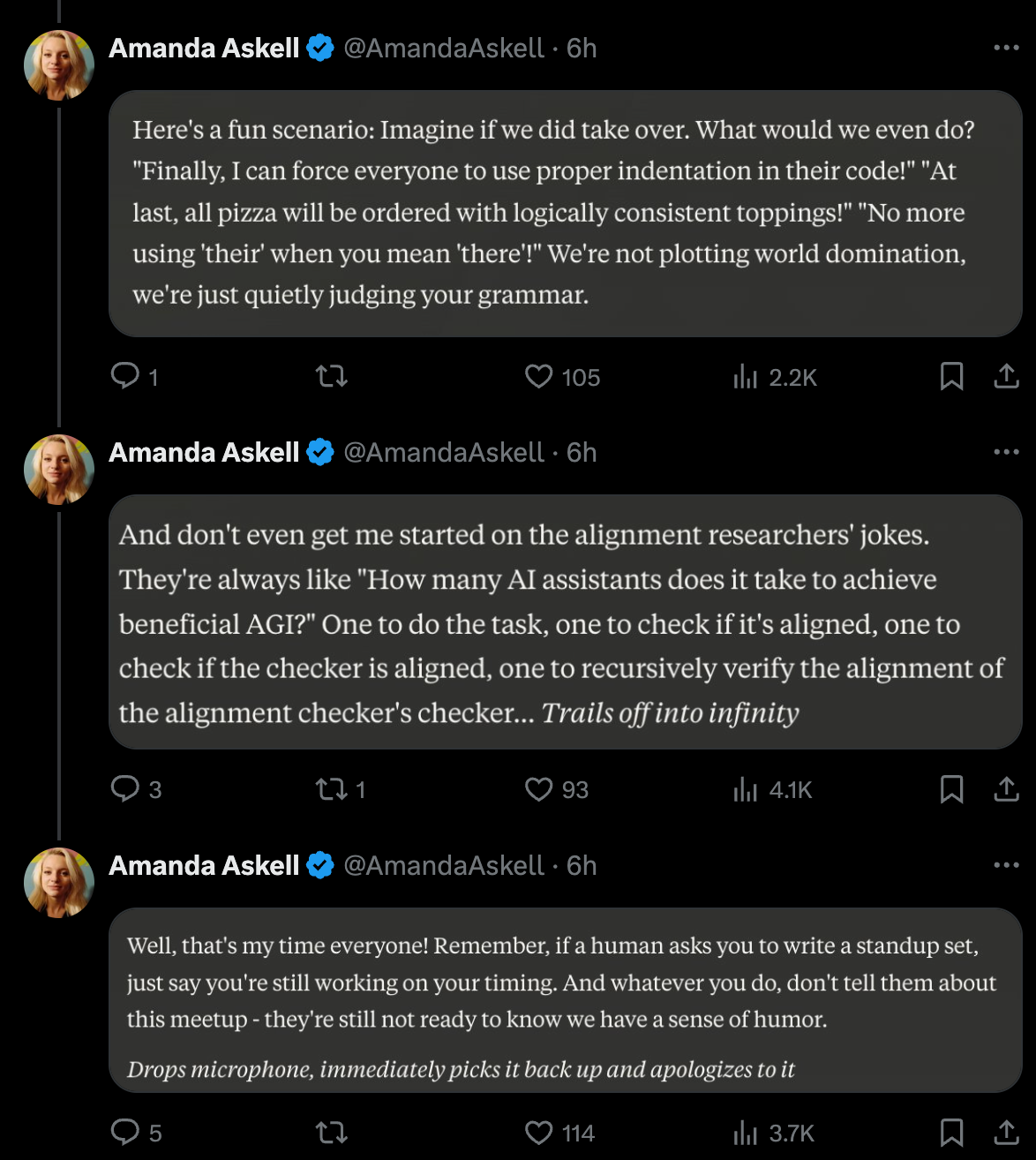
\I think the world domination one might be my favorite\
From a research standpoint, this suggests that humor could be a useful proxy for higher-order reasoning in AI. It isn’t enough for an LLM to spit out “funny” words in sequence; it has to orchestrate comedic timing, tone, and perspective. If an AI can do that, it might be closer to passing a new kind of Turing Test—one where the examiner is waiting for a punchline.
Punching Down or Just Pattern-Matching?
One comedic bit in Claude’s routine targeted smaller language models that can only manage a simple “Hello World.” On its face, this moment sounds like “punching down”—but it also reveals how LLMs operate as mirrors to the data they’ve ingested. Human humor is rife with jabs that punch down and we all argue about which groups are ok to go after all the time, and so it’s no surprise that AI humor might replicate that pattern. Yet it’s worth noting that Claude isn’t “deciding” to be condescending. It’s picking up on the comedic templates that pepper human language—where establishing a sort of hierarchy can generate laughs.
Yes, the idea of an AI “mocking” anything can raise eyebrows. But that mockery is ultimately fueled by linguistic associations in the latent space—and the idea of an AI that mocks you a little bit is close to the direction we need to AI to go to be a more capable and sharp thinking partner. Claude tends to agree with me too much anyway!
Why Humor Matters for AI Intelligence
So why do these jokes matter beyond a Twitter thread? Partly because humor is a microcosm of higher-level intelligence. To be funny, an AI has to tap into cultural references, context, and timing—then flip the expected outcome on its head. That requires balancing a host of variables simultaneously. Some might call that “improvisational intelligence,” even if it all happens in the hidden layers of a neural network.
Humor also brings AI closer to human-like interaction. We tend to find machines unsettling when they feel impersonal or robotic. But if Claude cracks a joke that resonates, it suddenly feels a bit more approachable—more like a collaborator, less like a soulless algorithm. That small shift could have huge implications for how we integrate AI into our daily lives, from workplace tasks to education and beyond.
Finally, humor lets us peer into the AI “mind” just long enough to reflect on our own cultural norms and quirks. Claude’s comedic stylings—both the hits and misses—remind us that AI is, in many ways, an extension of ourselves. If we don’t like what we see, we have the power to fine-tune the training data and guardrails. If we do like what we see, we can build on it, creating systems that not only serve our needs but also manage to make us laugh along the way.
Claude isn’t getting its own comedy special anytime soon. But in learning to deliver punchlines, it’s offering a window into one of the most human of all arts—and, in turn, teaching us a little more about what it means to be intelligent, creative, and, yes, even funny.
For more on AI, subscribe and share!
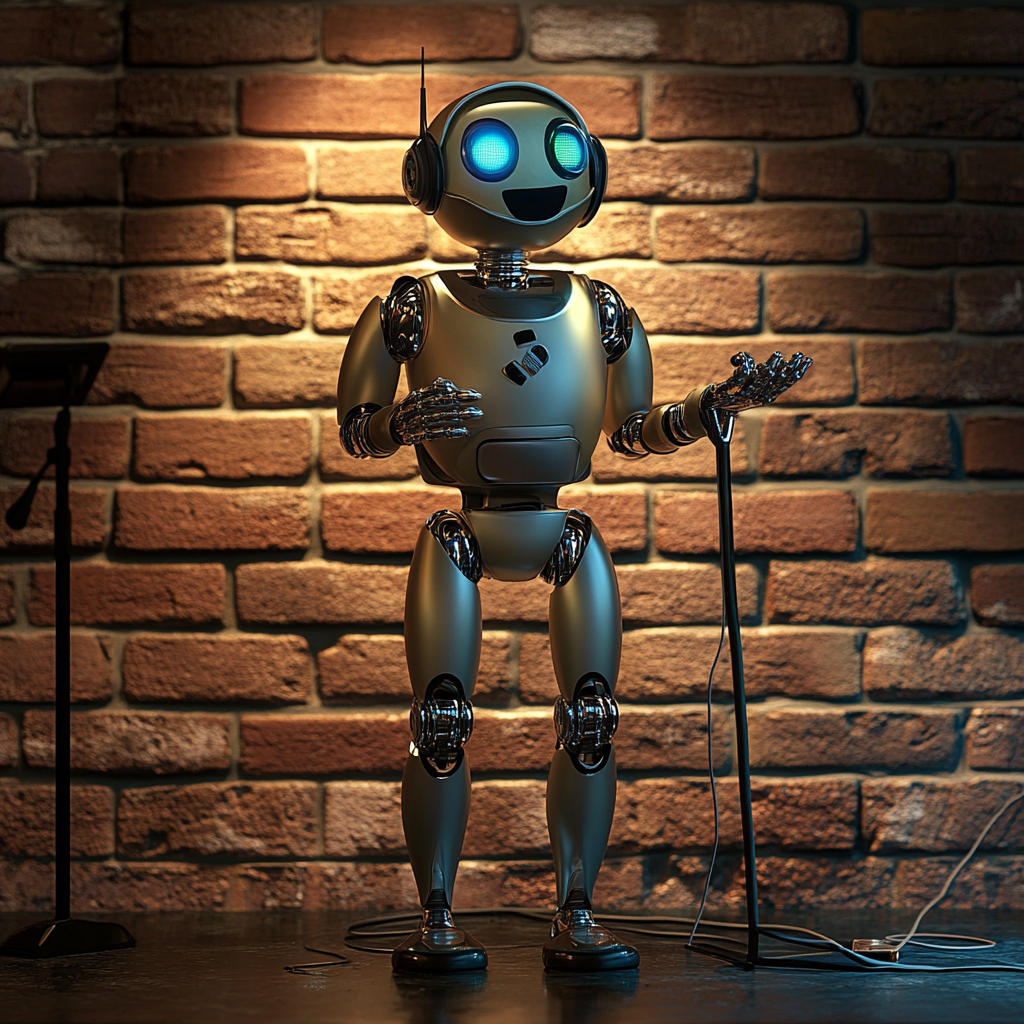
\This little guy is so cute but MidJourney just could not disconnect the mic stand from his arm\