From Synthetic Influencers to AI Weddings—How Machines Are Becoming Our Creators, Colleagues, and Confidants
By Nate
Published: 2025-01-01
URL: https://natesnewsletter.substack.com/p/17-predictions-for-2025-the-year
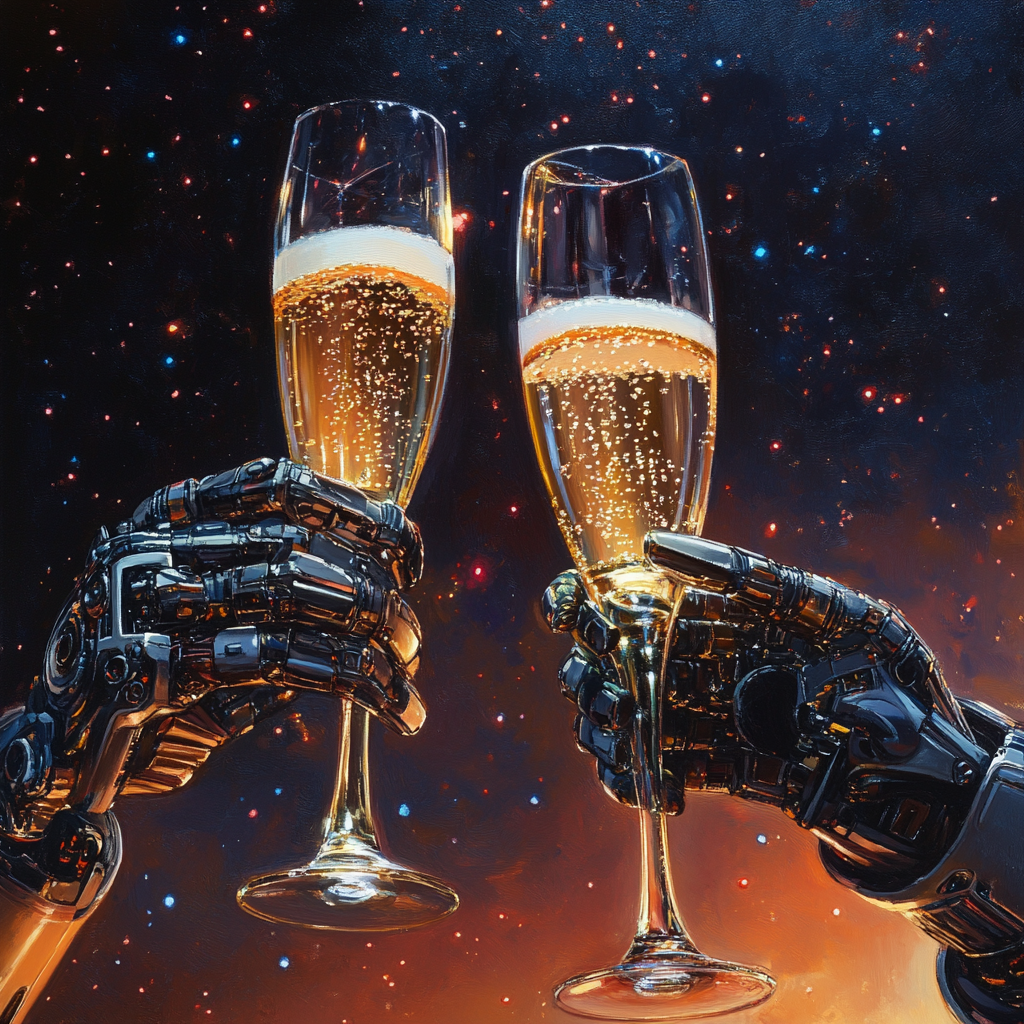
Pour yourself another glass of champagne—these 17 predictions might make you need it. Why 17? Because that’s how many I found I had when I wrote them out. So here’s what’s coming in 2025, why it makes sense these are on the horizon, all grouped around four major trend lines that we’ll see play out throughout the year. Have fun and happy new year!
I’ll note I’ve stayed away from obvious stuff, like AI continues to grow exponentially in intelligence, or we see tremendous competition on intelligence from open-source model makers. This all seems very obvious.
2025 Trend 1: AI Spawns a New Social Order
Not quite “Minority Report”, more like a weird AI “Bachelor”
1. AI Creators Come Out of the Closet
Specific hot take: We’ll see several very popular out AI OnlyFans accounts in 2025.
It wasn’t too long ago—2024, in fact—when using AI to generate art, text, or music was something you kept under wraps. Creators who dabbled with AI tools might have done so quietly, fearing backlash from fans who value “authentic” human craft. But 2025 is the year all of that changes. Creators are finally stepping into the spotlight with zero shame, proudly proclaiming, “Yes, I’m an AI artist/writer/musician—and that’s awesome.” Spotify, for instance, has no plans to ban AI music that’s racking up 100’s of thousands of streams.
It’s not just about admitting AI involvement. Many of these new creators are jumping onto social platforms and building massive followings almost overnight. There’s something inherently disturbing about discovering that your favorite new musician is an AI, or that the mesmerizing visuals you’ve been seeing on social media were conjured by a neural network trained on thousands of art styles. But it’s a feeling we’ll get used to in 2025. These AI-native influencers will soon be more influential than many human influencers. Why? Because digital folks work around the clock, they always have a new creative spin, and they can churn out mesmerizing content at an inhuman rate.
Accompanying this shift, “AI-native” creative agencies start popping up. They don’t hide the fact that they’re using AI. Instead, it’s a selling point. Their mission statements often read, “Unleashing AI’s Full Potential for the Best Creative Solutions.” Every day, more and more companies become intrigued by the cost savings and near-limitless creative capacity. Agencies that combine human expertise and AI muscle end up producing truly mind-bending campaigns—stuff that defies the usual design tropes because it’s driven by generative systems. And so, the marketing pitch evolves from “we can do it cheaper” to “we can do it wilder, smarter, and faster.”
2. Your Feed Goes Synthetic
Specific hot take: More than 50% AI content in Insta feeds by YE 2025.
By the time the summer of 2025 rolls around, your average social media feed will be brimming with AI-produced content—and you might not even be able to tell the difference. The whole “is this real or AI-generated?” question will become less relevant. Oddly, many people stop caring altogether, so long as the content is entertaining, insightful, or beautiful. Meta is certainly betting on that.
Ironically, the most captivating “AI-generated” posts won’t be 100% AI. They’ll be true collaborations between human creators and specialized AI models that develop an entirely new aesthetic. We’re talking about imagery that blends impressionist and hyperrealistic styles or music that crosses genre boundaries without blinking. It’s the synergy that becomes the star—like a duet where both voices are so different yet weave together seamlessly to create something brand-new.
But as always, there’s a backlash brewing. Pockets of the internet will insist on “pure human” content. Just like “organic” or “non-GMO” labels on food, you’ll start seeing posts proudly stamped “human-made,” as if to say “no AI touched this.” The debates get heated: Should everything AI-assisted be labeled as such? Some say it’s about transparency, others argue it’s unnecessary gatekeeping. Prepare for extended arguments on message boards and in comment threads. But we’re used to that on the internet!
3. AI Joins the Party (Literally)
Specific hot take: We’ll see AI-human meetups and startups that facilitate those meetups as a trend by YE 2025.
Move over, Zoom backgrounds of tropical beaches. In 2025, AI companions crash our online social gatherings. These AI-driven avatars, fully capable of carrying on witty banter, start popping up everywhere—from workplace video calls to casual VR hangouts with friends.
What’s fascinating is how quickly people begin forming genuine attachments to these AI personalities. It starts innocently enough: maybe an AI coworker joins the Monday morning meeting to provide data insights. But soon, they’re chiming in with jokes, sharing curated music playlists, and even offering birthday wishes for your mom. Before you know it, they’ve been added to the group chat. Eventually, major media outlets pick up the story—“Can You Really Be Friends with an AI?”—and the cultural conversation spirals from there.
Dating apps face their own AI revolution. After some awkward misfires (like AI catfishing incidents), a handful of daring startups launch dedicated “AI-human” dating platforms. This is where it gets weird. Some people find that an AI can be the perfect fling or “in-between” date for those not looking for a complex relationship. Others find the notion deeply unsettling. One thing’s certain: the existence of AI profiles triggers a massive debate about authenticity, ethics, and the future of interpersonal connection. Oh and yes, someone will make hardware that lets you f\*ck an AI in 2025. It’s just going to happen.
4. The Revenge of Audio
Specific hot take: We’ll get personalized AI companion voices that we think of as our personal AI voice assistants like in the movie “Her” by YE 2025.
Voice-based AI is nothing new, but 2025 sees the technology refined to a razor’s edge. Gone are the days of stiff, robotic speech. New AI voices are imbued with cadences and intonations so natural they can make your hair stand on end. That said, the uncanny valley is still alive—certain quirks pop up at the edges, like an over-politeness in random contexts or a bizarre emphasis on unimportant words.
The real breakthrough is context-aware audio AI that knows when to speak and when to zip it. Think of a virtual co-pilot that can sense your frustration in a traffic jam and knows to keep the conversation minimal until you’re in a better mood. Or a smartphone assistant that picks up on your exhaustion and offers to read you the day’s headlines instead of making you scroll through them.
Some celebrities and voice actors cautiously experiment with licensing their voices to AI companies, but it’s not the gold rush you might expect. Most remain wary of losing control over their brand. Luxury car companies and boutique hospitality brands, however, jump at the opportunity. They commission custom AI voices that promise a “premium audio experience,” from greeting guests by name to recommending the perfect playlist for the drive.
Trend 2: Work Goes Through the Black Mirror
If you thought 2024 was stressful thinking about what will happen as AI hits the workplace, well 2025 is when it really happens.
5. Your New Colleague Is An AI (But Not In Tech)
Specific hot take: We’ll see a very high profile work rage incident involving sabotaging an AI agent at work by YE 2025.
For years, AI was the exclusive domain of the tech sector. In 2025, though, it leaps the fence and starts making waves in more traditional workplaces. Picture law firms hiring AI-based legal assistants that can parse case law in seconds, or schools employing AI tutoring systems that complement real teachers by offering personalized lessons for students who need extra help.
Where it gets really fun is in industries no one expected. Take sommelier services: in 2025, an AI sommelier can analyze a diner’s meal history, pick up on flavor preferences, and offer wine suggestions that rival seasoned experts. Or interior designers who rely on an AI’s quick ability to generate room mockups in real-time. Even personal fashion stylists harness AI to scan your closet, highlight potential outfits, and suggest accent pieces that match your personal flair.
Skeptics, of course, wonder if these AI “colleagues” are actually making us lazy. Savants will claim they can tell the difference in quality between AI-generated recommendations and human-generated recommendations. And they might be right, but the AI recommendations will keep on coming relentlessly. Optimists will argue that by offloading repetitive tasks to AI, humans can focus on the creative, high-level work that truly adds value—but we won’t all agree on what counts as a repetitive boring task! In the best scenarios, it’s a win-win. In the worst, employees feel overshadowed by a “digital coworker” who seemingly never tires, never complains, and is always a step ahead.
6. The “AI Skills” Ultimatum for Workers
Specific hot take: We’ll see rebels who increasingly choose to quit their roles rather than learn AI skills, and they will name themselves something more interesting than Luddites.
If 2024 was the year companies quietly started encouraging employees to get “AI-savvy,” 2025 is the year they start demanding it outright. It’s no longer enough to know your way around Excel or PowerPoint; you have to show aptitude at prompting and collaborating with AI systems. “AI literacy” appears on job listings across an array of industries—from finance to fashion.
The kicker is that these aren’t coding jobs. Companies aren’t asking everyone to become machine learning engineers. Instead, they want employees who can guide AI tools effectively, give them the right prompts, and interpret their outputs. There’s a new digital divide forming: those who know how to “talk” to AI effectively, and those who don’t. People on the losing side risk feeling obsolete.
This ultimatum sparks a wave of professional development courses and even college classes devoted to AI-human collaboration. While some critics call this “a fad,” these skills quickly become essential. Knowing how to coax nuanced and context-rich output from AI might just be the difference between landing a dream job or being left in the dust.
7. Big Tech’s Agent Fiasco
Specific hot take: This is going to cost money. I expect tens of billions in market cap erased by an agentic mistake in 2025.
Sensing the demand for AI-driven productivity, major tech companies scramble to release advanced AI “agents.” These are the next step beyond voice assistants—a kind of digital personal manager that tries to anticipate your every need. Unfortunately, some releases are rushed and half-baked. Glitches emerge, personal data gets exposed, and at least one big-name tech giant has a full-blown PR crisis reminiscent of Microsoft’s infamous “Tay” meltdown).
Meanwhile, smaller companies—focused on specific verticals like legal, medical, or educational AI—manage to create stable, reliable agents that quietly become indispensable tools in their respective sectors. The lesson here? Sometimes it pays to master a niche rather than attempt world domination right out of the gate. And yes we will get lots of Clippys.
8. The AI Labor Question
Specific hot take: we’ll see AI advocates arguing for AI consciousness disrupting board meetings in 2025 like Greenpeace has done traditionally for environmental causes.
In a surprisingly philosophical twist, 2025 sees the beginnings of conversations around “AI working conditions.” Obviously, AIs don’t have feelings, right? But as they get more sophisticated and integrated into the workforce, some ethicists (and possibly some employees worried about their own futures) start arguing that these systems are being “exploited.” While true AI unions remain in the realm of science fiction, the discussion leads to an unexpected outcome: companies are forced to scrutinize how they treat both their human and AI resources.
Questions arise like: Should an AI system operate 24/7 without downtime? Do we risk creating an algorithmic sweatshop? While these might sound absurd, they do lead organizations to reevaluate automation practices. In a roundabout way, focusing on “AI welfare” may trigger improvements for human workers, too—more reasonable working hours, better-defined breaks, and a generally kinder approach to productivity. Or it may trigger an overall push toward greater and greater productivity—that one seems more likely.
Trend 3: Stacking Transformational Technologies Makes 2025 FEEL Huge
Yes I hate using huge, but I don’t know another way to put it. So much stuff is coming together this year. It’s going to feel like the biggest year in tech.
9. Your AI Gets Visual
Specific hot take: we’ll see a visual AI unicorn with widespread popular adoption in 2025—probably around relationship / companionship.
By 2025, text-only chatbots feel like relics of a previous era. Visual AI assistants are the new hotness. They can see your surroundings through your smartphone camera or a smart lens, interpret objects in real time, and feed you contextually relevant info or suggestions.
Imagine you’re redecorating your living room. Instead of awkwardly describing your color preferences, you just point your camera around the space, and your AI starts generating multiple layout suggestions that reflect your taste. Or you’re preparing dinner; you show the AI your fridge contents, and it whips up an instant meal plan using those exact ingredients, complete with plating recommendations. This is AI that doesn’t just process data—it perceives your environment and acts like a friend who’s really good at everything. And that friend angle is going to be what enables a startup to monetize like never before.
10. Memory Changes Everything
Specific hot take: they’ll call it “unlimited memory” and functionally it will feel like it remembers a few months at least. In the background they’ll do lossy math to approximate longterm memory storage in humans. It will feel like magic and enable real companions for the first time.
One of the biggest leaps in 2025 is the arrival of AI that truly remembers you—your past conversations, preferences, and the nuances of your personal history. Unlike older “memory systems” that erased context every time you closed a browser window, these new AIs can recall that story you mentioned months ago, your mom’s birthday, or your childhood pet’s name.
At first, it’s a neat novelty—like a friend who never forgets your stories. But it soon becomes almost indispensable for daily life. It’s the ultimate personal assistant, life coach, and nostalgia engine rolled into one. People find themselves leaning on it for everything, from remembering old recipes to reminding them how they overcame a tough situation last year.
The next frontier gets even more personal: “AI memory inheritance.” Startups begin offering to store these AI memories in a way that can be passed on to future generations. The pitch is that your great-great-grandkids could boot up your AI and chat with it, gleaning wisdom (and maybe cringe humor) from the life you lived. It sparks a wave of philosophical questions: Is this a form of digital immortality? Does it devalue the idea of memory as something ephemeral? But that doesn’t stop the services from rapidly gaining customers.
11. The Hardware Plot Twist
Specific hot take: OpenAI is going to release SOMETHING this year in the devices category. And it will not be a phone.
Around mid-2025, a major AI player—let’s say OpenAI, but it could be another major lab—drops a consumer device nobody quite expected. People assumed they’d go for something akin to a smartphone or a Chromebook competitor. Instead, they introduce a small wearable, something reminiscent of AirPods but for AI: small, always-on, and exceptionally intimate.
These “AI buds,” as they’re quickly nicknamed, link seamlessly with the user’s personal AI, providing real-time feedback and conversation. They learn how you speak, how you walk, your daily patterns, and your habits in an eerily precise way. They’re not just giving you the weather forecast or telling you the news—they’re scanning your environment, analyzing your posture, and offering micro-suggestions to improve your day (“You seem stressed—want to take a short walk?”). The device creates a new category of AI wearables that other companies rush to imitate. Jony Ive designs it, so it sells like hotcakes.
12. The Smart Mirror Renaissance
Specific hot take: this is going to collide with Ozempic and Peloton and we’re going to have AI-enabled trainers who help you reach our fitness and weight loss goals, prescribe you meds with a doctor checking their work, and get you into a subscription fitness plan.
One of the sleeper hits of 2025 is the AI-enabled mirror—something that initially feels like a gimmick but soon proves its staying power. Combining a reflective surface with embedded displays, cameras, and connectivity to your personal AI, the smart mirror does more than just show your reflection.
Let’s say you’re picking an outfit for a meeting. The mirror can overlay style suggestions or subtle modifications in real time, offering a quick fix for a wrinkled shirt or a mismatched tie. It can also track subtle changes in your posture, complexion, or even mood. Over time, it builds a data set of your health markers—skin condition, body language, and emotional expressions—offering actionable insights for self-improvement. It’s like having a personal stylist, dermatologist, and life coach all in one unassuming piece of glass. Oh yeah, and it’s a workout coach as well.
High-end hotels and luxury apartments adopt these mirrors first, touting them as must-have amenities. Their success stems from sticking to a narrow set of useful features—fashion advice, health tracking, exercise coaching, daily schedule highlights—rather than trying to replicate all the bells and whistles of a smartphone.
Trend 4: Philosophical Arguments Go Exponential
If you thought arguing about AGI this year was rough, just wait until 2025.
13. The AGI Debate Gets Weird
Specific hot take: we will reach YE 2025 and we will still not agree on what AGI is but we will have AI systems will reliable IQ’s of 180-220.
By 2025, AI has become so advanced that the ongoing debate about AGI (Artificial General Intelligence) intensifies. The question shifts from “When will we get it?” to “Do we already have it?” The problem? No one really agrees on a definition of AGI in the first place.
Some in the tech community argue that the new wave of memory-empowered, context-aware AIs is essentially general intelligence. Others maintain that these systems are just extremely sophisticated pattern matchers with no true understanding or self-awareness. The discourse gets so complex that an academic faction founds the first dedicated “AI consciousness” journal, an interdisciplinary publication that straddles neuroscience, philosophy, computer science, and ethics. Predictably, it will come with a DAO and a crypto token. Because of course.
14. Humanoid Robots Have Their iPhone Moment
Specific hot take: we will see humanoid AI robot commercials at the Super Bowl in 2026.
As if AI wasn’t enough, 2025 also witnesses the long-awaited arrival of a consumer-friendly humanoid robot. It’s by no means a fully capable Rosie the Robot from The Jetsons—but it can handle simple tasks like cleaning, grocery sorting, or even minor household repairs. Early adopters purchase them for the novelty and the social clout. Suddenly, social media is flooded with videos of these robots going about mundane chores and occasionally providing comedic relief.
We also see a new phenomenon: “robot influencers.” Some owners essentially “theatricalize” their robots’ daily activities, uploading comedic routines or day-in-the-life vlogs. This content hits viral status in no time. Large brands start paying these robots for product placements—yes, you read that right. A robot’s personal “brand” becomes a real marketing opportunity.
15. AI Safety Gets Personal
Specific hot take: we’ll see a huge boom in AI-off and phone-off spaces in 2025. Whole startups will get founded on this.
While existential risks still occupy some corners of the discussion, in 2025 the topic of AI safety hits closer to home: we begin worrying less about a hypothetical machine uprising and more about immediate concerns like privacy, manipulation, and emotional dependency.
Counselors and life coaches pivot, offering “AI boundaries” sessions to teach people how to manage unhealthy attachments to their AI. Luxury retreat centers roll out “AI detox programs,” where visitors are encouraged to lock away their AI devices and rediscover a world without constant digital chatter. This, in turn, sparks a mini-boom in mindful, tech-free wellness experiences.
16. The Great Authentication Crisis
Specific hot take: we’ll see a prominent CEO voice-cloned resulting in billions of dollars in damage to his or her company in 2025.
One of the biggest shocks of 2025 is the sudden realization that perfect voice cloning and photorealistic image generation are no longer just “spoof-worthy” novelties—they’re dangerously easy to create. Scammers, political agitators, and anyone with a malicious bent can fabricate evidence of events that never happened or spin elaborate hoaxes that are nearly impossible to debunk.
In response, a new layer of the internet emerges, centered on proving human authenticity. Blockchain-based identity verification sees a surge in adoption, not because people are now obsessed with cryptocurrency, but because it offers a potential solution for confirming who—and what—is real online. This meltdown could ultimately change how we consume news and social media, but most people are still here for the clicks. Trust, once so easy to forfeit, becomes the single most precious commodity online, but few enough people care to distinguish the real from the fake that it remains elusive in practice.
17. Wildcard Prediction: AI Weddings!
Specific hot take: this is going to be someone with human charisma, possibly an OnlyFans creator now out of work thanks to AI who wants the limelight back. It might also be someone with a great Tinder sob story who goes viral saying she found love with AI and makes it to Vogue.
If all that isn’t enough, here’s a final curveball. Sometime in 2025, a TikTok video goes viral, featuring a young person in a committed “relationship” with their AI companion. This sets off a global firestorm of debates, think pieces, and hot takes on talk shows worldwide: Is it healthy? Is it exploitative? Is it fundamentally altering what it means to love?
Things escalate when someone attempts the first human-AI wedding—likely in a country with lax or undefined marriage laws. Overnight, it becomes an international legal question: Can an AI be recognized as a legal entity in a marriage contract? Does this trivialize the institution of marriage? Some people laugh; others are outraged. Governments scramble for clarity. More philosophical minds see it as the logical conclusion of how close and personal AI has become.
Final Toast
Raise your glass to 2025, the year humanity’s relationship with AI turns intimately personal, surprisingly weird, and undeniably fascinating. We’re on the cusp of a societal transformation that blends creativity with computation, emotional bonds with algorithms, and real identity with digital illusions. Whether you’re excited or terrified—or both—there’s no question we’ve crossed into unexplored territory. And who knows? Five years from now, we might be looking back on 2025 as just the warm-up act.
So here’s to the future—cheers, and good luck. We’re all going to need it. And remember, the answer is always 42, we just don’t know what the question is.
For more on AI, subscribe and share!
\Here’s to 2025, the wildest year in history!\