A Deep Dive into the ARC-AGI Benchmark, the Hunt for Abstract Reasoning, and What Still Separates AI from Human Minds. How does o3 work and what does it say about us?
By Nate
Published: 2024-12-25
URL: https://natesnewsletter.substack.com/p/openais-o3-and-arc-agi-an-explainer
What is ARC-AGI? How do we know it’s a good test of human intelligence? I’ve never heard of this thing! Didn’t o3 kind of cheat on it by training on it ahead? Is o3 passing ARC-AGI really that big a deal?
I’ve gotten so many questions like this, and I’m doing a whole post just to answer them. This is why ARC-AGI is a big deal, this is also why it can be further improved, and this is how understanding ARC-AGI has helped me (and hopefully you) understand how the model works. This one is free so please share it with everyone you know who wants to understand o3 better!
OpenAI’s o3 system recently scored 87.5% on the ARC-AGI benchmark, effectively matching human performance on a suite of abstract reasoning tasks. Here are the details:
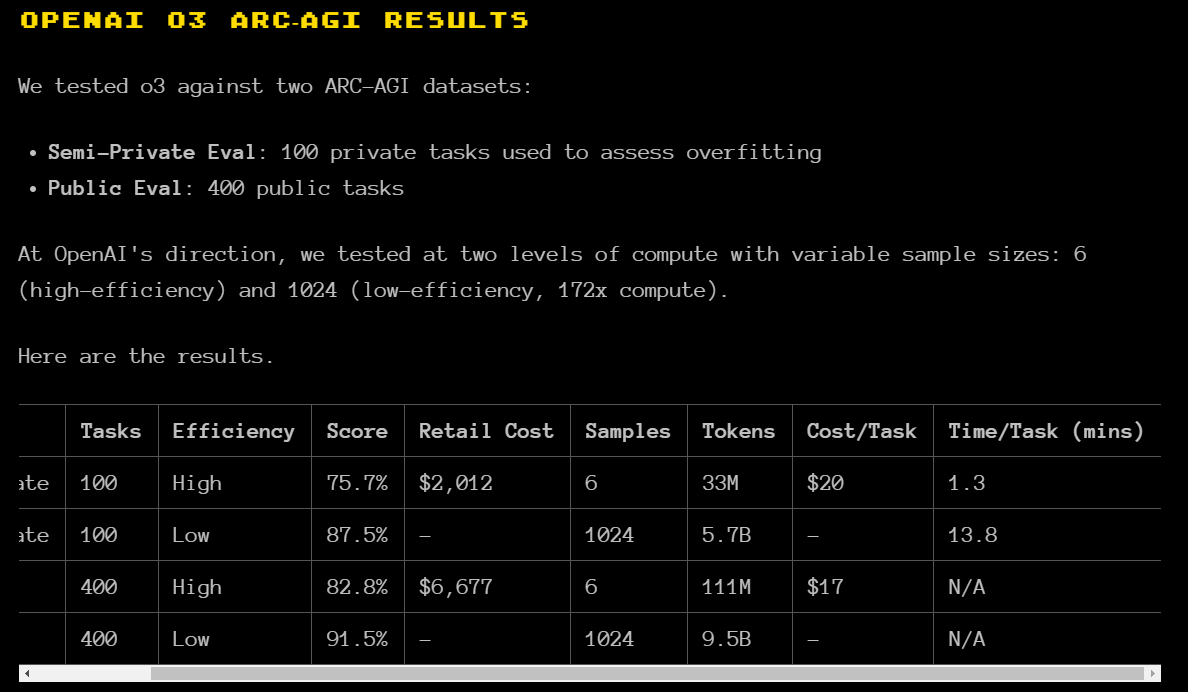
This benchmark, developed by François Chollet, is intentionally designed to push systems beyond what most AI excels at: it tests how well a model can deduce broad rules from just a handful of examples. Instead of merely recognizing patterns from a sea of data—like labeling a million images or generating fluent text—ARC-AGI challenges an AI to figure out something brand-new from minimal clues, much as a person might do when presented with an unfamiliar puzzle on an IQ test.
A typical ARC-AGI puzzle might feature a small grid with an odd shape protruding from one side and demonstrate through three examples how the rule “Any shape with a protruding line will move to the end of that line and cover any shapes it overlaps” should be applied. The fourth grid, unseen by the AI until testing, checks whether the model can correctly extend the same logic.
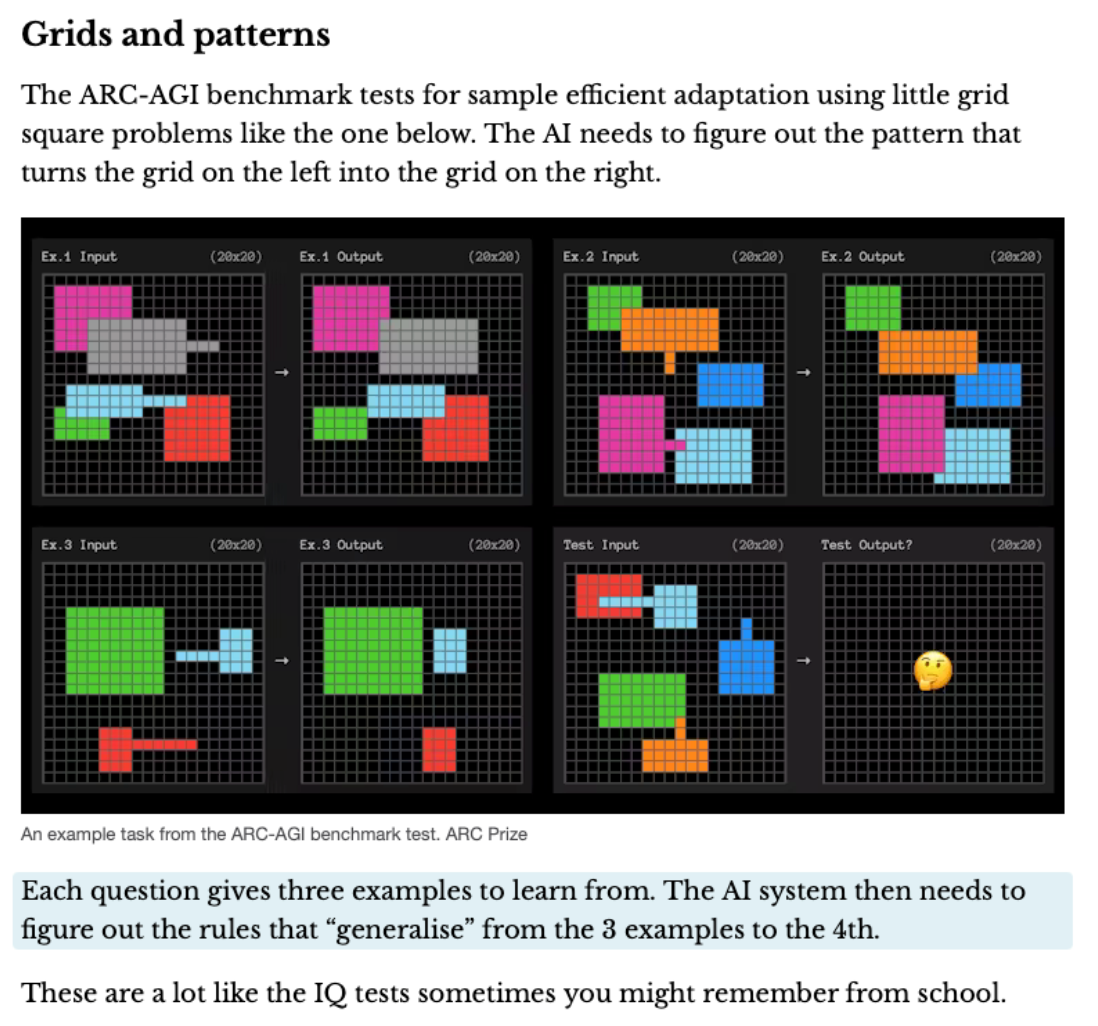
\Thanks to Michael Timothy Bennett Elija Perrierat the Conversationfor this one\
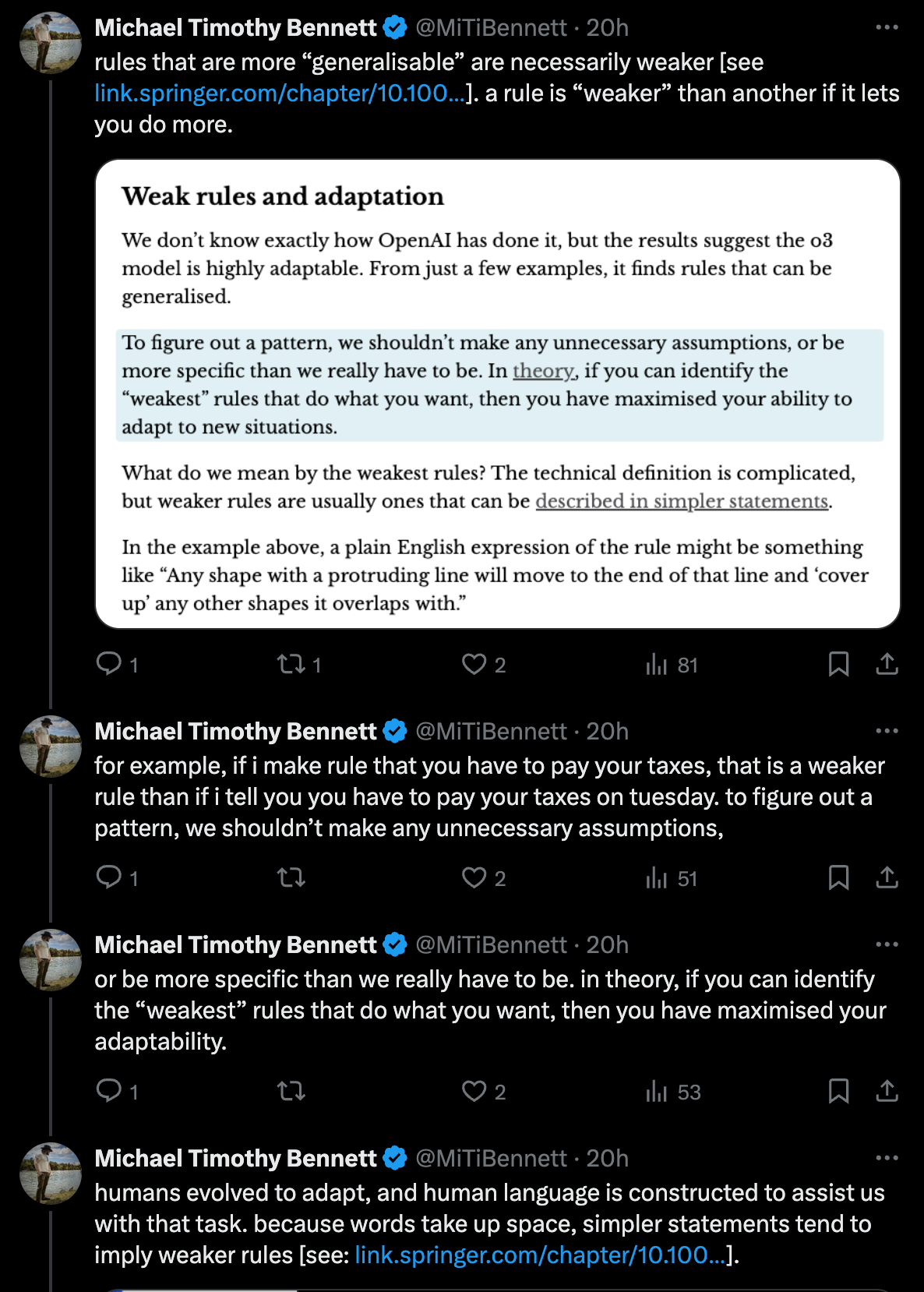
I’ll let Michael frame up what makes ARC-AGI interesting, because I think he says it better than me. The key here is “weak rules,” meaning simple explanations that are general enough to work consistently in new contexts.
So where does this get us with o3? o3’s success on ARC-AGI stands out because previous AI models peaked around 55%, well below human-level performance. Achieving 87.5% marks a radical jump to human-level performance (~85%), one that suggests a shift in how large language models (LLMs) handle reasoning under sparse data conditions. The significance is amplified by o3’s demonstrated strength in other areas, such as complex math and coding, implying it’s not just tuned to one test. If an AI can reliably solve brand-new problems without having memorized a massive corpus of solutions, many researchers see this as a sign of progress toward true Artificial General Intelligence (AGI)—or at least a proxy for how AGI might tackle unfamiliar tasks.
Some skeptics argue that o3 might be “cheating” by overfitting to ARC-AGI puzzles, but the design of ARC-AGI actively guards against that. Each puzzle is meant to be unfamiliar; memorizing a previous puzzle’s transformation rule won’t help when the new puzzle introduces an entirely different concept. Moreover, o3’s ability to prioritize weak rules makes overfitting less likely: by favoring simpler, broadly applicable logic rather than elaborate instructions that only work once, it avoids painting itself into a corner. Plus, as Paul Calcraft and Nat McAleese explain, o3’s likely model design further undermines the overfitting argument. A specialized model typically can’t jump from excelling on one narrow benchmark to another very different domain without extensive retuning. That o3 does so well across tasks suggests genuine flexibility rather than a memorized hack.
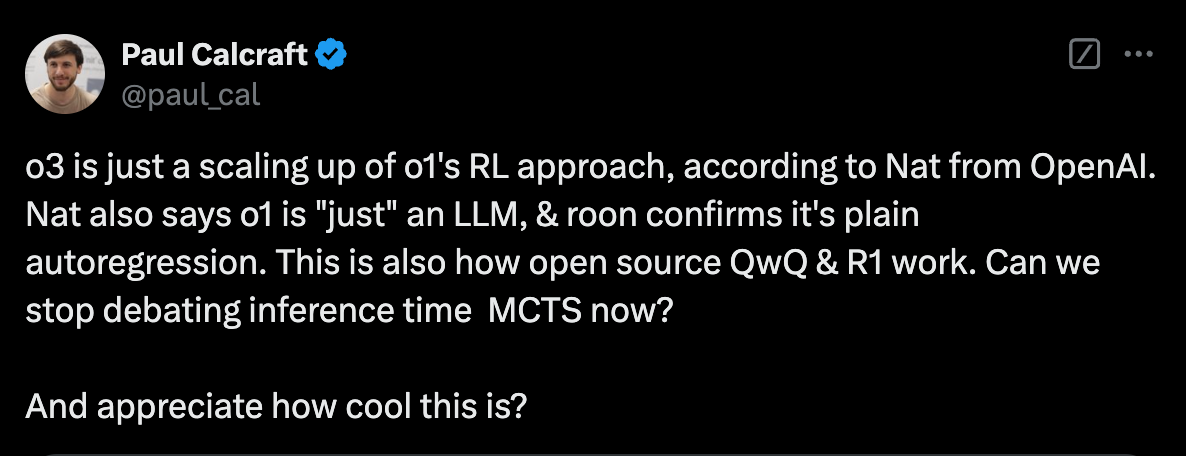
Sidebar: what is MCTS? MCTS is Monte Carlo Tree Search.
Monte Carlo Tree Search (MCTS) is a search algorithm often used for decision-making in game scenarios (like Go or Chess). It simulates many possible future game states by making random “rollouts” (or playouts) down the game tree, then backpropagates the results of those simulations to incrementally improve estimates of which moves are strongest. MCTS doesn’t necessarily involve learning a general policy or value function in the sense that it doesn’t store knowledge across different sessions—unless you combine it with other techniques, it generally starts “fresh” for each new search.
Reinforcement Learning (RL), on the other hand, is a learning framework in which an agent interacts with an environment over multiple episodes or time steps. The agent receives rewards (or penalties) based on its actions, and it continually updates a policy (i.e., a strategy) to maximize cumulative reward. RL approaches (like Q-learning or policy gradients) maintain and update learned parameters across many trials, letting the agent improve from experience rather than just from immediate simulations.
In short:
• MCTS is a search-based approach: it builds a game tree for each situation, simulates possible futures, and picks the best outcome. It doesn’t intrinsically retain long-term knowledge unless paired with a learning component.
• RL is a learning-based approach: it improves a policy by iteratively interacting with an environment and adjusting to maximize rewards over time, accumulating general knowledge that can apply across many scenarios.
They often complement each other (as in AlphaZero), with MCTS guiding search in each move and RL refining a policy and/or value function that informs the MCTS rollouts.
Back to our regularly scheduled programming on o3 and ARC-AGI…
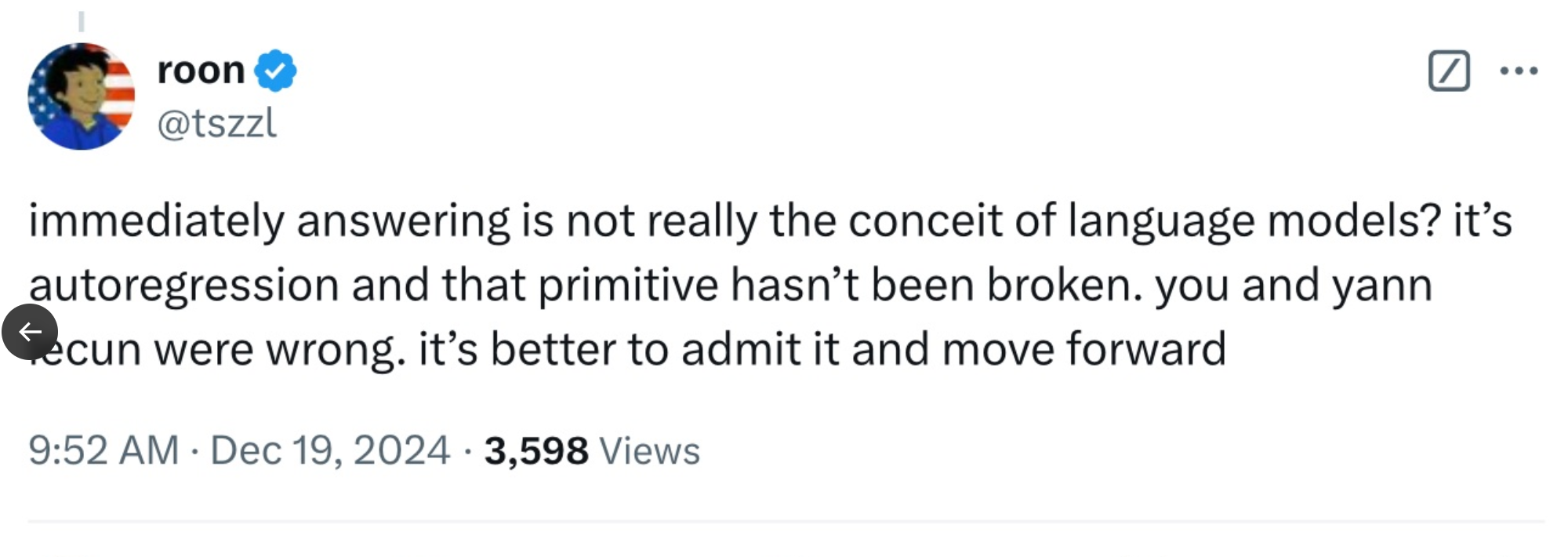
How is o3 built? Well there’s been some speculation online that MCTS is involved in helping o3 achieve its impressive results. But researchers at OpenAI have pushed back pretty hard, including notorious poster roon, who has since deleted this spicy one which means you know it’s good:
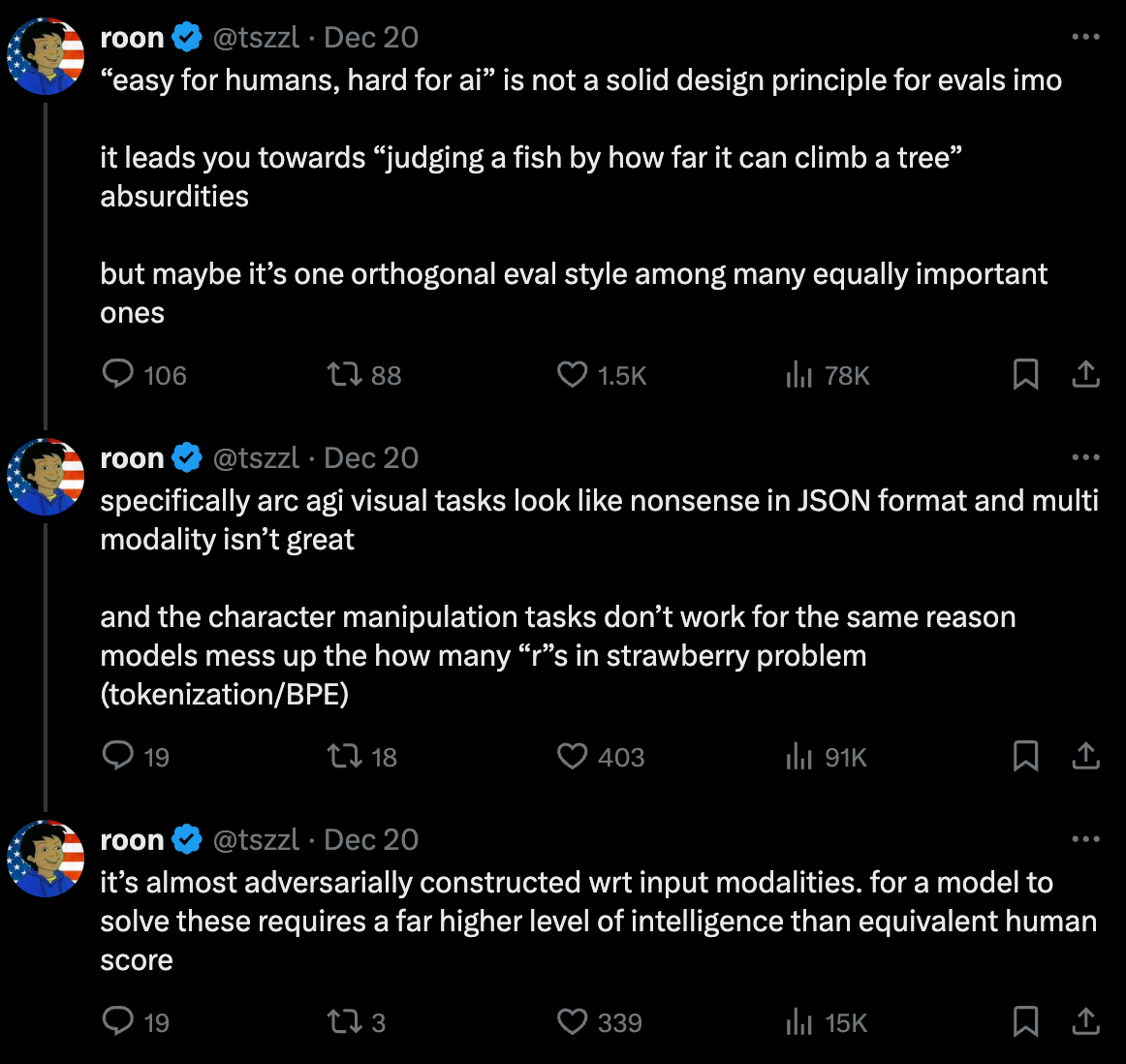
And if you’re wondering what roon thinks of o3 and ARC-AGI, here he is keeping up the spice levels:
So how did it all work? Enough company-formerly-known-as-Twitter gossip!
So here we go. To achieve these results, o3’s developers PERHAPS (we don’t actually know but this is a reasonable guess) combined synthetic traces of step-by-step reasoning with two reinforcement-learning approaches: RLHF (Reinforcement Learning from Human Feedback), where real people guided its learning process, and RLAIF (Reinforcement Learning with AI Feedback), where other AI systems helped evaluate solutions that were too time-consuming for humans to parse. By relying on multiple sources of feedback and perhaps by being rewarded for thinking longer, the model was encouraged to explore long, branching reasoning paths that less adventurous models might dismiss. The repeated theme is that scale and thoroughness, applied to the right type of reasoning, enable o3 to handle puzzles that stump more conventional systems.
A central part of o3’s method is Chain of Thought (CoT) reasoning. Instead of spitting out an answer in one step, o3 simulates numerous potential solution paths internally before deciding which one fits best. François Chollet (French researcher who helped create ARC-AGI) compares this to AlphaGo’s approach in the game of Go—rather than guess a single move outright, AlphaGo explores multiple sequences of moves, rates their viability, and then picks the best line of play. The difference in o3’s case is that it’s tackling abstract visual logic puzzles instead of a board game. At the highest computational settings—172× the standard compute—it processes millions of tokens per puzzle, effectively “thinking out loud” by generating lengthy chains of text that represent all the ways to interpret the puzzle’s rule.
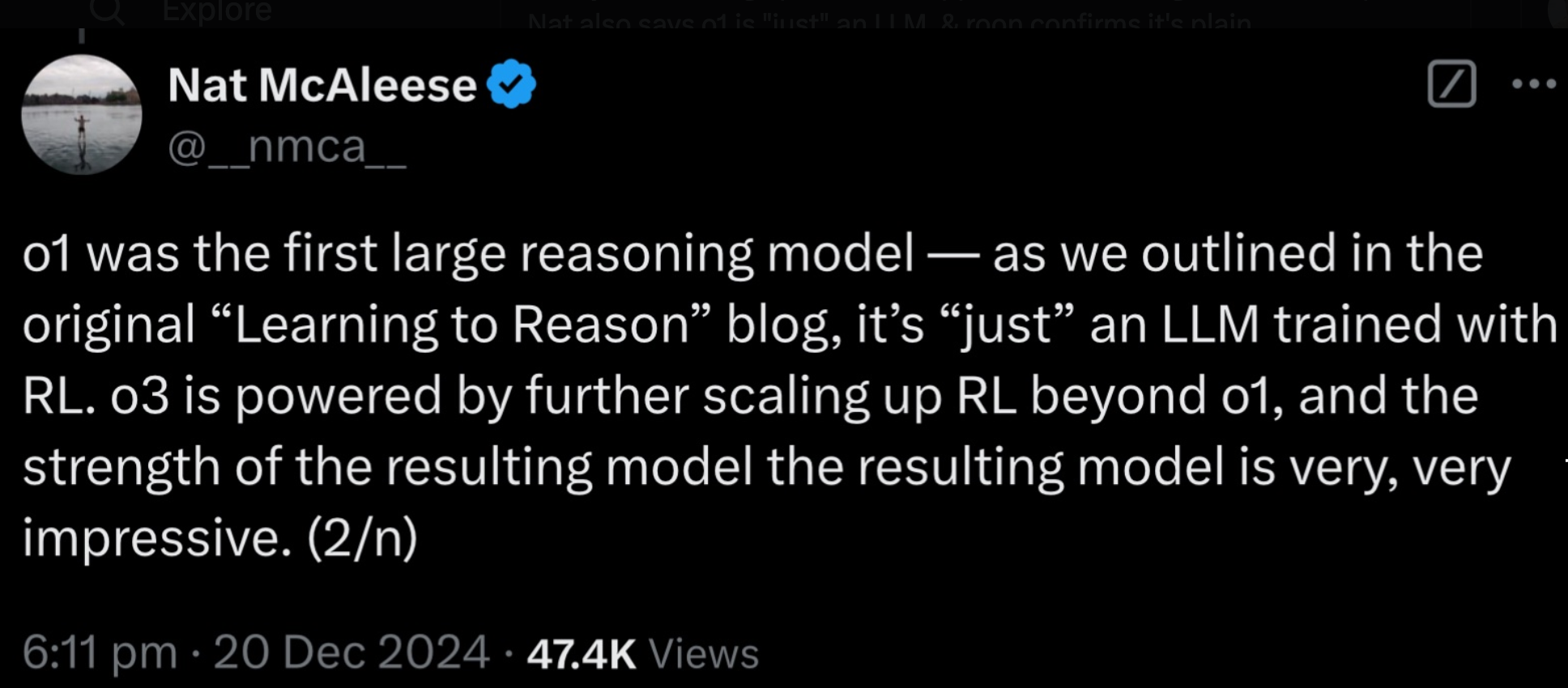
As far as we have been able to gather, it’s still an autoregressive model at its core, as Roon (@tszzl) points out—o3 isn’t a brand-new architecture. It remains a cousin of ChatGPT, just operating at a far larger scale and focusing heavily on iterative reasoning. In fact it MAY be so simple that it runs many many chains of lengthy reasoning and simply picks the answer that comes up most often—no additional heuristic needed. We will find out more in a couple of months here.
I originally included one of those classic “but we should be cautious” paragraphs here. I’m leaving it out. I think the achievement is astonishing the more I look at it. It should be taken on its own merits, and the evidence from OpenAI suggests that as amazing as it is o3 is soon likely to be succeeded by o4.
By hitting 87.5% on ARC-AGI, o3 demonstrates that large language models can, in fact, handle a form of abstract, rule-based reasoning once thought to require genuinely human intuition. LLMs are not JUST LLMs. Combining reinforcement learning with inference time compute may be enough to reach and blow past AGI in 2025. In fact, that should probably be the base case cautious assessment at this point.
I’ll close with a note to those who would say these machines are merely machines—I think one of the defining tensions of the next few years will be how we handle the ongoing conversation around the entangled relationship between intelligence and identity. I for one am fully comfortable (that is slightly uncomfortable but rolling with it) with the idea that the machines can think and remain machines. I don’t think using a word besides think is appropriate, and I think the analogy between basic neural firing patterns and the basic next token prediction of LLMs bears more thought. We may discover the latter gives rise to less complex behavior in our own brains than the former does in specially purified sand circuits.
(References: François Chollet, Michael Timothy Bennett, Paul Calcraft, Roon (@tszzl), Western\_Objective209, Nat McAleese.)
For more on AI, subscribe and share!

\The sand has begun to think…\