Part 1 of "From Labor to AI: Unraveling the Historical Threads of Work, Economy, and Society"
By Nate
Published: 2024-11-20
URL: https://natesnewsletter.substack.com/p/the-great-decoupling-labor-growth
The Machines are Coming!
Machines will eliminate 73 million U.S. jobs by 2030! Have you seen dramatic headlines like this before? So have I. And they are fear mongering. In this case, that’s a real number that I’ve deliberately cherry picked to highlight how our discourse has skewed AI job discourse toward fear uncertainty and doubt. The source (McKinsey—who else) actually projected a range of 39M to 73M jobs and used the absolutely critical word displaced, rather than lost. It’s a good example of the lazy thinking that dominates reporting on this issue, and it’s why I wrote this post.
But focusing just on what’s wrong with bad messaging and shallow analysis misses a deeper truth: our economy has already learned to grow while using less human labor than ever before. And we have done so consistently while managing (broadly speaking) the impacts of significant dislocation.
Look at the numbers. In 1800, the U.S. economy produced $0.05 trillion in GDP with 95% of people working. Today, we produce $24.42 trillion with only 60% of people in the workforce. This isn't a statistical quirk. It's the story of how technology changed our relationship with work.
Breaking Free from Total Labor
In 1800, everyone worked. Children spent their days in fields and factories. The elderly worked until they couldn't stand. Weekends didn't exist. Retirement was a foreign concept.
The first crack in this system appeared between 1800 and 1900. Labor force participation dropped from 95% to 89%. Behind these numbers lay real change: the first child labor laws, mandatory schools, basic pensions. Technology had created enough surplus that society could free some people from constant work.
Then came the Great Depression. Labor force participation crashed from 85% to 65% between 1929 and 1933. The crisis forced America to rethink work itself. The New Deal proved government could manage technological disruption. This lesson would matter.
The post-war years tell an odd story. From 1945 to 1970, America boomed. Yet labor force participation kept falling, from 70% to 67%. This era taught us something vital: technological gains could translate into higher wages and shorter hours for workers.
Digital Growth Takes Off
The real explosion came after 1970. Labor force participation dipped modestly to 60%. But GDP shot up like a rocket. Computers and the internet proved you could create massive economic value with less human work.
This breaks our instincts about growth. We assume making more means working more. History shows the opposite. Our biggest economic gains came as we needed less human labor.
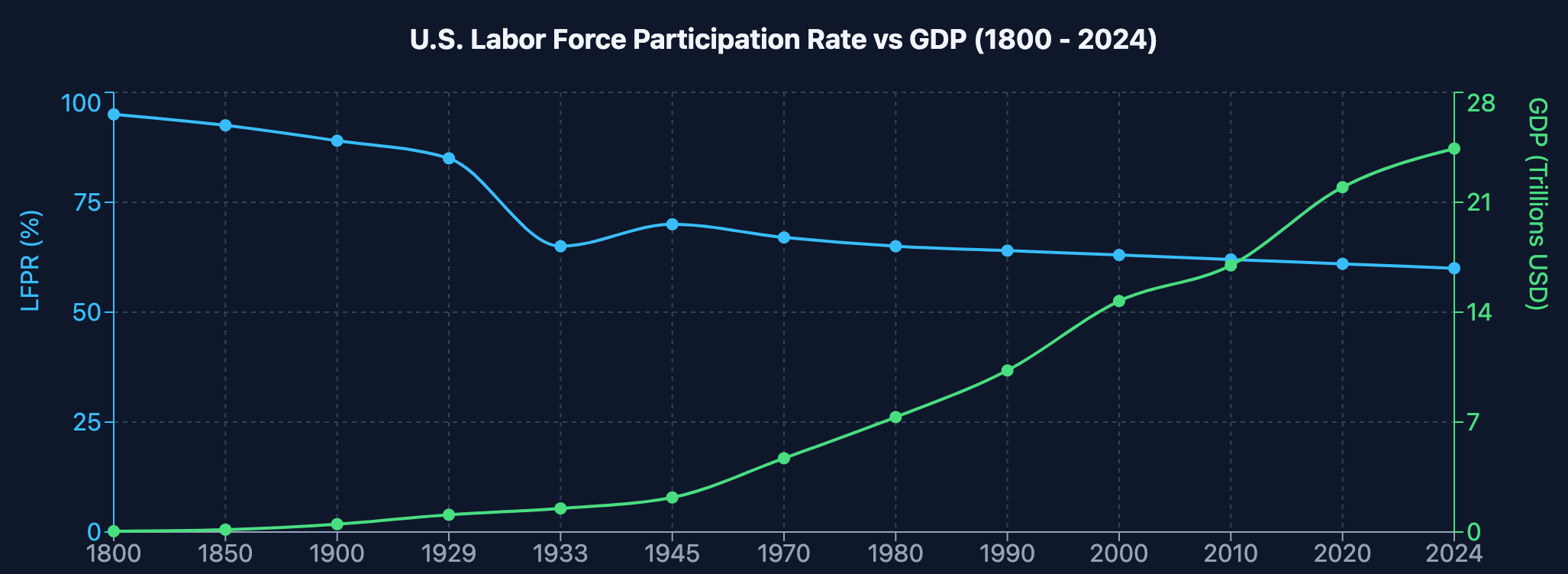
\Source: U.S. Bureau of Economic Analysis, Historical Statistics of the United States\
The Paradox of Efficiency
The economist William Stanley Jevons spotted this pattern in 1865. He saw that better coal efficiency led to more coal use, not less. New technology doesn't just save resources – it opens new possibilities that increase total activity.
Email shows how this works. It should have made communication more efficient than mail or phones. Instead, office workers spend more time communicating than ever. The technology didn't reduce work. It expanded what we could do (see Slack lol).
Look at cloud storage. Costs dropped 98% in ten years. Yet spending keeps rising because the cheap storage enabled new data-heavy industries. Efficiency didn't shrink demand. It created new kinds of work.
How Work Changes
Technology doesn't just replace human labor. It transforms it. The industrial revolution transformed craftwork into a TikTok craft business but created industrial design and made affordable apparel possible at billions scale. Computers eliminated human calculators but gave us software developers. The internet closed stores but built digital commerce.
Each wave of automation kills some jobs. But it also makes new work possible – work we couldn't imagine before. We now have reiki dog massage therapists as a real job, which is an actual example I heard Jeff Bezos use during an all hands at Amazon a few years ago.
The Road Ahead
Back to McKinsey. Those 73 million automatable jobs by 2030 tell an old story in new form. History suggests we're asking the wrong question. Instead of worrying about naming exactly which jobs will vanish, we should ask what new work will emerge, because that is what allows us to prepare in advance.
Falling labor force participation doesn't mean human work loses value. It means technology lets us be pickier about how we use human effort. The challenge isn't stopping automation. It's sharing the benefits of higher productivity, just as previous generations did.
Our next piece will explore how these patterns play out in today's AI revolution. We'll examine unprecedented AI adoption rates and what they mean for the future of work. The great decoupling is accelerating. It brings new challenges – and new possibilities for human labor in the age of AI.
Next in this series: "Beyond Automation: Understanding AI's Economic Transformation," where we'll examine the explosive growth of the AI market and its implications for the future of human work. I’m including a complete list of resources used in preparing this piece at the end of each article for clarity.
Enjoyed this? Subscribe and share!

\It may not look like much, but mills like this were the beginning of modernity\
Endnotes: From Labor to AI Series
[1] “Automation and Job Loss Statistics”
• Description: Analysis projecting that by 2030, an estimated 73 million U.S. jobs could be eliminated by automation.
• Source: Zippia
• URL: <https://www.zippia.com/advice/automation-and-job-loss-statistics/>
[2] “U.S. Labor Force Participation Rate”
• Description: Historical data showing that the U.S. labor force participation rate stood at 62.6% in October 2024.
• Source: Statista
[3] “Industrial Revolution”
• Description: Historical context on the impact of the Industrial Revolution on labor.
• Source: Encyclopædia Britannica
• URL: <https://www.britannica.com/event/Industrial-Revolution>
[4] “Labor Force Participation: What Has Happened Since the Peak?”
• Description: Analysis of labor force participation rate changes since the peak.
• Source: U.S. Bureau of Labor Statistics
[5] “Consumer Price Index, 1800-”
• Description: Historical economic data from 1800 onwards.
• Source: Federal Reserve Bank of Minneapolis
[6] “22 Top AI Statistics & Trends in 2024”
• Description: Analysis projecting a $3.8 trillion gain in the manufacturing sector by 2035 due to AI adoption, and a projected 21% increase in U.S. GDP by 2030 due to AI.
• Source: Forbes Advisor
• URL: <https://www.forbes.com/advisor/business/ai-statistics/>
[7] “Dr. Jevons’ Paradox and Energy Demand”
• Description: Examination of Jevons’ Paradox in modern contexts, illustrating how increased efficiency can lead to increased consumption.
• Source: Goehring & Rozencwajg
• URL: <https://blog.gorozen.com/blog/dr-jevons-paradox-energy-demand>
[8] “The State of AI in 2024”
• Description: Research indicating that 65% of organizations report regularly using generative AI in at least one business function.
• Source: McKinsey & Company
• URL: <https://www.mckinsey.com/capabilities/quantumblack/our-insights/the-state-of-ai>
[9] “Moravec’s Paradox: What Is It and What Does It Mean for AI”
• Description: Explanation of why AI excels at complex tasks but struggles with tasks humans find intuitive, highlighting the limitations of AI.
• Source: AI Plus Information
• URL: <https://www.aiplusinfo.com/blog/moravecs-paradox-what-is-it-and-what-does-it-mean-for-ai/>
[10] “Employee Development Statistics You Need to Know Right Now”
• Description: Data indicating that 60% of workers need training before 2027, and that 53% of organizations prioritize upskilling and reskilling.
• Source: Deel
• URL: <https://www.deel.com/blog/employee-development-statistics/>
[11] “A.I. Is Going to Disrupt the Labor Market. It Doesn’t Have to Destroy It.”
• Description: Analysis of AI’s impact on the labor market and suggestions for adaptation, emphasizing a nuanced understanding of AI’s role.
• Source: Chicago Booth Review
• URL: <https://www.chicagobooth.edu/review/ai-is-going-disrupt-labor-market-it-doesnt-have-destroy-it>
[12] “The Next Wave: Automation and Canada’s Labour Market”
• Description: Study indicating that 22% of current jobs in Canada are at high risk of automation, with projections of a decline of about 90,000 jobs in high-risk occupations by 2028.
• Source: Future Skills Centre
• URL: <https://fsc-ccf.ca/research/the-next-wave-automation-and-canadas-labour-market/>
[13] “United States Unemployment Rate”
• Description: Provides the latest unemployment rate data for the U.S., offering context on current labor market conditions.
• Source: Trading Economics
• URL: <https://tradingeconomics.com/united-states/unemployment-rate>
[14] “Labor Force Participation Rate: Purpose, Formula, and Trends”
• Description: Offers an overview of the labor force participation rate, its significance, and recent trends.
• Source: Investopedia
• URL: <https://www.investopedia.com/terms/p/participationrate.asp>
[15] “Designing a Successful Reskilling Program”
• Description: Provides insights into effective reskilling strategies and their impact on bridging skill gaps, emphasizing the importance of continuous learning.
• Source: Harvard Business Review
• URL: <https://hbr.org/2024/07/designing-a-successful-reskilling-program>
[16] “The Impact of Artificial Intelligence on Economic Development”
• Description: Explores how AI is expected to influence economic growth and development globally, offering a macroeconomic perspective.
• Source: Emerald Insight
• URL: <https://www.emerald.com/insight/content/doi/10.1108/jebde-10-2023-0022/full/html>
[17] “Global AI Market Projections”
• Description: Indicates that the global AI market is projected to reach $407 billion by 2027, with an annual growth rate of 37.3% from 2023 to 2030.
• Source: Forbes Advisor
• URL: <https://www.forbes.com/advisor/business/ai-statistics/>
Note: All URLs were accessed as of November 19, 2024. Some source material may have been updated or modified since the original publication.