Pardon the Chapell Roan reference, but it's Monday and we're having fun
By Nate
Published: 2024-10-29
URL: https://natesnewsletter.substack.com/p/todays-sharp-thought-homomorphic
A few days ago, Apple dropped a short paper discussing how they use Homomorphic Encryption (HE) to keep data private for Apple Intelligence. I’ve been familiar with HE in the context of data clean rooms, where HE offers a privacy-first solution that enables compliant data matching and modeling. AI brings new challenges on data privacy (who wants to share their ChatGPT history?) and data privacy has become a crucial concern as AI applications expand.
How does it work? Essentially, HE allows computations on encrypted data without ever decrypting it, keeping sensitive information secure while still enabling functionality. Here’s how it works: when a client encrypts data—say, a medical record or financial transaction or a picture of your trip to Paris—the encrypted form retains the same “computational shape” as the original data. This means that encrypted data can undergo the same mathematical operations as unencrypted data, allowing the server to perform computations directly on this encrypted version. Once complete, the server returns an encrypted result to the client, who decrypts it to see the outcome. Throughout this process, the server never accesses or reveals the underlying data, so your data stays private.
I think the Apple paper drew this better than I could, so I’ll just include their diagram of how this works for using Apple Intelligence to identify photographs using natural language here:
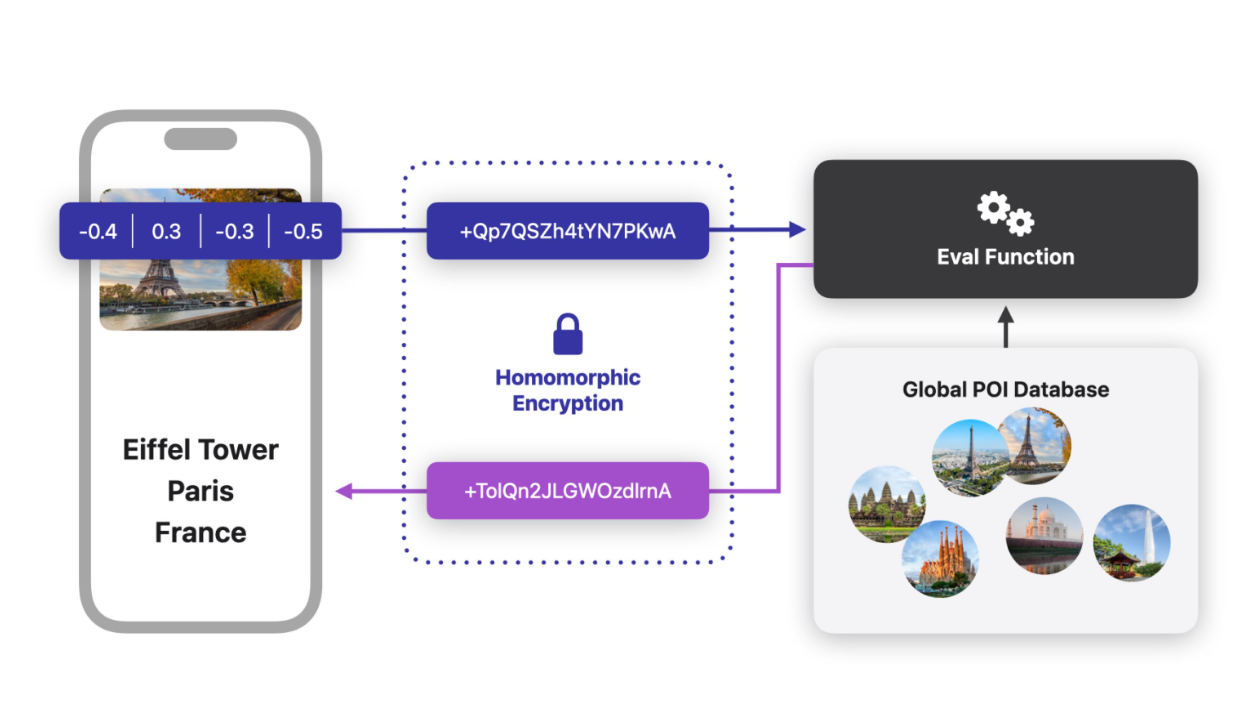
\Essentially, your photo becomes an unreadable hash that is matched to find similar unreadable hashes in the points of interest database Apple has created.\
With Apple publicly flagging this as useful with AI, HE is about to get a lot more use. Enabling computation on encrypted data opens up new possibilities for data security in fields that rely on private information, such as healthcare, finance, and cloud-based AI services. HE removes the usual “decrypt and compute” requirement, enabling sensitive data to remain always locked down while still being useful.
It’s not just the end user’s call, either. HE can secure data through the AI stack, at least potentially. Apple’s architecture here assumes HE encrypted databases for reference. Training and inference in machine learning can now happen under an encrypted layer, securing data from end to end. I’d have to dig deeper, but logically speaking I think there’s no reason why o1’s reasoning token approach shouldn’t be able to work off HE encrypted inputs as well.
The HE data clean room approach peddled by cloud services and the HE thinking around AI may meet in the next year as we start to see more secure AI in the cloud. There’s no hard technical obstacle to building a system that enables users to encrypt data on their devices before sending it for cloud processing for a wide range of business or personal applications. This approach potentially gives a compelling answer to the perennial “Is my data secure?” objection that AI sellers hear from business buyers in 2024. HE as a basis for AI tooling would enable powerful cloud AI tools without exposing raw data, offering greater control over personal and business information.
In collaborative machine learning, HE can work with federated learning to enable privacy-first data sharing across organizations. Imagine several hospitals jointly training a diagnostic model, with each hospital’s data encrypted throughout the process. This could lead to more secure urban infrastructure, such as smart city systems analyzing urban data without compromising residents’ privacy.
I’m not here to promise a silver bullet. HE demands high computational power and slows processing, which may in and of itself be why OpenAI is not (as far as I know) using it. Chips are more precious than gold, and anything that requires more chips at scale is going to rightly get questioned. HE also hasn’t been fully standardized, so companies often need to roll their own. Standardization of any security protocol opens vulnerability, but would also potentially enable scale.
Today’s Sharp Thought: AI offers unprecedented access to our thoughts as we chat with it more and more. It demands a more robust approach to privacy, and Homomorphic Encryption offers one of the first plausible ways to retain encryption throughout and continue to enjoy the advantages LLMs afford.
If you enjoyed this post, subscribe and share!

\Interesting that MidJourney visualizes HE as a hole in a steel wall with a view\