Understanding patterns of technological adoption over time has never been more critical to succeeding as a builder
By Nate
Published: 2024-10-25
URL: https://natesnewsletter.substack.com/p/todays-sharp-thought-entrepreneurship
When I grew up in Southeast Asia, I was basically a little IR nerd who loved reading about east Asian politics. Fortunately there was a (now defunct) magazine called the Far Eastern Economic Review (FEER was a great acronym) that gave me plenty of news and nerdy political takes on China and Southeast Asia. I loved it, and I’m sad it’s gone, but I was thinking of it his week when I realized we probably need to coin a term for whatever AI think we’re all living through.
Sam Altman has called it the Intelligence Age, and because he’s Sam that’s probably going to stick. But I always had a fondness for those cute Century-this-and-that type monikers—FEER used Pacific Century a lot to remind readers that economic activity was shifting to the Pacific Rim—so I thought I’d play around with a name for the 21st century now that we have a brand new defining general purpose technology,existing%20economic%20and%20social%20structures.).
I suggest we call this the Cognitive Century. Double C’s make it memorable. Harkens back to the long historical perspective we get with verbal frames like the Pacific Century, the American Century, etc.
With that in mind, let’s take a little historical detour. Fundamentally I think we’ve been living through the after-effects of the Industrial Revolution since the Newcomen engine was developed in 1712. Jason Crawford puts this well in a blog post covering the two century productivity boom unlocked by the Newcomen machine. It’s not as long a read as you think!
Jason argues we should view the industrial revolution as a model for general purpose technology adoption. That’s not a particularly new idea, but I want to refine that idea in a couple of ways here with an eye on AI.
First, I think time is not an accidental measure of these massive changes we all live through. Quite the opposite. I’d argue compressing linear time is one of the core drivers for these technological explosions and that the human motivation to pull the future forward into the present is one of the key dynamics that drives technology adoption curves over time.
Extending that thought a bit further, I think the desire to compress time is a reason why general purpose technology adoption curves have gotten relentlessly shorter. But just because the adoption curve shortens doesn’t mean that it ever ends. I believe tech adoption is asymptotal and effectively never reaches zero.Just think about it: the stone age arguably began 3.3 million years ago, and yet when I grew up on the island of New Guinea stone tools were still in use. This reminds me of the 1990’s tourist marketing campaign in Indonesia that Indonesians “lived in 30 centuries at once”—that sense of overlapping time is something I want to keep in mind as we think about AI.
Another way to think about it is that these technological adoption curves are ragged, and they fray across time. A lot of our stories as individuals is going to be shaped by how we negotiate our surfing position on the edge of the roiling changes of the great technologies of our age. Let’s take a simplified view here.
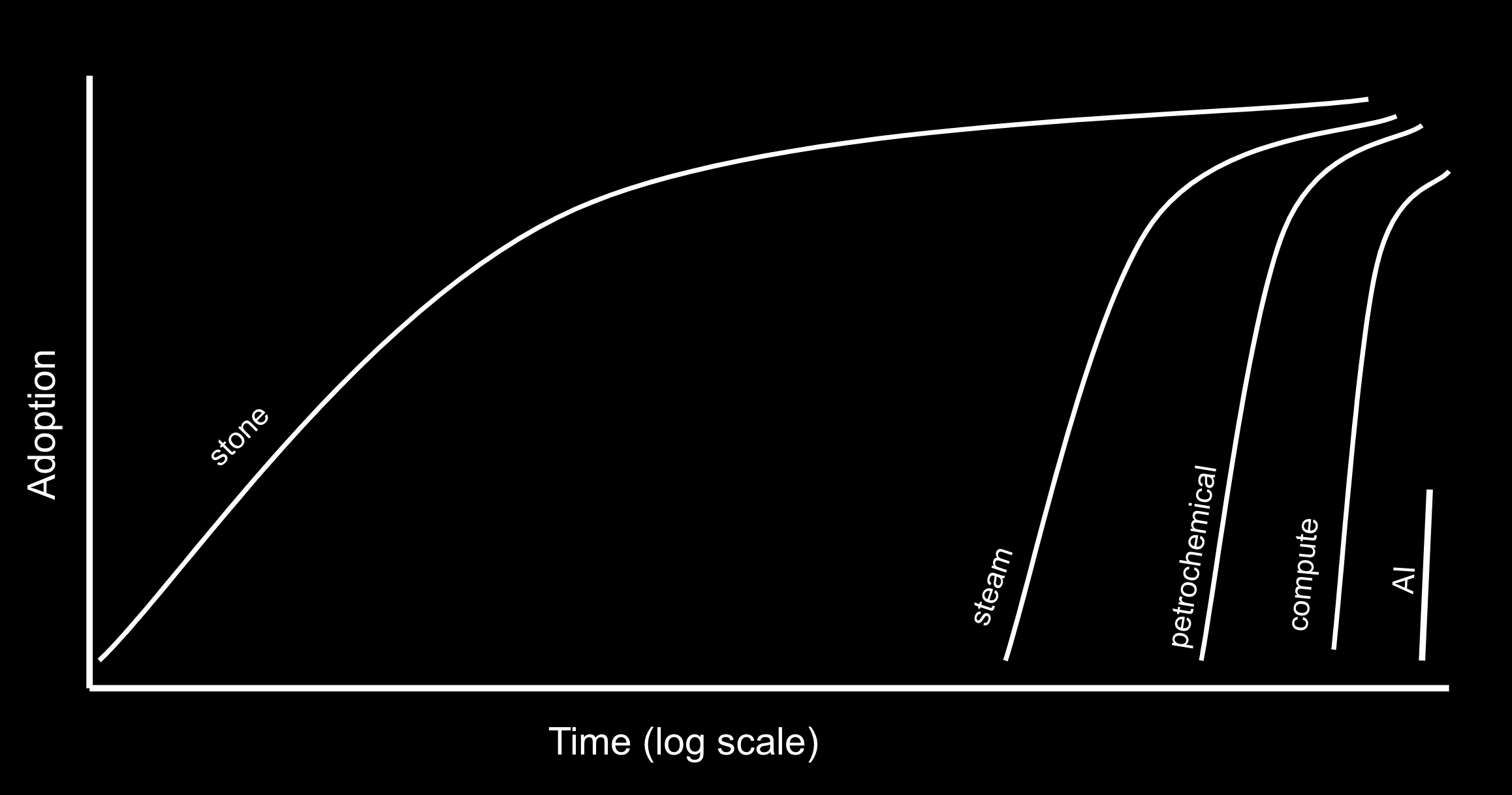
\Adoption curve of general purpose technologies over time (simplified)\
These adoption curves keep happening faster, but they’re still not instantaneous. The adoption of the steam engine took roughly two centuries. Petrochemicals took a century or so and isn’t quite done yet. Computers took 50 years, very roughly. It would not surprise me to see AI take a couple of decades, at least. Which would still make it the fastest adoption of a general purpose technology in history.
Why do these curves keep getting faster? Because the technology itself is about compressing value and effectively pulling time forward. Steam engines compressed the time and labor it took to make cloth. Computers compressed the world, bringing information at the click of a mouse. AI is compressing intelligence, taking what previously took hours to write and turning it into a 30 second pretty ok first draft. We invent this stuff to pull time forward, and we keep getting better at it.
And this idea of compressing value offers opportunities to entrepreneurs during the AI adoption tidal wave. I think there are hundreds of billions of dollars to be made in building solutions and offering services that effectively arbitrage time: taking the cutting edge of AI that’s available to early adopters and translating it into simpler solutions and options that humans further back on the adoption curve can get excited about.
There are billions of people who have never tried ChatGPT. There are tends of thousands of businesses doing a million dollars or more in revenue who have an interest or fear about AI but no idea how to get started. And there are thousands of businesses who are partway along the value chain. Maybe they offer a little stipend for ChatGPT, maybe they have a tiger team for AI. And all of these examples represent viable, marketable customer segments for builders.
I hear all the time “well this startup is already doing that,” and my answer is almost always “I don’t care.” The value of AI coupled with the ragged nature of the adoption curve means millions of business niches. If you’re a builder, find yours. You’ll have plenty of time to build a business just helping people adopt AI tools and practices. If you’re looking for an analogy here, there are going to be AI versions of John Deere, a company that has provided petrochemical (and lately electrical) driven tools to farmers, effectively displacing the horse in certain markets around the world.
The ragged edge of AI adoption isn’t just a temporary phase; it’s a structural characteristic of how revolutionary technologies diffuse through society. People and organizations will move onto and off this edge, creating dynamic shifts in competitive advantage. And this is happening faster than ever because of the compression shift—the Doppler effect—we observe in general purpose technology revolutions. Revolutions are speeding up, which means that entrepreneurship is going to look more like a swashbuckling Kessel run or running an honest trading business on Tatooine than building a staid bank at the heart of the Imperium. If Star Wars isn’t your jam, you can find the same analogy in Arrakis and Dune.
The point is that I believe entrepreneurs and builders (even inside companies) are going to need to get scrappier and more resilient as AI explodes faster than previous changes. I think this pressure to stay agile plus the tremendous productivity gains of internal AI tool use are feeding into Sam Altman’s prediction that we will see billion dollar companies built by ten people. Looking at the pace of AI development, I might go further and say we’ll see one person billion dollar companies in the next few years.
Today’s Sharp Thought: I’ll leave you with this. I believe the value to be unlocked in the next decade or so in AI is more than the value unlocked by all previous general purpose technologies combined. I think there are thousands of niches for competitive AI businesses across the ragged edge of the adoption curve, and those niches will change quickly. Therefore the future belongs to entrepreneurs who have a strong meta-skill in connecting AI to human needs, even as both are evolving.
Enjoyed this post? Subscribe and share!

\I asked Midjourney to draw the ragged edge of AI adoption and it did good\