By Evie Wentink
Published: 2026-07-16
URL: https://ethicaledge.substack.com/p/your-15-minute-break-is-a-legal-minefield
A notice quietly posted in King County, Washington this year is worth more attention than it’s gotten. It reads, in essence: you may be owed money because your employer didn’t let you eat lunch properly.
That’s not an exaggeration. It’s the plain-English version of a real class action.
The Case in Brief
In Gerald Arevalo, et ano. v. AT&T Mobility Services LLC, et al., Case No. 25-2-20318-2 SEA, pending in King County Superior Court, two former AT&T employees, Gerald Arevalo and Skylar Ruen, alleged that AT&T and several affiliated entities failed to provide compensation for missed and noncompliant meal and rest periods in violation of Washington law. AT&T disputes the claims and has not admitted wrongdoing.
The parties reached a proposed settlement of $1,750,000, and on May 6, 2026 a Washington court preliminarily approved it, authorizing notice to go out to the settlement class — all non-exempt employees of the AT&T entities in Washington from July 11, 2022 through the date of preliminary approval. Final court approval is still pending, and no money moves until that happens.
This isn’t an isolated incident for the company, either. AT&T has faced a string of similar meal-and-rest-break claims across the country in recent years, including a related California action, Gilbert v. AT&T Mobility Services, where the company agreed to resolve allegations that it failed to pay minimum and overtime wages, provide compliant meal and rest breaks, reimburse business expenses, issue accurate wage statements, pay wages when due and pay sick pay wages. A separate 2020 settlement addressed claims that AT&T failed to pay employees when they worked during their meal and rest breaks, leading the company to modify its policies for breaks, ensuring that employees get to take their break, and if skipping it is unavoidable due to work duties, employees will receive the premium pay rate to which they are entitled.
The pattern across these cases is consistent: it’s rarely that a company forbids breaks outright. It’s that operational pressure — call volume, understaffing, “just finish this one thing first” — quietly erodes break compliance until it becomes a legal liability.
Why This Keeps Happening
Here’s the part most employees don’t realize: there is no federal law that requires a lunch break or a rest break. The Fair Labor Standards Act is silent on the subject for adult workers. Whether you’re legally entitled to a break — and whether it must be paid — depends entirely on which state you’re standing in when your shift starts.
That patchwork is exactly what trips employers up, especially multi-state ones. A break policy that’s perfectly legal in Texas is a wage violation in Washington. And even within states that do mandate breaks, the rules on timing, duration, pay status, and penalties diverge sharply.
What This Means If You’re an Employee
If you work in one of the roughly twenty states with a meal-or-rest-break mandate, and you’re routinely:
-
Working through lunch without being paid for it,
-
Having your break interrupted by calls, texts, or “just one more customer,”
-
Never actually getting a break at all despite an 8+ hour shift,
...you may have a wage claim, not just a scheduling complaint. That’s the exact theory behind the AT&T settlement: the claim wasn’t that breaks were banned, it was that they were promised on paper but not delivered in practice, and employees weren’t compensated for the difference.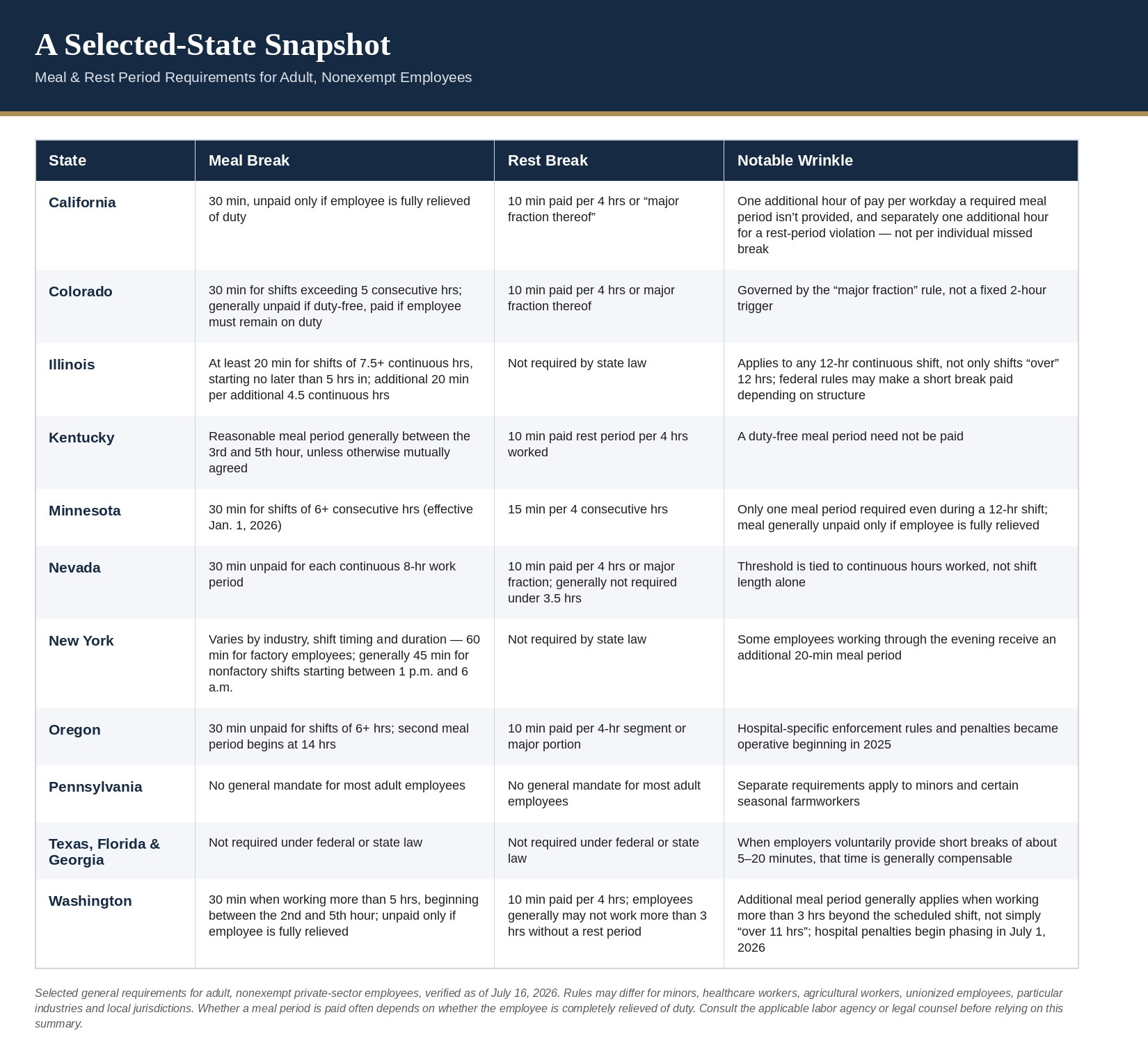
When an Employee Reports This: Don't Just Note It, Act on It
If an employee tells you they’re not being compensated for missed or interrupted breaks, that report is not a scheduling footnote. Treat it as a wage-and-hour signal, and treat it fast.
1. Don’t investigate the employee — investigate the practice. The instinct to ask “are you sure?” or “did you clock out correctly?” reads as deflection, and it usually is. The right first question is operational: what does this person’s actual shift look like, day to day, versus what the policy says it should look like? Pull the time records. If breaks are logged as taken but the employee says they were working through them, that gap is the finding — not a discrepancy to explain away.
2. Assume it’s not isolated. One employee rarely surfaces a problem that’s unique to them. If staffing levels, call volume, or coverage gaps made this person’s break impossible on a given day, the same conditions were almost certainly in place for their teammates on the same shift. Scope the review to the team or location, not just the individual, before you close the loop.
3. Fix the pay before you fix the policy. Back wages and break premiums owed are not contingent on a broader audit finishing first. If the record shows a missed or short break, compensate it. Waiting until “we’ve sorted out the whole system” to make someone whole is how a single complaint becomes a class of them.
4. No policy defense without enforcement evidence. A handbook that promises a 30-minute lunch is not a shield if the staffing model makes that lunch impossible to take. If you can’t show the break was operationally protected — enough coverage, no expectation of “just handle it if something comes up” — the written policy will not hold up, in an audit or in front of an employee who’s already lost trust in it. This matters most for multi-state operations: a hands-off approach that’s legal in Texas is a liability in Washington or California, so “we have a policy” only counts if it’s enforced to the strictest standard among the states you operate in.
5. Protect the person who spoke up. Nothing kills future reporting faster than a manager who gets visibly annoyed that someone raised this. Confirm directly with the employee that flagging it was the right call, and make sure their manager isn’t the one handling the investigation if there’s any chance of friction.
6. Close the loop, in writing. Tell the employee what was found, what’s being paid, and what’s changing operationally so it doesn’t happen again. Silence after a complaint reads as nothing happened, even when something did.
The Bottom Line
A break sounds like the smallest thing in an employment relationship. It isn’t. The moment an employee tells you they’re not getting paid for missed or interrupted breaks, that’s not a complaint to manage — it’s a liability to close, and a trust problem to repair. The AT&T case in King County is what happens when that conversation doesn’t happen internally first: the break issue stops being a fixable HR matter and becomes a $1.75 million legal one.
This article is for general informational purposes and is not legal advice. If you believe you’ve been denied legally required breaks or compensation, consult an employment attorney licensed in your state, or contact your state’s department of labor.