The headline number: $4.44 million globally, $10.22 million in the US
By Evie Wentink
Published: 2026-07-16
URL: https://ethicaledge.substack.com/p/the-true-cost-of-a-data-breach-in
A data breach isn't a single bill — it's a slow drip of expenses that can run for years after the initial incident: forensic investigations, legal fees, regulatory fines, customer notification, credit monitoring, lost business, and increasingly, class action settlements. Here's what the latest data actually shows.
The headline number: $4.44 million globally, $10.22 million in the US
According to IBM’s 2025 Cost of a Data Breach Report (its 20th annual edition, based on Ponemon Institute research into 600 breached organizations across 17 industries and 16 countries), the average global cost of a data breach dropped to $4.44 million, down from $4.88 million the year before — a 9% decline and the first drop in five years. The improvement is largely credited to faster breach containment driven by AI-powered defenses, with organizations identifying and containing breaches within a mean of 241 days, the lowest in nine years.
But that global decline masks a very different story in the United States. The US average breach cost actually rose to $10.22 million, driven by regulatory fines and slower detection times — a 9% jump that IBM’s global partner and head of X-Force attributed to a “widening gap” between the US and the rest of the world, driven partly by more American organizations reporting steeper regulatory fines.
A few other cost drivers worth knowing:
-
Shadow AI is expensive. Unauthorized generative AI tools used without security team visibility added roughly $670,000 to the average breach cost, and shadow-AI-linked breaches lasted longer (247 days vs. the 241-day average) and involved higher rates of customer PII exposure (65% vs. 53%).
-
Multi-environment storage costs more. Breaches involving data spread across multiple environments — public cloud, private cloud, and on-premises — cost an average of $5.05 million, versus $4.01 million for breaches confined to on-premises data.
-
Phishing remains the top entry point. Phishing was the most common initial attack vector across all breaches studied, and also one of the costliest, averaging $4.8 million per incident.
-
AI cuts both ways. On average, 16% of data breaches now involve attackers using AI, with phishing accounting for more than a third of those AI-powered attacks. On the defensive side, organizations making extensive use of AI and automation cut their breach lifecycle by 80 days and saved nearly $1.9 million on average compared to those that didn’t.
Class action settlements: a record-breaking year
Cost-of-breach reports only tell half the story. The other half is what happens when affected customers sue — and 2025 was a landmark year for that side of the ledger.
Data privacy class actions totaled more than 1,800 filings in 2025, averaging over 150 filings per month — more than 25% growth over 2024, and more than 200% growth since 2022. Duane Morris’s annual Class Action Review, which tracked over 1,700 class action decisions industry-wide, found that more than 1,700 class lawsuits of all types were settled in 2025 for a combined total of $79 billion — nearly double the prior year’s figure and a new record. Data breach and privacy litigation was a major contributor to that surge: plaintiffs filed nearly 1,900 data privacy class actions in 2025 alone, and “almost any significant cyber incident now triggers an immediate wave of class filings.”
Why the explosion? Major breaches typically take three to six years to work through the litigation pipeline before reaching a settlement, which means the wave of mega-breaches from 2020–2023 (Equifax’s aftershocks, MOVEit, and others) is now cresting through the courts in 2025 and 2026 — producing more open data breach class action settlements than at any point in US history.
The largest data breach settlements on record include:
-
Equifax — $380.5 million, covering roughly 147 million affected people
-
T-Mobile (2021 breach) — $350 million, plus a separate $150 million pledge toward improved cybersecurity, covering 76–77 million customers
-
Capital One — $190 million, covering about 106 million people
-
Anthem — $115 million, covering roughly 78.8 million people
-
AT&T (two combined 2024 incidents) — $177 million, still awaiting final court approval as of mid-2026
-
23andMe — $30 million, tied up in the company’s bankruptcy proceedings
-
Kaiser Permanente (web-tracker litigation) — $46 million
Beyond the mega-settlements, dozens of smaller cases resolve every month — often healthcare providers, credit unions, staffing agencies, and regional businesses paying anywhere from a few hundred thousand to tens of millions of dollars. As of mid-2026, trackers list dozens of currently open settlements with claim funds ranging from roughly $250,000 to tens of millions of dollars each, alongside high-profile ongoing litigation over incidents at PowerSchool, Oracle Health (Cerner), and the Snowflake-linked breaches affecting Ticketmaster, Neiman Marcus, and Advance Auto Parts.
One structural quirk worth noting: individual payouts are often tiny relative to headline settlement totals. In mega-breach settlements, the bulk of the money typically goes to credit-monitoring services (valued at retail rates) rather than cash, and claim rates for cash options usually run only 5–15% of the eligible class. Divided across a class of 100+ million people, that can work out to just a few dollars per person — even when the top-line number reads in the hundreds of millions.
Which industries get hit hardest?
Healthcare has topped IBM’s industry cost rankings for 14 consecutive years, and 2025 was no exception — though costs there actually fell: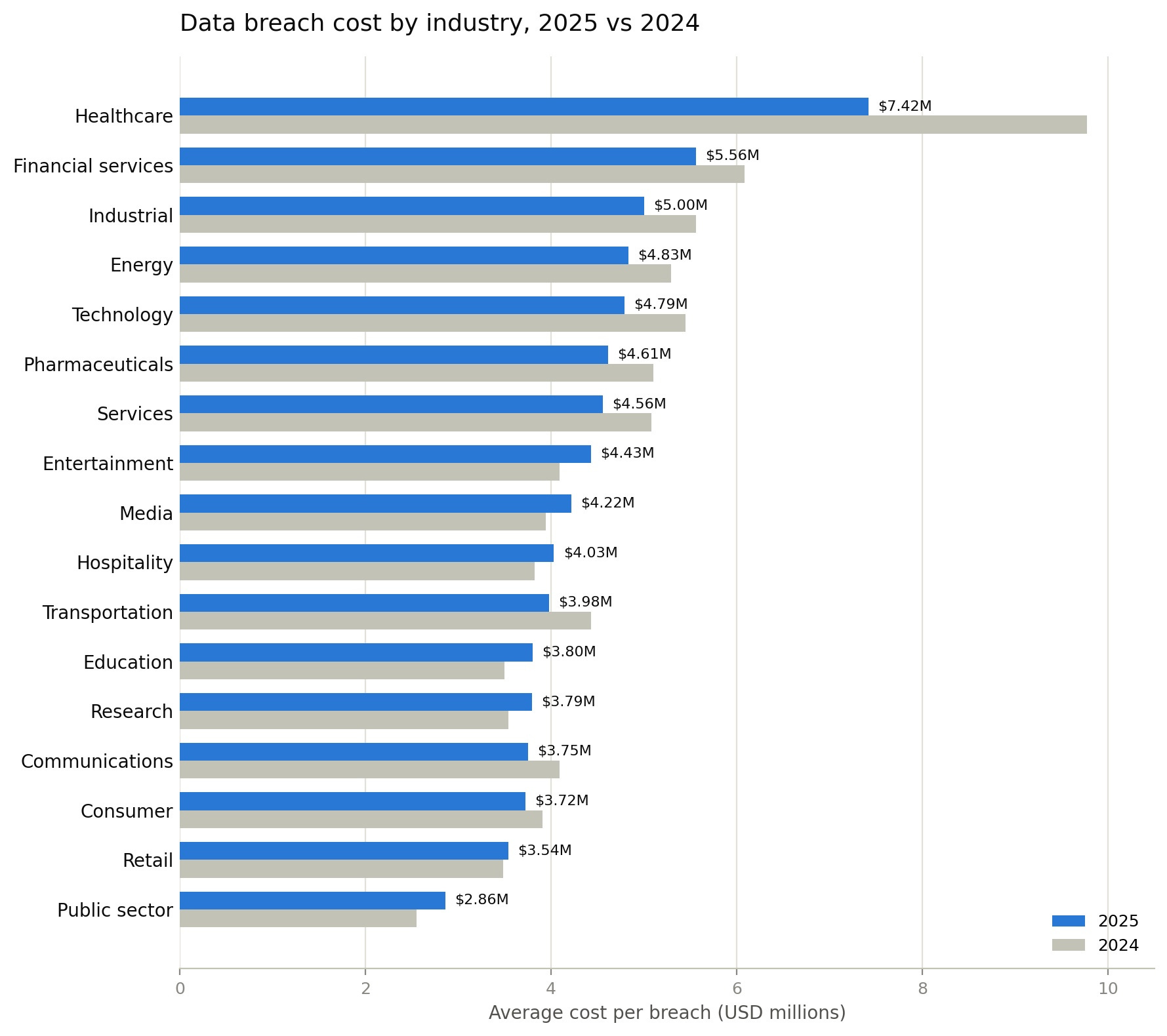
Source: IBM Cost of a Data Breach Report 2025, Figure 3
Why healthcare stays on top: it’s not just about volume — it’s about the value and shelf life of the data. A full medical record is worth far more on dark web markets than a stolen credit card number, because it can’t simply be canceled and reissued the way a card can. Healthcare breaches also take the longest to detect and contain: 279 days on average, more than five weeks longer than the global average — and every extra day of undetected compromise adds to the final bill. Heavy regulatory obligations (HIPAA in the US, GDPR in Europe) compound the cost with mandatory notification, remediation, and potential fines.
Financial services ranks second largely because of regulatory fines, fraud liability, and the fact that the sector remains a favored target for sophisticated, well-resourced attackers, including nation-state actors.
Interestingly, not every industry moved in the same direction. While most sectors saw breach costs decline year-over-year, entertainment, media, hospitality, education, research, retail, and the public sector all saw costs increase in 2025 — a reminder that the “AI is lowering costs” story doesn’t apply uniformly everywhere.
Why is this still happening — and where’s the gap?
With billions spent annually on cybersecurity, it’s worth asking why breach numbers and settlement totals keep climbing rather than falling. The data suggests this isn’t mainly a technology problem anymore — it’s a discipline and governance problem.
Attackers are exploiting known gaps, not zero-days. Vulnerability exploitation is now the leading entry vector into breaches, and organizations are getting slower at closing those gaps, not faster: median time-to-patch has risen roughly 34% in recent reporting, and only about a quarter of vulnerabilities on CISA’s Known Exploited Vulnerabilities catalog get fully remediated. Attackers largely aren’t inventing new tricks — they’re walking through doors that have been left open for weeks or months.
The supply chain is now the biggest blind spot. Roughly half of all breaches now involve a third party, a sharp year-over-year increase. Most organizations still audit their own systems far more rigorously than the vendors, contractors, and service providers they hand data to — often relying on a self-reported questionnaire instead of enforced, verified controls.
AI adoption is outrunning AI governance. This is the fastest-growing gap. The large majority of AI-related breaches occur at organizations that never put access controls on their AI tools, and most breached organizations either have no formal AI governance policy or are still writing one. Even companies with a policy rarely audit for “shadow AI” — employees pasting sensitive data into unapproved tools. Adoption simply outpaced oversight: it was faster and cheaper to let people start using AI than to govern how they used it.
The basics never went away. Phishing remains the single most common way attackers get in, and human error and IT misconfiguration together account for roughly half of all breach causes. No amount of advanced tooling fixes a person clicking the wrong link or a cloud storage bucket left open — and several of 2026’s largest breaches trace back to exactly that.
The gap, in short, isn’t a tooling gap — it’s an execution gap: the space between what organizations know they should do and what they actually enforce day to day. Policies get written but not audited. Vendors get assessed on paper but not verified. Security teams see risks that leadership doesn’t fully act on. And each new technology wave — cloud, now AI — gets deployed faster than the guardrails around it get built.
What actually helps
The organizations that avoid or contain breaches well tend to share a few habits:
-
Patch against a prioritized list, not everything at once. Remediation progress against CISA’s Known Exploited Vulnerabilities catalog is a far better predictor of resilience than “we run regular scans.”
-
Enforce access controls and MFA with vendors contractually, not just through a self-reported questionnaire — since third-party compromise now accounts for close to half of all incidents.
-
Write an AI governance policy before scaling AI use, not after. At minimum: which tools are approved, what data can be input, who has access, and a real audit schedule — not just a document that exists on paper.
-
Invest in detection speed. Breaches caught internally cost meaningfully less than those an attacker has to disclose publicly — every extra day of dwell time adds to both direct cost and legal exposure.
-
Practice incident response as a skill, not a binder. Many headline breaches trace back to training and readiness gaps as much as technical ones; teams that have rehearsed containment procedures consistently contain incidents faster than teams that haven’t.
The uncomfortable summary: breaches persist less because defenses are weak in some exotic technical sense, and more because organizations keep treating governance, patching discipline, and vendor accountability as slower, less urgent priorities than growth and adoption — until the bill, financial and legal, arrives.
The bottom line
Four trends are converging right now:
-
Detection is getting faster, which is genuinely bringing global average costs down for the first time in five years — but mostly for organizations with mature AI-driven security operations.
-
The US is becoming the most expensive place in the world to have a breach, thanks to regulatory penalties and litigation exposure that other regions don’t face at the same scale.
-
The legal aftermath is only getting bigger. With data privacy class actions up more than 200% since 2022 and a multi-year backlog of major breaches now reaching settlement, 2026 is shaping up to bring even more record-setting payouts — regardless of what happens to the underlying breach-cost average.
-
The root cause has shifted from technology to execution. Most breaches now trace back to known, unpatched vulnerabilities, unaudited third parties, and ungoverned AI use — problems that are organizational and behavioral, not purely technical.
For any organization handling sensitive data, the message from the numbers is fairly blunt: the cost of a breach is no longer just what it takes to fix the technical problem. Increasingly, it’s what happens in court years later.
Figures cited from IBM’s 2025 Cost of a Data Breach Report (Ponemon Institute), Duane Morris’s 2026 Class Action Review, and settlement-tracking sources current as of July 2026.
Thanks for reading Ethical Edge by Evie’s Substack! This post is public so feel free to share it.