On sabbaticals, imposter syndrome and what slowing down actually gives you
By Prabh Kaur
Published: 2026-05-21
URL: https://curiousintelligence.substack.com/p/dont-lose-your-sense-of-wonder
I’ve been in the AI industry for almost a decade - long enough to remember when organizations were still experimenting with it, when explaining what you did for work required a lot of context, when not many people outside the industry knew what to make of it. I watched it move from proof of concept to boardroom mandate to the thing everyone is suddenly an expert on.
After a three month sabbatical, I came back feeling like an imposter.
If that’s where I landed after a decade, I keep thinking about what everyone else must be feeling right now. People watching AI reshape their industries overnight. People who joined the workforce when AI had already stopped being an experiment and started being an expectation, and still feel behind. People who are deeply skilled in their industry and wondering if it still counts.
The answer isn’t to catch up faster. It’s to slow down enough to notice what you’re actually building - which, in my case, turned out to be the one thing AI cannot have.
A sense of wonder.]()
Wonder is the entry point.
One afternoon in India, I sat beside my mother while she used for the first time. She spoke to it in Hinglish - that fluid mix of Hindi and English that’s just how we talk - and it understood her.
Wonder is the entry point. Not expertise, not staying current - just honest curiosity about what this thing can do. She had a question and she asked it.
AI can process language and synthesize information at a scale no human can match. What it cannot do is feel that spark of genuinely wanting to know something just because you want to know it. Wonder belongs to you. Protect it.
I wrote about her for Mother’s Day on Wonderlogue - about presence, and what you see when you slow down enough to look.
Community is infrastructure.
I spent almost two months of my time away in India. Not passing through — being there. Living at a slower pace, around people I’ve known most of my life, inside rhythms that predate every technology conversation I’ve spent my career having.
India runs on a different cultural architecture than most of what I navigate professionally. Solidarity isn’t a programme or an initiative — it’s built into how people move through the world. Showing up is not discretionary. Community is not a benefit or a perk. It is the baseline assumption.
One evening over a couple of glasses of wine, my sister and I got deep into this — about AI, about India, about how intelligence in this country has always been embedded in everyday life. She turned that conversation into a piece about Mumbai dabbawalas, mothers as recommendation engines, auto drivers as Google Maps before Google Maps existed. I think it’s one of the most joyful takes on AI I’ve read.
Watching all of this up close, I kept thinking about organizations — about how we talk about culture as something to be built or transformed, when the more honest question might be what we’ve dismantled along the way. Values, trust, the willingness to show up for each other without being asked — these are not soft things. In a world being reshaped by AI, they are the infrastructure everything else runs on. The technology will keep changing. What holds people together, when it’s working, doesn’t.[
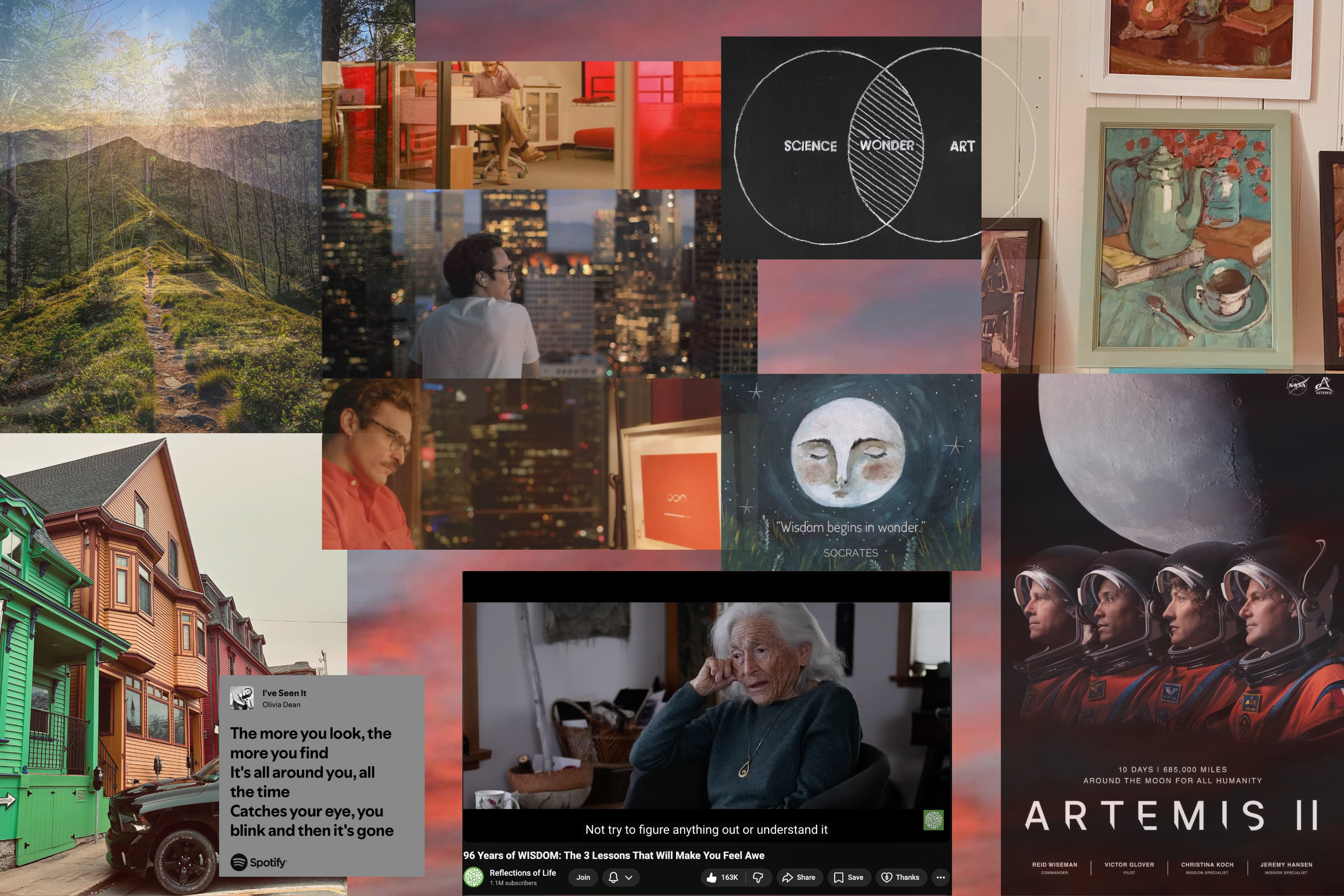
](https://substackcdn.com/image/fetch/$s!l36M!,fauto,qauto:good,flprogressive:steep/https%3A%2F%2Fsubstack-post-media.s3.amazonaws.com%2Fpublic%2Fimages%2F2174da38-51f0-4e9d-a045-1ae56b7a6b5e_3000x2000.png)Scroll to the end for what inspired this essay — a few things worth watching, reading, or listening to.
Presence is where pattern recognition lives.
Slow down enough and you start noticing things that were always there. The sunset is slightly different every single day. The moon changes shape every couple of days — reliably, indifferent to everything happening on the internet. The body knows when to wake up before the alarm does.
There’s a reason artists talk about process the way they do. I got a little nerdy about Olivia Dean’s The Art of Loving — not just the music but how the album came together, what she was sitting with when she made it. Understanding how something was made changes how you receive it. I watched a lot of science fiction. Her felt less like a thought experiment and more like a description of the present. The gap between what these films imagined and where we actually are kept closing the more I paid attention.
Presence isn’t a practice you adopt. It’s what’s left when you stop moving fast enough to avoid it.
Awe has to be lived.
I went hiking — trails where the only sounds were birds and wind through trees. Around the same time, I came across NASA Artemis coverage — astronauts describing the view of Earth from space. One small, luminous sphere. We are one species on one planet in one galaxy among billions. The universe is not organized around us.
Which brought me to a question I keep sitting with: who decided that humans are the most intelligent form of life on this planet? Humans. We made that call ourselves.
Something opened. I started exploring consciousness — not the AI version, the older question. What awareness actually is. Whether it belongs only to us. What it means that we are part of something vastly larger than what we can measure. Awe is what happens when you encounter something that exceeds your framework for understanding it. AI can process. It cannot be humbled. That distinction matters more than most AI conversations acknowledge, and it deserves its own essay.
A creative renaissance is coming.
Right before starting my new job, I asked to pick a place for a solo trip — my final break. It said Lunenberg. I found myself in an art gallery, talking to a painter.
We ended up on AI: what it means to have your life’s work used to train models without consent or compensation. The outputs being generated that look like art but came from extraction. He was making his work while we spoke, completely absorbed — thinking about it seriously but not bitterly. We talked about UBI, about capitalism and what it’s built to value, about what a world looks like when creativity is no longer scarce.
I left with one of his paintings. I just trusted what I felt standing in front of it.
We are heading toward a creative renaissance — not despite AI, but because of the pressure it’s creating. Artists don’t disappear. Wonder doesn’t disappear. What shifts is the ecosystem around them, and what emerges from that pressure is something I’m still forming.
All of this points toward something I want to explore on Curious Intelligence — pattern recognition as the intelligence that compounds, and why wonder is the prerequisite most people are skipping. You can’t develop it by consuming more. You develop it by slowing down enough to actually see.
AI cannot feel wonder. It cannot be humbled by the vastness of what it doesn’t know. It cannot stand in front of a painting and feel something shift.
The capacity for wonder is yours. It’s the foundation of pattern recognition, intuition, the judgment that makes you irreplaceable. It doesn’t require a grand pause. It requires attention.
Don’t lose your sense of wonder.
Glad to be back in the arena.[
](https://substackcdn.com/image/fetch/$s!kmS7!,fauto,qauto:good,flprogressive:steep/https%3A%2F%2Fsubstack-post-media.s3.amazonaws.com%2Fpublic%2Fimages%2F545a99c8-988a-42e9-a246-6fbd03e7f9a6_1200x571.jpeg)
Curious Intelligence explores the future of intelligence at the intersection of AI, leadership, economics, and human behavior. Subscribe to follow what comes next.
What fed this essay — a few things worth your time:
📺 96 Years of WISDOM: The 3 Lessons That Will Make You Feel Awe — Dot Fisher-Smith, via Reflections of Life. Watch this one slowly.
🎬 Her — Spike Jonze. Watch it again if you’ve already seen it. It hits differently now.
🎵 Olivia Dean — The Art of Loving. Then watch this podcast.
🎵 Sam Fender — anything. Start with Seventeen Going Under.
📖 The Bell Jar — Sylvia Plath. For when you need someone to have already named what you’re feeling.