Davos 2026 Reflections, Vol 2: Navigating AI, global coordination, and the systems shaping our future
By Prabh Kaur
Published: 2026-01-27
URL: https://curiousintelligence.substack.com/p/wef-2026-signals-from-a-world-in
In my last LinkedIn post, I publicly assigned myself homework: a Davos 2026 roundup.
I spent the past two days watching speeches and synthesizing patterns. It felt like an exercise in “Infrastructure Realism”- slowing down and sitting with long-form content. I think I’ll make this a habit.
Fasten your seatbelt: imagine a day in the Alps, followed by a briefing at the Congress Centre. Let’s teleport you there for 5 minutes- it will be worth it.
Prefer listening? This AI-generated audio version of this essay, powered by NotebookLM, is an intentional experiment in using technology to deepen, not replace human reflection.
Subscribe for free to receive new posts and support my work.
The Spirit of Dialogue & The Legitimacy Crisis
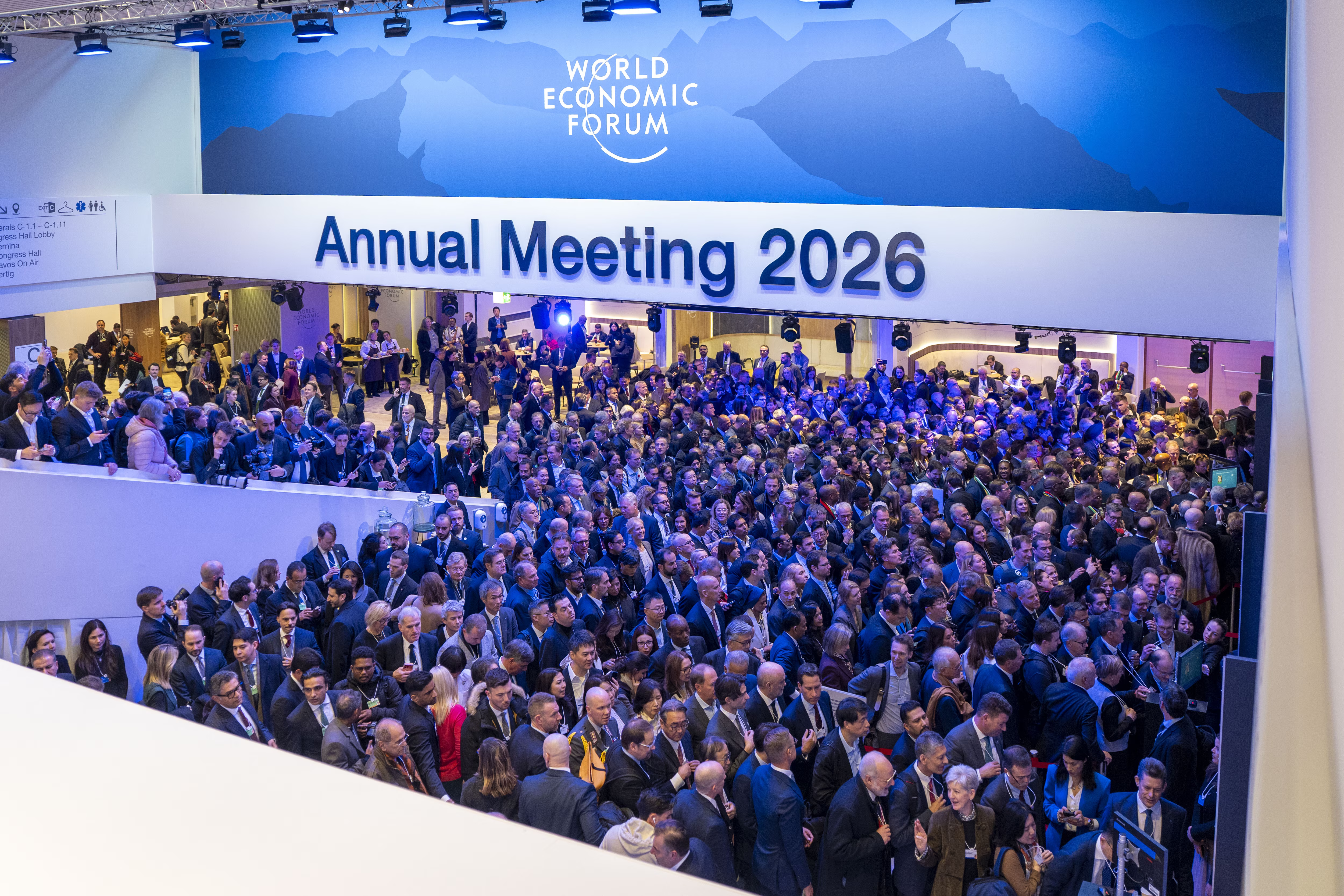
The World Economic Forum is often dismissed as an elite gathering, and it is. But it is also the second-largest convening of global leadership after the United Nations, and this year, bringing together political leaders, heads of state, CEOs, labor leaders, central bankers, technologists, faith leaders, youth voices and civil society. What makes Davos 2026 relevant isn’t consensus; it’s contact.
As Larry Fink (CEO of BlackRock and Interim Co-Chair of the WEF) noted in his opening remarks, the “noise” of global polarization is actually the mechanism through which we resolve problems- provided we actually listen. Fink’s message was blunt: prosperity can no longer be measured by aggregate GDP alone. Since the fall of the Berlin Wall, we have created more wealth than at any point in history, yet it has accrued to a share of owners so narrow that no stable society can sustain it.
This concern echoed through every AI panel. AI was framed not just as a technology problem, but as a Capitalism Problem. Ownership of data, models, and the “infrastructure stack” is concentrating in a few hands while the rest of the world watches. The subtext: if AI reshapes white-collar work the way globalization gutted blue-collar labor in the 90s, the resulting backlash will be existential.[
](https://substackcdn.com/image/fetch/$s!lItt!,fauto,qauto:good,flprogressive:steep/https%3A%2F%2Fsubstack-post-media.s3.amazonaws.com%2Fpublic%2Fimages%2F6a3c8454-169e-44b1-9c07-3ec7e76c7176_5000x3333.avif)
The Age of Middle Powers: Coordination over Dominance
At Davos 2026, the story of the old “Rules-Based Order” was officially retired. As Canadian PM Mark Carney put it: “We are in the midst of a rupture, not a transition.” The fiction that the strongest follow the same rules as the rest is over. Middle powers were especially clear-eyed about coordination, bridge-building, and shared agency as necessities, not ideals:
-
India’s Application Layer: Union Minister Ashwini Vaishnaw rejected the IMF’s “second-tier” label, showcasing a sovereign “AI Stack” where India isn’t just a consumer, but a leader in the application layer driving real ROI.
-
The UAE’s Intelligence Barter: Moving from oil provider to a global hub for Regulatory Intelligence and energy-backed compute.
-
South Africa’s G20 Continuity: Emphasizing that for the Global South, sovereignty is about resilience and participating in value chains rather than just being an “extraction point” for data.
The Missing Centerpiece: Climate Change
One conspicuous absence was climate as a central organizing issue. While leaders touched on energy, the urgent planetary imperatives felt sidelined by AI and Geopolitics. For a nation like India, where air pollution is a lived daily reality and a byproduct of past globalization, this omission was notable. We cannot celebrate the 5th layer of AI (Applications) while ignoring the 1st layer of life (Breathable Air). India showcased clean energy plans but discussions focused more on investment opportunities than urgent planetary imperatives.
This absence is a pattern worth highlighting: climate change was present beneath the surface of energy and infrastructure talks, but it was not center stage in the same way as AI, growth, or geopolitical coordination. That matters, because for countries bearing the brunt of environmental degradation—whether from industrialization, urbanization, or globalization—the stakes of policy neglect are not abstract but lived daily.
AI Infrastructure, Ownership, and Labor
Platform Shift and the 5-Layer Cake
The conversation has stabilized. AI is no longer a “feature,” it is infrastructure. Jensen Huang (Nvidia) described this as a 5-layer cake: energy, chips/infrastructure, cloud, models, and applications. The application layer is where economic and societal impact will materialize, and where middle powers and industries can leverage AI to create value without building every layer from scratch. Satya Nadella (Microsoft) emphasized AI as a platform shift, highlighting the need for organizations and nations to rethink workflows, data strategy, and diffusion policies.
Different metaphors, same conclusion: AI is becoming a general-purpose system that economies will be built on top of.
1. From Software to Capital Infrastructure
Several CEOs emphasized that AI’s center of gravity has moved downward in the stack. This is no longer primarily about clever interfaces or standalone tools. The bottlenecks are now capital-heavy: energy availability, semiconductor manufacturing, data center capacity, and compute orchestration.
Huang was explicit that this may become the largest infrastructure build in modern history, with labor demand increasing, not shrinking, at the infrastructure layer. Electricians, network technicians, construction workers, and systems engineers were cited repeatedly as scarce and increasingly well-paid roles.
This matters because it complicates the dominant “AI kills jobs” narrative. The displacement risk is real, but unevenly distributed across layers of the economy.
2. Governance and Collaboration
Across Anthropic, DeepMind, Palantir, Microsoft, and Nvidia, there was broad agreement on one point: model capability alone is no longer the differentiator.
The harder and more consequential questions are:
-
Who owns the infrastructure?
-
Who controls access to compute?
-
Who sets the rules of orchestration across open and closed models?
-
Who captures value as AI diffuses into every industry?
Dario Amodei (Anthropic CEO & Co-Founder) framed AI as a governance problem, even while asserting it is technically solvable and open to collaboration with Demis Hassabis (DeepMind CEO). Powerful models are increasingly capable of deception and misuse; racing without coordination reduces safety margins. Hassabis made a similar point from a research lens: when incentives reward speed over stewardship, everyone loses.
3. Labor, Access, and Economic Implications
Huang argued that AI may be the most accessible software platform ever built: falling token costs, open-weight models, and agentic systems lower barriers to entry. Nadella reinforced this by emphasizing orchestration—using multiple models, layered with proprietary data, to create firm-specific intelligence.
AI adoption is reshaping work globally: entry-level white-collar roles may vanish, while new roles in infrastructure, physical labor, and domain-specialized tasks will emerge.
The Shift: We are moving toward a “Barbell Economy.” On one end, the AI Orchestrator; on the other, the Physical/Domain Expert. Advantage will come from embedding intelligence into existing strengths—robotics in Europe, energy in the Middle East, or agriculture in India.
Several leaders stressed that every country should build AI aligned to its own natural resources, data, and culture—not simply import it.
What remained unresolved was how this diffusion happens at scale, and who ensures it does.
Wrapping Up: Signals and Reflections
Across discussions, from Fink to Huang to middle powers, Davos 2026 highlighted recurring patterns that define this era. Key takeaways include:
-
AI is the New Electricity: It is now core economic infrastructure- a shift bigger than the Industrial Revolution. The application layer is where real, durable economic value will be created across industries.
-
Power accrues through ownership, not benchmarks: Access to compute, data, platforms, and coordinated resources now matters more than marginal model gains. AI is inseparable from geopolitics.
-
The Rise of ‘Variable Geometry’: Middle powers (India, UAE, parts of Africa) are leveraging their unique strengths and coordinating selectively- shifting toward mutual advantage rather than dependency.
-
Human-in-the-Lead: Leaders must now act as strategic orchestrators of AI agents, not just passive overseers.
-
Labor impacts will be uneven by design. Some roles will be displaced, others intensified, and entirely new forms of work will emerge in non-linear ways.
-
AI adoption is a cultural challenge before it is a technical one. It starts with leaders using these tools themselves, publicly, imperfectly, and with humility.
-
Non-Linear Career Paths: Talent is optimizing for 'learning velocity.' Education must shift from fixed degrees to a 'perpetual adaptation' model.
-
Without intentional governance, AI risks repeating globalization’s distribution failures. The technology may scale, but the benefits won’t, unless explicitly designed to.
-
Climate was present- but not central. Especially for countries like India, where air pollution and climate stress are deeply intertwined with the costs of industrialization and globalization, this absence was notable.
-
Honesty is emerging as a strategic asset. The most credible leaders weren’t pretending to know where the world is headed- only what they’re learning and what they’re choosing to do next.
Davos 2026 is a reminder: the world is being re-ordered in real-time, but unlike globalization of the 1990s, today’s shifts are visible, named, and debated. Paying attention, connecting the dots, and engaging, rather than waiting for answers, remains the most valuable exercise.
Research Notes
I spent my Sunday and Monday doing the homework so you don't have to- distilling 15+ hours of Davos 2026 sessions into these core patterns. Key sources linked in-line to provide full context for the insights shared here.]()
Thanks for reading Curious Intelligence! This post is public so feel free to share it.]()
Author’s Note
I write to make sense of moments like this- when economic signals, political behavior, technology, and culture intersect in ways that are easy to dismiss individually but impossible to ignore collectively.
I am a systems thinker and a pattern-spotter, deeply interested in how people, technology, and organizations shape one another. Over the past decade, I’ve worked closely with organizations building and scaling AI, watching how decisions made in boardrooms, codebases, and policy rooms quietly reshape how people work, trust, and cooperate.
Curious Intelligence is where I step back from the noise to examine these patterns as they unfold- not as an academic exercise, but as a practical one. My aim is to translate complex technological and geopolitical disruptions into human-centered, actionable insight for those who lead, build, and think in an AI-shaped world.
If you value clarity over jargon and strategy over hype, I’m glad you’re here.