Guillermo Flor and I sat down with the CEO of Europe’s best-funded fusion startup at Slush. 10 clips on raising before revenue and building like SpaceX.
By Ruben Dominguez
Published: 2026-11-25
URL: https://www.thevccorner.com/p/proxima-fusion-deep-tech-funding-interview
Proxima Fusion has raised more than €650M in three and a half years, and its revenue line still reads zero. Its CEO, Francesco Sciortino, thinks a true deep tech company runs on zero revenue almost by definition.
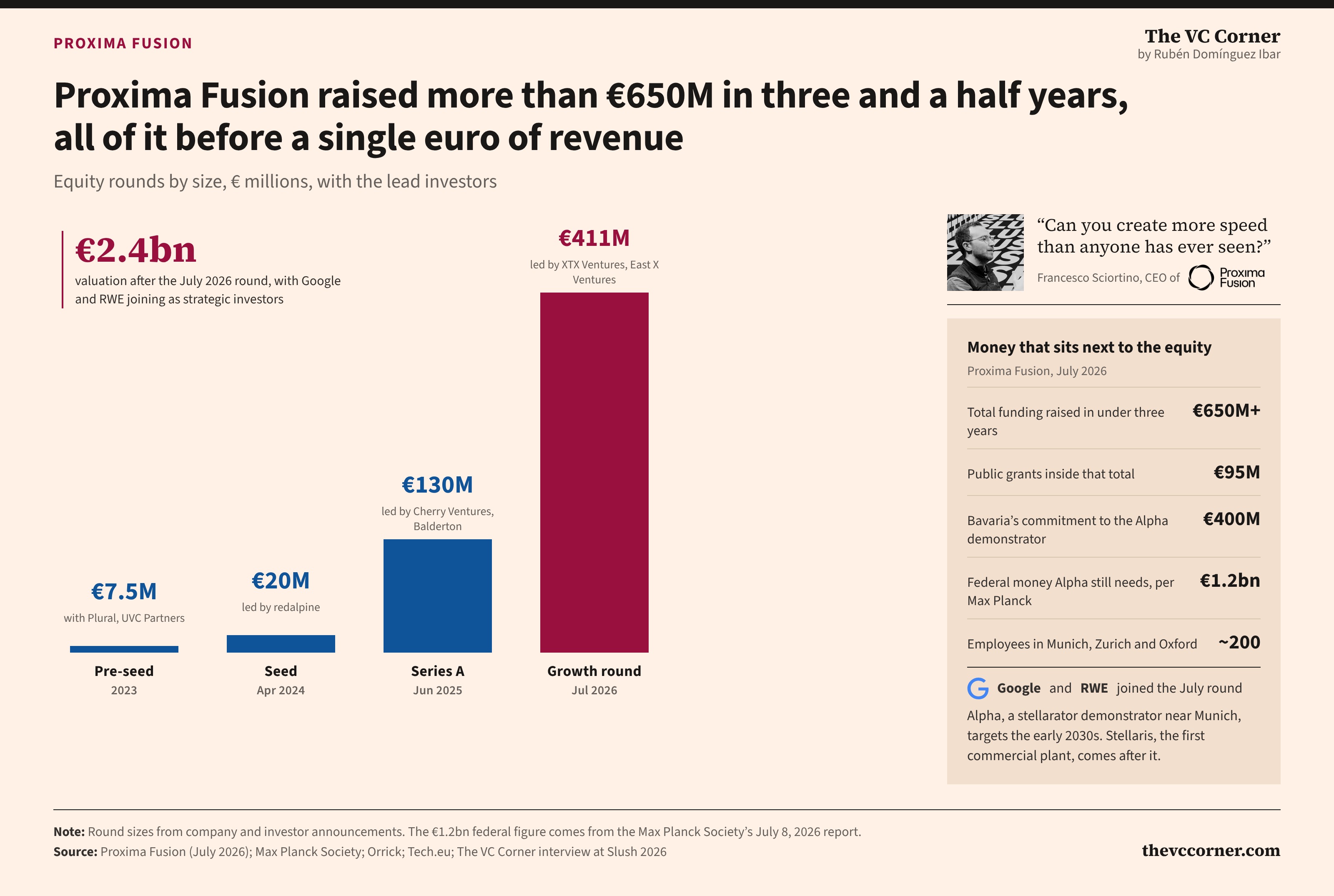
\Proxima’s equity rounds grew from €7.5M to €411M in about three years, before any revenue. Source: Proxima Fusion, investor announcements, 2023 to 2026\
- €411M raised in July 2026 at a €2.4bn valuation, with Google and RWE joining as strategic investors
- €400M committed by the state of Bavaria to Alpha, the demonstrator Proxima is building near Munich
- About 200 people in Munich, Zurich and Oxford
- The first spin-out of the Max Planck Institute for Plasma Physics, founded in 2023
- $518M by the Fusion Industry Association’s count, the second-largest fusion raise anywhere in the past year
What Proxima Fusion builds
Fusion powers the sun: light atoms are pushed together until they merge, and part of their mass turns into energy. Proxima designs stellarators, machines that hold a gas hotter than the center of the sun inside a twisted cage of magnets so fusion can run around the clock. Most fusion machines are tokamaks, shaped like a donut and run in pulses, and the stellarator’s twist lets it hold the plasma steadily.
The design comes from Wendelstein 7-X, the Max Planck stellarator in northern Germany and the most advanced one in the world. Proxima’s plan has two steps. Alpha, a demonstrator near Munich targeted for the early 2030s, has to show net energy gain in a stellarator for the first time. Stellaris, a commercial power plant, follows later in the decade.
Who Francesco Sciortino is
Francesco grew up in Italy, studied physics at Imperial College London, wrote his master’s thesis at the TCV tokamak in Switzerland and did his PhD at MIT. He joined the Max Planck Society in 2021 to work on the ASDEX Upgrade tokamak, and in January 2023 he co-founded Proxima with a team that includes chief scientist Jorrit Lion.
The investor list reads like a map of European venture. Plural and UVC Partners backed the €7.5M pre-seed, redalpine led the €20M seed, Cherry Ventures and Balderton co-led the €130M Series A, and XTX Ventures and East X Ventures led the July round, with Lightspeed, DST Global Partners, KfW Capital and SPRIND among the others. We interviewed two of those investors at Slush too: Plural’s Khaled Helioui and Balderton’s James Wise.
Guillermo Flor and I sat down with Francesco at Slush in Helsinki and asked how you raise hundreds of millions for a machine that is still being designed. We cut the answer into 10 clips.
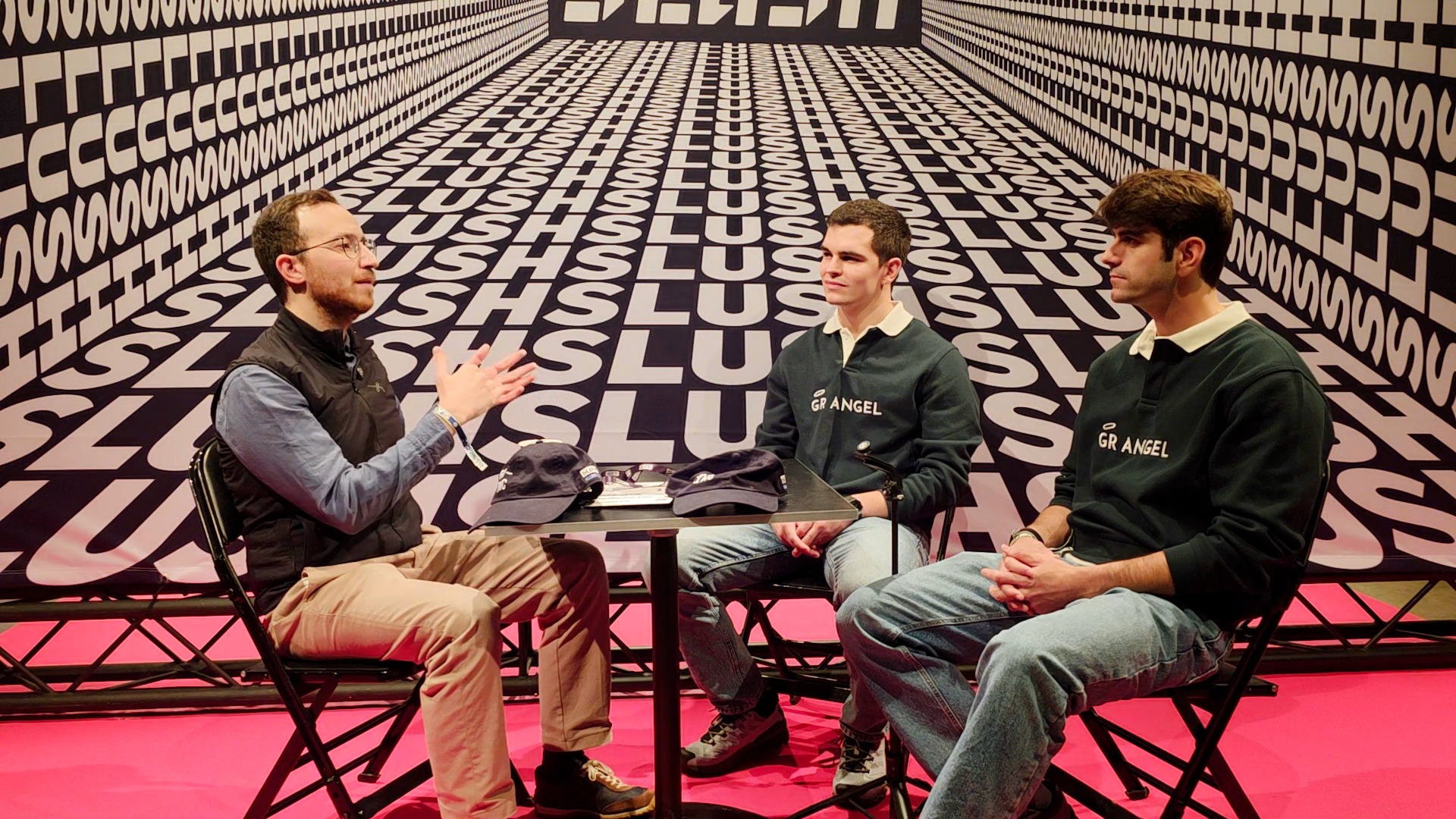
\Francesco Sciortino of Proxima Fusion (left) in conversation with Guillermo Flor and Rubén Domínguez Ibar at Slush in Helsinki, November 2026. Photo: The VC Corner\
The 10 chapters in this interview
- The case for the largest company ever built. What a reactor sells besides electricity.
- Fission, fusion and Germany’s new rules. Why the physics changed the law this month.
- Public money, private money and debt. Which funder carries which risk, in order.
- The one question deep tech investors ask. What replaces revenue in the pitch.
- The SpaceX playbook and Bavaria’s €400M. Why energy follows policy.
- Where the money comes from. Local first checks and global growth rounds.
- Europe’s supply chain edge over the US. Talent, team size, factories and China.
- Making it work before making it cheap. The lesson from Wendelstein 7-X and the Raptor engine.
- What AI does in a stellarator team. Geometry for the model, trade-offs for the people.
- Why he spends 30% of his time hiring. Proxima’s first hires and the profile it screens out.
What Francesco told us, in 10 clips
1. The case for the largest company ever built
It’s not a tough claim, I think, for anyone to believe that the fusion leader may be the largest company that humanity has ever made, and we’re all chasing that.
So far fusion has produced experiments and zero grid electricity. Francesco aims it at oil and gas, which still supply most of the world’s energy, while renewables keep their place in a cheaper overall system.
His case for size rests on what a reactor actually produces, which is neutrons. Those neutrons can make steam that spins turbines, deliver heat for chemical plants, steel and cement, and produce medical isotopes for cancer treatment, so the reactor works more like a platform than a single product.
He counts about 80 fusion companies and $20bn of private money chasing that prize. The Fusion Industry Association uses a narrower net: 56 companies, which raised a record $4.48bn in the 12 months to July 2026 and $14.24bn in total since 2021.
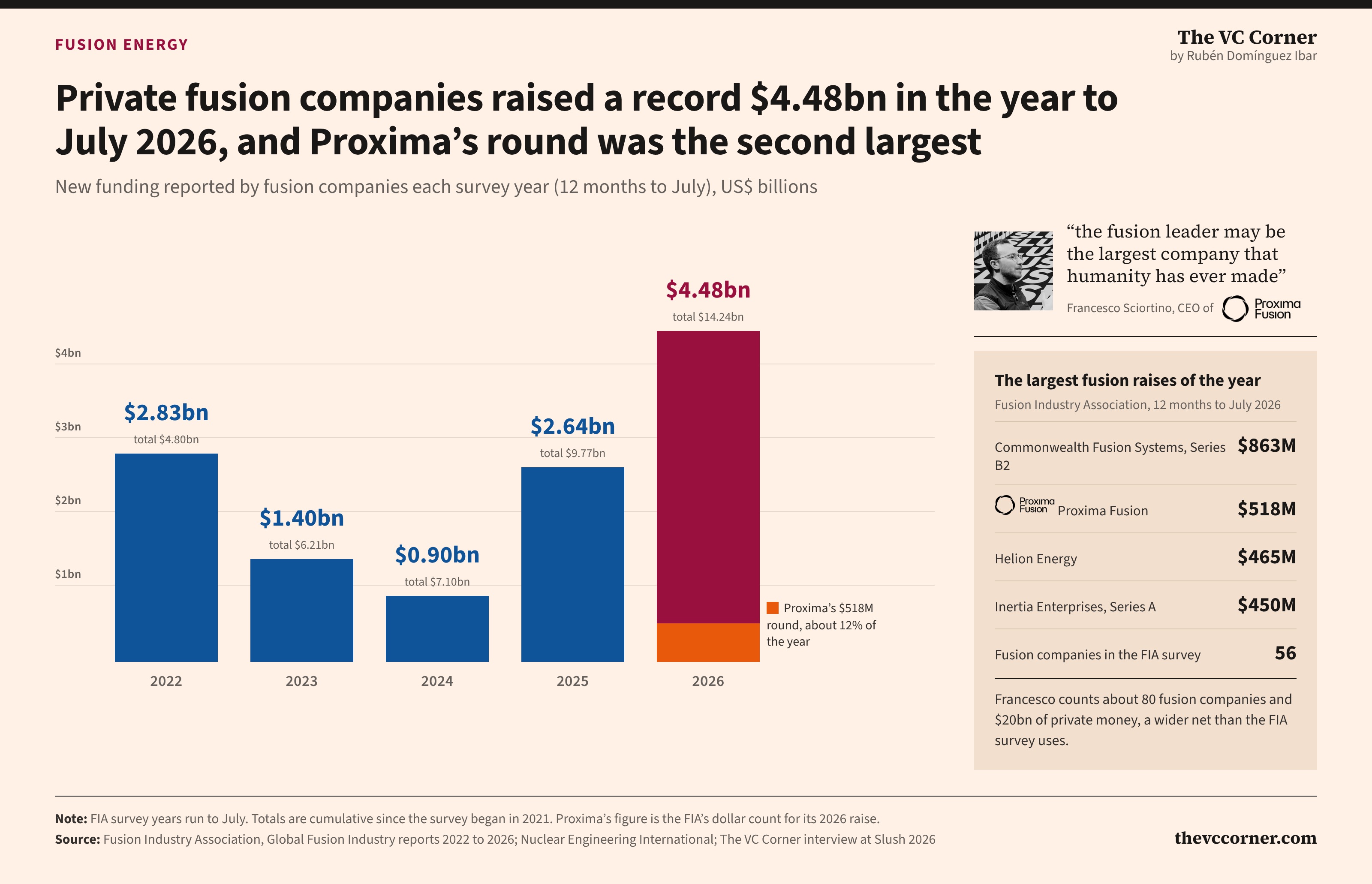
\Fusion companies raised a record $4.48bn in the year to July 2026, and Proxima’s round was about 12% of it. Source: Fusion Industry Association\
Someone asked him earlier that day whether fusion would feel like the end of history, and he flipped the question.
“I would say if everything goes well, this might feel like the start of history.”
2. Fission, fusion and Germany’s new rules
In fission, the process can run away, so you have to control it. In fusion, it’s the opposite. You have to move it, you have to keep it going.
Fission splits the heaviest atoms, uranium and plutonium among them, and fusion squeezes the lightest ones together, hydrogen more or less. Both turn part of the mass into energy through E = mc². Each fission split releases particles that split more atoms, which is why a fission plant has to contain a chain reaction, while each fusion reaction ends on its own and the process stops the moment anything fails.
That physics just reached German law. On November 12, the Bundestag passed a reform that brings fusion plants under the Radiation Protection Act as facilities that generate ionising radiation, outside the atomic law written for fission. The governing CDU/CSU and SPD voted for it, and experts at the hearing split over whether fusion deserves its own law. Francesco calls the change a very important step, because it tells companies like Proxima which rulebook they will build under.
3. Public money, private money and debt
There is a phase where you need the public and the private to work together. And we are in that phase.
Every deep tech company goes through the same phases, Francesco says. Public research money de-risks the science first and lifts the technology readiness level from one to two, three and four. Proxima sits in the next phase, where public and private money work side by side, and for now he calls it a 100% research and development company whose angle is proving fusion can be commercialized well inside 30 years.
The business model follows from one fact: utilities are very conservative. The first fusion plant has to be designed, built and operated by Proxima itself. Once that plant runs and the technical risk drops, the next ones can be financed with debt like any infrastructure project, and the company leaves the venture world. Later it can also sell stellarators to other plant builders as an OEM, which he sees as a faster way to scale.
4. The one question deep tech investors ask
They ask me, can you go faster? Can you create more speed than anyone has ever seen? And if you do, then you go for the next round.
With revenue years away, the pitch becomes a slope. Each round, investors compare how steeply Proxima creates value against everyone else and look for a plateau, and as long as the curve keeps climbing, the next investor sees another 10x, 100x or 1,000x ahead. Francesco says a fusion company tells the same equity story as a rocket company or a biotech.
Proxima’s own rounds show what that speed looks like on paper: €7.5M in 2023, €20M in 2024, €130M in 2025 and €411M in 2026. Deep tech rounds are priced on speed, and four rounds in three years, each at least two and a half times the size of the last, is the curve investors paid for.
If you are raising before revenue, start here:
5. The SpaceX playbook and Bavaria’s €400M
The reason why SpaceX was able to scale is because of a public contract effectively with NASA deciding we’re not going to go and launch rockets. Instead, we’re going to launch a competition in the private sector and then we’re going to finance a good chunk of that and then we’re going to rely on it. And that’s what’s happening in fusion.
Energy is set by policy, Francesco says, and many people resist that idea. Building a fusion company looks far more like building rockets than consumer electronics, and our breakdown of SpaceX’s record IPO shows where that path can lead.
Proxima’s version starts in Bavaria. In February 2026 the state, Proxima, RWE and the Max Planck Institute for Plasma Physics signed an agreement to build Alpha, and Bavaria committed €400M of non-dilutive money on the condition that Proxima first matched it with private capital, which the €411M round did. Public research gets a new experiment, and Proxima gets to prove it can build power plants.
The money Alpha still needs
Alpha also needs about €1.2bn from the federal government, and that money was still uncommitted when the Max Planck Society reported on the project on July 8. Proxima says talks are under way. Until Berlin commits, the demonstrator rests on one state and the private round.
6. Where the money comes from
Growth capital has never been a regional thing. Early-stage capital needs to be local because founders need to be able to see, to create connections, to help, to get operational help.
After the first checks, Proxima wants the best investors wherever they sit, whether Singaporean, Japanese, American or European. Each has to understand what Proxima is building, share the mission and have pockets deep enough for the rounds ahead.
The July round followed that pattern, with XTX Ventures and East X Ventures in the lead, Google and RWE as strategic investors and returning backers from across Europe and the US. Proxima says it has raised more than €650M in total, including €95M in public grants, which Francesco says makes it the best-funded stellarator company in the world.
If your raise crosses borders, start here:
7. Europe’s supply chain edge over the US
Europe, on the technical talent, I would say it’s on par. On a supply chain level, it’s miles ahead compared to the United States. Heavy mechanical, high-precision engineering. The United States has, to a significant degree, de-industrialized. Europe has not.
Francesco rates European engineering talent as equal to America’s, and he gives the US the edge in turning that talent into startup builders. Team size matters less than people think: Proxima needs a few hundred people today and thousands later, chosen for technical know-how.
Factories are where Europe pulls ahead. Proxima’s daily conversations cover steel for the magnets, supply chain quality and power supplies, all areas where European heavy engineering still runs deep. He calls the Shenzhen area extremely competitive and says China has yet to catch up with Proxima’s work.
8. Making it work before making it cheap
The most important thing about the first engine of a rocket is that it needs to work. You cannot simplify something, or you cannot try to make something cheaper before it works.
Francesco calls Wendelstein 7-X a truly inspirational project and a reminder that a commercial plant has to be simpler. SpaceX’s Raptor engine is his model: the first version was complicated, it worked, and the simplification came after.
Much of the fusion world pitches the opposite order, a cheap concept that will be made to work later. Proxima starts from the design Wendelstein 7-X already proved and works on making it cheaper.
“It’s much better to go the other way around, to say this works, now I’m going to make it cheap.”
9. What AI does in a stellarator team
AI is capturing that integration and lets the humans then understand the trade-offs.
A stellarator is a very complicated geometric object, and geometry is something AI captures well. Half of Proxima’s technical team works on magnets, a hardware milestone helped by simulation. The other half of the problem is integration, fitting the whole machine together, and that is where Wendelstein 7-X became too complex to build and more expensive than it should have been.
AI now maps that integration so engineers can see the trade-offs, and the final call stays human. Francesco uses it himself to summarize what the team produces, because for him communication sits at the bottom of every engineering process. The AI Corner’s physical AI investment OS maps where money is going in AI for hardware.
10. Why he spends 30% of his time hiring
You need to augment yourself, and eventually what the team can do is much more than what you can do.
Francesco calls recruiting the single most important function in the company and gives it about 30% of his time, and he wishes it were more. The founding team did good work, and the first few hires multiplied it and drew in everyone after. One, Nicolò Foppiani, came from a particle physics PhD at Harvard, a field far from fusion. Another came from seven years at Tesla and told Francesco he cared about the best engineering more than about cars.
Aerospace has always been central to Proxima’s hiring, and automotive keeps growing. Proxima wants engineers who question requirements and take parts out, and it screens strictly for people who work in teams, because lone wolves who thrive in academia struggle in a company that moves on alignment.
I told Francesco that 60% of my engineering class in Madrid ended up in consulting or investing. His answer: consulting teaches you to deliver, it works as a training ground, and once you find a mission you care about, the place to learn is building it.
Hiring engineers for hardware? Start here:
What I’m taking from Slush
Proxima sells speed today and neutrons later. The capital stack behind it, grants for the physics, equity for the build and debt for the plants that follow, is the template for any company whose product takes a decade to ship.
- Founders: Map which funder owns which risk before your first pitch: grants for the science, equity for the build, debt once the first unit runs. Then show investors the slope of your value curve and how fast it is rising.
- Investors: In a pre-revenue round, ask how steeply the company creates value against its peers, and check how much early risk public money already carries.
- Engineers and operators: Proxima hires from aerospace, automotive and particle physics, in Munich, Zurich and Oxford. If you work in simulation, manufacturing or integration, its open roles are worth a look.
- Energy buyers: Fusion makes neutrons, and neutrons become electricity, industrial heat and medical isotopes. Work out which of your costs move if industrial heat gets cheap.
If this breakdown saved you time, send it to one founder or investor who needs it.