The weekend’s other big murder simulator.
By Sonny Bunch
Published: 2026-11-20
URL: https://www.thebulwark.com/p/in-new-hunger-games-truth-is-fascisms

\Joseph Zada as Haymitch Abernathy inThe Hunger Games: Sunrise on the Reaping. (Courtesy Lionsgate)\
IT’S A GAME WHERE AMORALITY RULES THE DAY—but only if you want it to. Choices must be made and those choices have consequences: The game makers will send new challenges to those who act poorly or try to upset the balance. An entire nation’s GDP is on the line as young people line up to do battle while others simply watch the stream, taking it all in.
I speak not of Grand Theft Auto VI,but of The Hunger Games: Sunrise on the Reaping, the latest prequel in the long-running YA series that keeps churning like a well-oiled machine of casual death. Set between the 2023 prequel, The Ballad of Songbirds and Snakes, and our initial introduction to the series and its hero, Katniss Everdeen (Jennifer Lawrence), Sunrise on the Reaping is a member-berry-laden prequel that spends much of its runtime introducing us to younger versions of some of the characters we knew and loved (or hated) from the original series.
It’s first and foremost an origin story for Haymitch Abernathy, played in the original by Woody Harrelson and by Joseph Zada as a teenager here. Haymitch was the second victor from District 12—one of fourteen distinct regions (thirteen districts plus the Capitol) in a post-apocalyptic North America—in the competition’s history, and now we see how he became the drunken, sad-sack mess he was by the time Katniss rolled around. He was an accidental tribute, called in when one of the two boys chosen for this second “Quarter Quell” (25th anniversary) made a break for it rather than choose to fight to the death for the entertainment of the Capitol.
We also meet the younger version of the calculating Plutarch Heavensbee, played by Philip Seymour Hoffman in the original films and Jesse Plemons here. Plemons has big shoes to fill—this was one of Hoffman’s final roles before dying from a drug overdose in 2014—and I think he does an admirable job of bringing Heavensbee’s inner turmoil and quiet scheming to life without ever feeling like he’s doing an impression of Hoffman. Plutarch is, arguably, even more important to the film than Haymitch, at least thematically, as the script by Billy Ray and Michael Lesslie drives home the importance of narratives and the danger faced by a society where truth is manipulated to serve the ends of those who wish to remain in power. In a fascist autocracy, truth is one of the first victims of the new regime.
Heavensbee has the ear of President Snow, played initially by Donald Sutherland and here by Ralph Fiennes, and it’s the perfect sort of role for Fiennes, who has become one of our premier big-screen fascists. He’s played Nazis of all stripes: Nazi post-apocalyptic presidents hellbent on killing kids for the entertainment of the masses; Nazi noseless warlocks hellbent on killing magical kids for the purity of magical bloodlines; and Nazi Nazis hellbent on killing Jews of all ages. He shifts wildly but cleanly between quiet menace, as in Sunrise on the Reaping, and overt theatricality, as in the Harry Potter films or In Bruges, where he plays a vicious family-man gangster who, perhaps ironically given the litany above, has moral qualms about killing kids.
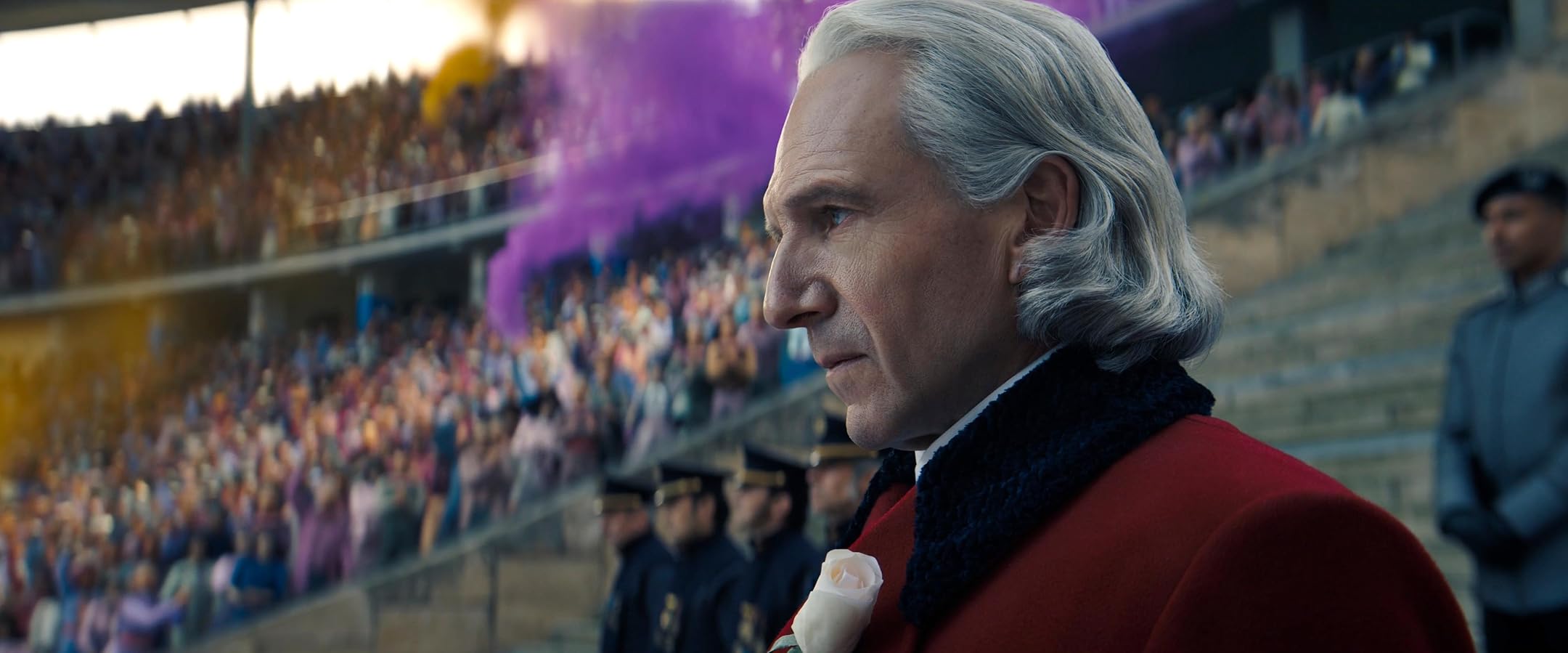
\Ralph Fiennes as Coriolanus Snow inThe Hunger Games: Sunrise on the Reaping. (Courtesy Lionsgate)\
And of course there’s Effie Trinket, played originally by Elizabeth Banks and here by Elle Fanning. The attempted rehabilitation of Effie in Sunrise gets to the heart of the big problem with these prequels: She shows up in the new film as a last-minute helper for the District 12 tributes, who have been poorly outfitted by a useless stylist. She is thoughtful and caring and works hard for them, coming to see them as real people rather than props to be used by the Capitol in their sick games. But this is roughly the arc Effie goes through in the original films set a quarter-century later, when she begins as a thoughtless joke of the upper crust and evolves into a supporter of the revolution fought by Katniss and the rebels from District 13. It’s repetitive in miniature form, an unnecessary redux of something we’ve seen before.
But then, repetition in miniature feels like so much of what people want. What are the big entertainment stories from the last few weeks? Hey, a new James Bond. Look at this, a fresh Godzilla movie set in the post-war era. Ah, finally, a second prequel to a movie series based on books that began in Dubya’s second term. At least Grand Theft Auto VI—the fifth (or, depending on how you count, seventh) sequel to a franchise that began in primitive form in 1997—feels like a remake in maxi-ture. I keep reading critics who spent 100, 150, 170, 200 hours playing the game before release, more hours than I’ve spent, cumulatively, on gaming in the last four years.
The Hunger Games: Sunrise on the Reaping is entertaining enough for fans of the series, and I’d be lying if I said it didn’t occasionally tug on the heartstrings. It is, also, an important reminder that those who control the message control the world and that small acts of defiance add up to greater resistance in the long run: One stands athwart history yelling stop even when those who need to hear it can’t—or refuse to listen. (Of course, actions usually speak louder than words.) That said, it’s a pretty straightforward replay of everything the franchise has done before, just in double time.
Watch for the launch this weekend of our new Bulwark show, Reporter and the Spy. Journalist Michael Weiss and former CIA officer Marc Polymeropoulos discuss covert operations, global conflicts, and secret information, unpacking what’s happening behind the scenes.
Want to learn more? Check out the trailer for Reporter and the Spy here.
Don’t miss it: Follow the show on Apple Podcasts, on Spotify, on YouTube, or wherever you get your podcasts.
The Biggest Cultural Event in a Decade

\Jason and Lucia, chillin’. (Courtesy Rockstar Games)\
Speaking of Grand Theft Auto VI, that’s the subject of this week’s The Bulwark Goes to Hollywood. The gameis going to do something like $3 billion of business in the first few days of its existence. It’s just a huge phenomenon on many levels, and Gene Park of the Washington Post joined me to talk about what it means for America and the entertainment world more broadly. The biggest question I had: Should Tim Miller have a podcast station on the next iteration of the game? I think the answer to that one is clearly yes.
My Weekend With the White Nationalists
And speaking of Tim, I talked to him about last week’s white nationalist conference in Irving, Texas. You can read all about my three days with the New Christian Right here and watch me discuss it with Tim below:
Assigned Viewing: Tenet

\Robert Pattinson inTenet. (Courtesy Warner Bros. Pictures)\
THERE IS A TEMPTATION in certain quarters to dismiss Robert Pattinson—who was, this week, revealed to be the new James Bond—as a pretty boy, a lightweight, the sparkly vampire of Twilight fame. This is understandable, I suppose, but it’s woefully out of date as a way of mentally categorizing his work. Pattinson has spent the last decade-plus turning in really interesting performances in a variety of movies, oftentimes doing so in exceptionally odd ways.
There just aren’t that many young actors who, high off the success of something like Twilight, would work with someone as daring as David Cronenberg. But he did so in Maps to the Stars and Cosmopolis, a pair of films that wrestle, in different ways, with success and failure and the psychological toll of both on those who experience them. He’s frequently playing weird little guys making weird little choices, as in Good Time, a Safdie Brothers film that is somehow even more unnerving than Uncut Gems, at times. Or The Rover, a sort of lo-fi Mad Max, in which Pattinson plays a . . . well, let’s just say “slow” person trying to survive in a post-apocalyptic wasteland.
The Lighthouse is not my cup of tea—while I like director Robert Eggers a great deal and consider The Witch and Nosferatu to be genuinely unnerving works of historical horror, The Lighthouse is a little too odd for me—but you have to admire anyone who can go toe-to-toe with Willem Dafoe and, potentially, outweird him. And it’s indicative of Pattinson’s complete disregard for his status as a teen heartthrob that he’d make this movie, one in which he’s yelling about the smell of farts or, ah, enjoying himself to the imagined visage of a mermaid.
And just this year he has had fantastic and fantastically different performances in The Drama and Primetime and The Odyssey. In The Drama he is the avatar of millennial neuroses, unsure of how to navigate a world in which condemnation is the coin of the realm. In Primetime he plays a near-messianic Chris Hansen, a man so consumed with his own sense of righteousness that he doesn’t care whom he destroys. And in Christopher Nolan’s The Odyssey, he’s the loathsome Antinous, the foremost suitor pressuring Odysseus’s wife; his unctuousness gives us license to cheer for Odysseus’s slaughter of the suitors. There’s a decent chance Pattinson gets an Oscar nomination for that turn, though who knows what his work in next month’s Dune: Part Three will bring.
But it’s Tenet, Nolan’s twisty 2020 thriller, that serves as proof of concept for what Pattinson could do as James Bond. It’s not just that Tenet is, functionally, a Bond film, a globe-hopping action-adventure movie about spies trying to save the world from annihilation. It’s that Pattinson’s Neil does, well, everything you could want a Bond to do, more or less. He’s smooth, he’s suave, he can handle himself with a gun, he can rappel and scale a wall, he can do 100 on the highway, probably backwards if needed.
So look, I understand the trepidation. But it’s misplaced! Pattinson’s a fine choice for James Bond and he’ll do fine work as the representative of His Majesty’s Secret Service.