Building a lasting partnership after decades of mistrust will take years.
By Mark Hertling
Published: 2026-11-19
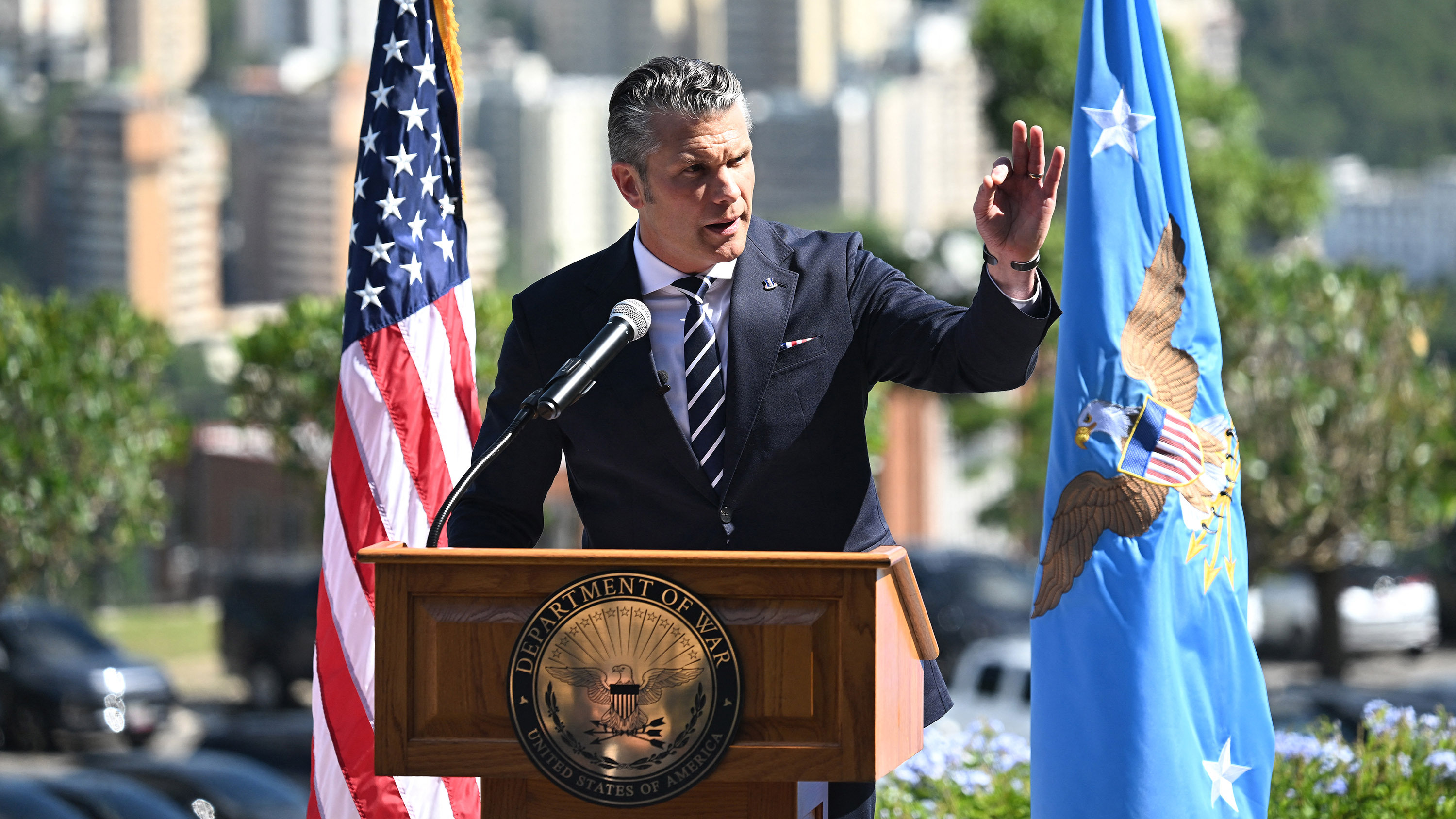
\Defense Secretary Pete Hegseth giving a press conference at the U.S. embassy in Caracas on November 18, 2026. (Photo by Juan Barreto / AFP via Getty Images)\
WHAT SHOULD WE MAKE of Pete Hegseth’s surprise visit to Venezuela on Wednesday?
The U.S. defense secretary traveled to Caracas, stood next to interim President Delcy Rodríguez on Venezuelan state television, and announced the two countries had signed an agreement to strengthen military training, increase intelligence sharing, begin military equipment and technology transfer, and improve border security. This in a country where just ten months ago American special operations forces had ravaged the Venezuelan high command, captured Nicolás Maduro, and transported him and his wife to the United States to face criminal charges. (A country that, also on Wednesday, President Donald Trump disturbingly referred to as an “acquisition” of the United States.)
During his remarks, Hegseth celebrated the transformed relationship and proclaimed that Venezuela “has gone from our most aggressive regional threat to a compliant security partner.” That statement is especially striking given that much of Venezuela’s political and military establishment from before Maduro’s capture remains in place.
Listening to Hegseth, it’s hard to avoid concluding that he’s declaring victory at the starting line.
Let’s take a step back. Military cooperation with other nations is a critical part of American national security strategy; it helps form partnerships and, eventually, alliances. During my time commanding U.S. Army Europe, one of our primary missions was theater security cooperation: the resource-intensive work of developing and maintaining military-to-military relationships with countries throughout a given region. This includes exercises, training events, exchanges in professional military education courses, officer exchanges, and agreements regarding shared security concerns. (In the case of Venezuela, that certainly means improved border security and intelligence sharing to fight drug smuggling.)
The kind of general framework we had in Europe with the forty-nine countries on the continent also exists in other combatant command areas of operation. U.S. Southern Command does similar work across Central and South America. One of the biggest success stories in that region has been “Plan Colombia,” a security-cooperation partnership launched in 2000 to strengthen Colombia’s army and help the government in Bogotá regain control of territory held by insurgents and criminal drug cartels.
Building up a strong, lasting relationship that advances American interests requires years of work from multiple officials from both governments. On the U.S. side, the combatant commander, the American ambassador, and State Department officials all play important roles. And, it should be noted, there is nothing especially untoward in a defense secretary like Hegseth taking the lead in working out agreements.
But it takes time.
I got a firsthand glimpse of how far apart our two countries were in 2001, shortly after I was promoted to brigadier general. As part of a ten-person senior leadership course called CAPSTONE—designed to familiarize newly promoted generals with strategic issues and American military relationships around the world—we traveled aboard an Air Force C-17 to Panama, Brazil, Colombia, Guatemala, and Venezuela to meet senior government and military officials in each country. Most of our visits provided valuable insights into the political and military challenges facing those countries.
But our visit to Venezuela was different. When we landed in Caracas, Fidel Castro was arriving for what we understood to be a birthday celebration hosted by then-President Hugo Chávez. Chávez was distancing himself from the United States and establishing closer ties with Cuba—and in the coming years would develop increasingly close relationships with Russia, China, and Iran. Our aircraft was held on the runway for approximately four hours; we never disembarked.
My point in sharing that story is just that that kind of cold relationship, which lasted for over two decades, may make it difficult for a fresh restart with a country where most of the political and military infrastructure and emotions are still in place.
Restoring a relationship after decades of estrangement is complicated. Venezuela is used to decades of an authoritarian political system, and its security forces are rife with corruption, narcotics trafficking, and human rights abuses. American military training and exercise assistance will, I believe, be difficult to stand up. Given that much of the previous government’s institutional structure remains intact, any agreement that tries to strengthen Venezuela’s military without addressing its relationship to civilian authority and democratic institutions will be tough.1
Hegseth’s description of Venezuela as a “compliant security partner” is a bold assertion. Long-term military partnerships are built on mutual trust and shared responsibilities. Those relationships take years to develop, particularly when the two countries have spent decades viewing one another with suspicion and even hatred, and our attack on their country in January was terribly intense and likely hasn’t been forgotten.
Don’t get me wrong: There is real potential value in this agreement. Re-establishing military cooperation with Venezuela is a critical step toward improved regional security and advancing American interests. But success depends on the difficult diplomatic and military work that follows Wednesday’s announcement. Announcing a partnership is easy; building one is the real challenge.
Think of it this way: There were certainly some countries in Europe that were (and a few that still are) tainted by their time under Soviet rule. Likewise Venezuela is not suddenly a new country just because Maduro is out of the picture.