While Trump’s envoys flatter the Russian dictator, Ukraine’s successes reveal his weakness.
By Cathy Young
Published: 2026-11-18
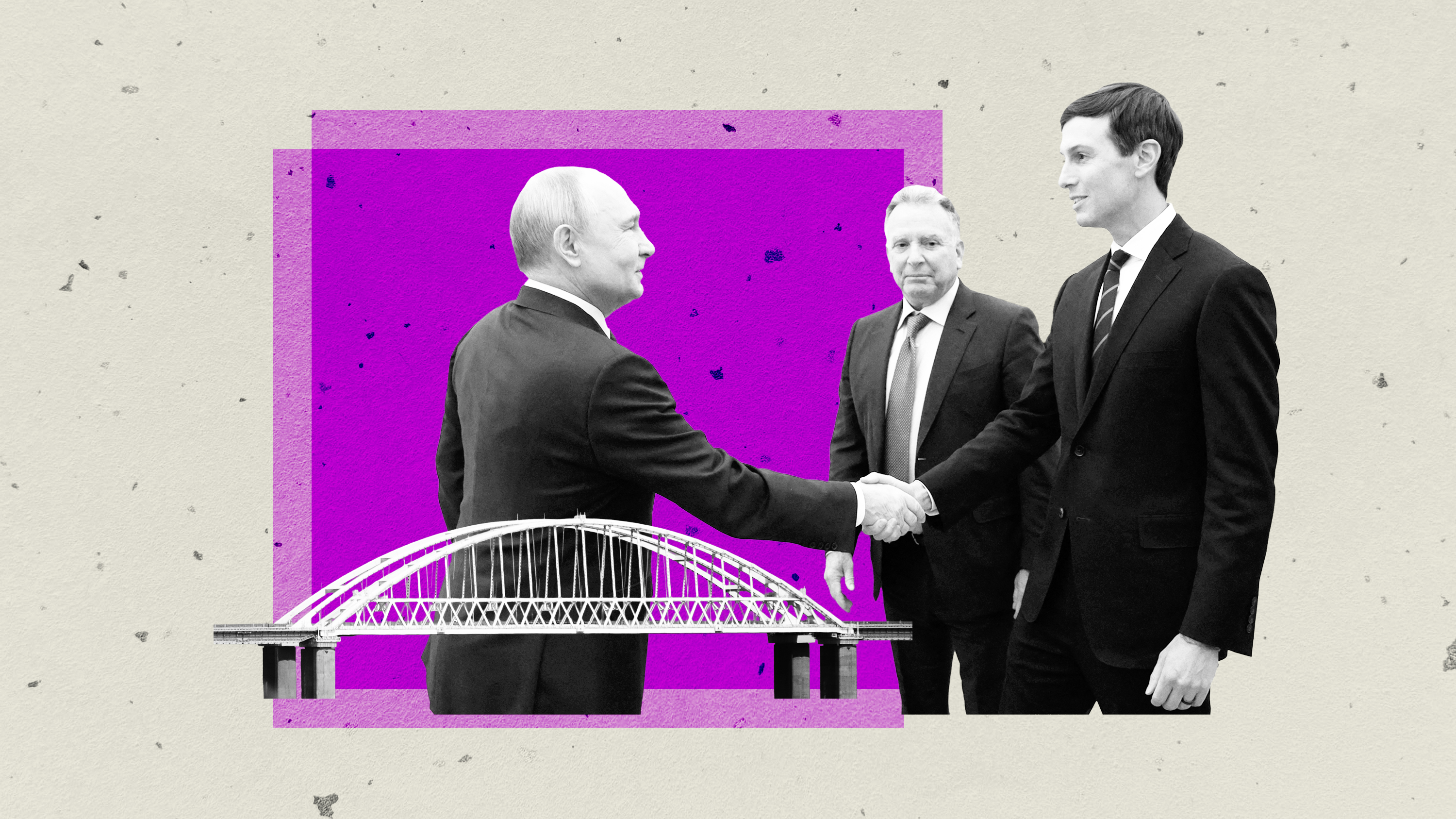
\(Photo illustration by Bill Kuchman/The Bulwark| Photos: Getty, Shutterstock)\
THIS WEEK’S TRILATERAL SUMMIT among Donald Trump, Vladimir Putin, and Xi Jinping in Shenzhen, China on the sidelines of the Asia-Pacific Economic Cooperation leaders meeting will likely be too short to allow for a substantive exchange. But I don’t expect the three men will pass up the opportunity to play Masters of the Universe for the cameras.
For Putin, the event holds a special appeal. As expatriate Russian political analyst Alexandra Filipenko pointed out in an interview on Tuesday, the Russian president believes the summit shows he deserves a place “at the big boys’ table,” where he might join in deciding matters of global security. There’s one small problem with that framing: Just two days before the event, the world got a demonstration of Putin’s inability to ensure the security of even a dearly prized geopolitical possession: the Kerch Bridge. Built after the 2014 annexation of Crimea to connect the peninsula to the Russian mainland, the 12-mile bridge stands as a symbol of the Russian claim on the stolen peninsula. Now, a part of it stands no more. Following weeks of attacks on Russian air defenses that left a gap in protective coverage over the structure, a combined drone and missile attack by Ukraine caused a large part of the span that supports a four-lane roadway to collapse.
While the partial destruction of the bridge will likely cause logistical problems for Russian operations in Ukraine, Ukrainian reactions to the news have centered on Putin’s humiliation. “Ukraine today has essentially publicly castrated Russian Tsar Vladimir Putin,” journalist Ivan Yakovina declared on his YouTube stream. Television host and YouTuber Olena Kurbanova, visibly beaming, showed an undated clip of a middle-aged Russian woman defiantly declaring, perhaps after one of Ukraine’s earlier, far smaller strikes targeting the bridge, “The Crimea bridge still stands and will stand. Just like Vladimir Vladimirovich [Putin], it is forever steadfast.” Oops.
Kremlin spokesman Dmitry Peskov jauntily assured Izvestia that “there is no doubt that the bridge will be restored and will be even better than before.” But even hawkish Russian “warbloggers” were unconvinced.
As Yakovina noted, this wasn’t even the Kremlin’s only bad news on Tuesday: The Ukrainian military also struck the Salavat petrochemical factory in Bashkortostan, a major oil-processing facility run by the state-controlled Gazprom. The extent of the damage is not yet known.
Understanding what’s happening in Ukraine, Russia, and across Europe takes more than following the headlines. At The Bulwark, we’re committed to serious reporting, informed analysis, and clear-eyed arguments about war, diplomacy, military power, and the future of European security.
Join our Bulwark+ community today and help us keep asking the hard questions and making sense of a dangerous and changing world together.
ALL THIS COMES on the heels of yet another round in the so-called U.S.-Russia-Ukraine negotiations pushed by the Trump administration and its Two Stooges, Trump real estate pal Steve Witkoff and clown prince Jared Kushner. At those talks in Abu Dhabi last week, the Russian team, led by Putin court historian Vladimir Medinsky, turned the conversation to Europe’s overall “security infrastructure” and advanced a set of demands so bold, one might think Russian troops had already steamrolled over Kyiv and Warsaw and were powering their way toward Berlin.1 In addition to a drastic downsizing of the Ukrainian military and a categorical prohibition on foreign military aid to Ukraine going forward, the Russians also demanded an end to all NATO presence in countries that joined the alliance after 1997, a transformation of the country of Moldova intended to prevent its integration with the EU and keep it within Russia’s “sphere of influence,” and a curtailment of the U.K.-France nuclear protection for other European countries, intended to partly replace weakened security guarantees from the United States.
For people familiar with twentieth-century Russian classics, this wish list evokes the 1928 satirical novel The Twelve Chairs—specifically, a catchphrase from its con-artist antihero: “Would you also like the keys to the apartment where the money is stashed?”
It’s possible that these bizarre Kremlin demands are simply a dramatic opening position meant to be negotiated down. Or maybe Putin and his henchmen are genuinely delusional, suggests Tufts University international politics professor Daniel Drezner—and perhaps the delusions are being cultivated by Trump’s dumb-and-dumber envoys, who have sought to appease the Russians from the start. Exiled Russian writer and astute commentator Dmitry Bykov has a similar idea: Noting parallels to Nabokov’s play The Waltz Invention, Bykov suggests that the people around Putin have “started humoring him, and as a result he’s started going crazy. . . . The horrible part is that he quite seriously believes that his conditions will be met.”
Or else the Russian dictator is simply stalling for time, believing that by next spring his strategy of causing blackouts in Ukrainian cities during the cold months will finally break Ukraine’s resistance. In the meantime, U.S. negotiators are reportedly proposing brilliant ideas like redrawing the borders of the Donetsk and Luhansk provinces—which Russia claimed to annex in 2022 and listed in its constitution in 2022 as Russian territory—to match the extent of Russia’s occupied holdings, which would in turn make it possible for Putin to claim his forces had achieved full control over them. (The Ukrainians refused the suggestion.) Obviously, none of this is serious; Trump might as well, as one witty Russian speaker suggested in a YouTube comment, offer to rename Alaska “the Donetsk province” and give it to Putin to make him happy.
After the talks in Abu Dhabi concluded on November 11, the Two Stooges flew to Moscow for another sitdown with Putin himself. Reports that they received matching puffer jackets with “Russia” insignia as a gift from Putin adviser Kirill Dmitriev have been disputed. What we do know, from Kremlin-released footage, is that they listened politely while Putin rambled through a Soviet-era joke about a crook and an investigator—the apparent purpose of which, ironically, was to illustrate the concept of a conversation going in pointless circles. This embarrassing moment was made even more uncomfortable by the interpreter’s long and painful struggles to translate Putin’s wit for the table.
Putin did propose something ostensibly practical: a five-day ceasefire in the town of Kostyantynivka to allow the evacuation of an unknown number of remaining residents, similar to the one recently arranged in Oleshky, a town near Kherson. (While the administration has touted Melania Trump’s role in brokering the truce, it was mostly coordinated by Russian and Ukrainian human rights commissioners.) A key difference between the two towns, however, is that Oleshky has been under actual Russian occupation for almost five years. Kostyantynivka, despite repeated claims by the Russian military to have taken the town, is a complicated patchwork of Russian and Ukrainian posts and drone-controlled “kill zones.” Not only would a truce be virtually unenforceable; analysts believe that the proposal is most likely a Trojan-horse ploy to allow Russian forces to reinforce their positions in Kostyantynivka, or even expand their control over the town with a view to completing its capture after nearly a year of very costly fighting—and this in turn would make it possible for Russian forces to launch new attacks against other nearby fortified Ukrainian cities.
Just like Putin’s tedious joke, these negotiations aren’t going anywhere. The basic features of the situation remain the same: Russia’s delusional intransigence, Ukraine’s staunch resistance, the American president’s pathetic excuse-making for Putin, and Trump administration officials’ disgraceful criticisms of Ukraine’s strikes against targets deep within Russian territory. What happens next depends on whether Ukraine will be able to get the weapons—and, crucially, the air defense interceptors—it needs. The new Congress must act to provide more aid, prevent any further interruptions in satellite communications and intelligence-sharing, and do what it can to make Trump irrelevant.
Trump goes to Shenzhen as humiliated by the GOP’s collapse in the midterms as Putin is by the Kerch Bridge collapse under Ukrainian fire. The degradation of those two strongmen—Lilliputians playing giants, in the caustic words of exiled veteran TV journalist Alexander Nevzorov—opens new opportunities for Ukraine and its supporters.
In reality, Russian forces are currently bogged down trying to take what’s left of Mala Tokmachka, a hamlet with a prewar population of 3,005.