Plus: Daniel Roher, the best young filmmaker working today.
By Sonny Bunch
Published: 2026-11-06
URL: https://www.thebulwark.com/p/the-all-encompassing-terror-of-godzilla-minus-zero-review
 (Courtesy Toho)
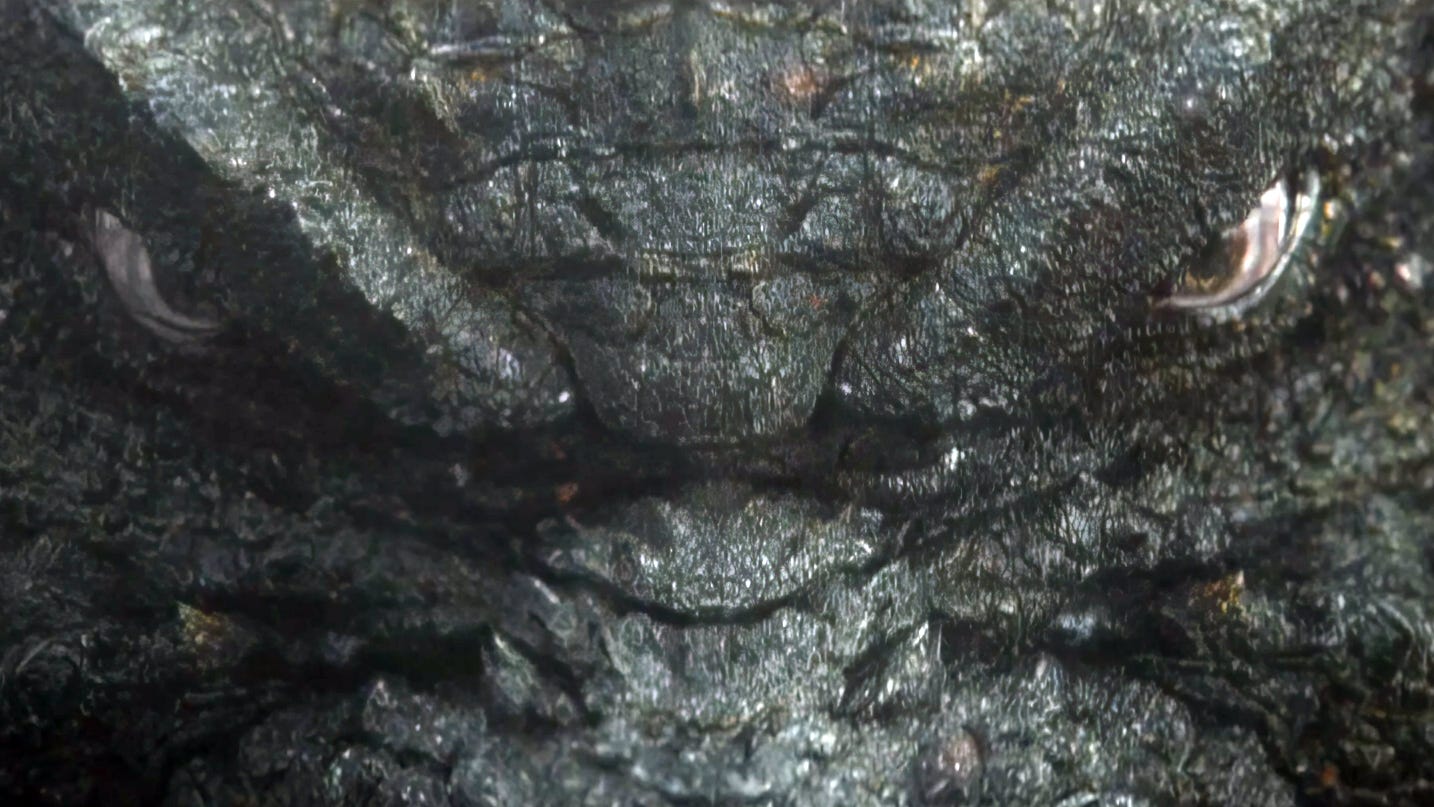
Godzilla Minus Zero has the IMAX screens this weekend in theaters across the country, and if you’re going to this movie, that’s the ideal way to experience it. Note: I didn’t say “see it.” I said “experience it.” Because right from the very first moment, as King Ghidorah screams onto the screen, leveling city blocks with golden beams of fire, you realize you’ve entered into something terrifyingly immersive.
The image is big, obviously, but the sound is bigger, a terrifying cacophony of animal roars, screeching metal, and collapsing concrete. The roaring din is something both Godzilla Minus Zero and its 2023 predecessor, Godzilla Minus One, have emphasized, particularly in the theatrical setting. These are not your friendly neighborhood kaiju from the Godzilla vs. Kong set of films put together by Warner Bros. and Legendary, a series that, among other things, has shown a giant lizard suplexing a giant monkey with pyramids as a backdrop.
From the first moments we see Godzilla in Minus One, on the Japanese island of Odo, he is big, mean, and loud. The sort of angry-loud that makes you involuntarily shrink back in your seat, clap your hands over your ears like Timmy in that jeep in Jurassic Park. In the new movie, Ghidorah is, somehow, even louder. And that’s before he grows two extra heads—hence his name, which comes from “hydra”—with which to screech and breathe fire and, terrifyingly, lift whole towns via some sort of antigravity breath before dropping them thousands of feet straight down.
Minus Zero begins where Minus One left off: It’s two years after the attack by Godzilla, and the island nation is still just picking up the pieces when Ghidorah strikes. Mr. Noda (Hidetaka Yoshioka) leads the nation’s emergency response, and once again calls upon former kamikaze pilot Kōichi Shikishima (Ryunosuke Kamiki) to aid in the defense of the people. Helping them is Aoyama (Masami Nagasawa), a savant meteorologist who can feel when storms are coming like Roy Hobbs can feel when a fastball’s coming. And, of course, there’s Noriko (Minami Hamabe), whose surprising survival in the first film came with a terrible price.
Modern action films sometimes run into a problem of scale: The bigger the threat, the less terrifying the threat truly is. The Godzilla/Kong movies are just goofy; Galactus in last year’s Fantastic Four seemed relatively lightweight despite his city-sized presence; Superman fought his clone a few weeks before that and I struggled to remember what, precisely, was smashing around Metropolis. One reason these movies, particularly the comic book movies, fail to land is that, oftentimes, it feels like no one is actually in any danger. New York, Metropolis: They’re always magically evacuated, free of civilians.1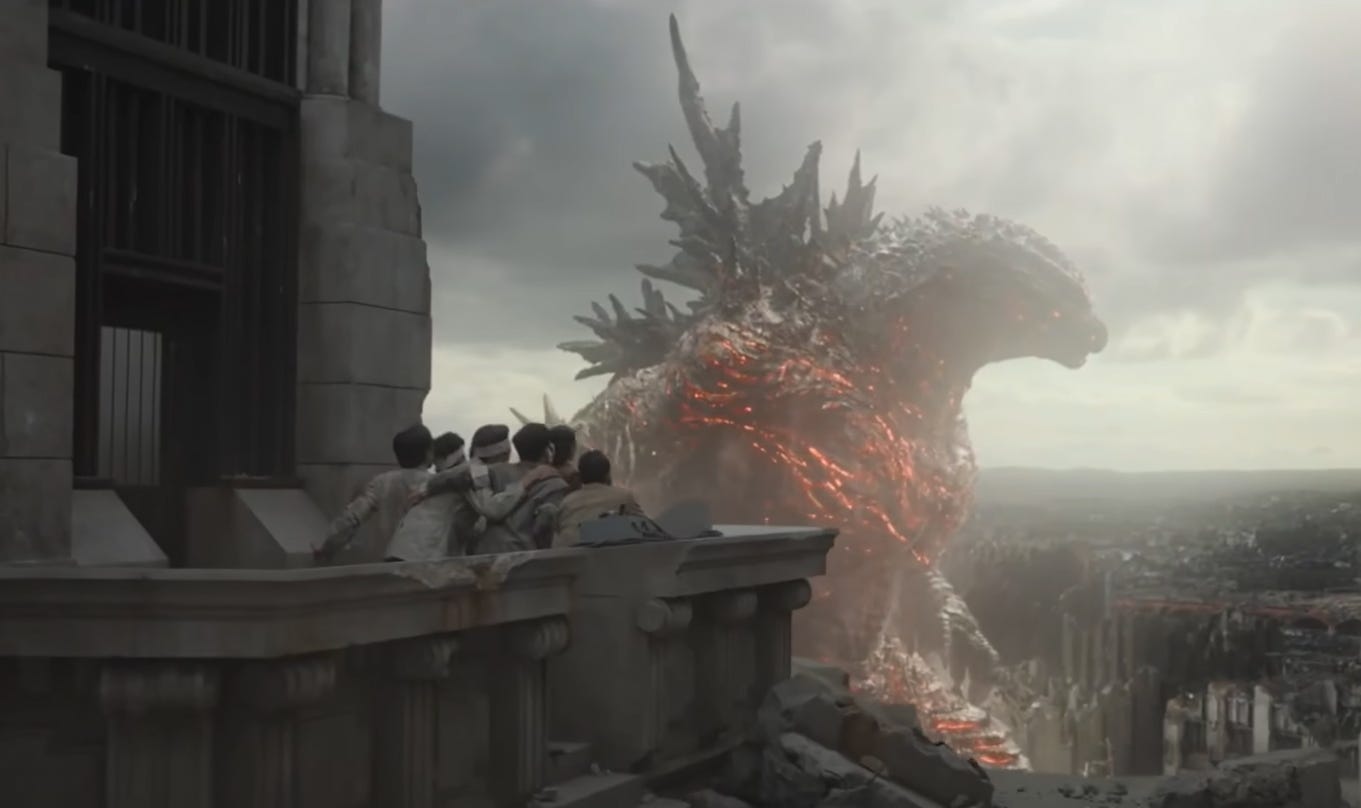 (Courtesy Toho)
Godzilla Minus Zero does not spare civilians. Indeed, one of the main points of this film is the responsibility that comes with choosing to do the right thing in order to save civilians. But for that message to land, we have to see the aftermath of war. Not just the war against the kaiju, mind you, but war in general. Never forget that the Godzilla franchise is one born of the scars the Japanese psyche incurred after the firebombing of Tokyo and the nuclear annihilation of Hiroshima and Nagasaki. The Minus films add to that legacy by tossing in the wickedness of Japan’s own policy of fighting to the last man, of turning soldiers into suicide bombers and self-immolating pilots.
As such, Godzilla Minus Zero really earns its R-rating: I did not go into this expecting to see multiple sequences of nuclear annihilation and the effect that has on the human body, but see them we do. When Ghidorah isn’t eating people or burning them alive or stomping on them for fun, he’s levitating their houses and smashing them on the ground. All of this happens amid a soundscape that has been turned to 11. It’s an intense film, is what I’m saying, and maybe one you’ll want to leave the younger children home for. Particularly given the surprising emotional heft of the movie, which revolves around the Shikishimas and their daughter, Akiko (Sae Nagatani).
These are not triumphal films, precisely, but they are, ultimately, hopeful: movies about shared humanity and the necessity to keep living, no matter what. Because, hey: You never know when things are going to turn around.
SPEAKING OF THINGS TURNING AROUND: How about that election in Texas, huh? I was at the vice president’s final stop in the state last week just days before the election; you can read my dispatch here. Needless to say, his last-ditch swing through North Texas did not have the hoped-for effect on turnout.
And if you hit that paywall, I hope you’ll consider signing up for a Bulwark+ membership. We’re doing a post-election flash sale, so take advantage now while you can:
Assigned Viewing: The Daniel Roher Filmography
Tuner (Paramount+)
Navalny (HBO Max)
The AI Doc: Or How I Became an Apocaloptimist (Netflix/Peacock)
Once Were Brothers: Robbie Robertson and the Band (HBO Max)
Blink (Disney+)
On this week’s episode of The Bulwark Goes to Hollywood, I talked to Daniel Roher about his recent film, Tuner, and what goes into making your first narrative feature after a hugely successful career in documentaries. Of particular interest in this interview: The importance of hiring Dustin Hoffman for a key supporting role, which helped attract Leo Woodall to the project. And Woodall delivers what I can only describe as an “Oh man, that guy’s a star” performance here. If Denis Villeneuve wasn’t giving him serious consideration for James Bond after this film’s release, he and his casting director were making a mistake.
Tuner had a run in theaters early this year but got a little swamped by coming out around the same time as Obsession and Backrooms. The directors of those films—Curry Barker, 27, and Kane Parsons, 21, respectively—got a ton of attention for being young filmmakers making exciting originals. But any list of exciting younger filmmakers that doesn’t include Roher, 33, is missing a key entry. It’s not just Tuner—though, again, Tuner is really quite excellent, a tight, 107-minute high-concept crime thriller/romantic drama of the sort that they “don’t really make anymore”—but his documentary work as well. Director Daniel Roher (left) posing with the cast of Tuner—Dustin Hoffman, Leo Woodall, Tovah Feldshuh, Lior Raz, and Havana Rose Liu—in September 2025 in Toronto. (Photo by Gareth Cattermole/Getty Images for IMDb)
Most notable is Navalny, for which he won the Best Documentary Oscar at the 2023 Academy Awards. It is one of the key texts of our age and a must-watch for anyone who wants to understand the levels of depravity Ukrainians are dealing with in their ongoing war against Russia, even if it’s not a film about the Ukrainian war. No, this is a thriller disguised as a documentary, a taut, fast-paced drama about a guy trying to do the right thing in a country where the right thing gets you poisoned to death by the government. It’s gripping and gutting, a must-watch.
Once Were Brothers is a little less dramatic, focused more on music and the work of the 1970s rock group the Band. It’s a relatively straightforward musical history documentary, featuring new interviews with seminal figures like Martin Scorsese (who directed The Last Waltz, arguably the greatest concert film of all time, about the Band’s farewell performance) and Bruce Springsteen. Not to harp on runtime, but it’s a lean 98 minutes, which is the perfect length for a documentary of this sort: not rushed, not languid, won’t take your whole night but will leave you satisfied. (We talked a bit in the interview about the importance of respecting audiences by keeping runtimes under control, and I have to say that I salute Roher for doing just that.)
And then there’s The AI Doc, which came out earlier this year. I wrote about it a bit here, but given all the talk about, you know, the possibility of Anthropic and the other AI companies figuratively careening us all off a cliff to fiery death via “misalignment”—as devilishly benign a phrase for extinction as one can imagine—it’s probably worth revisiting. Like Roher, I’ve long had an eye on the possibility of accidental AI self-immolation and the fantasies of transhumanism that dominate much of Silicon Valley, so this doc felt like a worthwhile warning to folks who haven’t paid enough attention . . . as well as a reminder that there are, potentially, some positive uses for the tech as well.
When I interviewed Roher, he was in the midst of editing his latest feature, a “romantic caper” starring Matthew McConaughey. It’ll be out next year from Netflix. It is, he says, likely to be about an hour forty-five minutes. I can’t wait to watch it.
One of my long-running grievances about the response to Man of Steel is that the complaints about civilian casualties incurred during the fight in Metropolis between Zod and Superman led to every comic book movie either emptying their cities or moving the action to barren wastes, as in The Flash or Eternals. It just absolutely kills any sense of stakes or danger.