He brags about his hold on the base. But that base is shrinking.
By Will Saletan
Published: 2026-11-05
URL: https://www.thebulwark.com/p/exit-polls-trump-is-why-republicans-lost-midterms-2026-blue-wave
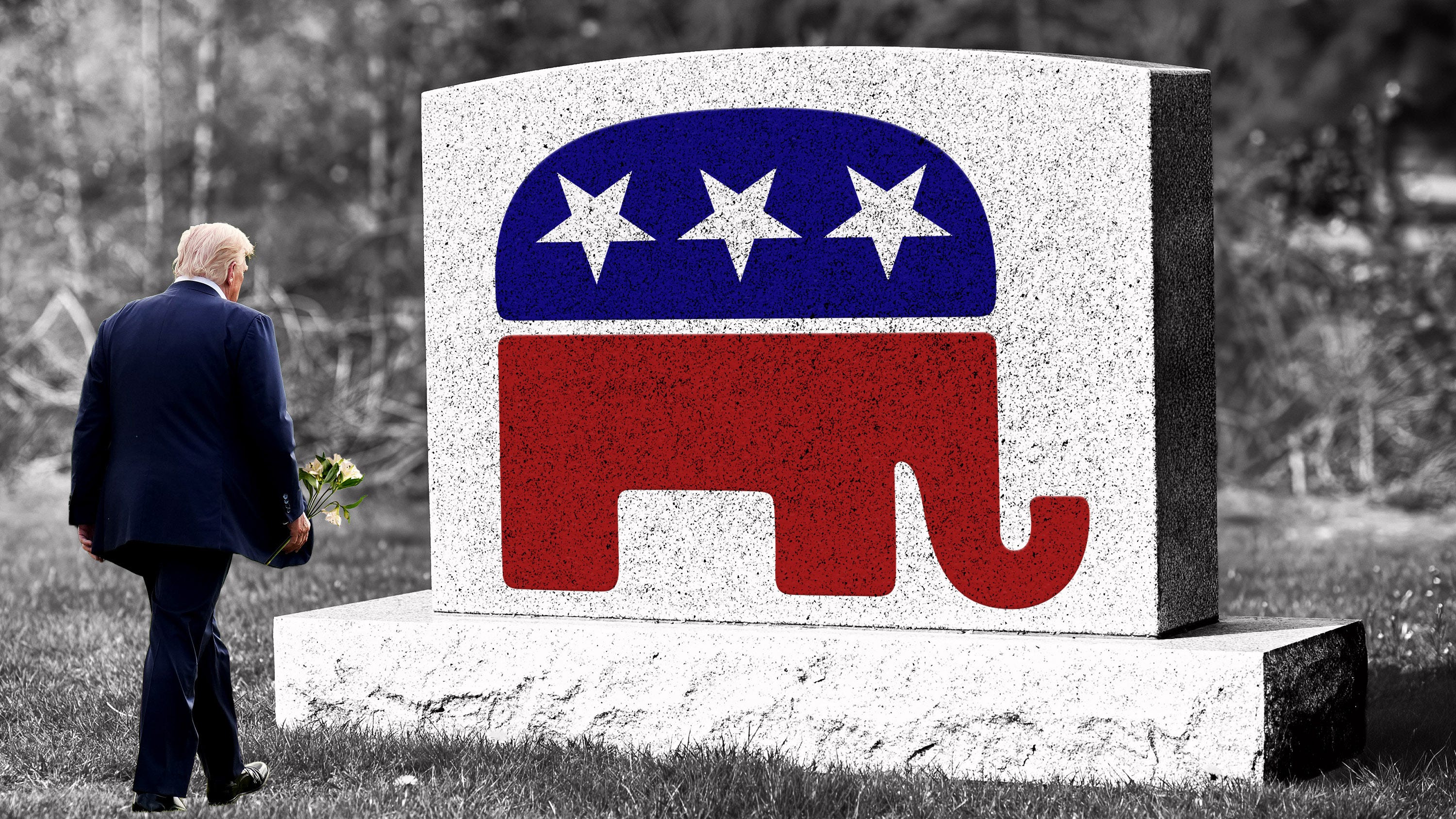 (Photo illustration by Sarah Rogers/The Bulwark | Photos: Getty, Shutterstock)
DONALD TRUMP RESPONDED to Tuesday’s Republican debacle with his usual humility. “I wasn’t on the Ballot,” he wrote on Truth Social, “and if I was, we would have won IN A LANDSLIDE!”
He’s full of it. For weeks, at pre-election rallies, Trump told voters to act as though he were on the ballot. And they did. Some conservatives voted for him, but many stayed home. And tens of millions of Americans came out to vote against him.
Trump killed his own party. The exit polls from the past three midterms prove it.1
The simplest index of Trump’s effect is an explicit question in the exit polls: “Was one reason for your vote for U.S. House today to express support for Donald Trump,” was it “to express opposition to Donald Trump,” or was he “not a factor”? In 2018, voters who said they were expressing opposition to Trump outnumbered those who were expressing support, 38 percent to 26 percent. In 2022, the AP and network exit polls diverged somewhat, but again, both found that opposers outnumbered supporters by about 12 points.
This year, the deficit was much worse. Forty-four percent of voters in House races said they were expressing opposition to Trump; only 16 percent said they were expressing support for him. That’s a 28-point gap, more than twice the previous margin. When you compute how many votes that gap cost House Republicans, it works out to more than a quarter of the electorate.
In all three midterms of the Trump era, including the 2022 midterm when he was out of office, Trump has weighed down his party. Each time, most people who said he wasn’t a factor voted for House Republicans. And each time, most people who said he was a factor voted for House Democrats.
ANOTHER MEASURE of Trump’s effect is his approval rating. Overwhelmingly, people who approve of his job performance vote for Republicans in the House, while those who disapprove of his job performance vote for Democrats.
In 2018, roughly 45 percent of voters approved of Trump’s performance, while 55 percent disapproved. Around 45 percent of voters strongly disapproved of him.
In 2022, exit polls didn’t ask the approval question, because he wasn’t the president. But this year, the question returned, and Trump’s numbers were far worse than before. Only 37 percent of voters approved of his performance; 63 percent disapproved. Fifty-four percent of voters strongly disapproved. That’s a significant increase from his previous strong-disapproval number.
Eighty-six percent of Trump disapprovers voted for House Democrats in this election. When you multiply the 63 percent by the 86 percent, you find that these people made up 54 percent of the electorate. Game over.
Trump often brags that when he’s on the ballot, he brings out additional Republican voters who don’t show up in midterms. That’s true. But the extra turnout he generated in 2020 and 2024 masked an underlying decline in his support among the general population.
To take one example: In the final Reuters/Ipsos poll before the 2018 midterms, 41 percent of Americans approved of Trump’s performance in office; 53 percent disapproved. In the final Reuters/Ipsos poll before this year’s midterms, only 32 percent approved of Trump’s performance; 64 percent disapproved. That’s a plunge from minus-12 to minus-32. And between the two polls, the percentage of Americans who “strongly” disapproved of Trump’s performance swelled from 38 percent to 50 percent.
When the general population is two-to-one against a president, it’s unlikely—to put it charitably—that he would have benefited his party, on balance, by boosting turnout.
A THIRD MEASURE of Trump’s waning power is the shrinkage of the MAGA vote. At his rallies in recent weeks, he routinely played a video clip of CNN analyst Harry Enten extolling Trump’s grip on the MAGA base. In the clip, Enten noted that 98 percent of self-identified MAGA supporters planned to vote for House Republicans.
While gloating about the 98 percent, Trump missed the real story: As a share of the electorate, MAGA voters are in decline. In 2022, 32 percent of voters identified themselves as MAGA Republicans. In 2024, with Trump on the ballot, 36 percent identified as MAGA Republicans. But this year, only 19 percent did. That’s a huge falloff, not just from the last presidential election, but from the last midterm.
Trump is too stupid, arrogant, and insulated to acknowledge any of this. In the White House, he’s lovingly attended by sycophants. When he goes out, he stays in a bubble, surrounded at rallies by his fans. He dismisses bad numbers as “fake polls,” and he sucks on tautological binkies like the CNN survey of people who still call themselves MAGA.
But it turns out that the polls weren’t fake. Americans don’t like Trump. And now his party has to decide what to do with him.
In the 2018 and 2022 midterms, two polling consortiums—one led by the Associated Press, the other by several TV news networks—measured voters’ opinions of Trump and how those opinions influenced their decisions in House elections. Those efforts merged last year, so only a single consortium conducted exit polls in 2026. The national numbers posted for these exit polls are specific to House races, but they generally correspond to Senate and gubernatorial races as well.