MAGA without Trump? Reaganism without Reagan? The GOP’s next act could be a revival, a reinvention, or stumbling into more of the same.
By Joshua Tait
Published: 2026-11-04
URL: https://www.thebulwark.com/p/the-four-paths-ahead-for-republicans
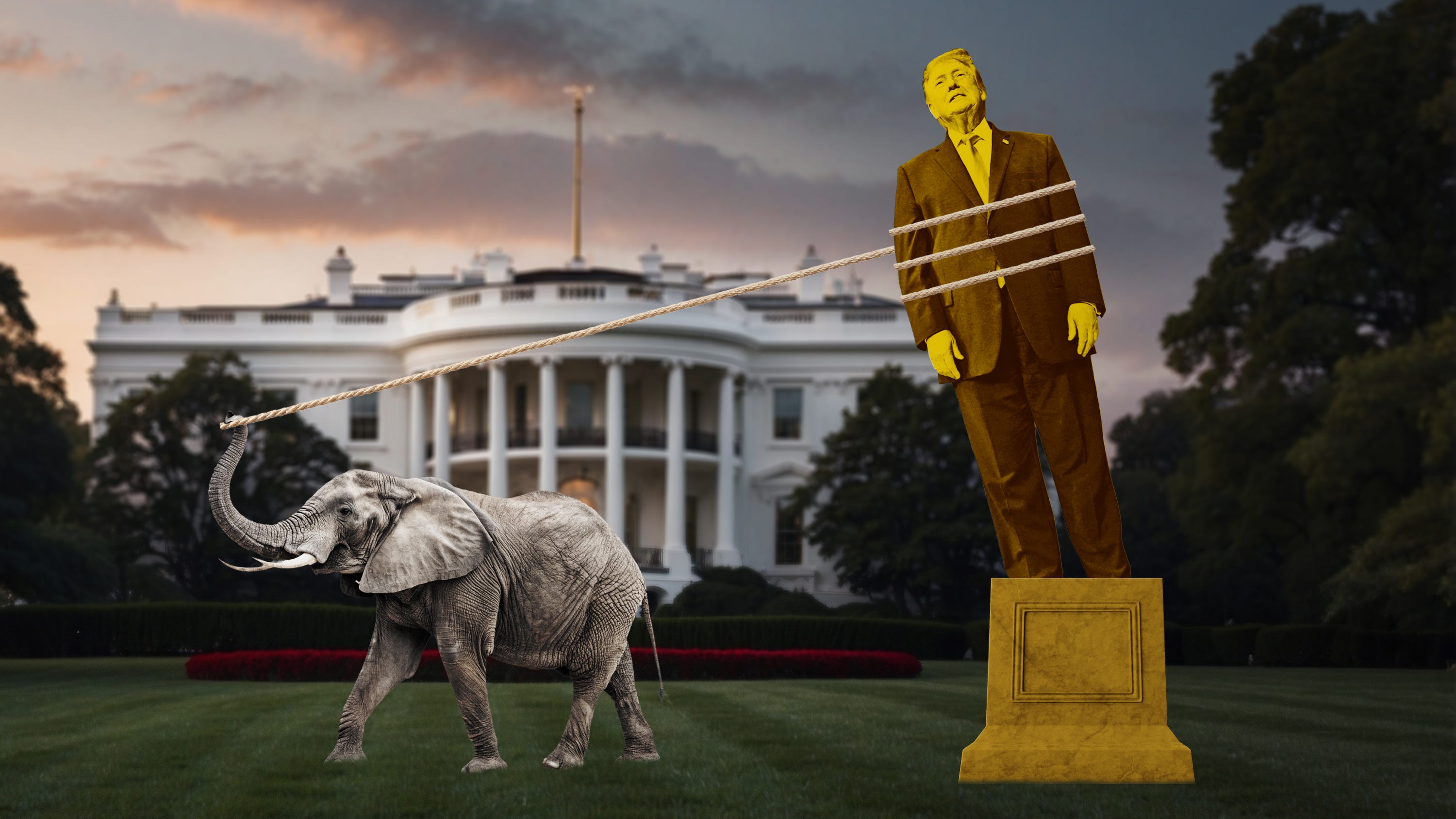 (Photo illustration by Bill Kuchman/The Bulwark | Photos: Getty, Shutterstock)
DONALD J. TRUMP IS A SUPER-LAME DUCK. The man who has dominated the Republican party and the American right for over a decade suffered a thorough repudiation in the midterms. The GOP was utterly shellacked, surrendering House and Senate seats they once thought were impregnable.
Trump has treated the Republican party like one of his own failed casinos, and in turn the Republican party, once the more ideological of the two main parties, has remade itself in Trump’s image. Sometimes literally.
But, after this historic repudiation of Trump’s narcissism, wars, tariffs, and deportation agenda, where does the party go from here? For better or worse, the Grand Old Party is one of the two viable national parties. It is going to have to put forth a candidate in 2028, and the ambitious aspirants for the presidency are quickly going to start exploring ways to differentiate themselves. So even as the Republican base and the vast right-wing media universe try to figure out how to think about what just happened and what comes next, the potential candidates are already beginning to think through the ten thousand practical questions—of funders and hires, of speeches and interviews, of travel and allies and especially policy—that will define their campaigns, and thereby reshape the party.
Can the GOP find a way up from Trumpism?
Near-Term
The fight within the Republican party over who is to blame for Tuesday night’s results is going to be a fierce, savage free-for-all. Some in the grifter-commentator class, like Matt Walsh, will be ready to blame Trump; others, not quite. But at an institutional level, expect a clash between, on one hand, the MAGA establishment that attempted to turn Trump’s insecurities, idiosyncrasies, hatreds, lusts, and idées fixes into a governing agenda, and, on the other, the America First movement that reflexively blames elected Republicans for everything.
MAGA establishment figures Ted Cruz, Marco Rubio, and JD Vance are bellwethers here. (Pete Hegseth is toast.) Cruz will redouble his efforts to revive Tea Party–era conservatism as a return to “true” Republican values. Vance will start leaking to every journalist he meets in an effort to put space between himself and Trump.1 What he says or implies will indicate the strategic thinking of the right’s illiberal intellectual class. Rubio, as always, will attempt to put himself at the dead center of wherever he thinks the party is going.
Meanwhile, America First bombthrowers like Tucker Carlson and Marjorie Taylor Greene will hammer Republicans for acquiescing to Trump’s war of choice in Iran, for covering up the Epstein files, and for failing to deport enough immigrants. It’s unlikely the kook right will rally behind another candidate the way they did around Trump; their participation in the coalition will likely be more ad hoc, less reliable, and more dependent on how much nuisance value they can extract from the larger blocs.
Longer-Term
Trump’s political death is going to leave a vacuum at the top of the Republican party, and the struggle to fill that void starts now. Of course, Trump still has two years left in his term, but the befuddled and now-repudiated Old Man no longer possesses the menace and gravity he once had. So while he’ll capture headlines and make bad, even dangerous, decisions, he’s less electorally relevant than ever.
The recent history of American conservatism suggests four possible pathways for Republicans:
1. ‘True MAGA Has Never Been Tried’
The media-intellectual-political apparatus that the American right has built over the past fifty years remains powerful. A good chunk of that system of podcasts, infotainment networks, think tanks, publishing houses, magazines, and so on has been thoroughly MAGAfied. These are the cadres that will maintain that true MAGA has never been tried. Think tanks and other organizations like the Center for Renewing America, America First Policy Institute, the Claremont Institute, American Compass, and the Intercollegiate Studies Institute have made or remade themselves in efforts to elevate Trump’s instinctual illiberalism to the level of political theory. Committed to this hard-right ideology, they will push the GOP to maintain the MAGA trajectory—potentially abetted by Vance, replacement-level Republican senators with four or more years left in their terms, and the “based” under-30 staffer class that knows only Trumpism.
There are two key indicators of the viability of this pathway. One is Vance, who has worked himself into the leading position among the MAGA intellectual elite. If he tries to become the Acolyte of True Trumpism, then it’s a good bet there’s some energy behind that project. If he tries to reinvent himself as a New New JD, then Trumpism is done for. The other indicator is the Heritage Foundation, which started as the intellectual home to Reaganism, then became a vestigial organ on an electioneering effort increasingly uninterested in ideas at all, and since Trump’s first term has become a sort of Higher Party School of MAGA. If Heritage swaps out its embattled president, Kevin Roberts, with someone of a less populist-authoritarian mold, then change could be coming for the GOP.
The MAGA grifters and podcasters will be at sea for the near future as they search for a new message. Until the newly elected Dems are in office—and possibly for some time afterward—they will have relatively little to complain about. What they will have is low morale and cratered audience trust. But they are alert to audience signals, so when they land on a narrative, it will be a useful sign.
2. Zombie Zombie Reaganism
Although much diminished, there remains a segment of elected Republicans who are old enough to antedate Trump’s takeover of the GOP. Fewer than fifty of the Republican House members who will be serving in the new Congress were already in office by the time Trump was first elected in 2016. On the Senate side, only twenty or twenty-one Republicans who served before Trump’s election will be back.2 Still, there are enough of them that some in this subset of Republicans might prefer a return to the Reaganite–Tea Party conservatism that dominated the right from 1980 until 2016. It’d be an easy move for folks like Cruz, Rubio, and the conservative justices on the Supreme Court, as well as Dispatch-type conservatives who have already started asserting Trump should have tried conservatism.
In many respects, small-government, anti-tax, and back-the-blue law-and-order conservatism is the natural political ideology of the party’s historically middle- and upper-middle-class base and its donor class. It’s a worldview the conservative movement and Republican party have spent decades insisting is the natural American Way.
Republicans will be tempted to lean heavily into Obama-era constitutionalism and demands for fiscal discipline as rhetorical devices to rein in Democrats and claim the moral high ground. There are some problems with this strategy, though. America Firsters will scream bloody murder that the “neocons” or “establishment” are trying to reclaim the party. And at the same time, Republican demands for constitutional propriety and tight financial belts have been exposed as hypocrisy. Plus, Reaganite conservatism hasn’t really been a winning message since . . . 1988? 2000?
3. Good Governance Revival
Republicans may struggle to escape the Trumpian millstone for the next decade—which could mean they will have to prove to skeptical voters that they can be a normal, competent party capable of leadership. It may take a while for them to win back voters’ trust. Or maybe they will be forced to emulate the centrist Democrats of the 1980s and 1990s who, in an effort to move away from the left-wing candidates defeated by Nixon, Reagan, and Bush, began presenting themselves as “New Democrats.”
If MAGA really is obliterated and the GOP becomes a rump regional party, its future may lie in distinctly branded “New Republicans,” consciously and explicitly non-Trumpian—perhaps even pragmatic, good-governance types—drawn from moderate governors in purple or blue states. It’s an unlikely scenario, but we might see the emergence of something like a Republican Leadership Council or a Coalition for a Republican Majority—centrist organizations pushing for a centrist, post-Trump future. I won’t hold my breath.
4. Muddling Through
Inertia is a powerful thing. It’s quite possible that a combination of party loyalty, polarization, the right-wing infotainment complex, and perceived Democratic overreach or lack of focus may produce a haphazard Republican revival. A GOP that muddles through won’t magically become coherent or well-led. Having undergone ten years of Trumpism, the party’s depleted human capital will not be easily replenished. Republican candidates for years to come will likely largely be MAGA or conservative drones drawn to the party but out of step with the nation. Its staffers and thinkers will be shallow, as real talent will be drawn either to the Dems or to private-sector careers. The biggest concern here is the current GOP staffer class, which has been selected (and self-selected) for its allegiance to MAGA. New leadership can remove some of these people, and it would help if that leadership made clear to them that they’re no longer welcome. Think: DOGE, but for Republican staffers. Whether and how quickly those positions can be filled by people of more consequence and competence is another matter.
But even a shell GOP may well still be competitive at a national level, as the Republican party was at the presidential level in the second half of the twentieth century despite Congress being dominated by Democrats. Just about every democratic nation has a center-right party; they’re arguably necessary for a democracy to survive. And ours, for better or worse, is the Republican party. It’s too soon for us to know what they will stand for, except that they will oppose Democrats, and in some elections that will be enough. The party did just fine back before it was the party of ideas, when conservatism was a series of “irritable mental gestures,” as Lionel Trilling described it.
The party must repudiate Trump
Whatever the way forward, Republicans will have to finally reckon with Trump and his legacy. He’s a super-lame duck now, and he won’t live forever. In fact, his standing will only decline over time as the media and historians correctly portray him as a disastrous president and Trump supporters’ feelings toward the president become less entangled with their own decisions to vote for him. Distance will lead to clarity. Republicans will find that they have to repudiate Trump in some way or another.
Republican candidates in 2028 will have to thread the needle delicately—presuming Trump is alive and cognizant (or, for that matter, not mounting an unconstitutional bid for another term for himself). But after that, as with every cult of personality, someone will have to finally name it. Perhaps it’ll be a moment like Khrushchev’s “secret speech,” or maybe it’ll be closer to the Chinese Communist Party view of Mao—70 percent good, 30 percent bad. Regardless, Republicans will have to say publicly where they stand regarding Trump. And if they dodge the question, Democrats should wave the bloody shirt of Trumpism for as long as they can.
Oh, look, he’s already started.2
Depending on the outcome in Alaska.