Plus: Vivek Ramaswamy’s closing harangue.
By Andrew Egger
Published: 2026-11-03
It’s Election Day, and boy, do we have election coverage for you: Tim, Sarah, and JVL will kick off our election night broadcast at 7:00 p.m. EST on Substack, YouTube, Facebook, and Twitch. Sam and the rest of the Bulwark team will carry us through the night as results come in across the country. Everyone is welcome. See you tonight! Happy Tuesday and happy Election Day.
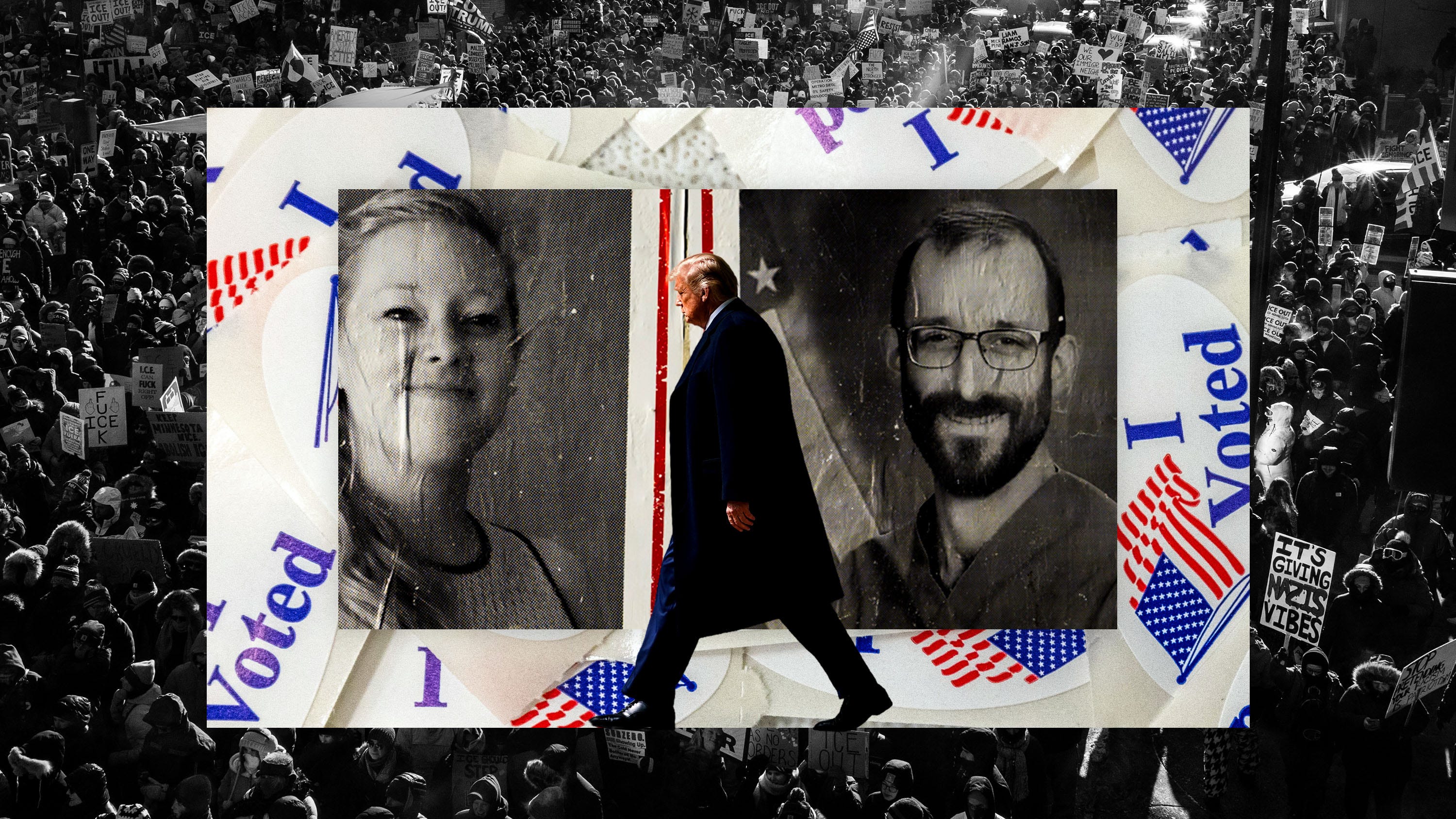 (Photo illustration by Sarah Rogers/The Bulwark | Photos: Getty)
Trump’s Downfall Started in Minneapolis
by Andrew Egger
So here we are at last. After two years of Donald Trump’s Washington—the idiocy, the cruelty, the malice, the bullying, the bigotry, the hubris, the state violence, the monomania, the cowardice—it’s finally time for the president to make the first payment on the bill. Barring a catastrophic polling error (and when has that ever happened?), Americans seem set to deliver a colossal rebuke to Trump, who stormed into office last year ready to crack heads and is now doddering out the last days of his trifecta ranking asses.
The big political killer was Iran. Trump’s disastrous Middle East war fractured his coalition and doomed the country to a year (or more!) of terrible economic vibes. A week into the war, Trump’s approval rating was sitting north of 42 percent; it’s been slumping lower ever since. Nothing makes price-conscious Americans reach for their pitchforks like spiking energy prices.
But I think that the turning point in Trump 2.0 actually came a little earlier. The thing that convinced Trump he needed to beat a retreat on a core part of his domestic agenda was his fiasco in Minneapolis.
There’s no better time than Election Day to join our pro-democracy community. We’d love to have you.
It’s only been a year, but it’s already easy to forget just how big a part large-scale state violence against Democratic protesters played in Trump’s plans in 2025. Over and over, the White House launched remarkable provocations against blue cities and states, from Los Angeles to Portland to Washington, D.C. These actions weren’t just intended to cow Democratic leaders. They were intended to stoke deliberate conflict between militarized agents of the state and people on the ground—conflict that Trump and MAGA could then repackage as content for their base.
Amid Trump’s many simultaneous assaults on the norms and laws that restrain the presidency, this content served a specific rhetorical purpose. In videos of riots and clashes with protesters, Trump’s government represented the forces of order, while those who opposed him were the forces of chaos. The law, Trump’s violence argued, wasn’t some bunch of buzzkill rules dorks and eggheads used to rein in great men like him. The law was pepper spray in an angry protester’s face.
As I wrote last October:
Trump goes out of his way to start conflicts. He wildly exaggerates the horrors of daily life in blue cities. He sends the National Guard in a shock-and-awe show of force into those same places. In the protests and clashes that result, he tells them the only way they can err is by pulling their punches. You’ve got to teach these criminals, he says, the only way they understand. They spit, you hit. And “criminals” are whoever Trump says they are.
When he ordered ICE into Minneapolis, Trump was just following the natural progression of this plan. But the plan quickly met disaster. ICE’s clownishly brutal occupation of the city spurred ever-increasing organized resistance from locals, who tracked ICE vehicles and made their job consistently irritating and difficult—blowing their cover by following them with blaring horns and shrieking blowing whistles, organizing deliveries of groceries and other materials to terrified immigrants wouldn’t have to risk leaving their homes, and so on. And videos of irritated agents lashing out at annoying but law-abiding and peaceful protesters started to turn public sentiment against the occupiers—even before things went catastrophically wrong.
And then came the deaths of Renée Good and Alex Pretti. More than anything else, these two instances of shocking police violence against peaceful protesters turned the tide. Trump and Co. wanted a constant feed of videos of police administering street justice to hooligans; instead, Americans’ social platforms were suddenly full of videos of deadly violence dealt against—in Pretti’s case—a man who had literally tried to peacefully place his body between an agent of the state and the woman he was roughing up.
MAGA’s propaganda machine tried feverishly to smear these two dead Americans as domestic terrorists and would-be cop killers. But no one was buying it, and soon even they had to admit it. Not long after, the White House announced an about-face: They were heading out of Minneapolis. From now on, federal immigration enforcement would focus on the red cities and states that would cooperate with less fuss. The blue-city occupation strategy was at an end.
I don’t mean to oversell this. It isn’t as though Trump et al. have gotten significantly more careful about the violence the state wields: Others have died at the hands of DHS agents this year, including Lorenzo Salgado Araujo in Houston and Johan Sebastián Durán Guerrero in Maine this summer. And, as our Adrian Carrasquillo reported last week, Good and Pretti’s families have never gotten accountability from the officers who killed them.
But Minneapolis’s resistance still achieved something extraordinary: At a time when Trump seemed at his strongest and they seemed at their weakest, they managed to throw him off his violent agenda simply by standing up nobly as individuals and as a community against his designs. Maybe—probably?—voters will put Democrats back in power today, and Trump will never again achieve the level of unilateral state authority that he enjoyed last year. But even if they don’t—even if Republicans beat the odds and give Trump back more or less united control of Washington—Minneapolis still gives us the model: You resist with whatever you’ve got.
One Last Round with Ramaswamy
by Jim Swift
*West Chester Township, Ohio
*The prevailing sentiment online is that a blue wave is going to wash Republicans out of the majority in both chambers today. But out here in the Cincinnati exurbs Monday night, prognostications were a bit different.
“It is a Ramaswamy tsunami,” a man at a bar declared. He paused, then added, “and a Husted high tide.”
The prognosticator in this case was the Republican candidate for attorney general of the state of Ohio, Keith Faber. He and a small battalion of quarter-zipped Republican pols were taking turns warming up Lori’s Roadhouse for gubernatorial candidate Vivek Ramaswamy, who was in town to make the closing argument of his beleaguered, often-bizarre campaign.
The spacious music venue had arranged rows of four-tops to seat around 300 people in the dim, red-lit hall. Other early attendees—staff, mostly—adhered rigidly to that GOP quarter-zip aesthetic.
I had barely settled at the open bar when a man with his phone out approached me and demanded to know: Why was I there if The Bulwark hated Vivek so much, huh? And why hadn’t I condemned Amy Acton, the Democratic candidate in the race, as an alcoholic, huh? He briefly gained a head of steam before leaving me to my drink; he had a recording to review and (maybe) post. An Ohio State Highway Patrolman stepped in to fill the spot, and he stayed there through the rest of the program, never saying a word to me.
The candidates arrived about twenty minutes behind schedule. Ramaswamy and his running mate, Senate President Rob McColley, strode past half-empties on the tables as much of the statewide Republican ticket strode behind them. The bus contingent had, you guessed it, their quarter-zips on. The group’s tidy, techy appearance belied the nastiness of the attacks on Acton many of them were about to spout, as when the candidate for treasurer—not exactly a role that requires a dogfighter—smugly told the audience: “Not one of us is going to slur our speech.”
He was referring to a video from Acton’s Thursday appearance in Toledo that her critics have used to claim she is an alcoholic. That’d be quite a secret to keep in today’s world, but plausibility aside, it became a recurring subject throughout the evening. AG candidate Faber brought it up, too, urging supporters to send it to friends and family. It was all done in service of the same basic message: Acton was unfit to lead. She was a complete sot. What’s worse—she’d gotten involved in, like, COVID stuff, man.
Vivek’s running mate attempted to instill the central point through a bit of call-and-response.
[Y]ou gotta ask your friends, family, and neighbors, “Who do you trust? Who do you trust to deliver lower property taxes?” (Audience: Vivek!) “Who do you trust to take out Medicaid waste, fraud, and abuse?” (Audience: Vivek!) “Who do you trust to end sanctuary cities in the state of Ohio?” (Audience: Vivek!) “And who do you trust to make it so that you and your family can live, work, raise a family, and prosper here, and your kids and grandkids don’t have to leave for another economic opportunity?” Let’s hear it. Who do we trust? (Audience: Vivek!)
When Ramaswamy took the mic, he promised his next visit to Butler County would be as governor.
“That’s the good news,” he said.
Then came one of the most abrupt unforced pivots I’ve witnessed at a political event: “The bad news is communism is spreading across the West.”
He took the crowd on a quick tour of looming horrors: France was burning, New York was under socialist rule, Los Angeles was soon to follow, and Minnesota was plagued by entitlements fraud and what he called an “illegal immigration infestation.”
Then he invoked Dearborn, Michigan. “Are you gonna let that come to Ohio?” he asked.
“This is not Republican versus Democrat. This is common sense versus communism.”
Common sense, in his view, means lower electric bills, an end to sanctuary cities, and becoming “the most conservative governor this state has ever seen in our history.” It means maybe-sorta abolishing property taxes altogether.
And it means calling and texting everyone in your contact list to tell them to vote for Ramaswamy, even if it requires suspending normal phone etiquette. “Tonight’s an exception. You can do it,” Vivek said.
“This is the last night of this campaign,” he told the crowd. “I’ll remember this for the rest of my life. You will, too, when we get this right tomorrow morning.” And just like that, the quarter-zip brigade retired for the night.
AROUND THE BULWARK
-
Trump Was Right. He Is on the Ballot... But, MONA CHAREN asks, what possible reason is there to vote for him?
-
A Warning for Trump’s Project 2025 Mastermind… On Receipts, REP. BRENDAN BOYLE joins CATHERINE RAMPELL to discuss what Democrats plan to do if they take back the House, from reversing Trump’s healthcare cuts and tariffs to confronting the economic fallout from his Iran war. Plus, SAM STEIN joins to break down Trump’s closing economic message and how rising costs and voters’ frustrations over the economy could shape decisions at the polls.
-
A Political Earthquake in Texas… On election eve, GEORGE CONWAY welcomes veteran Republican strategist MIKE MADRID to Psycho Politics to talk about extraordinary Latino voter turnout, why Trump’s 2024 coalition may be coming apart, and the growing possibility of a Democratic upset in Texas.
-
MAGA Preps for the World to End—Literally… With Republicans fearing electoral doom, right-wing pundits send their audience to the bunker, reports WILL SOMMER in False Flag.
-
Final Senate Polls Are So Good, Sarah Can Barely Believe Them… It’s the last Secret Podcast before Election Day!
-
Is Trump’s GOP About to Get Wiped Out? BILL KRISTOL joins TIM MILLER on The Bulwark Daily to discuss the Iran war and its impacts at home, and why the polls are rosy for Democrats. JVL joins for a bonus segment to break down Haley Stevens’s breakdown.
-
Tucker Carlson Says Trump is Considering a Nuclear Attack on Iran… On the latest Command Post, MARK HERTLING and BEN PARKER break down Tucker Carlson’s alarming claims that the Trump administration could be preparing a nuclear strike on Iran.
-
A Close-Up View of the Wildest 24 Hours of the El-Sayed Campaign… Haley Stevens’s stunning defection, a fundraising surge, and a possible Senate majority in the balance. JONATHAN COHN reports from Michigan in The Breakdown.
QUICK HITS
BOMBS AWAY?: Will Trump hit Iran again after the midterms? There’s been growing chatter that he’s considering it, and America’s regional allies are glumly bracing for impact, assuming they’ll bear the brunt of Iran’s retaliation if America starts dropping bombs again. But the president hasn’t made up his mind, the Wall Street Journal reports:
The president told Israeli Prime Minister Benjamin Netanyahu in a call Saturday that he wanted to first give continuing diplomatic efforts a chance to succeed, people familiar with the call said.
Netanyahu pressed for strikes immediately after the U.S. midterms, the people said. Israel’s military has prepared attack plans and on high alert, one of the people said. . . .
“The only reason why I’m not finished with Iran is I want to be nice. I want to try and save all those lives if I can,” Trump said Sunday at a rally in Iowa ahead of Tuesday’s midterm elections. “But at some point we’re going to have to give them the hammer.”
Yesterday, the Journal also reported that the United States had bombed Iran’s Qeshm Island—apparently without any relation to the short, sharp escalation Trump is mulling after the election. This all from the man who said he could win the Vietnam War in a week.
AMERICA’S SMALLEST DONOR: Trump has made a couple billion off the presidency since last year, but he doesn’t seem particularly interested in giving back to the people who helped make it possible. The Washington Sun reports that Trump didn’t contribute a dime of his own money to a single candidate, PAC, or super PAC this cycle, despite plenty of promises to do so: “I’m going to be making contributions to various campaigns and people that I think are good,” he told the Sun in September. “I’m going to spend whatever amount of money necessary to try and help us.”
Instead, he’s been treating other people’s money like his own—in open violation of federal law. Trump isn’t supposed to direct the spending of his super PAC, MAGA Inc. But he’s made no secret that the PAC’s hundreds of millions—funded by the likes of Miram Adelson, Jeff Yass, and the Winklevoss twins—are, in his words, “money that I control.”
“For months voters have watched donors to Trump’s roughly $400 million war chest land posts in the administration and receive presidential pardons, among other favorable treatment,” former FEC Chairs Trevor Potter and Ellen Weintraub wrote in a Washington Post op-ed last week. “These results, coupled with Trump’s assertion of control, fly in the face of the basic legal bargain that allows organizations such as MAGA Inc. to raise and spend funds.”
HERE COMES CHUCK: Democrats may be poised to retake power in Washington, but voters still don’t like the party much: Surveys consistently find the Democrats’ national approval rating significantly lower even than the GOP’s. But despite widespread disapproval even among their own voters, Washington Dems aren’t in any big hurry to make leadership changes. In fact, Politico reports, the mood among Senate Democrats is that, should they retake the chamber, Sen. Chuck Schumer will walk back in basically unopposed as majority leader.
If the wave predictions fizzle, things might look different:
“This isn’t last year,” said a Schumer-neutral Senate Democratic aide granted anonymity to speak about internal caucus dynamics, referring back to government funding fights with Trump that had many Democratic senators publicly fuming over how Schumer handled them.
But if Democrats are in the minority, the 75-year-old leader could find himself dealing with members who publicly break with him, questions from colleagues about whether he will retire in 2028 or even an unlikely longshot challenger, according to five people interviewed about Schumer’s standing.