Don’t expect “Christian nationalism” to disappear when Trump disappears.
By Jonathan V. Last
Published: 2026-10-29
URL: https://www.thebulwark.com/p/the-power-of-trump-compels-them-christian-nationalism-empathy
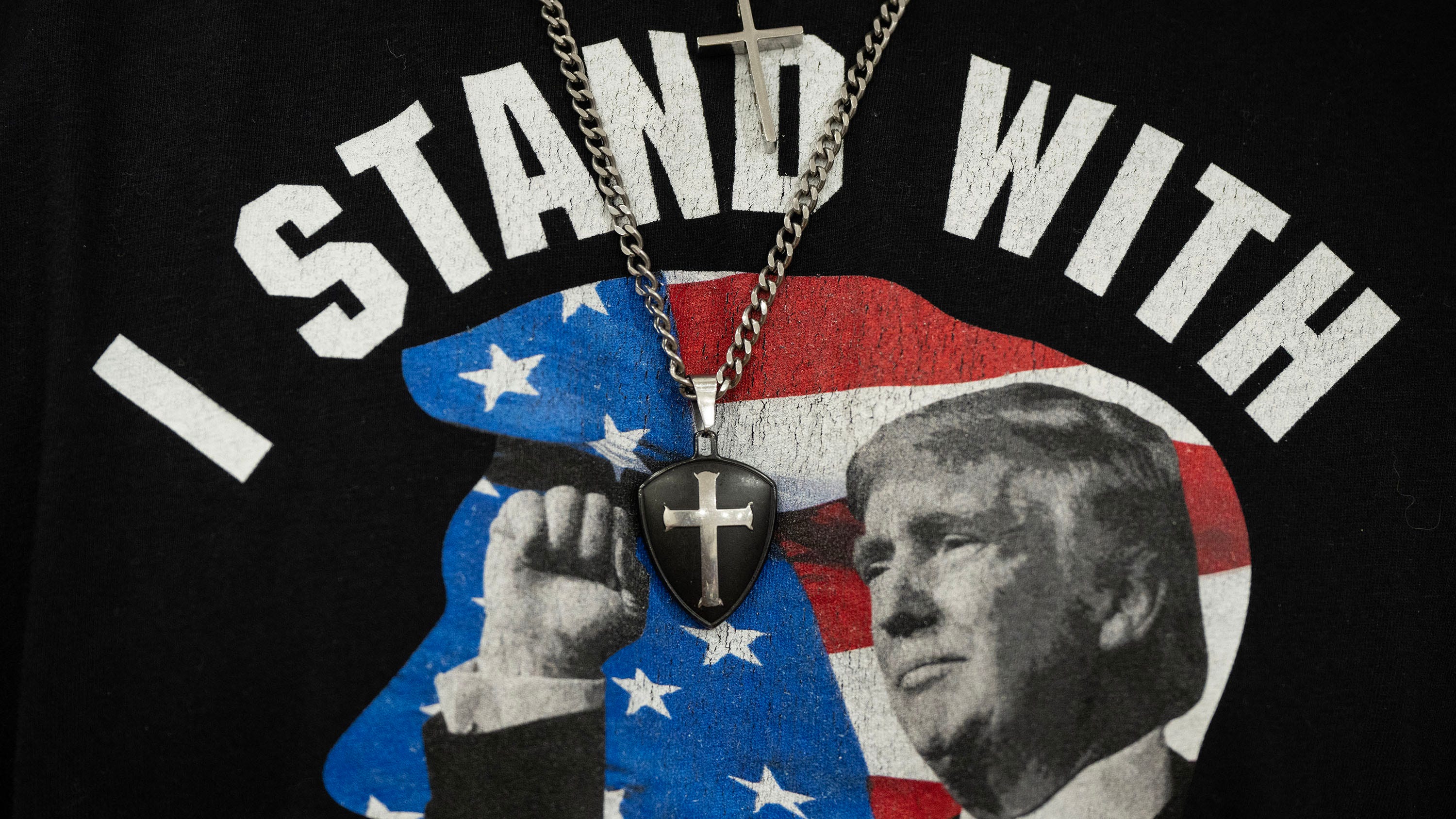 (Photo by Andrew Caballero-Reynolds/AFP via Getty)
1. Christian Nationalism
Someday the Lord will call Donald Trump home. At that happy hour, as Trump is welcomed to eternal life, there will be a great deal of uncertainty in American politics. What will happen next?
My thesis is that there will be no return to normal because Trump has fundamentally changed the character and desires of a large group of American voters.
This is the sort of idea that’s hard to quantify because you can’t come at it head-on. You have to look for oblique angles. The Public Religion Research Institute just gave us some interesting data points. I want to talk about them, and the Gospel, and the future of American politics.
And empathy.
PRRI’s latest survey asks a number of interesting questions. For instance, what do people think of the term “Christian nationalism”?
It’s important to understand that Christian nationalism is not a type of Christianity. It’s a type of nationalism.
Christianity is, by definition, universal. “For God so loved the world that He gave His one and only Son, that whoever believes in Him shall not perish but have eternal life.”
Note “the world” here, not “Israel,” or “Egypt,” or “Samaria.” Or, obviously, America. The bedrock idea of Christianity is that Jesus Christ is the literal Son of God and that He was sent for all. Christianity, again by definition, can have no foundation in nationhood. In a very real sense, it is antithetical to the idea of nationhood.
So what is Christian nationalism? It is a form of nationalism that cloaks itself in Christian identity. Which is to say: It is a false Christianity. Again, just by definition.
Most Americans understand this dichotomy, which is why a plurality of Americans (48 percent) view “Christian nationalism” unfavorably. But there are two groups that have glommed on to the idea: Republicans and white evangelical Christians.
Favorable views of Christian nationalism are up from four years ago. Where did this increase come from? Largely white non-evangelical Protestants and white Catholics.1 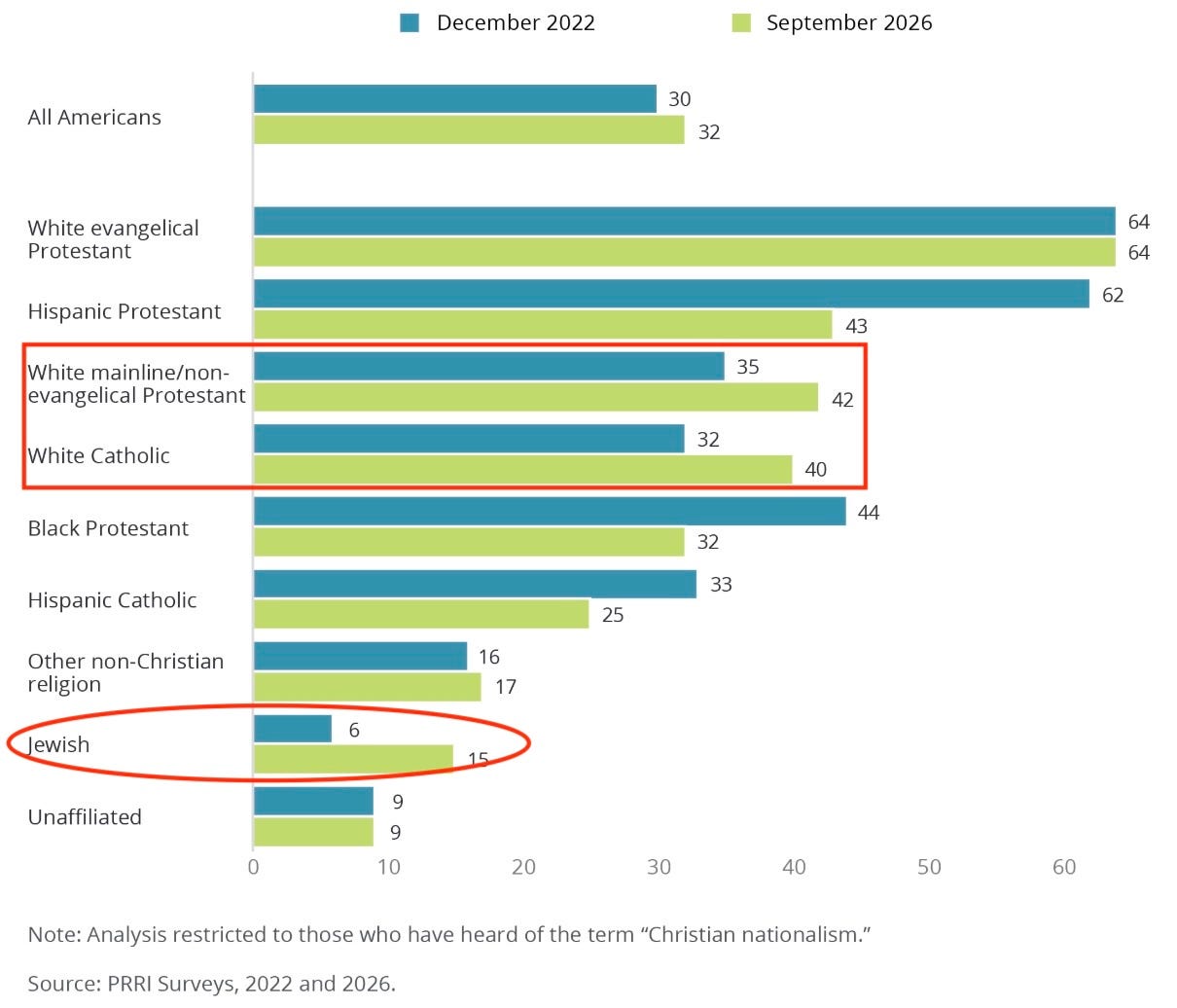
Take a look at what’s going on here to really understand the character of Christian nationalism. Among Hispanic Protestants and Hispanic Catholics and black Protestants, support for Christian nationalism fell off a cliff.
But among white non-evangelical Protestants, white Catholics, and Jews—huge increases in favorability.
There is no way to interpret this shift as anything but an increased, shared understanding that “Christian nationalism” isn’t about Christ. It’s about white ethnonationalism. That’s why Hispanic Protestant support dropped by a third while Jewish support nearly tripled.
Everyone understands the score.
Now what happens when religious groups stop seeing themselves as based on theological concepts and start viewing themselves in terms of ethnonationalism?