In an interview before the former president’s Michigan visit, the progressive Senate hopeful reassesses his old critiques.
By Jonathan Cohn
Published: 2026-10-21
URL: https://www.thebulwark.com/p/abdul-el-sayed-michigan-senate-campaign-barack-obama
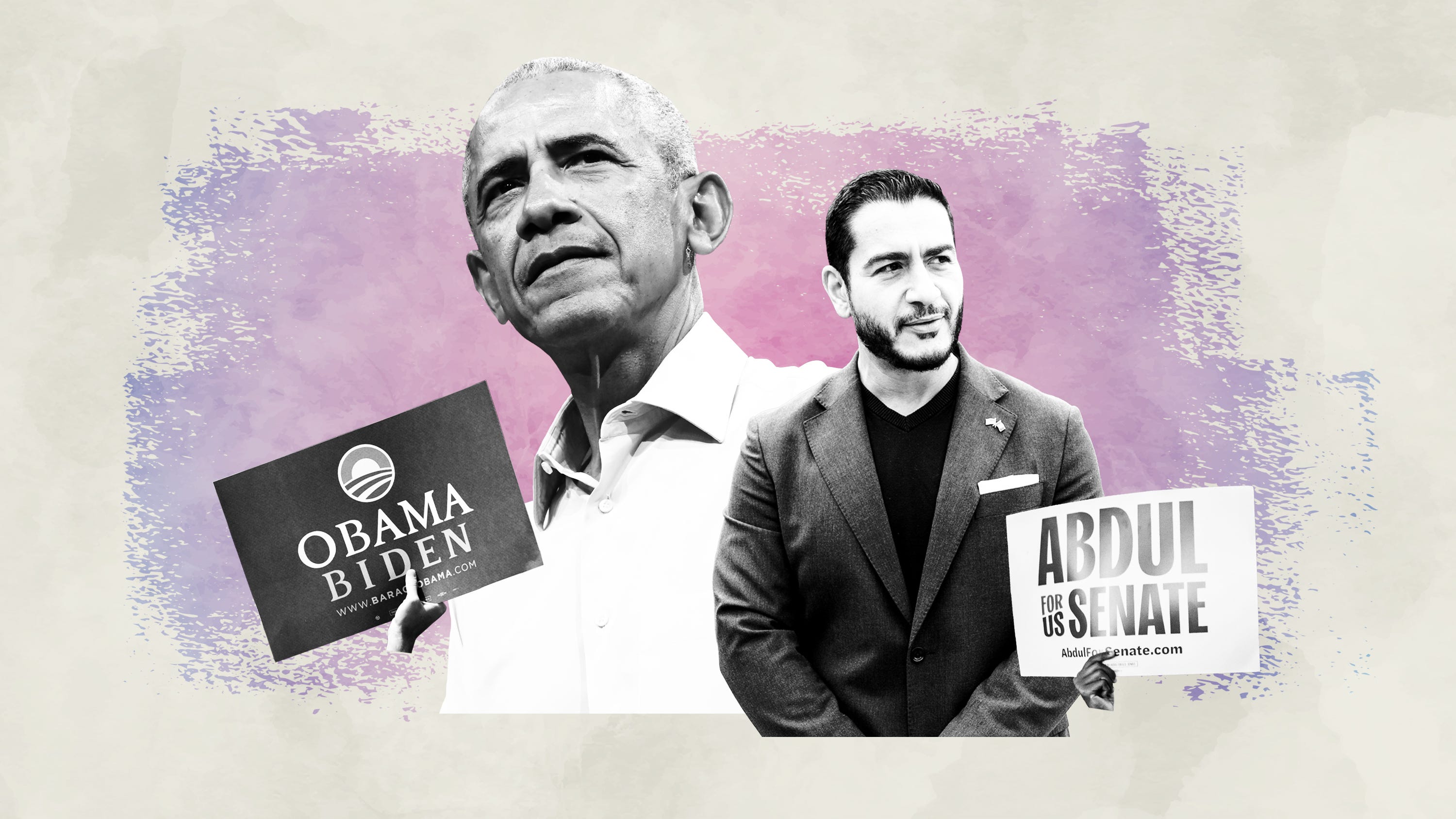 (Photo illustration by Bill Kuchman/The Bulwark | Photos: Getty, Shutterstock)
*Along I-75 in Southeastern Michigan
*ABDUL EL-SAYED REMEMBERS EXACTLY where he was the first time he saw Barack Obama. It was July 2004 and El-Sayed was 19, standing at the kitchen sink of his parents’ house outside Detroit while the Democratic National Convention in Boston was playing on the television.
Obama, then a Senate candidate, was giving the primetime keynote address—an ode to hope, unity, and American pluralism that would go on to launch his career in national politics. But El-Sayed, who at the time was on the pre-med track at the University of Michigan, says the speech had a more personal significance for him. It made him believe a minority kid with a funny-sounding name could speak to and be accepted by much larger audiences, kindling an interest in politics that eventually would lead him to become this year’s Democratic nominee for Michigan’s open Senate seat.
“I was doing dishes, after I got home late and was eating on my own,” El-Sayed recalled this past Sunday, as we spoke on board his campaign bus in between events. “And I remember the TV being on and just being like holy . . . wow . . . I’ve never seen that before. And the speech was so good. And it was the first time I was thinking, ‘Bro, you’re talking about me.’”
This coming Saturday, El-Sayed will get a chance to tell Obama about this moment directly when the former president comes to Detroit to campaign for the Michigander. It will be the first time the two have met in person and only the second time they have spoken, following a phone conversation after El-Sayed won the nomination in August in which Obama called to pledge his support.
But for all of the gracious words they have said about each other in public and (reportedly) to each other in private, the fact remains that El-Sayed is part of the Democratic party’s progressive wing. And among progressives, the predominant sentiment about Obama’s presidency is a combination of ambivalence, disillusionment, and occasional hostility.
The premise is that Obama was too timid, that he failed to shake up institutions or distance himself from a party establishment bankrolled by corporate America—if not from a lack of fortitude, then at least from a lack of ambition. He may be the most popular politician alive, but there’s this long list of things he got wrong. He should have punished banks and bankers for their role in the 2008 financial crisis. He shouldn’t have embraced tough border control for the sake of bipartisan immigration reform that Republicans were bound to oppose. He shouldn’t have heeded advisers and members of his own party urging him to make deficit reduction a priority. And so on.
Progressives aren’t the only Democrats who express versions of these sentiments. But they are the ones who do so most loudly and frequently, and that includes El-Sayed, who during graduate studies in 2012 said of Obama’s re-election bid that he “was not the right choice—he just wasn’t the wrong one.” El-Sayed struck a somewhat more measured tone in his 2020 memoir, Healing Politics, praising Obama’s character and some of his policies accomplishments. But even then, he bemoaned the “inspiring intentions unfulfilled or reversed.”
During our conversation, El-Sayed didn’t exactly take back any of these sentiments. But he also expressed an appreciation for Obama’s leadership and the accomplishments of the Obama presidency not so evident in his past writing.
That evolution could be purely cosmetic, in order to avoid awkwardness now that Obama is on the way to campaign for him. Or it could be political expediency as El-Sayed tries to rally the Democratic faithful, especially black voters who have not embraced him with the enthusiasm they have Democratic candidates in the past.
Many of those voters remember ads from the bruising primary that made it appear (disingenuously) that El-Sayed had attacked Michelle Obama over the health initiatives she led as first lady. The former president’s blessing could go a long way to making those memories go away, and tilt what looks like a tight race in El-Sayed’s direction.
But there’s another possibility: