America is turning its back on its allies and its values.
By Mark Hertling
Published: 2026-10-20
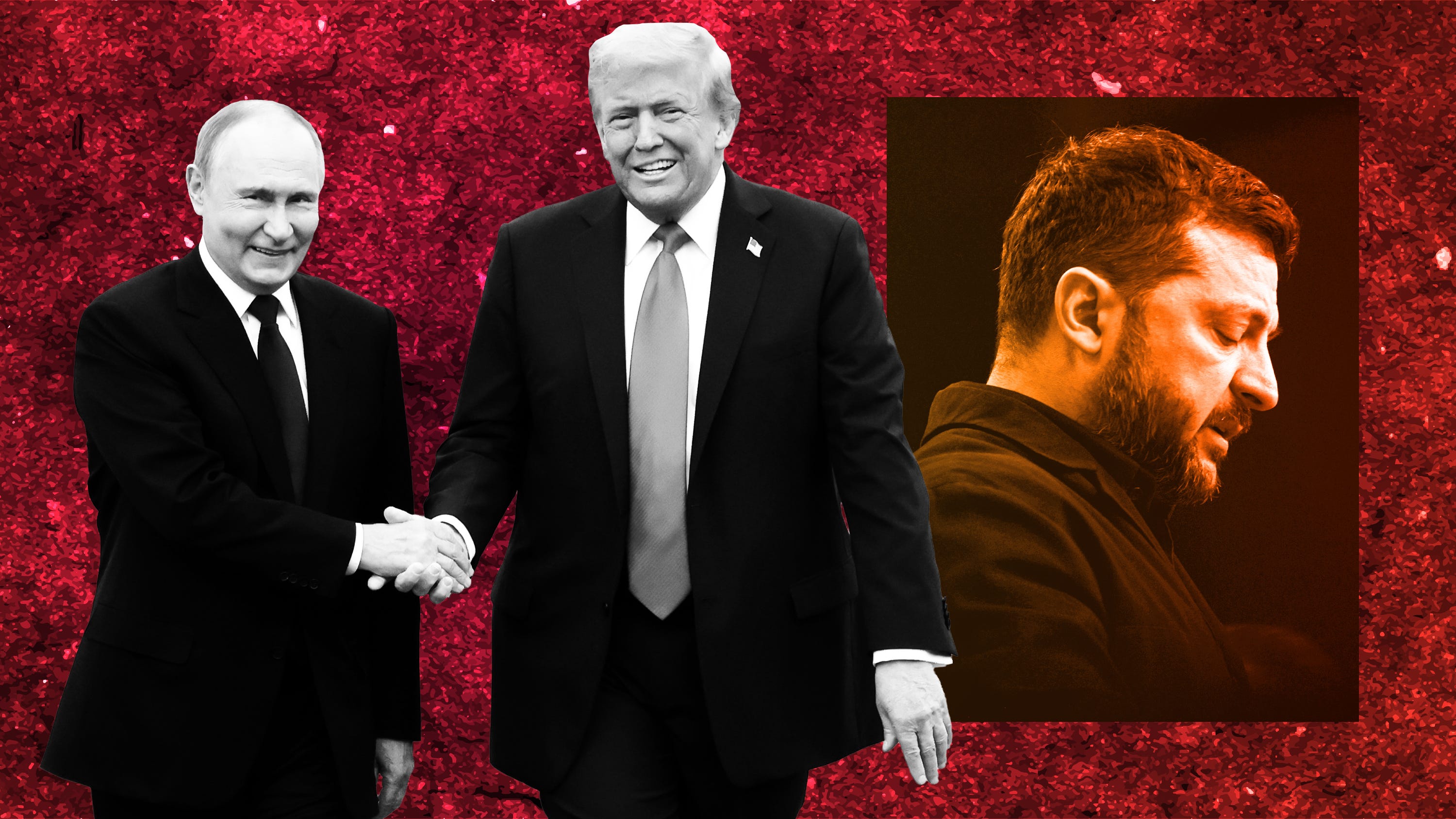 (Photo illustration by Bill Kuchman/The Bulwark | Photos: Getty, Shutterstock)
ON SUNDAY, PRESIDENT DONALD TRUMP defended his decision to suspend new sanctions against Russia. He repeated his argument: “I am in the process of negotiating Peace in the war between Russia and Ukraine, and don’t want to do anything that will drive, foolishly, Russia away from the bargaining table. . . . I WANT THIS WAR END!” He rabidly criticized Ukraine’s attacks on Russian oil refineries and suggested that Ukrainian President Volodymyr Zelensky didn’t want to end the war and was contributing to rising fuel costs for American farmers and businesses. At first glance, some of that might sound reasonable. In context, it is a disturbing and shameful abandonment not only of a would-be ally in need, but of the best and noblest traditions of American foreign policy dating back centuries.
Any military commander who has experienced war understands the value of diplomacy, and I have seen enough death and destruction to know that negotiations, even with terrible adversaries, are sometimes necessary. But diplomacy requires understanding the interests of those across the table, and effective negotiations require leverage. Instead of using American economic power to pressure the country that started this war but shows no capability of winning it, Trump is offering that country economic relief while criticizing the nation that is successfully defending itself.
Zelensky’s response was unusually direct. In an interview on NBC’s Meet the Press, he warned that if the United States formally sided with Russia, Ukraine would “not prevail.” This was not simply an emotional appeal from a leader exhausted by almost five years of war; it was his pragmatic assessment of the consequences of an American president who appears finally unable to resist his urge to side with the aggressor over the victim.
America is the only country in the world dedicated to an idea. If you still believe in that idea, join Bulwark+ and help defend it with us.
I’ll readily admit my personal bias inclines me to root for Ukraine. When I commanded U.S. Army Europe, one of our most important partnerships was with Ukraine’s military, especially with their army leader, who became a dear friend, Col. Gen. Henadii Vorobiov. He had asked us to help him transform a military that had inherited much of its structure, doctrine, and culture from the Soviet Union, and we spent significant resources doing just that. We talked tactics, training, and leader development, and we helped them develop a professional noncommissioned officer corps, empower junior leaders, and build a military that served its citizens rather than a powerful ruler. He understood that transforming an army required transforming its culture, and through our partnership I learned much about Ukraine’s history and its people’s aspirations.
Some of our most memorable conversations concerned Ukraine’s suffering under Soviet rule. Vorobiov shared personal stories about his family’s experiences during the Holodomor, the catastrophic famine caused by Stalin’s policies in 1932–33 that killed millions of Ukrainians. Those stories were not distant historical abstractions; they were events his grandparents had survived, and they formed part of the national consciousness that shaped how Ukrainians viewed Moscow. Their country had lived under the Soviet thumb for far too long, and generations had suffered because of it. After declaring independence from the Soviet Union in 1991, Ukraine was determined to pursue a different path. Their political institutions were imperfect, corruption remained a challenge, and their military needed significant reform. Yet there was an unmistakable desire to build a country democratic in its aspirations and independent in its decisions.
I had also spent years dealing with Russian military leaders, and the contrast was striking. Russia’s military culture remained rooted in centralized authority and rigid hierarchy, with a distrust of government and its authoritarian leaders, while Ukraine’s emerging leaders increasingly embraced initiative and accountability. I don’t want to romanticize those encounters. Ukraine had serious problems then, and it still does. But I saw something worth supporting: a nation struggling to define its own future rather than allowing its larger neighbor to define it.
Almost five years after Putin launched his full-scale invasion, Ukrainians are still fighting to determine their own government and destiny free from foreign control. Despite the destruction of their cities, the wanton and purposeful killing of their civilians, the displacement of millions, the kidnapping of tens of thousands of children, and hundreds of thousands of military casualties, their will remains, because they believe their country belongs to them.
THERE IS AN ARGUMENT IMPLICIT in Trump’s recent statements. Russia invades a neighboring country, attempts to destroy its government, annexes territory, attacks civilian infrastructure, and continues killing its citizens. Ukraine responds by striking energy infrastructure that helps finance and supply those military operations. (Diesel is, of course, not just a commodity to be traded but also a fuel used in military machines.) And the American president criticizes Ukraine for defending itself while offering economic benefits to Russia?
There is an important distinction between wanting the fighting to stop and wanting peace. In military strategy, we talk about ends, ways, and means: the objective, how we achieve it, and the resources employed. If the objective is durable peace in Europe, the strategy must address the war’s fundamental cause: Putin’s determination to deny Ukraine (and others) its sovereignty. Instead, Trump’s approach appears designed to make aggression more tolerable for Putin while making resistance more difficult for Zelensky. Rewarding coercion is no recipe for a lasting peace.
Zelensky understands this. Ukraine has demonstrated extraordinary resilience and adaptability, but a nation’s ability to resist aggression depends on more than battlefield performance. It also depends on political and moral support, confidence that partners will honor commitments, and access to capabilities that allow commanders to protect their forces and civilians.
The recent interruption of American intelligence-sharing and the throttling of the Starshield internet service show how vulnerable those relationships become when political or personality disagreements interfere with military operations. Interrupting these capabilities, even briefly, has deadly consequences, and Congress should immediately investigate what happened.
While they’re at it, Congress should also more forcefully demand an explanation for Trump’s decision to suspend significant sanctions on Russia. Such an explanation is required by law. What commitments has Moscow made in return? What evidence suggests economic concessions will produce durable peace rather than strengthen Russia’s ability to continue fighting?
THE TRUMP ADMINISTRATION DISPLAYS a troubling inability to distinguish between the personal interests of its officials, the national interests of the United States, and the strategic interests of Russia. Reporting indicates Trump’s envoys, Jared Kushner and Steve Witkoff, have explored arrangements to restore Russian natural gas flows to European markets. One of their proposals involves reopening pipelines that previously carried Russian gas into Europe through Ukraine, with the idea that it would benefit both Russia and Ukraine. European officials have understandably recoiled. Since the invasion, European governments have worked to reduce dependence on Russian energy, recognizing that Moscow used those relationships as instruments of political pressure. Now American negotiators appear interested in reversing that progress.
Russia’s energy revenues help finance its military and give it leverage over European politics. (How would Americans feel if Xi Jinping could decide to cut off the heat in winter?) Restoring access to lucrative markets before Moscow demonstrates a genuine commitment to ending aggression risks replenishing the resources Putin needs to continue fighting while recreating the dependence that allowed Russia to threaten European governments in the first place.
It’s bad enough that two years ago we equivocated about standing up to the bully on behalf of the victim. Now we’ve not only told the victim to quit resisting, but also handed the bully our own lunch money and encouraged him to keep bullying in the future. It is, in a word, ludicrous.
THE QUESTION AT ISSUE IS NOT just about Ukraine and Russia, or Trump and Zelensky and Putin. It is about what the United States stands for. The Declaration of Independence speaks of a “separate and equal station to which the Laws of Nature and Nature’s God” entitle an independent people. Vladimir Putin and the Russian government are guilty of many more and worse crimes against the Ukrainians than the Founders accused King George III of perpetrating against the colonies. When “a long train of abuses and usurpations, pursuing invariably the same Object evinces a design to reduce them under absolute Despotism,” what are the Ukrainians doing if not exercising their “right” and “duty” to “throw off such Government, and to provide new Guards for their future security”?
The question now is whether the United States should use its extraordinary economic, diplomatic, and military power to reinforce international rules protecting sovereign nations, or weaken those rules to accommodate a dictator who repeatedly violates them.
For 250 years, Americans have embraced the ideal that nations should determine their own destiny. Since our revolution, we’ve believed sovereignty, self-determination, and opposition to territorial conquest were central principles of the international order. Those principles are not simply expressions of American morality; they are foundations of our national security. From the earliest days of our Republic—from the French and Greek Revolutions—through to the present day, the United States has consistently struggled with how to support independent, democratic nations around the world. We haven’t always been successful at achieving our ends or living up to our values. But rarely have we so obviously and notoriously abandoned them.
WHEN I COMMANDED U.S. ARMY EUROPE, almost every conversation with military and political leaders from nations formerly under Soviet domination eventually turned to Russia. Leaders in Poland, the Baltic states, Romania, and elsewhere understood Moscow’s history of intimidation because their nations had experienced it firsthand. They knew their security depended on credible alliances, and they all now know that the outcome in Ukraine will shape European security for decades.
American might is built on military capabilities, but it’s also built on allies’ confidence and adversaries’ calculations. Trust within alliances is difficult to build, easy to destroy, and nearly impossible to restore quickly. Every time Washington treats Ukraine’s sovereignty as a negotiable inconvenience while offering Russia economic benefits, that trust erodes.
I still think about Henadii Vorobiov, his family’s stories, and our conversations about transforming Ukraine’s military. He understood reform would require sacrifice and discipline, but believed his country deserved the opportunity to determine its own direction. That was the Ukraine I came to know: imperfect, but recognizable to every American.
Everyone wants this war to end; we should all want Ukrainian and Russian soldiers to stop dying, Ukrainian children to sleep without air-raid sirens, and Europeans to live without the constant threat of Russian aggression. But peace cannot mean allowing the stronger nation to take what it wants from the weaker one.
Trump may believe offering Putin economic rewards while pressuring Zelensky demonstrates diplomatic sophistication. It does not; in fact, it guarantees the opposite.
Bullies do not become less dangerous because we reward their behavior. They become more confident and more likely to threaten others. When the world’s most powerful democracy begins helping the bully instead of defending the principles protecting his victims, the consequences extend far beyond Ukraine. They reach into the very question of what America stands for, and whether we still aspire to be the nation generations of Americans, and countless people around the world, have believed us to be.