‘The Social Network’ revealed a man's hollowness. ‘The Social Reckoning’ shows how he filled that hole: with ragebait.
By Sonny Bunch
Published: 2026-10-09
URL: https://www.thebulwark.com/p/the-social-reckoning-review
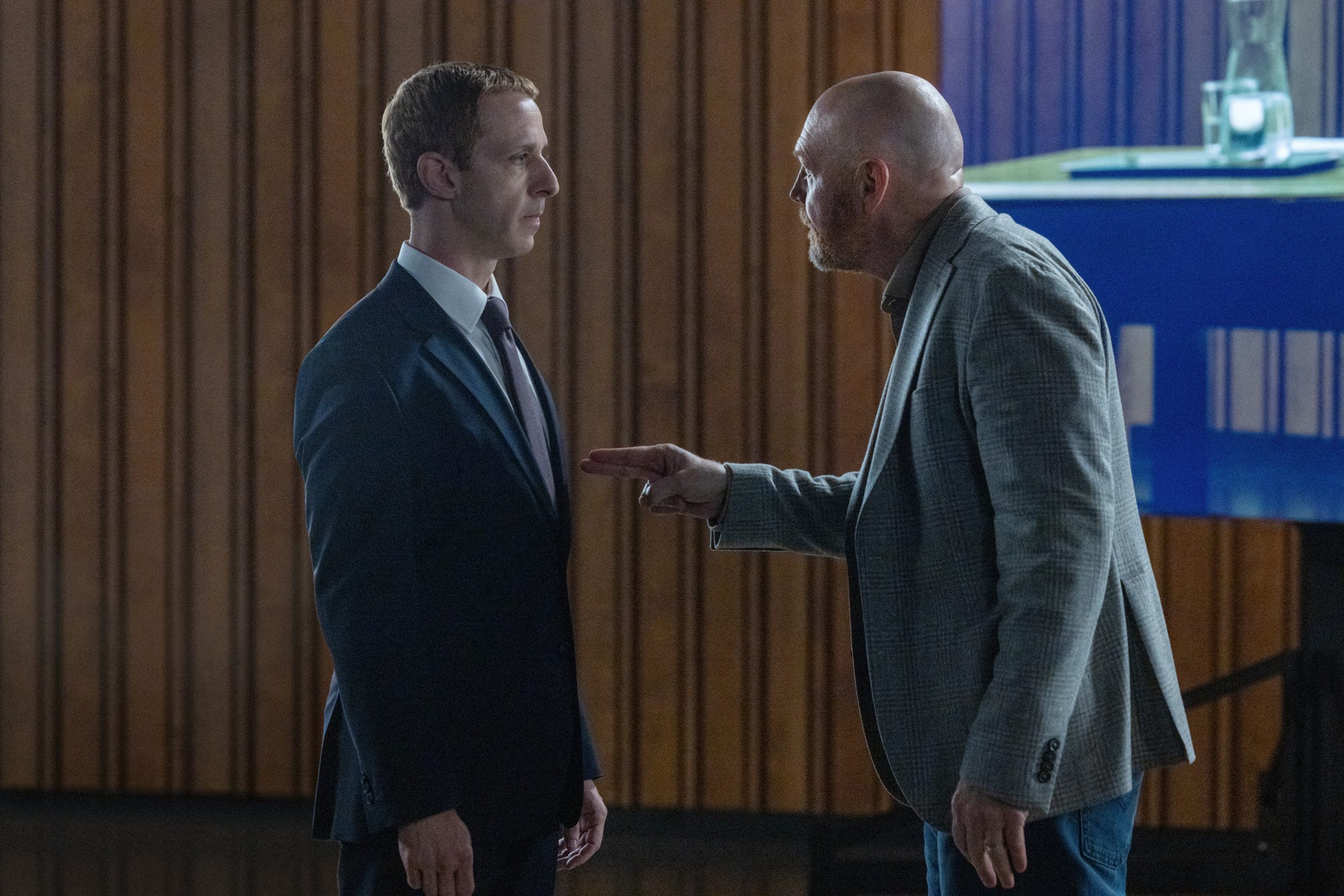 Jeremy Strong and Bill Burr in The Social Reckoning. (Courtesy Sony Pictures)
IN THE WEEKS LEADING UP to the release of The Odyssey, and then in the weeks after, I noticed a weird thing. Whenever I tweeted something about Christopher Nolan’s film, it would rack up huge numbers. Big engagement, tons of likes, lots of views. It was getting sucked into the algorithm like few topics I regularly tweeted about.
It quickly became obvious that The Odyssey had been juiced by Elon’s algo because it had become a vector of anger and disinformation. Arguments raged over the nature of the translation by Emily Wilson that Nolan referenced in interviews about the film, whether it was woke or wrong or whatever. (Many obscure experts in ancient Greek were uncovered during those months, I tell you.) Racists were apoplectic that a beautiful black woman would dare be cast as Helen of Troy and her twin sister Clytemnestra. (No black woman could possibly be the offspring of Zeus, in the form of a swan, and a human.) And false rumors swirled around the character being played by Elliot Page. (“A trans man? Playing Achilles? What about Brad Pitt and his gauzy linen? When did he stop being the masculine ideal?”)
Now, the South African émigré who now owns Twitter undoubtedly had an ideological reason for hyping rage about the race of Helen of Troy and the genitals of the actor (not) playing Achilles. (Turns out Page was playing Sinon. Oops!) But the primary goal was undoubtedly something much simpler. The angrier people were and the angrier they got—either because of the casting or the blatant misinformation surrounding the casting—the more time they spent on the platform. The more they shared tweets. The more traffic they drove to the site. The more advertising revenue was generated. The more usage Grok got.
The Social Reckoning, Aaron Sorkin’s sequel to The Social Network, asks how we got here. It is not about Twitter or The Odyssey, of course. It’s about Facebook and how it fueled the January 6th insurrection that attempted to disrupt the peaceful transfer of power from Donald Trump to Joe Biden.
These are, arguably, higher stakes than what trolls think about Lupita Nyong’o’s acting choices.
 Jeremy Allen White and Mikey Madison in The Social Reckoning. (Courtesy Sony Pictures)
TO SET THE ARTISTIC STAKES, first and foremost: The Social Reckoning is not as good as The Social Network, simply on a visual level. And that’s because Aaron Sorkin, a massively talented writer of screenplays and play-plays and teleplays, is not a massively talented visual filmmaker. Not incompetent, mind you; not embarrassing. But The Social Network was directed by David Fincher, meaning that it had his painterly eye for composition and was lit in a way that felt both dramatic and real. Just one quick example: There’s this great sequence of a regatta in The Social Network that uses tilt-shift photography to make the whole thing look like a miniature recreation, a toy for the wealthy to amuse themselves.
Aaron Sorkin does not even attempt something as interesting as this image. Nor should he. It’s not his skillset. He’s a writer of words, not a painter of pictures. This is a pretty locked-down movie, for the most part, occasionally veering into handheld black and white during flashback scenes or vivid action during the storming of the Capitol by the goons supporting Donald J. Trump’s efforts to overturn the 2020 election.
The Social Network was a piece of psychoanalysis and everything Fincher did was designed to demonstrate that Mark Zuckerberg had a hole in his soul he hoped to fill with love and admiration. He desired acceptance.
The Social Reckoning, on the other hand, is one part journalism procedural, one part detective story, one part courtroom drama. The detective story involves Frances Haugen’s (Mikey Madison) effort to uncover why one of her friends—whom she knew as a San Francisco progressive taking spin classes—filmed herself getting into a racist confrontation with cops and then posted it to Facebook as if it made her look good. She is on Facebook’s Civic Integrity Team: a true believer in the power of social media, albeit one who puts the ethics of connecting the world ahead of pure engagement.
The journalism procedural follows Jeff Horwitz’s (Jeremy Allen White) effort to uncover how Facebook is manipulating the discourse. He gets in touch with Frances after discerning that the company is censoring comments on Mark Zuckerberg’s (Jeremy Strong) posts. These are small potatoes. The real issue, she says, is that 64 percent of people who join extremist groups on Facebook do so directly due to algorithmic prodding by the platform. They are recommended membership in QAnon, militias, and other degenerate groups by Facebook itself. When Horwitz and his interns set up a test profile, the number of days it takes to get a recommendation to join a white-power group is just ten. The question is: why?
And this is where the courtroom drama kicks in. Not technically a trial, though, as Zuckerberg is preparing for congressional testimony in early January 2021. The morning of January 6, 2021, as it happens. He’s peppered with questions by Raya (Wunmi Mosaku), a crisis-comms professional who wants to make sure he understands how to react in a polite and semi-human manner to the senators asking him why his platforms are so bad for society. Charlie Garrigan (Bill Burr) heckles him from the sideline with pointed asides about political advertisements and the lack of fact-checking on the platform. Yes, engagement is through the roof, but at what cost?
And to whom?
Hey, if you like your news and analysis without algorithmic fiddling, ragebait, or billionaire overlords deciding what you should see, consider joining Bulwark+. We’re independent and reader-supported—and we’d love to have you as part of our community. Join now for 30 percent off the regular price:
ONCE AGAIN, I FEEL COMPELLED to remind you that this is an Aaron Sorkin production, and if you’re the sort of person who tends to get annoyed by Sorkinisms—overlapping dialogue, just-so asides, and too-neat moral messages—you’re probably going to be annoyed by this movie. It has a lot of them.
But Sorkin is one of the most successful screenwriters in the world for a reason, and The Social Reckoning is a good reminder of why. For a subject that is both dire and incredibly dry—seriously, you try and write a good algorithm plot; just watch Tenet and ask Christopher Nolan how tough that is—this script is both zippy and funny. Horwitz’s relationship with his put-upon WSJ interns is comic gold. It helps that Mikey Madison is a tremendous talent with fantastic comic timing; she veers between near-autistic awkwardness and cutting asides without sacrificing the character’s internal moral struggle. The repartee between Madison and White, who convincingly plays an investigative reporter investigating tech companies who can’t even use his rental car’s GPS, keeps things light while driving home the complicated nature of the algorithmic fiddling they’re uncovering.
They exist in stark contrast to Strong’s Zuckerberg, a performance that veers between robotic data-crunching and imperial annoyance at having his prerogatives questioned. Zuckerberg’s portrayal is the weakest part of the film, and the fault is equally Sorkin’s and Strong’s. He simply doesn’t feel … human. And while I kind of understand that as a creative choice from Strong, a talented mimic tasked with mimicking a guy whose robotic nature is often remarked upon, it’s less excusable from Sorkin, who previously brought Zuckerberg to something approaching life in The Social Network.
But maybe that robotic lack of humanity is precisely the point. In the fifteen years between the creation of Facebook depicted in The Social Network and the algorithmic juicing to maintain market share depicted in The Social Reckoning, Zuckerberg has been consumed entirely by the need to hold on to the empire he has built. There’s a reason he adopted that infamous Julius Caesar hairstyle, after all: Imperial aspirations don’t propagate themselves. Maybe morality goes out the window in a world where your company is more valuable than most nation-states and your user base is bigger than most continents.
THE QUESTION THAT SORKIN wrestles with throughout the film is what should Facebook do. This is the central debate between Zuckerberg and Garrigan. Garrigan understands that the company’s turn to “meaningful social interactions” for its algorithmic ranking has been a disaster, a tool for empowering ragebait at the expense of rational discourse. But he also believes that the company should do a better job of fact-checking, particularly of political ads. Zuckerberg dismisses this as jealousy, sour grapes from a guy who got out before his $250 million stake could grow to $1.2 billion. “I left when you started commoditizing gullibility,” Garrigan retorts. He has no regrets.
I don’t think anyone who has paid attention to the world of social media would argue that the turn toward emphasizing rage as an attention-grabbing strategy hasn’t been a disaster for society; it’s one thing to allow speech on general principle and another thing entirely to algo-juice the worst of the worst. But I also question whether or not we really want a world in which billionaires are the arbiters of what can and can’t be said. Yes, yes: We only want the platforms to squelch disinformation. But in a world where the owners of the largest platforms are vying for the favor of a megalomaniacal president with a very loose grasp on what, precisely, reality looks like, do we really want these billionaires deciding what, precisely, counts as disinformation?
The Knifeman and the Apparatchik

OVER ON THE HOMEPAGE, I’ve got a double review up of two prominent Hollywood figures’ forays into autobiography. Here’s how it starts:
It’s hard to imagine two memoirs more different in tone, style, or substance than Bob Chapek’s Behind the Castle Walls and Ari Emanuel’s Roll the Calls.
There are superficial similarities. These are two men who reached the height of power in one of the most prestigious industries in America. Bob Chapek was the head of Disney for a turbulent stretch encompassing the rise of COVID, the streaming boom, and a palace coup by his predecessor and successor, Bob Iger. Ari Emanuel, meanwhile, is the most famous agent in the world, thanks to Entourage, and a man who has built William Morris Endeavor into a world-bestriding colossus that handles boardroom brawls and literal bloodsports through its TKO Group, which owns both UFC and WWE.
After reading the memoirs, you can’t help but feel for Chapek. He’s a guy who has, in all likelihood, done more to change the actual business of Hollywood through his work at Disney than Emanuel, an inveterate dealmaker who came into agenting after that industry’s biggest innovation, packaging, had already been created by Michael Ovitz and the other CAA sharks. And yet Chapek’s out of the game (Ovitz too), while Ari remains, eternal, undying, unyielding. That’s because Ari is not just an inveterate dealmaker—he’s also a vicious knife fighter. Chapek, on the other hand, is kind of a whiner.
Early Oscar Picks
With the Academy Awards only <checks watch> five months away, what better time than to start the statuette speculation? On The Bulwark Goes to Hollywood pod I talked with the “Prestige Junkies” from the Ankler, Katey Rich and Christopher Rosen. Come for the analysis of Robert Pattinson’s four-movie Oscar problem, stay for the discussion about whether Netflix can finally win Best Picture: