Libertarian candidates are polling surprisingly well. In close races, a few points could be all Democrats need.
By Lauren Egan
Published: 2026-10-01
URL: https://www.thebulwark.com/p/libertarians-third-party-independent-democrats-2026-midterms
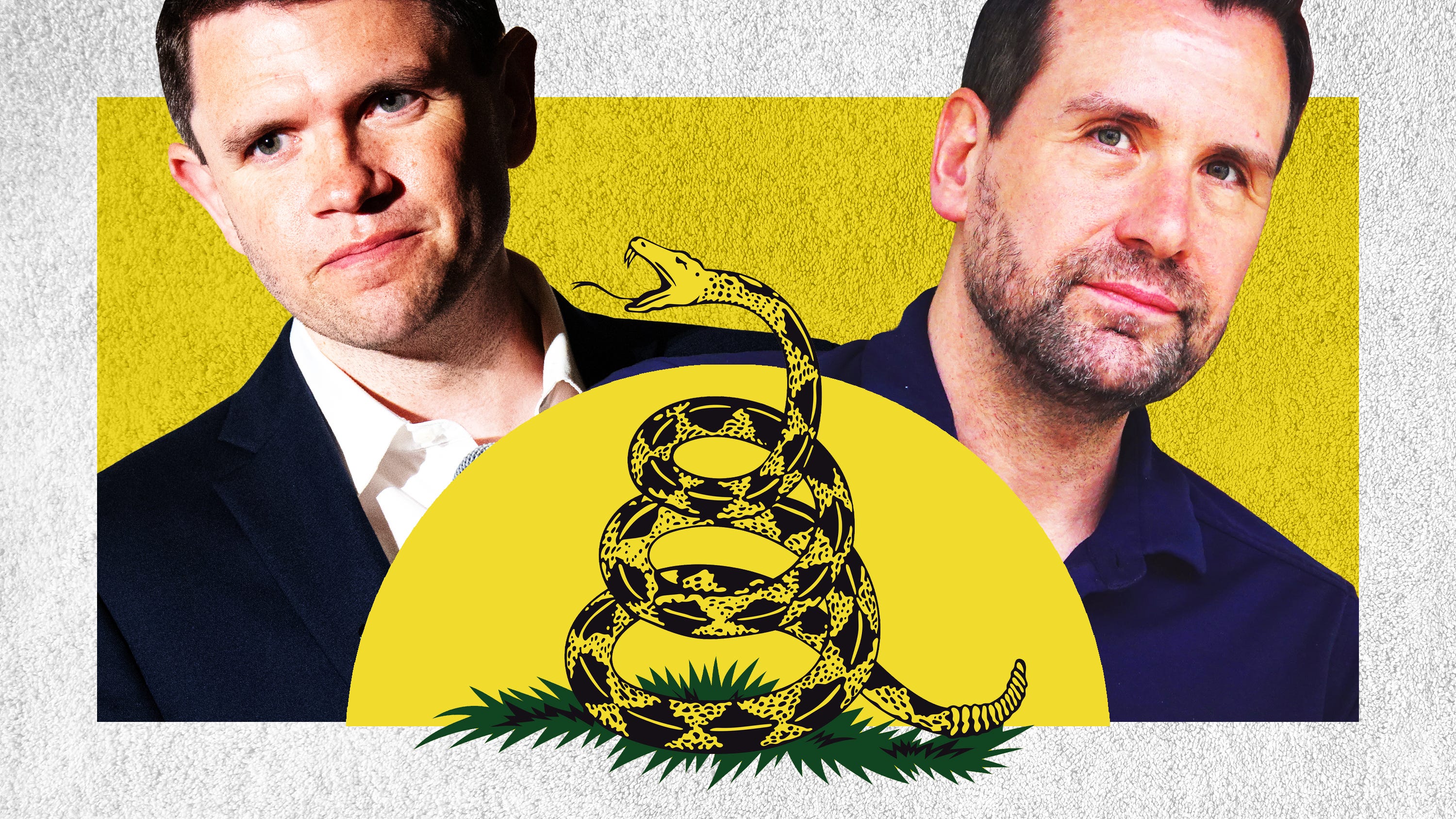 (Photo illustration by Bill Kuchman/The Bulwark | Photos: Getty, Shutterstock)
AS DEMOCRATIC OPERATIVES brace for the final weeks of the midterm campaign, they’ve been pleased to discover that they may not need to actually get above 50 percent of the vote to win in several key races.
Libertarian and other third-party candidates are poised to play a particularly consequential role this cycle—likely as spoilers for Republicans, and likely to a greater degree than in past elections. Several Democratic pollsters told me they’ve been surprised by how well those candidates continue to poll, noting that historically their support tends to fade as voting nears. And there is widespread belief that their overperformance will squarely hurt Republicans: The theory goes that pissed-off GOP voters will choose to back third-party candidates as an act of protest against Donald Trump or GOP incumbents without having to vote blue.
“We’re seeing Libertarians poll steadily a month out from the election at 4 to 5 percent, depending on the poll and depending on the state,” said Kevin Akins, a Democratic pollster who is working on a number of competitive battleground races this cycle.
“The Libertarian impact and effect here has the potential to be more pronounced than ever in battleground races,” he added. “If the Libertarian candidates hold their current position . . . it could be the difference in flipping the U.S. Senate this year.”
Democratic officials told me that they’re seeing this dynamic play out in competitive House races in North Carolina, Ohio, Iowa, Florida, Pennsylvania, and Texas. They also believe it could be a factor in Senate races in Iowa, Texas, South Carolina, Ohio, and Kansas.
“Both parties’ branding is shit. And so Republicans are really getting hurt in places like Texas, where I think [the Libertarian candidate] gets 2 or 3 percent,” said Democratic pollster John Anzalone. “All of a sudden the Democrats’ win number is not 50 percent; it’s 48, or 48.5, or 47.5. And that’s a big deal.”
The midterms are almost here. Then come the presidential primaries.
There will be campaigns and scandals, victories and defeats, promises and lies. And there will be no shortage of people telling you what they’d like you to believe.
Our job is different. We’re here to find out what’s true and to help you think through what comes next.
Independent journalism needs independent support. Join Bulwark+ today and help us keep doing it.
Democrats have historically faced their own challenges when it comes to third-party candidates siphoning off their votes. And they could face them again this cycle with a number of key House races featuring Green party candidates—including some with suspicious ties to conservatives. But the impact of third parties tends to become magnified as voters sour on one or another of the major parties—something that is quickly happening to the GOP as the midterms near.
Recent polling shows that the Republican brand has taken a beating since the 2024 presidential election. A new Wall Street Journal poll—which Anzalone conducted along with Republican Adam Geller—found that just 38 percent of registered voters have a favorable view of the Democratic party and 39 percent have a favorable view of the Republican party. Another recent survey from the Argument found that the net favorability of the Republican party among likely voters is 10 points worse than the Democratic party’s.
“Everyone really hates the Republicans right now,” Lakshya Jain, head of political data and polls at the Argument, told me. “It is hard to overstate just how mad people are at the Republican party for the war, the price of gas, just for Trump in general. This is basically what public opinion looks like when the public thinks that there’s a failed presidency.”
There are clear signs that Republicans know that Libertarian candidates could pose a particular threat this November. Over the summer, the Washington Post reported that Health Secretary Robert F. Kennedy Jr. pressured Rick Stewart, a Libertarian candidate running in Iowa’s 2nd Congressional District, to drop out of the race. Libertarian Marco Battaglia also told Politico that RFK Jr. and incumbent GOP Rep. Zach Nunn privately urged him to end his campaign for Iowa’s 3rd Congressional District (Battaglia was later removed from the ballot by state officials after failing to meet election requirements).
As for the Iowa Senate race, Democrats see Libertarian Thomas Laehn as particularly helpful in Josh Turek’s effort to defeat Republican Ashley Hinson.
“[Laehn] kind of presents himself as conservative. That’s really going to hurt Hinson because folks are very upset with how everything has been going in Iowa. And there are a lot of pissed-off traditional conservatives,” Derek Eadon, former chair of the Iowa Democratic Party, told me.
“I just don’t think we’ve seen anything like this here. I’m confident that [Laehn] is going to get more votes than any [Libertarian] candidate has before.”
In my conversations with party operatives, another race that kept coming up as one where the Libertarian candidate could have a particularly large impact on the outcome is the Texas Senate contest between James Talarico and Ken Paxton. Democratic operatives believe that some Republican voters won’t feel comfortable backing the scandal-plagued Paxton. They told me that the contentious GOP primary between Paxton and Sen. John Cornyn only deepened the fracture in the party’s base. It piqued a lot of interest when Cornyn posted a local news story to his X account in June about how Libertarian Ted Brown was courting disaffected conservative voters.
“There are a non-insignificant number of Cornyn voters who I think are up for grabs and are uncomfortable with the idea of Ken Paxton—and maybe at this point, after all the ads, could be uncomfortable with [Talarico],” said a Texas-based Democratic strategist who is close to the Talarico campaign. “There’s a world where Ted Brown gets 3 or 4 percent of the vote in this thing.”
That would be a significant shift from the competitive 2018 Senate matchup between Beto O’Rourke and Sen. Ted Cruz, when the Libertarian on the ballot received 0.8 percent of the vote. O’Rourke lost that race by 2.6 percentage points.
THE BIG QUESTION IS NOT JUST how much of the vote Libertarian candidates will win in these contests. It’s also whether Democratic groups will spend money in the final weeks of the election in support of those Libertarian candidates.
Although it can be a risky and controversial tactic, promoting third-party spoiler candidates is not without precedent.
In the last weeks of the 2024 election cycle, a number of Democratic-aligned super PACs were launched to boost Libertarian and third-party candidates in battleground House and Senate races around the country. One of those groups, the Save Western Culture PAC, spent money promoting Brown, who ran as a Libertarian in the Texas Senate race against Democrat Colin Allred and Sen. Ted Cruz, winning 2.4 percent of the vote. Since that PAC was created in mid-October, its donors and ties to the Democratic party weren’t disclosed in Federal Election Commission filings until after Election Day, and even then were obscured behind a Delaware corporation. Another group, Voter Protection Project, which had been created a few years earlier, spent nearly $4 million in 2024, largely in support of third-party candidates in a handful of competitive House races.
During that cycle, the Democratic Congressional Campaign Committee also encouraged outside groups to spend money on third-party candidates in an attempt to steal votes away from Republicans. Through a strategy known as “red boxing”—when party committees and candidates publicly post messaging guidance as a way to legally coordinate with super PACs—the DCCC suggested that allied groups run ads supporting the Libertarian in places like Montana’s 1st Congressional District.
The 2024 efforts to promote Libertarians had mixed results. Republicans, who did their own version of this with Jill Stein’s presidential campaign in 2024, blamed Libertarians for costing them at least three House seats in districts where those super PACs spent money. But such spending did little to impact the Texas Senate race. Cruz won re-election with 53 percent of the vote, comfortably outpacing Allred’s 44.5 percent. Brown’s vote share was too small to be considered a spoiler.
If Democrats were to use a similar strategy again this cycle, it likely wouldn’t begin for a couple of weeks. But in my conversations with committee officials and super PAC executives, there seemed to be little appetite for sinking money into third-party candidates right now. And the DCCC’s red boxes for competitive races where Libertarians are on the ballot don’t mention supporting the third-party candidates. That’s largely because Democrats are already facing a money deficit compared to Republicans and don’t feel they have extra cash to spend on a risky maneuver. Some party operatives also told me that the current party leadership is uncomfortable with the tactic in general, believing on principle that their campaign money should only be going to helping Democratic candidates.
But things can change. No committee or operative is particularly keen to telegraph their election-closing campaign tactics. Ultimately, we will have to wait until the post-election FEC reports to find out just how uncomfortable Democrats really are with such a strategy.
Want to comment? Join Bulwark+
My open tabs:
— You Are No Longer Invited to Dinner
— Individual Choices Won’t Fix America’s Public Schools
— At the Texas Lineman’s Rodeo, They’ve Got the Power
— It Was the Essential Home of Supreme Court News. Now It’s a Joke. What Happened?