The HHS secretary uses fear of contamination to denigrate modern medicine and advance a project rooted in vulgar eugenics.
By Alan Elrod
Published: 2026-08-25
URL: https://www.thebulwark.com/p/rfk-jr-toxic-world-vaccines-contamination-safe-hhs-autism-ocd
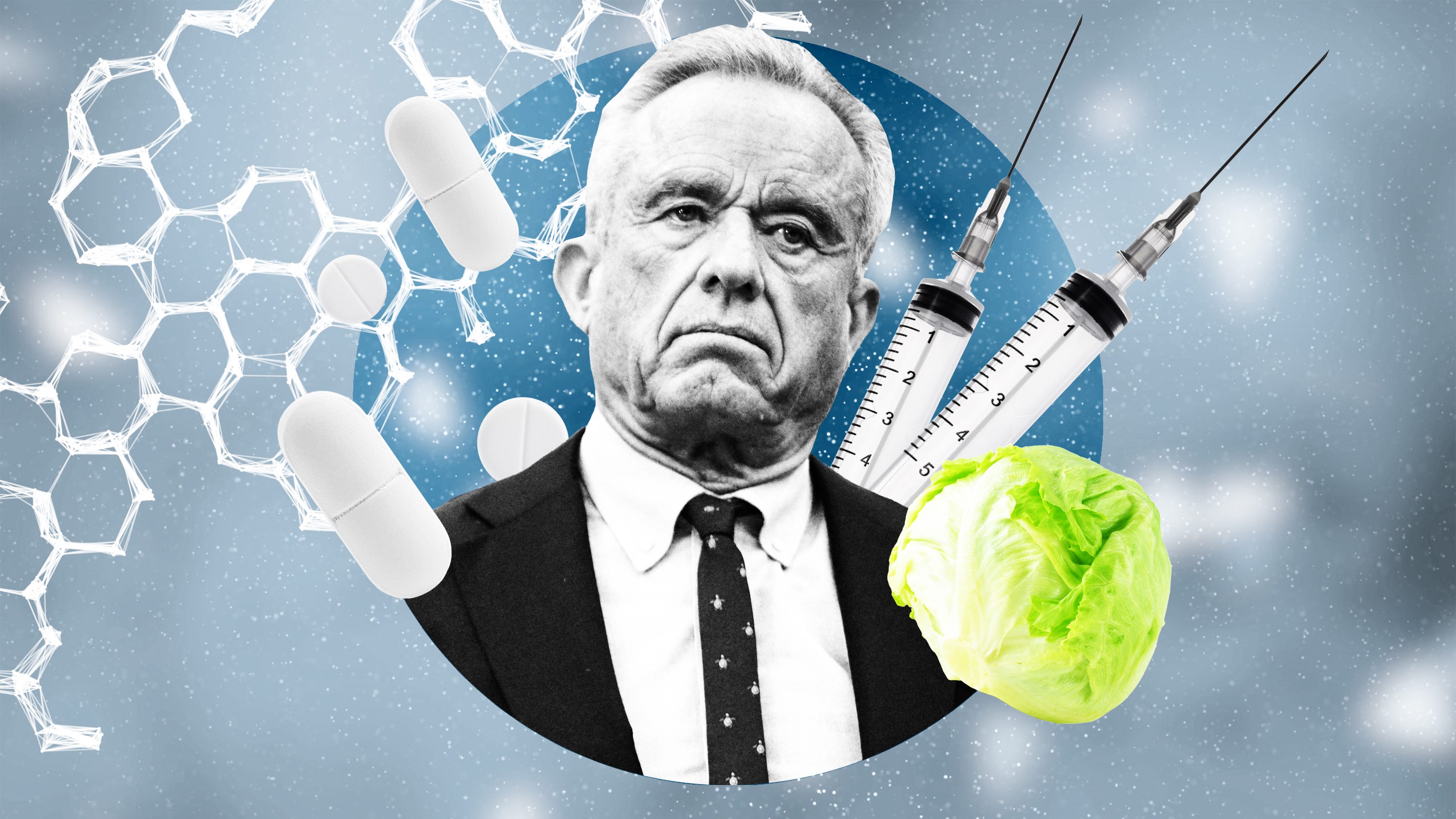 (Photo illustration by Bill Kuchman/The Bulwark | Photos: Getty, Shutterstock)
IN TODD HAYNES’S 1995 FILM SAFE, housewife Carol (Julianne Moore) is beset by mysterious, undiagnosable ailments that push her from a life of suburban alienation in her empty Los Angeles mansion into one of complete physical isolation at a New Age wellness camp in the desert. She gets there with the help of impersonal medical professionals, 1980s wellness psychobabble, and her own growing fear that the entire modern world around her is menacingly, inescapably toxic.
Her arc is tragic; it culminates with her standing alone in front of a mirror in an isolation hut on the wellness compound grounds. With lesions visible on her pallid face, she says “I love you” to her reflection, repeating it over and over. She has by this point been fully severed from both society around her and, more crucially, herself. Watching the film for the first time this summer, I was struck by the movie’s prefiguring of parts of the contemporary MAHA movement. But I also saw a reflection of some of my own struggles with mental health.
Carol’s decline offers a picture of the world that helped to give us our current health and human services secretary, Robert F. Kennedy Jr. The same wealthy, alienated milieu of Southern California of the late twentieth and early twenty-first centuries provided a setting for Kennedy to make his transition from middling failson of Camelot to sleazy environmental lawyer to the mendacious quack we know today—one who wants people to believe that the entire world is menacingly, inescapably toxic.
Kennedy’s environmental law work began as a vehicle for community service ordered by a judge following a drug arrest. He carried that out as a volunteer at the Natural Resources Defense Council (an organization that has since publicly repudiated him) and worked to clean up the Hudson River, beginning a phase of his career that lasted for several decades. By the late 2000s, Kennedy was in Los Angeles and undergoing the final stage of his transformation into the man familiar to us today. He joined Children’s Health Defense and began giving talks about how, after they receive a vaccination, “children go to sleep, and three months later, their brain is gone. This is a holocaust, what this is doing to our country.”1
In addition to its evocation of Kennedy’s paranoid California, Carol’s story also left me with something more personal—a painful moment of self-recognition. I cannot remember when I first exhibited the symptoms of obsessive-compulsive disorder, the health condition that has shaped my adolescence and early adult life. I can recall, even in my earliest days, a vague sense of needing to separate the “dirty” from the “clean.” Later, as a young member of the dry, legalistic evangelical denomination of the churches of Christ, I fixated on sin—its omnipresence and its seeming irremovability. Fears of alcohol poisoning and heavy metals followed, but the theme was always the same: The world around me was dangerously contaminated, and I had to do everything in my power to remain unpolluted. At times, this pursuit drove me to the edge of insanity. It even became a risk to my life.
A diagnosis in my late twenties—some two decades after I started experiencing symptoms, a typical pattern for OCD sufferers—made sense out of my experiences and helped me to recognize that my own disordered thinking posed a greater risk than the threats I fixated on in the world around me. So, watching Carol, I felt a sense of identification with her.
Importantly, concerns such as Carol’s—or mine, amplified as they are by my condition—aren’t always wholly baseless. It’s true that we did spend much of the twentieth century pumping leaded gas into the atmosphere, choking our rivers with toxic sludge, and manufacturing consumer products that sometimes turned out to be hazardous. But that doesn’t mean those concerns take a rational form. Carol’s fears, for example, are more vague and less scientific. It’s “chemicals,” she repeatedly says, that are causing her infirmity. After her doctors express bewilderment at her illness, one for which they cannot seem to find any diagnostic evidence, she seeks out the ministrations of dubious “wellness” professionals who are far less scrupulous about what they are willing to diagnose, and what treatments they are willing to prescribe.
Don’t miss any of our signature political reporting and analysis, our cultural coverage, and even our critical-personal essays like this one that blend these genres: Sign up for a Bulwark+ membership for unlimited access.
Join Bulwark+ and don't miss a thing
Haynes has said that Safe is meant in part as a critique of the kind of self love–focused wellness advice that for a time was offered to everyone from HIV/AIDS sufferers to anorexics like Karen Carpenter; the message they received was that they alone were responsible for their recovery and survival. Only by embracing and empowering themselves could they beat their affliction, no matter its specific character. As Haynes said in an interview with BFI,
Peter’s [the wellness center leader’s] cure is to adhere completely to these very basic ideas about self that affirm the society as it is. His kind of New Age philosophy comes out of a 60s ideology, using Eastern traditions to re-examine the West. It claims to change the world through self-esteem or a softening of basic structures of resistance, but I see it as a reiteration of basic conservative arguments about the self, which are closely aligned with masculinity and patriarchy.
Eugenics looms here, as well. If the method of salvation is embracing self-actualization, then saving yourself is a choice. If you fail, you are culpable for the failure; those who make it—who survive, who overcome, who get better—deserve it. This is a common assumption in wellness circles such as Kennedy’s vaccine-skeptical MAHA movement, where “take control of your health” and “do your own research” are shibboleths.
THAT LATTER EXPRESSION HAS BECOME the calling card of another, related community, of course. QAnon functions as a kind of mental environment for its adherents, a hothouse of the mind in which self-help, quasi-religious, and clean-living philosophies grow wildly, intertwining with vague anti-establishment and anti-government fears. (Naturally, there is some overlap between QAnon and MAHA.) Some writers refer to this larger phenomenon under the heading of “conspirituality.”
In their 2023 book Conspirituality: How New Age Conspiracy Theories Became a Health Threat, authors Derek Beres, Matthew Remski, and Julian Walker argue that parts of the modern wellness movement (even including benign-seeming practices like yoga) express—and reinforce—longstanding ideas of “body fascism.” The key part is the focus on empowerment and liberation through ruthless self-inspection. In conspiritualist thinking, bodily fitness is a signal of moral goodness, and wellness is a confessional practice as much as it is a physical regimen.
In this way, wellness leaders and cure peddlers come to take the place of priest or guru. Beres, Remski, and Walker characterize the conspiritualist trend as a “warmed-over version of the nineteenth-century pseudoscience of physiognomy—the premise that the appearance and performance of one’s body revealed character and social value.” And crucially, conspiritualism has a highly individualistic bent: Society is dangerous, stupid, and conformist; enlightened individuals must lift themselves out of it by becoming something like supermen.
There is a rhetorical framework, one RFK Jr. often uses, that brings together all these ideas: that of hygiene. If society itself is contaminated—by the chemicals in the food and air, by the medicines prescribed to keep us healthy and well, and by the very people and institutions who do not live up to the standards of their particular view of what is good and clean—then self-empowered individuals must shun anyone and everything that might spread the contamination to them or their loved ones, especially their children.
For instance, when Secretary Kennedy says that vaccines cause autism and then goes on to talk about how autism renders a person’s life socially worthless, he is using the language of hygiene on a social scale. Take him at his own word in describing the alleged effects of contamination by vaccines:
These [children with autism] are kids who will never throw a baseball, they’ll never go out and date. They’ll never write a poem. They’ll never pay taxes.
Kennedy would seemingly prefer for people to contract, suffer from, and occasionally lose their lives to preventable disease rather than escape these depredations and even out the larger-scale outcomes of illness by embracing society-contaminating vaccines; how else to account for his claim of being a “freedom-of-choice” person while limiting access to COVID-19 vaccines, as he did last summer? It is difficult to avoid the conclusion that the HHS secretary sees deaths from outbreaks of diseases we had beaten or contained, like measles and cyclosporiasis, as a form of social hygiene that kills off the weak and susceptible while safeguarding the strong from the nefarious, enervating interventions of public health. It’s quackery, but in a Darwinian register.
Kennedy’s obsession with contamination of a moral or figurative kind might seem hard to square with his reputation for heedlessness of the more literal sort: After all, he’s known for handling roadside animal carcasses, including a dead bear and a whale. When it comes to food, Kennedy has claimed to have no “gag reflex,” boasting, “I will literally eat anything.” To some degree, this simply attests to Kennedy’s idiosyncratic strangeness. But there is also something else at play. Consider the letter his cousin Caroline wrote to try to convince senators to vote against RFK’s confirmation as HHS secretary last year. In that letter, Caroline called him a “predator,” noting that “it’s no surprise he keeps birds of prey as pets,” even putting “baby chickens and mice in the blender to feed his hawks.”
Caroline’s account suggests that Kennedy is the sort of person who revels in the violence and gore of the food chain, the sense of its brutal order. His lurid fascination with death and disease, his wholly unsympathetic view of the creatures too weak to overcome their assailants: It’s all of a piece.
IT’S NO SURPRISE THAT, just as the secretary has deep disdain for vaccines, he disdains SSRIs and the people like me whose maladies they address. HHS is moving to curb what Kennedy sees as a national mental health crisis fueled by the “overuse of psychiatric medications, especially among children.” In announcing the move, Kennedy stated that “We will support patient autonomy, require informed consent and shared decision-making, and shift the standard of care toward prevention, transparency and a more holistic approach to mental health.”
Prioritizing “patient autonomy” and “shared decision-making” might sound blandly unmeaning, the sort of thing you might read in a press release from a hospital system, but the deeper goal is shared with Kennedy’s other initiatives: Put the onus back on the individual to figure it out on their own. Obviously, we are all responsible for our own lives, but no one who affirms that simple truth should take the implied extra step of making individuals morally responsible for the presence of conditions they cannot control. That is where Kennedy’s recrudescent social Darwinism becomes visible—a bootstrap mentality applied to the mind.
Like his well-attested antivax beliefs, this is bunk. In another time, my own illness likely would’ve reduced me to pauperism. At the very least, I would probably not have the life I do now. When, in a brief hubristic attempt to go off my medication without any sort of therapeutic safety net, I was prescribed emergency Valium and teetered on the brink of hospitalization, I did not find myself troubled with doubts about the value of modern medicine.
You might think that I must hate those who subscribe to the kind of conspiritualist and MAHA nonsense spread by Kennedy and his ilk. I don’t. Rather, when I think of people who feel frightened by a world that seems dangerous and alienating, and who come under the sway of predators such as our own HHS secretary, I can only say: There but for the grace of God go I.
The fear they feel is what empowers many of our worst impulses. It’s what pushes Carol to her tragic and lonely end. And it’s at the heart of RFK’s pitiless eugenicist crusade. In truth, that fear is one of the most dangerous contaminants, to self and society, that threatens the American way of life today. And Trump’s secretary of Health and Human Services wishes to continue spreading it far and wide.
Reject the fear: Share this story far and wide.
We have rendered “holocaust” in this quotation as a common noun owing to the indefinite article; however, there is a case to be made for Kennedy intending to evoke the Holocaust using this language, as the contemporaneous reaction to his comments—and his subsequent apology for his word choice—suggest. –Eds.