Senator Abdul El-Sayed: “In forcing Jensen Huang's reinstatement, Trump clearly chose the stock market over national security. He's all but admitting that Nvidia is ‘too big to fail.’”
By Matt Stoller
Published: 2026-11-25
URL: https://www.thebignewsletter.com/p/the-week-the-oligarchs-declared-war
What we’ve seen over the past three days is something remarkable: the explicit dominance of the stock market over all other priorities in American life.
Three weeks ago, Americans went to the polls and decisively voted against data centers, monopolies, and oligarchy. Corruption was a central theme, as was big tech. Yet, on Monday, President Donald Trump reinstated the CEO of Nvidia, Jensen Huang, a centi-billionaire caught in the center of a chip export and espionage scandal, in the hopes that it would foster a re-inflation of the AI bubble. And while incoming Democrats reacted angrily, Wall Street shrugged them off as irrelevant.
Here’s the backstory. Nvidia, a dominant and innovative AI chipmaker, has three interrelated problems. First, the company is a well-known monopolist, routinely threatening smaller customers that might seek to buy chips from other sources to maintain its market power. Monopoly power and corruption are often hand-in-hand, and Nvidia has also given the White House $25 million for the President’s ballroom. Second, its CEO is the ringleader of the circular financing gambit at the center of the AI Bubble, so Nvidia is also a prime mover behind the expansion of data centers. And third, the company is likely reliant on smuggling chips or computing power to Chinese firms, contrary to U.S. export controls. Whether that policy is a good idea or not is irrelevant, it is U.S. policy.
So when Huang resigned, caught in the snare of the national security establishment leaking through the New York Times, it seemed like much of the energy propping up a bubble would dissipate. But then Trump stepped in with a shocking intervention; Wells Fargo called this decision akin to the 2008 bailouts.
Trump’s surprising move fostered jubilation all over Wall Street and Silicon Valley, and led to a massive upward surge in the stock market. The chip company alone gained a trillion dollars in market value.
What of the AI bubble now? Well, one theory is what Commerce Secretary Howard Lutnick’s investment bank Cantor Fitzgerald noted: “All is Right in the World Again.”
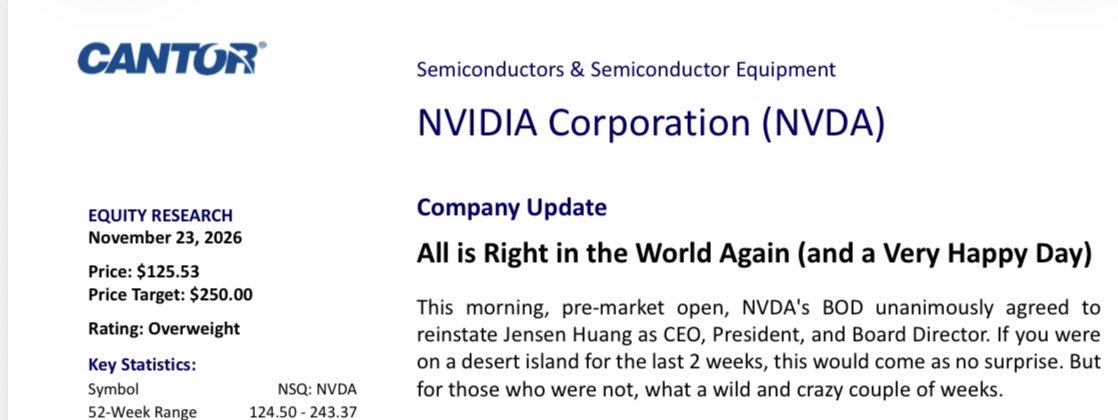
I’m not going to go over the litany of billionaires and venture capitalists celebrating Huang’s reinstatement, but there were many, from Elon Musk to Palmer Luckey to Paul Graham. They were not just happy at their portfolios, but at a fundamental vision of the world in which power is concentrated in the hands of a chosen few. In the parlance of Silicon Valley, they use the term “founder” to denote the special class of super-citizens, but the moral justification of aristocracy has been known by many different frameworks. It’s the Divine Right of Kings.
The best articulation of this vision was from Donald Trump, who spent nearly an hour on the phone with CNBC anchors to discuss how he had engineered Huang’s rehiring. Trump’s argument was that Huang had done nothing wrong, that America “must protect our geniuses,” and that the stock market needed to remain high.
There was no investigation into whether lawbreaking occurred, and it is unlikely that the Securities and Exchange Commission will seriously look into whether there was fraud.
I started tracking the skeptical statements of Democrats, but as with billionaires, there were too many to fully list out. Incoming Speaker Hakeem Jeffries, House Oversight Chair Robert Garcia, incoming Banking Committee Chair Elizabeth Warren, Senators Chris Van Hollen, Chris Coons, Ruben Gallego and Chuck Schumer, Representatives Debbie Dingell, Becca Balint, Pat Ryan, Greg Casar, and many others spoke out critically. They largely focused on the national security angle of diverting chips to China and espionage, with some arguments about economic fragility.
The most compelling comment came from incoming Senator Abdul El-Sayed, who asked some core questions about the fragility of such an an arrangement:
Should any one company (and any one person) have that much power over the economy? If something even more serious were to happen to Nvidia that interrupts their business, what are the ripple effects for the economy as a whole? What can we do immediately to insulate the broader economy from that?
On Wall Street, there is a dim view of the possibility to restrain Trump, Nvidia, Musk, or anyone else with large amounts of capital. Jim Cramer, who has become a central organizer of political discourse, mocked the idea that incoming Democrats would or even could do anything about this situation. They might hold some hearings, but like 2008 when the bankers got off with bonuses, that’s what would happen here.
For many months, I’ve been noting that the powerful set of super rich tech titans simply will not accept the results of elections, or the legitimacy of public governance that goes against their wishes. This episode crystalizes that dynamic, putting it front and center. It would be hard to find a more explicit repudiation of the public will than what Trump and Silicon Valley financiers engineered. And how, and if, Democrats respond, will determine whether this contempt for democracy is deserved.
For many years, readers of BIG have been concerned about the power of big tech. But not until 2024, when Silicon Valley titans got behind Trump, was this view any sort of broad consensus. Now it is. And the reason, intuitively, is because Trump’s alliance with tech titans and Wall Street is based on an ideology that is obviously anathema to the welfare of ordinary people.
The Right caters to an elite class that simply does not accept the legitimacy of opposition. Among that class is Elon Musk, who years ago tweeted that “The Left is the party of murder,” and “we must fight back or be murdered.” The stakes, he argues, are existential. Last September, as the right declared the killing of Charlie Kirk to be akin to 9/11, I described just what this ideology is about:
Covid, with liberals ensconced in institutions like public health networks or media outlets, was a mass attempt at physical control of their families and lives. The “regime” as they call it, of interconnected government bureaucrats, academics, tech firm and pharma executives, and nonprofit donors and operatives, defined content moderation controls to prevent them from speaking and forced them to take medicine. On a moral level, the left, by forcing entirely new ways of seeing gender, seeks to impose a theocratic regime, the “Great Awokening.”
But their view of the non-right as a threat to life, liberty, and property isn’t a result of recent events, it is fundamental to their value system. Since the New Deal, the right has bitterly contested the American institutional setup. Conservatives never accepted that Bill Clinton or Barack Obama were legitimately elected Presidents, which is why the right impeached Clinton for frivolous activities and why they held onto the birth certificate story about Obama. It’s why Donald Trump’s allegations that the 2020 election was rigged found such purchase on the right, even though most of them know that the vote counts were real. Their point is that Trump is the legitimate ruler, and Joe Biden, the latest left-winger, is not. And that would be true no matter how many votes Biden, or any Democrat, got. The left is just not legitimate under any circumstances.
Behind this view is an ancient vision of liberty, a secularized version of the divine right of kings, filtered through Thomas Hobbes. Hobbes believed the people owe obedience to their ruler; the failure to offer this obedience results in a society with no rules, equality before a naked a state of nature. Such a state is barbarous, “nasty, brutish, and short” in the famous Hobbies-ian frame, or as Musk updated it, being ruled by “the party of murder.” A sovereign must rule and impose order, and within that order lies freedom.
Today, that sovereign is Donald Trump, advised by Wall Street. And in the zone of discretion he allows, there is liberty, with all the attendant values such as free speech, freedom of religion, free exchange of goods and services, and so forth, such as he proscribes.
But free speech in this context is not a liberal notion of being able to express one’s political views, regardless of the sovereign’s wishes. It seemed that way when Joe Biden was President, that’s how, say, Brendan Carr expressed it then, but that’s only because the right never accepted Biden as a real President. Free speech in the context of the right means being able to say whatever you want, subject to the limits imposed by a legitimate sovereign. It has comes to mean being free to use anti-woke rhetoric, because such freedom is what a wise ruler allows. (“I feel liberated,” said a top banker. “We can say ‘retard’ and ‘pussy’ without the fear of getting cancelled . . . it’s a new dawn.”) Trump may revoke these rights at any time, since he is entrusted by a higher order to protect us. That is his duty.
Similarly, with his decision to bailout Silicon Valley and Wall Street, and to “protect our geniuses,” Trump is acting on behalf of a class that does not believe in elected government, and will not be subjected to it. Just last week, JPMorgan CEO Jamie Dimon said he plans to set “an example” by finding ways to offset a bank tax increase introduced by the UK gov't, so politicians “understand the trade-offs of these unfair penalties.” He added the move was “more in sorrow than in anger." This class will engage in capital strikes, or public relations campaigns, or undermine governments entirely, with Trump in power, or not.
There are many policy levers one can use to address this crisis, from antitrust to securities law to criminal law to the Federal Reserve’s suite of tools. And the only reason we are in this situation is because we haven’t used most of those levers to benefit the people for forty five years. Which lever to use or create is not as important as noting that the use of any one of them will foster fierce and brutal pushback.
It’s possible, even likely, that the AI Bubble pops, which will lead back to the political system with all those Democrats holding committee gavels. If the bubble somehow keeps going for a few more years, even a feckless Democratic Party will at some point try to do something extremely modest, and leaders will get vicious pushback all out of proportion to what they are trying. The fight is unavoidable.
So here we have a real crisis. The public voted almost as explicitly as they could on economic populist grounds. It was a crushing election, as dominant as we’ve seen since 1974. Yet Silicon Valley financiers don’t realize what happened, because they stopped paying attention to the interests of the public many years ago. And maybe they are right to do so. But the stakes are existential.