Warsaw Summit x Poland’s $1T Rise
Published: 2026-06-28
URL: https://www.sourcery.vc/p/icymi-elevenlabs-polands-1t-rise
Brought to you by:
Brex—The intelligent finance platform: cards, expenses, travel, bill pay, banking. Built for scale. Trusted by OpenAI, Anthropic, Vercel, Granola, Deepgram, & Sourcery.. teams that move fast AF. visit → brex.com/sourcery
ElevenLabs Homecoming: Inside the Warsaw Summit & Poland’s $1T Rise

Pictured: Charlotte + Molly (Warsaw Nov 2025)
Live from Warsaw, on June 1st, the ElevenLabs “Homecoming” Summit doubled as a showcase for Polish Dynamism, as Poland crossed into the world’s top 20 economies, locked in historic defence funding, and kept building toward one of Europe’s most interesting tech hubs. Poland intends to back its founders, weaponise its geography, and sit at the frontier of AI.
ICYMI: ElevenLabs Polska “Homecoming”
Hi, it’s Charlotte from Sourcery. 👋 I’m Molly’s head of Special Ops, and a few weeks ago I embarked on a very Special Operation in Warsaw, Poland.
ElevenLabs hosted their biggest summit yet, their “Homecoming,” at Teatr Wielki, Poland’s National Opera, in the city where the company started. I was on the ground to make sure you don’t miss anything. Around 2,500 founders, leaders, institutions, researchers, investors, artists, and more came from across Poland, Europe, and beyond, and ElevenLabs got all of them in the room.
President Karol Nawrocki opened the event. The Deputy PM and Defence Minister, Władysław Kosiniak-Kamysz, spoke, as did former president and Nobel laureate Lech Wałęsa, Bolt’s Markus Villig, and filmmaker Darren Aronofsky.
ElevenLabs’ own board members flew in too: Andrew Reed of Sequoia, Jennifer Li of a16z, and Seth Pierrepont of ICONIQ, alongside executives from LOT, Polsat, InPost, and PKO Bank, several of Poland’s legacy companies.
It was really 2 stories at once. ElevenLabs, founded in Warsaw in 2022, is now valued at $11B and is one of the most consequential AI businesses in the world. And Poland, the country it came from, crossed $1 trillion in nominal GDP last September, sits on the cusp of the G20, and is growing faster than almost anyone in the EU. The summit put both side by side.
Back Where It All Began
On June 1st the summit opened at Teatr Wielki, one of Poland’s most significant cultural institutions. Built 150 years ago, it remains one of the largest opera stages in Europe, and was nearly destroyed during WWII before being rebuilt.
The parallel to the company was hard to miss: a venue defined by its technical core. The auditorium has a 1,150 m² stage, a flying system with more than 100 bars for scenery, and 6 two-level hydraulic traps. Engineering in service of performance, not unlike the Met. A 150-year-old institution where art and machinery meet, now hosting a company doing the same with the human voice.
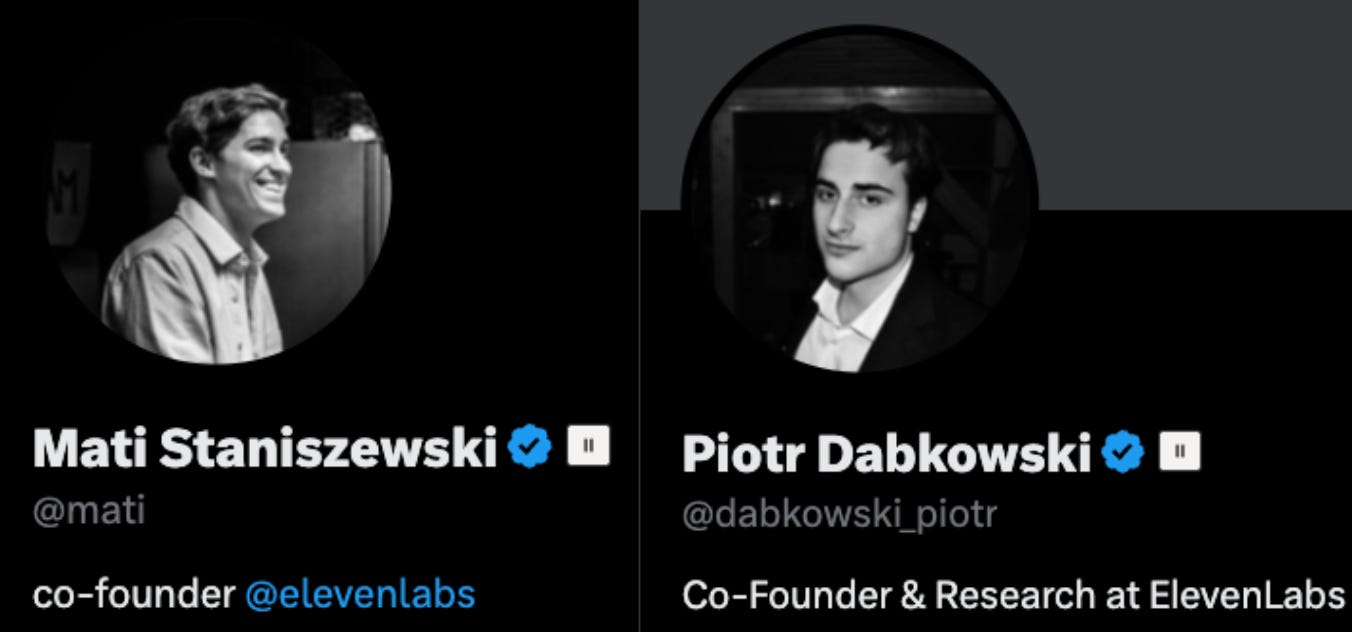
Warsaw holds a special significance for ElevenLabs, not only because both Piotr + Mati grew up there, but because it is where the early days of the company took place.
“My co-founder Piotr built our first ever model right here in Warsaw. It was the first human-like model that was contextually aware, emotional, and actually crossed the uncanny valley of speech.”

The Polish Engineer
There’s a running joke that Poland produces the world’s best engineers, a reputation built on serious technical education and a healthy dose of grit and ambition.
Here are some of the biggest Polish tech founders:
-
OpenAI: Wojciech Zaremba, a Polish-born mathematician and computer scientist, was one of OpenAI’s co-founders, while Jakub Pachocki has become one of the company’s leading researchers.
-
Snowflake: Marcin Żukowski, a Polish co-founder, helped build technology that became foundational to Snowflake’s data infrastructure.
-
ICEYE: Rafał Modrzewski, educated in Warsaw and at Aalto, leads one of the world’s leading SAR satellite companies, which raised a €200 million Series E in December 2025 at a €2.4 billion valuation.
-
Verkada: Polish-born co-founder and CEO Filip Kaliszan built Verkada into one of the most valuable companies in physical security, with its December 2025 round valuing the company at around $5.8 billion.
-
Fireworks AI: Paweł Garbacki, educated at the University of Warsaw, was one of the PyTorch engineers who co-founded Fireworks AI, which raised a $250 million Series C at a $4 billion valuation in October 2025.
-
Klarna: Sebastian Siemiatkowski remains one of the most visible founders with Polish roots in European tech.
-
ElevenLabs: Mati Staniszewski and Piotr Dąbkowski, and key members of their team including CFO Maciej Mylik, came up through Warsaw, making the company’s return feel symbolically resonant.
All the People in the Room
President Karol Nawrocki, one of the company’s early users, vowed to continue his support for emerging Polish technological growth, backing Polish founders and innovation as he opened the event.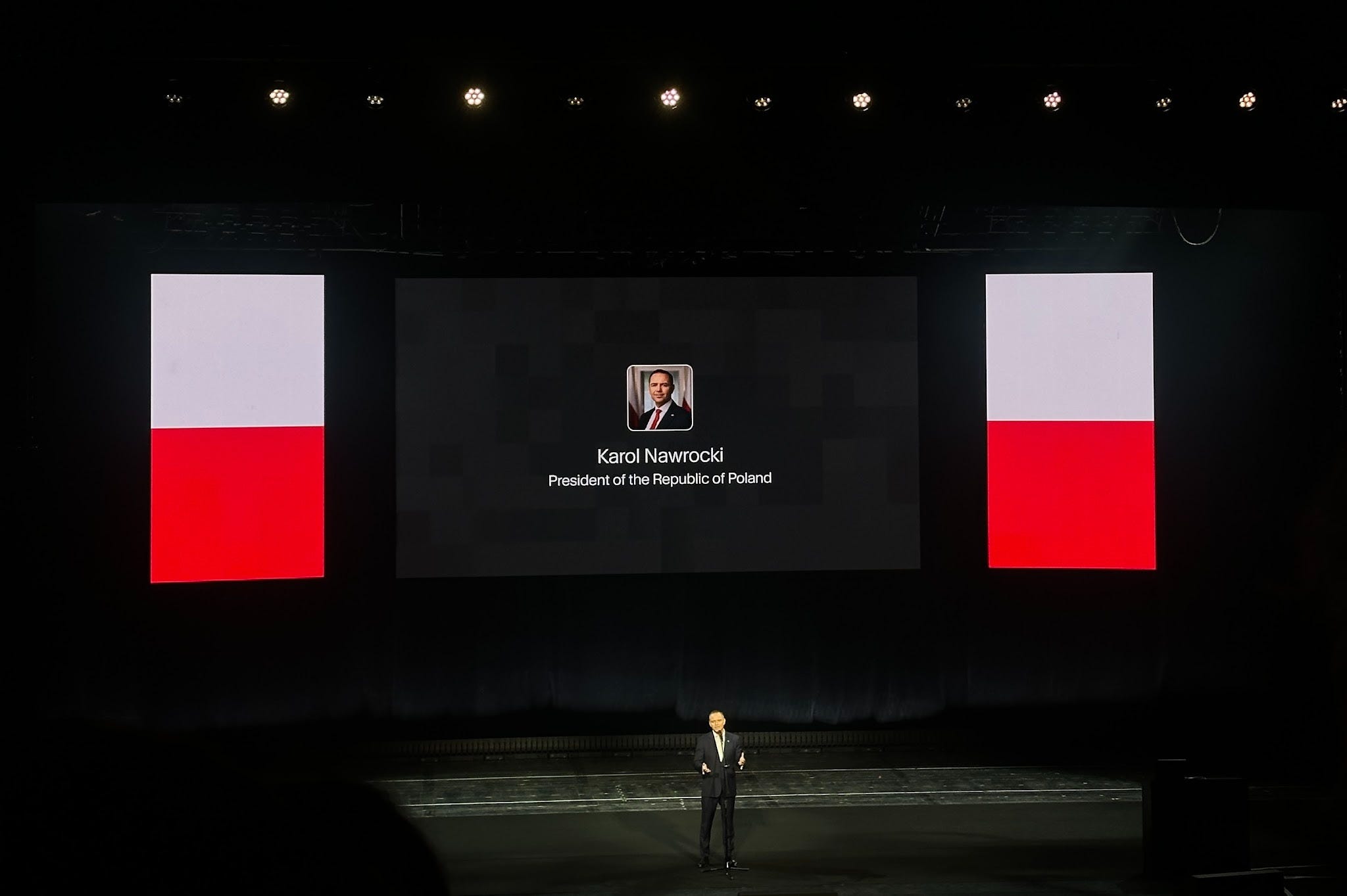
The Deputy PM and Defence Minister put AI at the centre of Polish security rather than at its edge. He didn’t soften the backdrop. These are scary times, he told the room, with the war next door and a volatile neighbourhood, and Europe can’t afford to treat AI as optional. He pointed to Poland’s role in DIANA, NATO’s Defence Innovation Accelerator for the North Atlantic, the Alliance’s deep-tech engine for dual-use startups working on AI, autonomy, and quantum. The message: AI integration across Europe is now a matter of security, not just productivity, and Poland intends to be at the front of it.
Executives from Poland’s legacy institutions, Polsat Plus Group, LOT Polish Airlines, InPost, and PKO Bank, took the stage on how they’re deploying AI. ElevenLabs announced a partnership with LOT Polish Airlines to overhaul customer experience with voice agents. Mati spoke with InPost’s Rafał Brzoska (on Day 2) about reinventing parcel delivery across Europe, and with Piotr Żak about positioning Polsat Plus Group for the decades ahead.
$3.3B, $6.6B, $11B..
Back in February, Molly asked Mati about the significance of the number 11. The answer is that it’s everywhere in ElevenLabs’ identity: Mati’s birthday, Polish Independence Day (November 11), a play on the pause sign, mathematical properties, even Apollo 11. It shows up in the valuations too.
The company’s marks have come in multiples of eleven:
-
$3.3B Series C in January 2025 (co-led by a16z and ICONIQ Growth)
-
$6.6B employee tender offer that September (led by Sequoia and ICONIQ, a secondary sale rather than a fundraise)
-
$11B Series D in February 2026 (led by Sequoia, with Andrew Reed joining the board).
If the pattern holds… $22B coming soon..
ElevenLabs was founded in 2022 and hit roughly $330M ARR by the end of 2025. By the end of April 2026, 4 months later, it had crossed $500M ARR.
The Series D first closed in February 2026 at the $11B valuation. A later close in May 2026 added BlackRock, Wellington Management, Salesforce, & Santander, joining Nvidia, which had invested the previous September. That is 4 years from the first model built by hand in Piotr’s Warsaw apartment to a Series D at $11B, and it makes ElevenLabs one of Europe’s most valuable AI companies.
Poland Takes a Stake in ElevenLabs
On June 17th, a few weeks after the summit, Vinci, the investment arm of state development bank BGK, took a minority stake in ElevenLabs. The investment was about 42 million zloty, or $11M, putting the Polish state on the cap table alongside a16z, Sequoia, and ICONIQ. The size of the stake was not disclosed.
The investment was paired with AI Lab Poland, a national initiative to give early-stage Polish AI startups access to capital, expert networks, and connections through ElevenLabs. The stated goal is to build the domestic AI ecosystem, using ElevenLabs as the reference case.
ElevenLabs is also expanding locally. The company plans to grow its Warsaw team from around 60 to more than 200 over the next 18 months to serve customers across Central and Eastern Europe, and Staniszewski said the investment will go toward regional expansion. Finance Minister Andrzej Domański framed the move as part of a push for Poland to create technology rather than only use it.
Polish Economic History in a Nutshell
A bit of context for readers less familiar with the story (or who did not take Polish history):
In 1989 to 1991, Poland’s economy went through “shock therapy” under the Balcerowicz Plan, switching rapidly from a planned economy to capitalism. Those transition years brought hyperinflation, mass privatisation, and a collapse in output. But the same period set the foundation for everything that followed: a high-energy, gritty, deeply ambitious push to rebuild Poland after years of occupation and nearly half a century as a Soviet satellite state.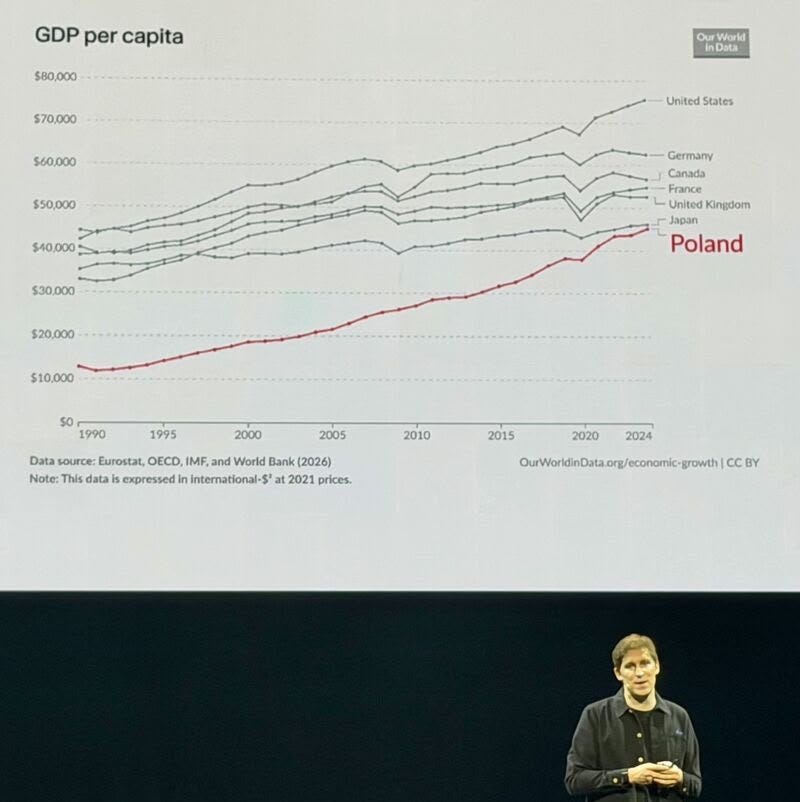
Polish economic growth in key points:
-
Around 1991, GDP growth was still negative as Poland absorbed the shock of transition.
-
By 2000, growth had stabilised in the mid-single digits, and from 2000 to 2019 Poland expanded almost every year, including through the 2008 to 2009 crisis, when it was the only EU economy to avoid a recession.
-
In 2020, during COVID, GDP fell by about 2%, then rebounded by nearly 7% in 2021, with continued positive growth in 2022 to 2025 (around 3% to 5%).
-
2025 closed with growth of 3.6%, among the fastest in the EU, and the IMF forecasts roughly 3.3% for 2026.

Why Now?
Poland’s geography was historically one of its biggest weaknesses, the cause of repeated partitions and occupations, most recently during WWII, when its territory was divided between the Third Reich and the USSR. Today, the same location is its biggest advantage. It sits at the hinge between Western Europe and Ukraine, Scandinavia and the Balkans, EU supply chains and NATO’s eastern front.
What makes it work, combined with geography:
-
EU-scale capital.
-
A large, educated workforce feeding off strong technical universities, the source of the “Polish engineer” talent pipeline.
-
A new wave of ambition and innovation, a founder generation born into a capitalist Poland.
Defence is the other engine. Under the EU’s SAFE programme, Poland secured €43.7 billion in low-interest defence loans, the single largest national allocation under the €150 billion facility. The funds are earmarked for priority defence investments including air defence, anti-drone systems, artillery, and border infrastructure, and the first payment of €6.6 billion (15% of the total) landed in May 2026.
Poland is also pushing at physical infrastructure. Varso Tower, the Foster + Partners skyscraper near Warsaw Central Station, topped out at 310 metres in 2021 and was completed in 2022, making it the tallest building in the EU. Even bigger is Port Polska (formerly the Central Communication Port, or CPK), the Foster + Partners greenfield mega-airport and high-speed-rail hub rising between Warsaw and Łódź, the largest infrastructure project in Central and Eastern Europe and one of the most ambitious in Europe, with a roughly €30 billion price tag. Opening in 2032, it’s built to handle 34 to 44 million passengers a year (scalable toward 100 million), anchored by a 480km high-speed rail line linking Poland’s largest cities.
A Foster + Partners architect, who worked on both buildings, spoke during the summit.
The one obvious shortcoming is energy: Poland still has a significant transition to make to reduce its dependence on legacy fuels. But even that weakness is now forcing investment into new infrastructure and, increasingly, into tech-enabled efficiency and grid management.
Bolt’s Markus Villig x Sequoia’s Andrew Reed
Markus Villig, the Estonian founder & CEO of Bolt, sat on a panel with Sequoia’s Andrew Reed. Reed is Sequoia’s lead on both companies. He led the firm’s investment in Bolt and sits on its board, having backed the €600M Series E in 2021 and the $709M round Sequoia co-led in January 2022 at an $8.4B valuation. He also led Sequoia’s $11B Series D into ElevenLabs in February 2026 and joined that board.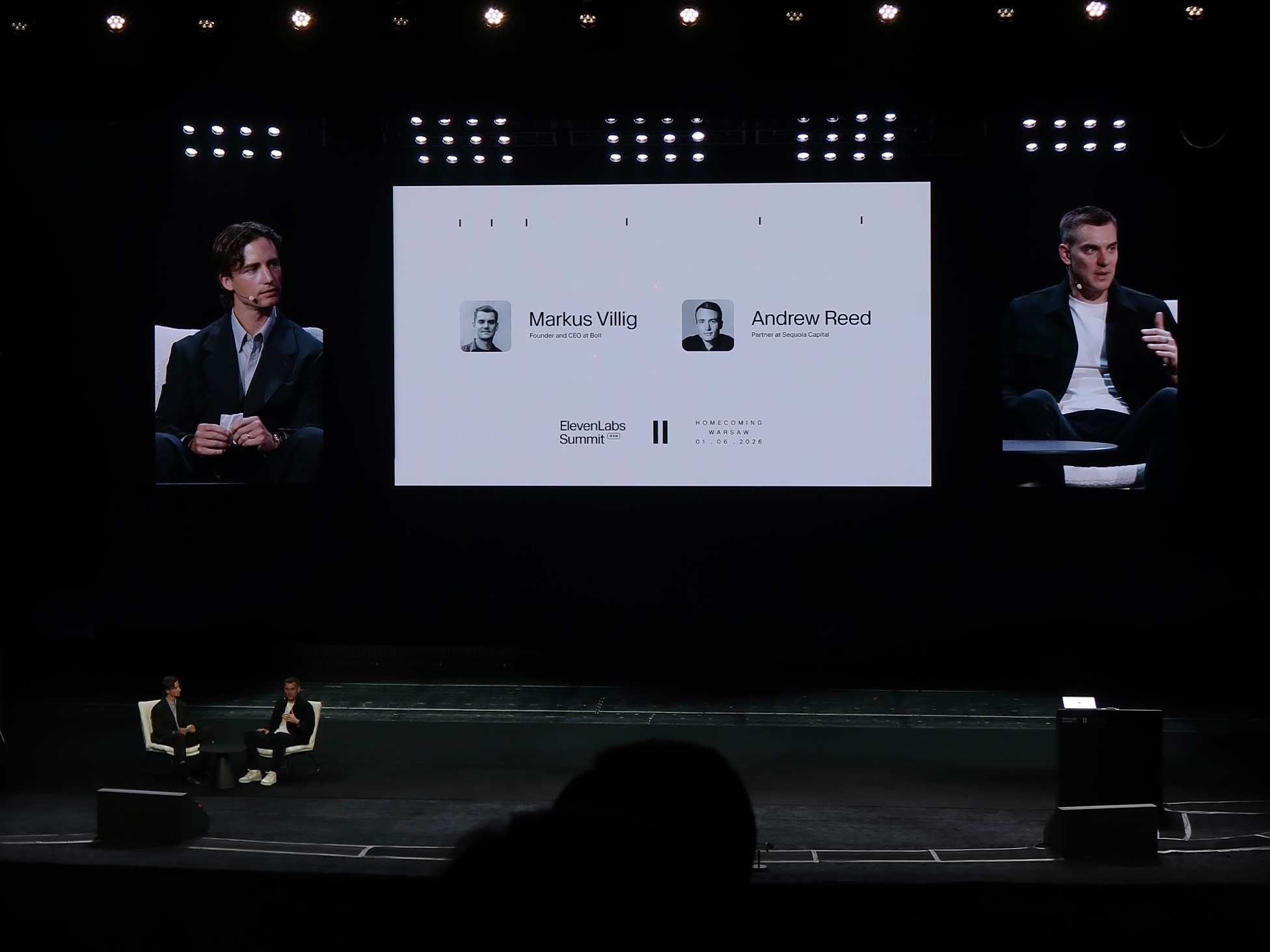
Bolt has a direct Poland connection. Villig founded the company in Tallinn in 2013, originally as Taxify, and it now has more than 100 million customers across 45+ countries and 400+ cities in Europe and Africa. Warsaw is Bolt’s second-largest office and one of its main engineering hubs, running Delivery, Platform, and Data Engineering teams. Villig noted that the Polish engineers Bolt hires in Warsaw are central to how the company builds.
The panel also covered the mechanics of scaling a mobility business: barriers to entry, product differentiation, and the question of a future IPO.
Darren Aronofsky on Creating with AI
Filmmaker Darren Aronofsky sat with ElevenLabs’ Alex Haskell on creating with AI. In May 2025, Aronofsky launched Primordial Soup, a creative studio built to use generative AI in filmmaking, announced at Google I/O alongside a partnership with Google DeepMind. The studio’s filmmakers get early access to DeepMind’s video models, including Veo, and feed product feedback back to the research team. Its first project, Eliza McNitt’s “Ancestra,” premiered at the Tribeca Festival in June 2025 and combined live-action performances from SAG-AFTRA actors with AI-generated visuals. Its animated series “On this day… 1776” runs on TIME’s YouTube channel through 2026, timed to the 250th anniversary of the Declaration of Independence.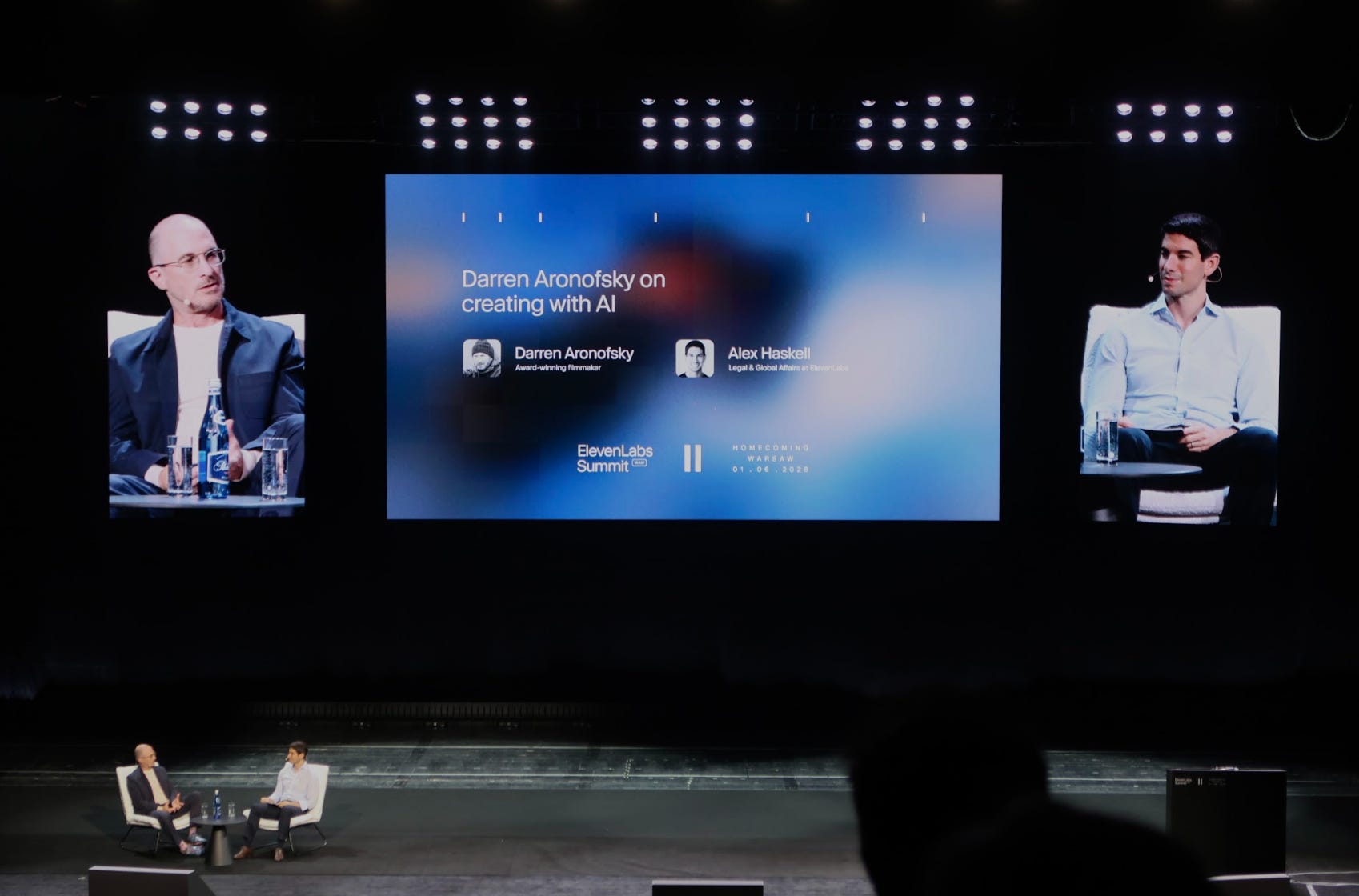
Aronofsky’s framing is that AI is the next entry in a lineage that runs through sound, color, and VFX, and that the goal is to keep artists in control rather than replace them. He has a long track record of pushing film technology, including the 18K “Big Sky” camera system built for his Sphere production in Las Vegas and the earlier VR project “Spheres.” The use of generative AI in film also draws significant pushback from parts of the industry over authorship and labor, which is part of why the keep-artists-in-the-driver’s-seat positioning matters to how these tools get adopted.
The connection to ElevenLabs is the shared thesis. Both companies are betting that AI becomes a tool inside the storytelling stack: Primordial Soup works the visual and narrative layer, while ElevenLabs supplies the voice and audio layer through text-to-speech, dubbing, and making content work in any language and voice. Holding the conversation in an opera house, a venue built around the human voice, put that division of labor on display. Dubbing in particular is core to ElevenLabs’ product and to Aronofsky’s stated interest in reaching wider audiences without losing the original performance.
Jennifer Li Fireside
Jennifer Li is a general partner at a16z, where she leads the firm’s AI infrastructure investing. a16z co-led the ElevenLabs Series A in 2023, the deal Bryan Kim won and signed (Kim is a board observer). Li took the board seat and has held it through the Series D at an $11B valuation.
Her read on the company ties to its pitch: she tracked synthetic voice for years and waited for a model to cross the uncanny valley, the point at which a generated voice carries real intonation and emotion rather than sounding robotic. ElevenLabs was the one that did, the same milestone Mati described on stage when he called the first Warsaw model the first to cross the uncanny valley of speech. 
Her wider thesis frames why a company like ElevenLabs fits the summit’s argument. Li holds that infrastructure is becoming the most important layer of the AI stack and that distribution is the key differentiator, with AI’s impact comparable to the internet’s. Before a16z she led product at Solvvy, a conversational AI company acquired by Zoom, and earlier worked at AppDynamics, acquired by Cisco for $3.7B.
Check out her cameo in the ElevenLabs doc.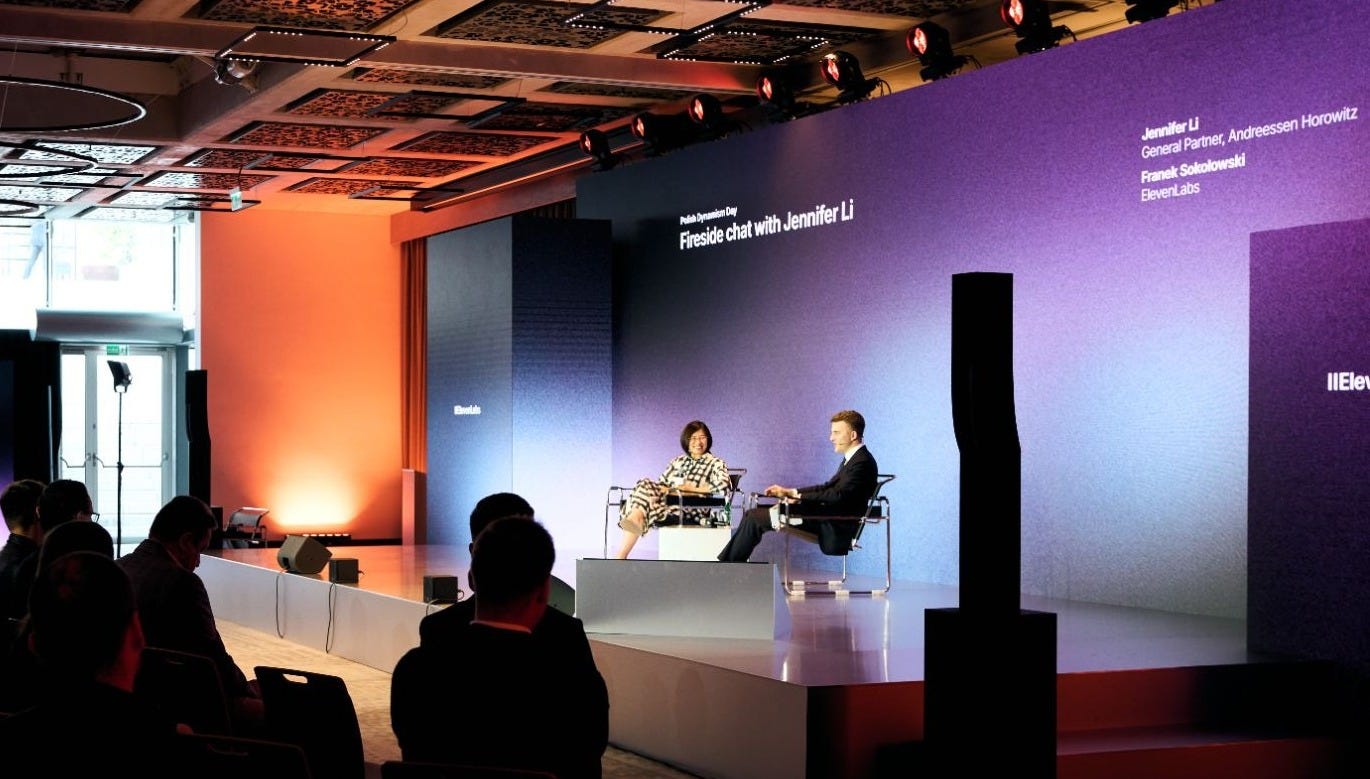

Two New Models
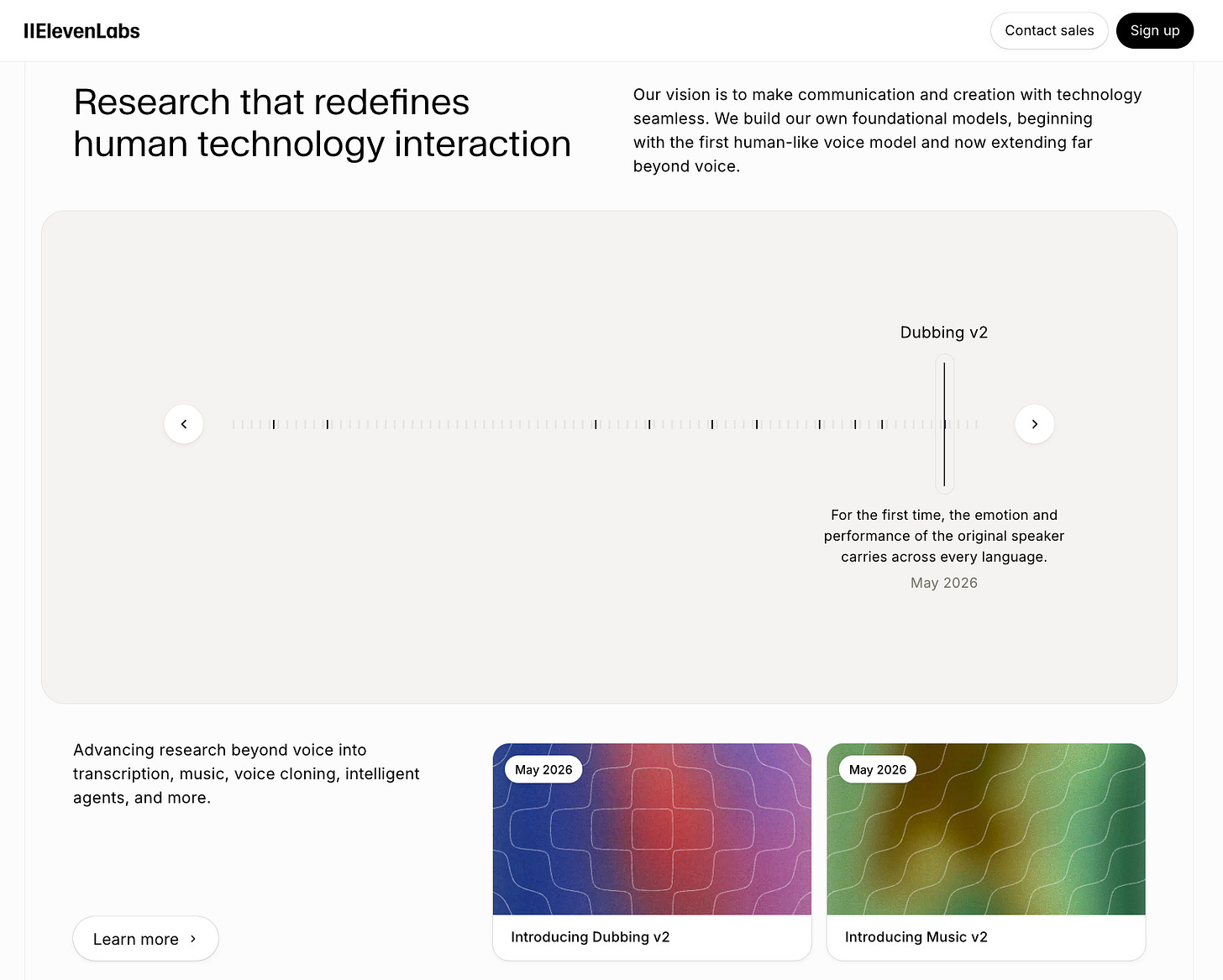
Mati showcased 2 new models:
-
Dubbing V2, the first end-to-end dubbing model, conditioning on the original audio to solve flat sound and editable after the fact, shown via a Ramp Super Bowl ad.
-
Eleven V4 (out in weeks), a text-to-speech model with line-by-line control over a full range of emotions. The live demo of an AI booking experience closed on the iconic voice of Polish actor Piotr Fronczewski, a deliberate local flourish.
Even More to Build
It was fitting that the man who opened Polish Dynamism Day (June 2nd) was Lech Wałęsa, Poland’s first post-communist president, founder of Solidarność, Nobel Peace laureate, and one of the most consequential figures in the country’s history. The day before, he’d been shown ElevenLabs’ original machine, the one Piotr assembled by hand in his Warsaw apartment at the very beginning.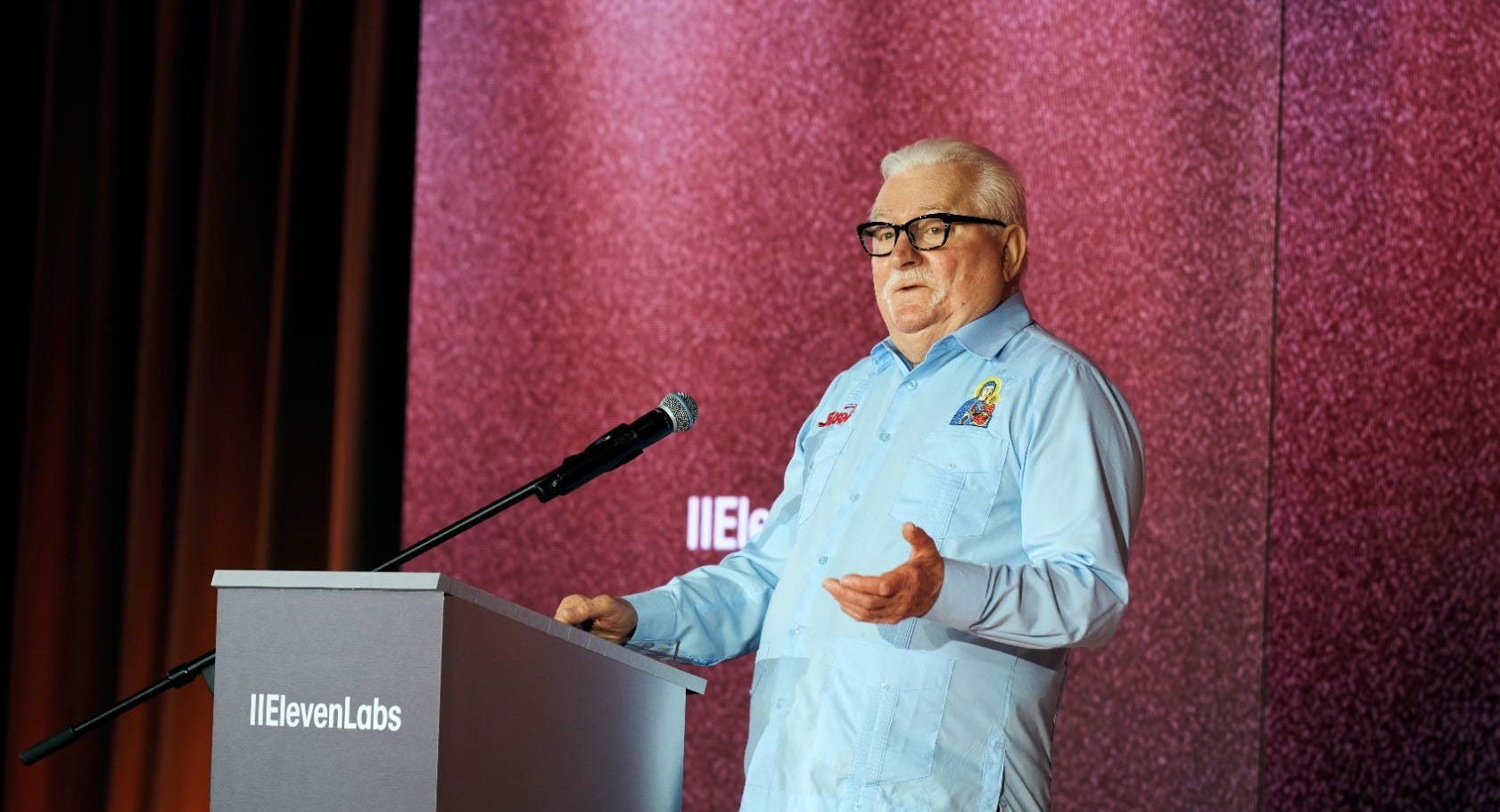
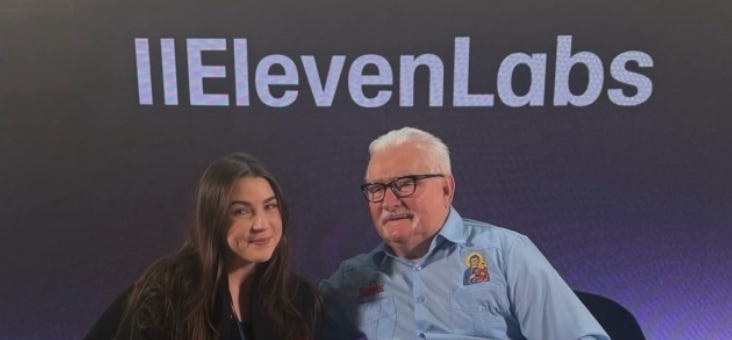
Pictured: Charlotte + Lech Wałęsa
His message to a room of founders and leaders who mostly keep their distance from politics: don’t. He argued that collaboration between tech leaders like ElevenLabs and the government is what sustains a capitalist system, and that strong democracy and free markets need founders to stay engaged.
The day before, Mati opened the summit on a very similar note, the company and the country both coming home:
“Poland has been through a remarkable transformation… We are only in the very early days of discovering what AI makes possible. The ambition is there. The technology is advancing. There is so much more to build, and we are proud to be pulling this future into existence with all of you today.”
Brought to you by:
Turing—Turing partners with frontier AI labs to improve model capabilities in coding, reasoning, tool use, & multimodality, as well as with Fortune 500 enterprises to build & deploy end-to-end agentic AI systems in mission-critical workflows Visit: turing.com/sourcery
VCX—VCX is the public ticker for private tech, allowing investors of all sizes to invest in venture capital. View The Portfolio at GetVCX.com
Deel—Deel is the global people platform that helps startups hire, manage, pay, and equip anyone, anywhere. Trusted by more than 35,000 fast-growing companies, Deel is the people platform that just works, so teams can scale without the chaos. Visit: deel.com/sourcery
Public-–Investing platform Public just launched Generated Assets, which lets you turn any idea into an investable index with AI. With Generated Assets, you can build, backtest, refine, and invest in any thesis with AI. Gone are the days of one-size-fits-all ETFs. Try it today: public.com/sourcery
Merge—The leading provider of customer-facing integrations and agentic tools for frontier LLMs, Fortune 500 organizations, and B2B SaaS companies. Visit: https://merge.dev
The material presented on Molly O’Shea’s website are my opinions only and are provided for informational purposes and should not be construed as investment advice. It is not a recommendation of, or an offer to sell or solicitation of an offer to buy, any particular security, strategy, or investment product. Any analysis or discussion of investments, sectors or the market generally are based on current information, including from public sources, that I consider reliable, but I do not represent that any research or the information provided is accurate or complete, and it should not be relied on as such. My views and opinions expressed in any website content are current at the time of publication and are subject to change. Past performance is not indicative of future results.
Paid Endorsement. Brokerage services by Open to the Public Investing Inc, member FINRA & SIPC. Advisory services by Public Advisors LLC, SEC-registered adviser. Crypto trading provided by Zero Hash LLC, licensed by the NYSDFS. Generated Assets is an interactive analysis tool by Public Advisors. Output is for informational purposes only and is not an investment recommendation or advice. See disclosures at public.com/disclosures/ga. Matched funds must remain in your account for at least 5 years. Match rate and other terms are subject to change at any time.