When AI work passes from person to person, checking it has to be someone’s job before it moves.
By Charlie Gilkey
Published: 2026-10-27
URL: https://www.productiveflourishing.com/p/wheres-the-hitl-human-in-the-loop
As more and more work shifts to being AI-assisted or AI-managed, we’re going to have to start asking who the HITL (Human in the Loop) is and where the HITL is in the process of work being created.
While it will be obvious to many people and leaders that people need to check AI work and that team output will be checked by humans, we’re already seeing that many people are passing AI output to other humans and those humans are passing that AI output to other humans. In a 2025 University of Melbourne and KPMG study of more than 48,000 people across 47 countries, 66% said they rely on AI output without evaluating its accuracy.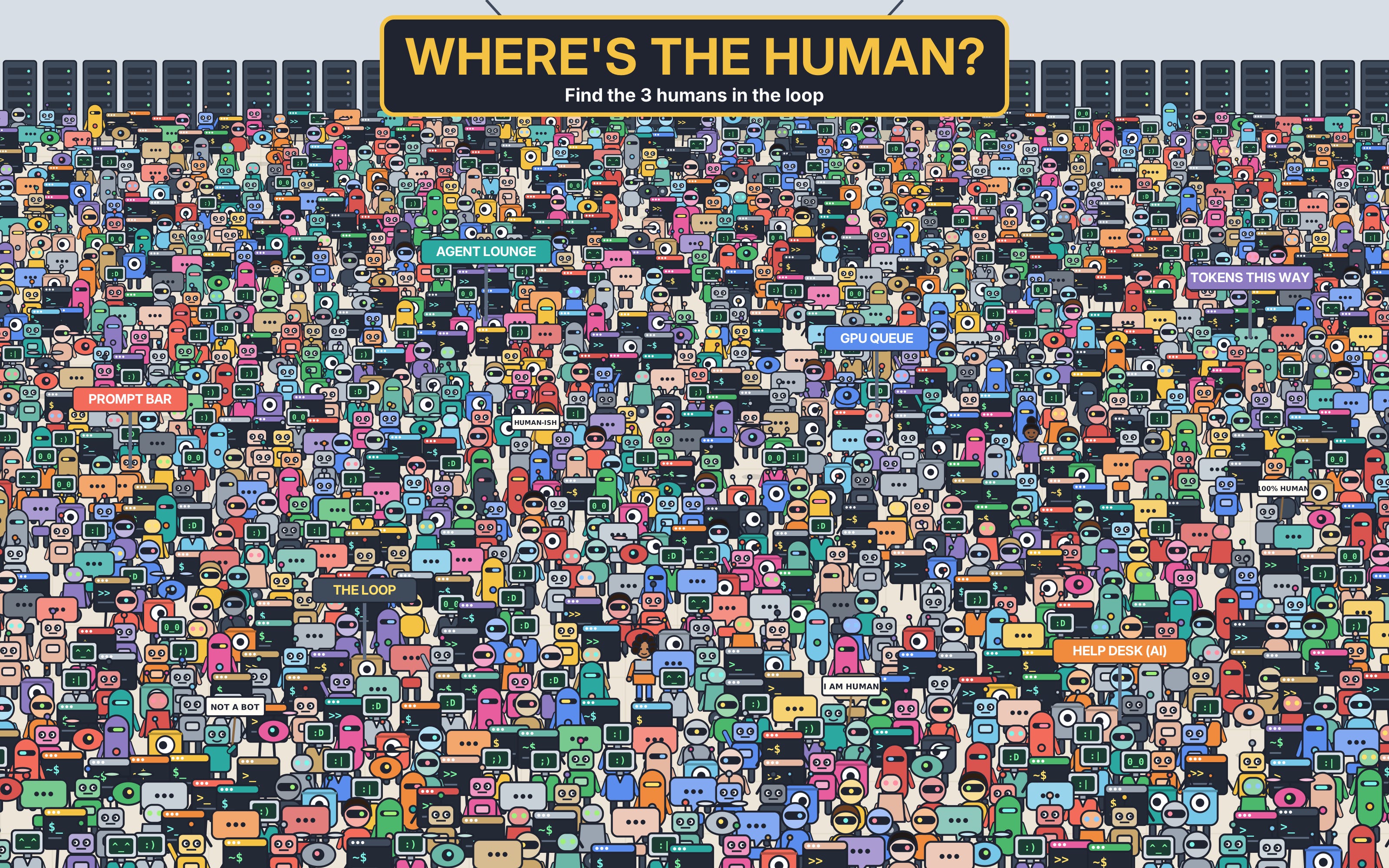 Find the 3 humans in the loop. Tap to enlarge.
It’s bad when it’s the leader that finally sees something that’s off and even worse when it’s the leader that starts the process. When the leader starts the process, seeing and calling out a problem is tantamount to questioning the leader without knowing whether it’s AI output or what the leader actually thinks. And often there’s no way to know: 57% of employees in that same study said they hide their AI use and present AI-generated work as their own. So many people are already disincentivized to question their leaders that the more common outcome is the AI work that comes from a leader will be reinforced by the organization rather than questioned.
Subscribe to Productive Flourishing to do your best work that won’t be replaced by AI, but perhaps will be supported by AI.
Good team habits can mitigate this, of course. If we decide that we’re all going to be responsible for being the HITL for our own work before we pass it on, then we won’t necessarily need to call that out. If leaders make the obvious explicit that the onus is on someone who uses AI to check their work, then we at least won’t end up in a place where “Claude/ChatGPT said it” is a reasonable response when our work is wrong or slop.
This is going to become even more important as AI gets even better, for the tells we see today may not exist in a year. The AI companies are rushing headlong to make AI agents more human-like and they will likely be successful, mostly because we may stop paying close attention to our colleagues and correspondents to see the 10-15% difference between their work without AI and their work with AI.
We need to start asking this question now, for I’m concerned that there will be more folks who won’t even know what it means to check AI’s work before too long. This is not a joke: some of my colleagues who are in AI enablement and working with younger workers are already exasperated at the exasperation of folks not knowing what it means to check AI or how to do it.
Productive Flourishing is a reader-supported publication. To receive new posts and support my work, consider becoming a free or paid subscriber.