Most of what feels urgent is one of three kinds of gaps between the world and what you want. Each kind calls for a different response.
By Charlie Gilkey
Published: 2026-10-02
URL: https://www.productiveflourishing.com/p/problems-puzzles-situations
We often confuse a problem, a puzzle, and a situation.1
A problem is something that must or needs to be solved. It’s usually manifest because it’s painful, annoying, disgusting, or dissonant.
A puzzle is something that could be or would be good to solve. It could be “good to solve” because you enjoy the process of solving it or because the outcome you’re looking for would be a nice-to-have, not a need-to-have.
A situation is something that either doesn’t need to be solved or will resolve itself on its own. Situations sometimes look and feel like problems because the situation may not be what you want or need. You know you have a situation when it resolves with a true “It is what it is.” You may not like the is-ness of it, but the is-ness is not something to dwell upon. How you accept the is-ness is.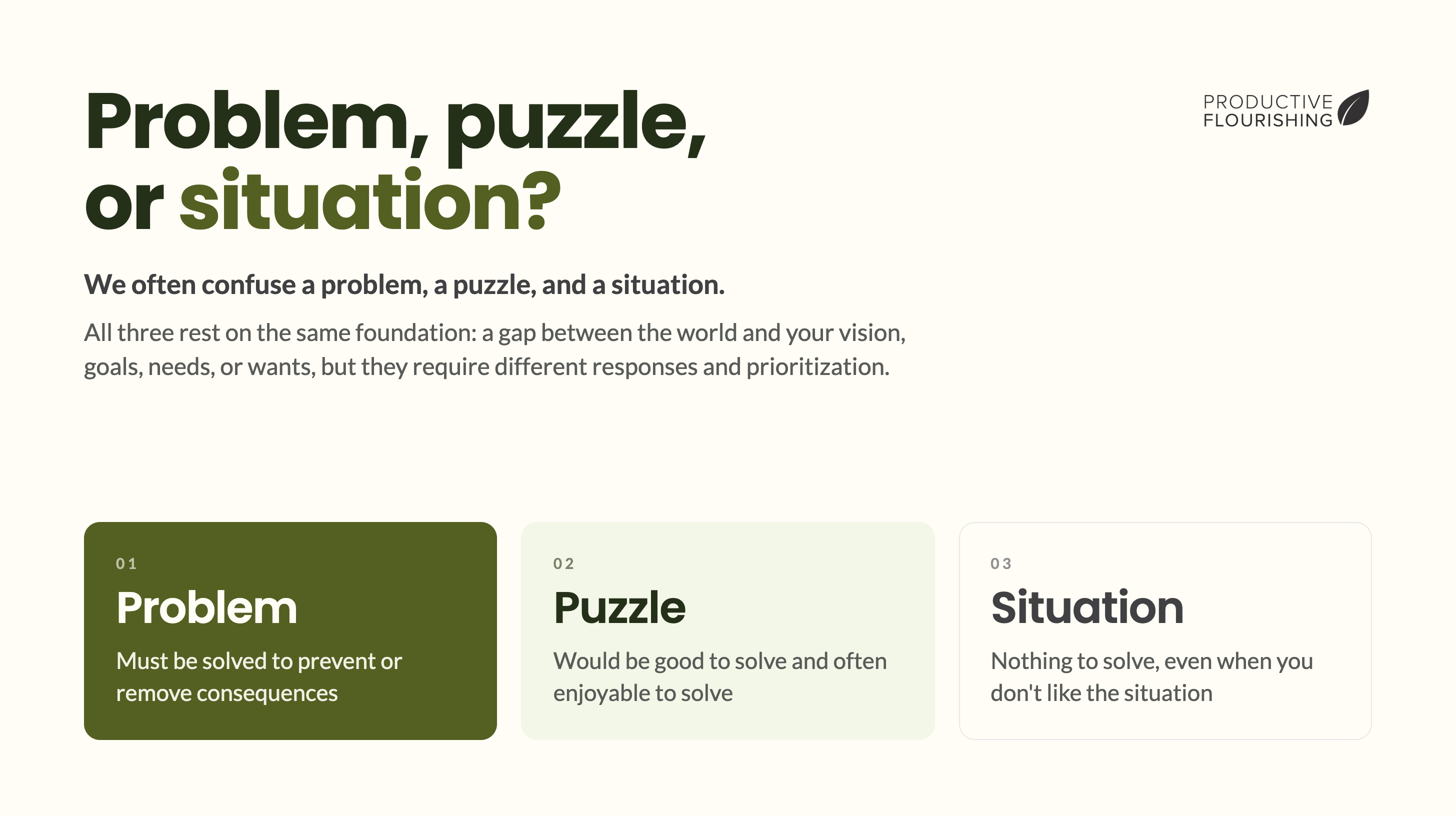
All of them rest on the same foundation: there’s a gap between the world and your vision, goals, needs, or wants. The difference is what to do about the gap.
It’s not a problem if you don’t subscribe, but doing so may help you with your problems, puzzles, and situations. 👇🏽
If you’ve been in a coaching session with me or at one of our community events, you’ve probably heard me say something like “Okay, I hear about the situation. But I’m not sure I hear a problem yet.” Or “Oh, that’s a neat puzzle. Are you making it a problem?”
What happens next is the point: they stop and interrogate what’s really going on. Sometimes they can quickly point to something pressing or hot. Sometimes they see the issue is tied to a strategic or future-building item. And a lot of the time, they see that they don’t actually need to do anything.
The question is always useful because it makes them articulate what’s really going on. Thousands of reps over decades strengthened my ability to see the difference, at the same time that people have different contexts, values, and needs.
True problems and puzzles don’t resolve themselves. They persist until somebody does something to change them. When we make puzzles problems, we live in a place of continual artificial urgency. When we make problems puzzles, we’re ignoring the reality that something needs to change.
Not sure which you have? Ask what happens if you don’t solve it. If something real breaks or degrades, it’s a problem. If the honest answer is nothing, but it’d be nice, it’s a puzzle.
Whether situations create problems is contextual. If I don’t need to do anything outside and have nothing that’s going to be affected by getting wet, then rain is merely a situation. If I rode my motorcycle to meet someone and it unexpectedly started raining, that could be a problem. Or it could just be that I need to ride home in the rain, take a warm shower, change clothes, and avoid emotionally over-investing in the situation.
When we make situations into problems, we amplify the drama and crises in our lives. They’re going to resolve on their own timelines, regardless of what we do about them. But we humans would rather futilely try to change something to assert our control than surrender to reality or other people’s agency. Better to have a healthy shrug than an unhealthy and emotionally expensive urge to fix everything.
On the work front, the situation people most insist is a problem is how behind they are. It feels like a problem because their integrity or reputation seems to be on the line. But flip the scenario: if a valued colleague or friend were in the same spot, they’d apply a lot of grace and see that it’s simply that person’s turn on the fall-down ride.
On the personal front, it’s being sick, injured, or navigating a new diagnosis. Those situations often cause real physical problems. The problems people intensify, though, are around how they’ll be seen and how people will treat them.
The aforementioned shrug can also be a dodge. Sometimes we call a real problem a situation because “it is what it is” costs less than changing something. The tell is that situations resolve on their own timelines and relabeled problems keep coming back around, unsolved.
Truly understanding the difference between all three allows for better prioritization, more peace of mind, and better expectations for ourselves. It may mean letting some puzzles and situations slide off your deck so you can focus on real problems. Or it may reveal the opposite: a project list so full of problems that no puzzles ever get a focus block. Putting out fires all day and never getting to your puzzles gets old.
The next time something has your attention and you feel the urge to fix it, take a beat and evaluate whether you’re dealing with a problem, puzzle, or situation. Adjust accordingly.1
got a verbal preview of this post and let me know that ’s new book, The Knot, discusses problems versus situations. Even though I’ve been talking about problems, puzzles, and situations for years, there’s a good chance that Seth influenced it so I’m giving a presumptive hat-tip and attribution. I haven’t read The Knot yet, but I’ve already bought it and intend to read it soon.