Why did we lose the capacity to get lost in books, and how can we rebuild deep focus and rediscover the joy of reading?
By Polymath Investor
Published: 2026-07-18
URL: https://www.polymathinvestor.com/p/how-to-immerse-yourself-in-books
 [Full Version printable PDF available at the end.]
Around 2007, while starting to write about the internet’s cognitive effects, Nicholas Carr noticed he could no longer sit with a book or long article the way he once had: “I used to find it easy to immerse myself in a book or lengthy article... Now my concentration starts to drift after a page or two. I get fidgety, lose the thread, begin looking for something else to do.”
And rather than merely writing about the problem, he acted on it: he and his wife moved from a well-connected Boston suburb to the Colorado mountains, where cell service was absent and the internet arrived over a slow DSL line. He canceled his Twitter account, put Facebook on hiatus, mothballed his blog, shut down his RSS reader, and cut back on Skype and instant messaging, in order to finish writing the book about exactly this problem.[[0]](#_ftnref1)
I remember when reading meant falling through the page and into another world. You didn’t just consume stories; you were transported to them. You would imagine the scenes, live through the suffering and joy of the main characters.
Maybe I’m just idealizing the past.
But ask yourself honestly: when was the last time you sat with a single book for a full, uninterrupted hour? I suspect we’ve collectively frayed our attention spans, trading deep immersion for shallow skimming, profound understanding for dopamine snacking. I get it, maybe you never experienced that kind of absorption. But I’m telling you. We all have it, and that skill is there waiting to be used again.
Getting lost in a book isn’t really about how much you like a story, it’s about how much you’ve actually practiced staying immersed in one. Deep focus is a brain-muscle; it builds through repetition, gets weak when you ignore it, and only rebuilds when you deliberately train it again.
The internet didn’t kill your love for reading, from my research it appears it just rewired your brain to expect a constant drip of quick, cheap rewards: a new notification, a fresh scroll, another dopamine hit. So, getting your reading groove back is possible. You just have to make your brain remember how to slow down, sink in, and stay there.
My hope is that this guide provides you with an arsenal of tools and protocols to help you recover that lost skill, reconquer that forgotten land, and, with time, fall in love with reading again.
Hey there, don’t forget to check out this July offer!
If you enjoy the Meta Skill series and want access to the whole library, plus all the other content in downloadable PDFs, through July 31st, you can access a full year of membership 60% off.
Some of the content is free, but if you’re able to support, please consider a paid membership and you’ll get:
-
The complete Meta Skills library: every field manual in the series, in PDF, with new manuals added as they publish
-
12–14 high-conviction investment write-ups a year: detailed, data-backed reports on underfollowed companies with asymmetric upside
-
The Trend Tracker: emerging themes traced from the data and signals down to the specific public equities positioned to benefit, from AI-infrastructure chokepoints to the defense upcycle
-
The Investing Library: forensic accounting toolkits, sector rulebooks, mental models, and historical base rates to improve your process
-
Every full post and the complete archive: each deep-dive report and the full back catalogue, nothing locked
Offer closes July 31st.
Get 60% off for 1 year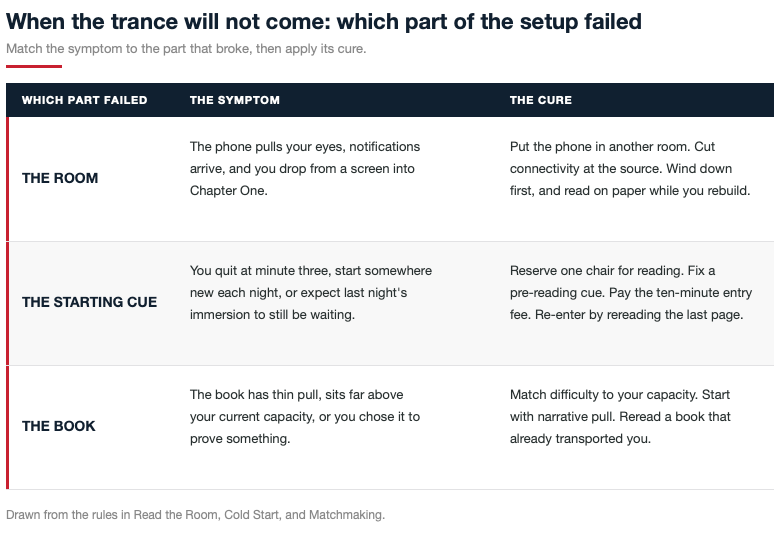 Figure 1. When the entrance doesn’t come, look at which part of the process failed, then apply its cure.
Read the Room
This part is about getting rid of anything that could distract you before you start reading; like your phone, the internet, or even the type of book you’re using. The point is to change your environment, not just try to force yourself to focus harder.
Put the phone in another room. Take your phone and put it in another room before you start reading. Don’t just leave it next to you on the couch or turn it face-down—that’s not enough. Even if you’re not using it, just having your phone nearby can make it harder to concentrate, according to some research. The closer your phone is, the more it can mess with your focus. Some studies suggest this effect isn’t huge, but it’s probably real enough to matter. So, the easiest way to avoid distractions is to charge your phone in another room and use something else as a timer or alarm if you need one. The big mistake people make is thinking it’s enough to just put the phone face-down within reach, but that doesn’t really help—distance is what counts. Why It Works: Ward[[1]](#ftn1) and colleagues (2017) found in their “brain drain” experiments that people did worse on attention-demanding tasks when their own phone sat on the desk than when it was in a bag or another room, even though they never touched it[[2]](#ftn2).
Cut connectivity at the source. Turn off your internet or block distracting websites before you start reading, so you don’t have to keep fighting the urge to check your phone or computer. For example, Nicholas Carr, the author of The Shallows, found he couldn’t read more than a couple pages at a time until he moved to a place without cell service and stopped using social media, then he was able to concentrate and write an entire book. Hugh McGuire got back into reading by keeping devices out of his bedroom and taking breaks from social media at certain times. The key is they changed their environment to make distractions impossible, instead of just trying to use willpower. You can do something similar by setting your Wi-Fi to turn off automatically at a certain time, or using an app that blocks social media when you want to read. Don’t rely on just trying to resist temptation, set things up so you don’t even have the option. That’s what worked for the authors I mentioned above who managed to start reading again. (Carr, 2010; McGuire, 2015)