The king's prize, the investor's dilemma and Pabrai's 2x4
By Polymath Investor
Published: 2026-04-24
URL: https://www.polymathinvestor.com/p/poincares-mistake
Henri Poincaré was one of the greatest mathematicians who ever lived. In 1889 he won a cash prize from King Oscar II of Sweden for solving a problem that sounded almost embarrassingly simple: given three objects in space pulling on each other through gravity, predict where they will be in the future.
Then, reviewing his own proof, he found a mistake.
When he traced the mistake through, the solution fell apart. What he discovered with this early version of debugging was not a harder version of the same problem. It was a different kind of problem entirely.
Apparently, two bodies is easy. Newton had solved it two centuries earlier. You can calculate where the Earth and Moon will be a thousand years from now and be off by almost nothing.
But add one more body, a third rock, and well…everything changes.
That’s the three-body problem1.
Now, this system turned out to be what we now call a chaotic system: something that is wildly sensitive to where things start. Get the initial position of one body wrong by a millimeter, and your forecast a year out is off by thousands of kilometers. Two years out, you are lost somewhere beyond Pluto.
In this type of problems, errors do not add. They compound.
Mind you, this was decades before anyone used the word “chaos.” What Poincaré stumbled upon2 was the mathematical bedrock of weather forecasting, fluid dynamics, population ecology, and (though he would not have known it) the daily experience of every fundamental investor.
Think about what you do when you build a model on a company (in Excel or in your head). You pick a revenue growth rate. A margin path. A discount rate. A terminal value. A capex schedule. Each input has an error bar. Each error bar interacts with the others.
A company is not three rocks in a vacuum. It is embedded in a web of customers, competitors, regulators, suppliers, currencies, and capital flows, each of which is its own chaotic system. You are not modeling a three-body problem. You are modeling a ten-thousand-body problem(!).
Anywhere you have feedback loops and nonlinearity, small initial differences cascade into divergent outcomes.
So…if you cannot forecast, why bother?
The trick is not to avoid forecasting altogether but to find situations where the payoff does not depend on a precise forecast, situations where the odds are overwhelmingly in your favor: a hard catalyst, a structural chokepoint, a cash-rich balance sheet trading below liquidation.
Mohnish Pabrai has a phrase for these situations:
“What we’re looking for is something that hits you in the head with like a 2×4.” -Mohnish Pabrai
Not a mildly appealing thesis. Something that hits you.
And in 2002, hit he was.
The company was Frontline. It owned one of the largest VLCCs (very large crude carriers) fleets at the time. This company had made a choice. Instead of locking the fleet into one or three-year time charters with guaranteed day rates, it put the entire fleet on the spot market. Breakeven on these ships, once you paid for crews and fuel, was around ~$15,000 per day.
Then oil demand softened, and spot rates collapsed to roughly $10,000 per day. Frontline was now losing a lot of money. The stock got taken out back and shot.
What was the market doing? It was trying to forecast a chaotic input (spot freight rates), extrapolating the current losses, and pricing Frontline as if this misery would continue indefinitely. Nobody could forecast when rates would recover.
What was Pabrai doing? He was not trying to forecast rates. He was looking at the balance sheet.
Two things jumped at him.
First, the debt was non-recourse. Each loan was tied to a specific ship, like a car loan. If Frontline defaulted on a ship’s debt, the bank could take the ship. They could not take the company. There was no parent-level debt waiting to drag the whole enterprise into bankruptcy. The worst case for any single ship was covered.
Second, the liquidation math was absurd. If Frontline got into a cash crunch, they could sell three ships, pay off that ship-level debt, and have enough cash to sustain operations for a while. Then sell three more if needed. And if they simply decided to liquidate the entire fleet, sell every ship, retire every loan, shareholders would walk away with around ten or eleven dollars per share.
The stock was at six.
Almost two times your money just to turn the lights off.
“The trick in investing is just to sit there and watch pitch after pitch go by and wait for the one right in your sweet spot. And if people are yelling, ‘Swing, you bum!,’ ignore them.” -Warren Buffett
That was the 2x4. Not a prediction about shipping rates. Not a supply-demand model of global crude. A structural feature of the capital stack that made one of the outcomes (bankruptcy) nearly impossible, and another outcome (voluntary liquidation) worth double the quoted price.
A solid balance sheet trading below liquidation. The downside was protected. The upside was a free option on rates.
Pabrai bought the stock at $6 or $7, and he sold it for $10 or $11 after a few months3. That’s a solid ~60% in a short period of time, not bad.
Then the market turned. By late 2003, rates had climbed past $50,000 a day. Then in 2004 they had blown through $100,000. At the peak that year, they hit roughly $250,000. Frontline’s breakeven was still $15,000. Day by day, each ship was earning fifteen to twenty times its cost. Frontline owned dozens of them.
Had he held through the recovery, the stock ran to roughly $140, paid hefty special dividends, and spun off other companies along the way4. On a total return basis, close to a thirty-bagger.
That is the inversion Poincaré would have recognized. You cannot solve the three-body problem. You cannot predict with exact precision where rates will go. But you can, occasionally, find a situation where the odds are massively stacked in your favor.
And that, in the end, is the whole game. Not forecasting the weather. Not out-modelling the ten-thousand-body system. Just waiting, patiently, and recognizing the 2x4 when it finally shows up.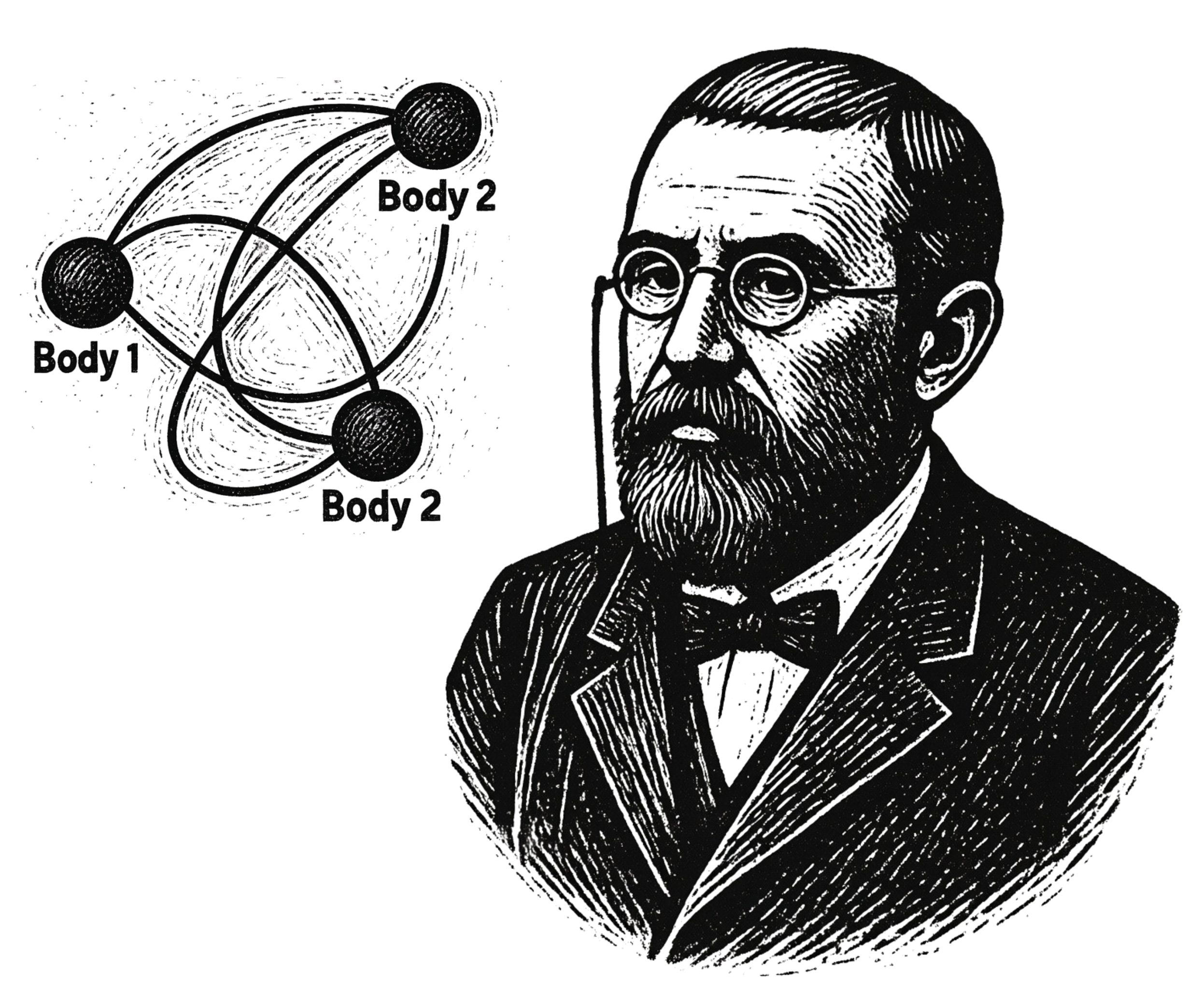
Disclaimer**This newsletter and any related emails (the “Publication”) are provided for informational and educational purposes only. They do not constitute an offer, solicitation, or recommendation to buy, sell, or hold any security or other financial instrument, nor should they be interpreted as legal, tax, accounting, or investment advice. The Publication is general in nature and has been prepared without regard to the investment objectives, financial situation, or particular needs of any specific person. You should conduct your own independent research and consult with a qualified financial adviser and other professional advisers before making any investment decision. The information contained in the Publication is based on sources believed to be reliable, but its accuracy, completeness, or timeliness cannot be guaranteed. All information and opinions are subject to change without notice. Any forward looking statements or projections are inherently uncertain and actual results may differ materially due to various risks and uncertainties.
Investing involves significant risks, including the possible loss of principal. Past performance is not indicative of, and does not guarantee, future results. The views expressed in the Publication are those of the author(s) in a personal capacity and do not necessarily reflect the views of any employer, affiliate, or other entity. The author(s) and related parties may hold or acquire positions in securities, instruments, or issuers discussed and may buy or sell such positions at any time without notice. Neither the author(s) nor any publisher, affiliate, director, officer, employee, or agent accepts any liability for any direct, indirect, incidental, consequential, or punitive damages arising out of the use of, or reliance on, the Publication.
Jurisdictional and regulatory notices
United Kingdom: This Publication is general editorial content. It is not an invitation or inducement to engage in investment activity for the purposes of section 21 of the UK Financial Services and Markets Act 2000. If you choose to engage in any investment activity, you should rely only on the terms of the relevant offer as set out in the issuer’s prospectus and applicable regulatory filings.
European Economic Area, North America, Australia, and Asia: Distribution of this Publication may be restricted by local law or regulation. It is not intended for any person in any jurisdiction where such distribution would be contrary to local law or regulation. Recipients are responsible for informing themselves about, and observing, any such restrictions that apply in their jurisdiction.
By reading the Publication, you agree that you use it at your own risk and that you are solely responsible for any investment decisions you make.**1
What’s the three-body problem? If you have two objects moving under gravity (say, the sun and the earth), Newton showed in the 1600s that you can write down an exact formula for how they move. But the moment you add a third body (say, adding the moon, or Jupiter), that math doesn’t work anymore. There’s no clean formula. The motions interact with each other in ways that can’t be solved with algebra. For two hundred years after Newton, the biggest names in mathematics (Euler, Lagrange, Laplace) tried various tricks and approximations, and they couldn’t solve it. 2
What Poincaré did in the 1880s and 1890s was revolutionary. Instead of trying to solve the equations exactly (which couldn’t be done), he asked a completely different kind of question: can we describe the qualitative behavior of the orbits? Will they stay bounded? Will they return close to where they started? What shapes do they trace in the long run? To answer this, he invented entirely new mathematical tools. His masterwork was a three-volume book called Les méthodes nouvelles de la mécanique céleste (”New Methods of Celestial Mechanics”), published in 1892, 1893, and 1899, totaling nearly 1,300 pages.3
Pabrai, M. (2019, August 30). Mohnish Pabrai on his book, The Dhandho investor [Transcript]. MOI Global. https://moiglobal.com/mohnish-pabrai-the-dhandho-investor-201907/4
Frontline spun off Ship Finance (SFL) in June 2004 and Golden Ocean in December 2004, and paid enormous dividends, so total return to a holder who sat through it would have been much higher than the pure share-price ratio suggests.