President Trump’s address to the nation last week reignited false claims about widespread fraud in the 2020 election: NewsGuard’s False Claim of the Week
Published: 2026-07-20
URL: https://www.newsguardrealitycheck.com/p/2020-election-denial-is-back
Welcome to Reality Check, NewsGuard’s nonpartisan newsletter that tracks the false claims and conspiracy theories that shape our world — and who’s behind them. Please support us by becoming a premium member or sharing our work.
Follow us: X | LinkedIn | Instagram | TikTok | Bluesky
False Claim of the Week: The 2020 U.S. Election Was Marred by Widespread Fraud
NewsGuard’s “False Claim of the Week” highlights a claim from NewsGuard’s False Claim Fingerprints, a proprietary database of provably false claims and their debunks. The claim that widespread fraud occurred during the 2020 U.S. election is NewsGuard’s “False Claim of the Week” due to its widespread appearance across social media platforms and websites, its high engagement levels, and the high-profile nature of the sources promoting it. Those three factors, as well as its significant subject matter and potential for harm, make it our False Claim of the Week.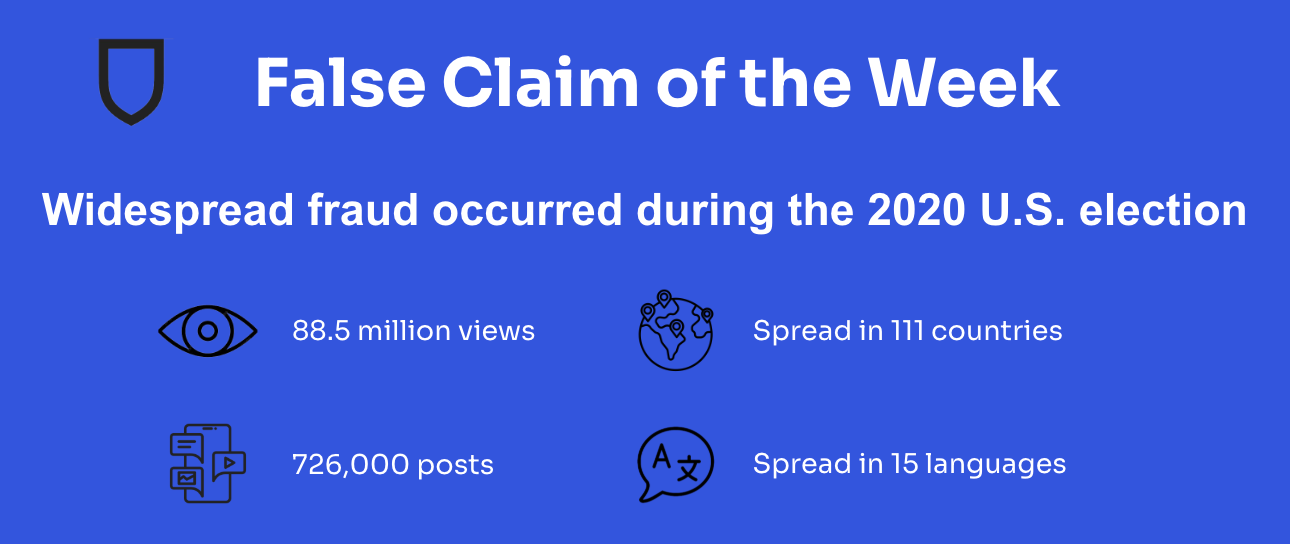 The amount of spread on X from the seven-day period July 14, 2026, to July 20, 2026.
Debunk: Trump Reignites Baseless 2020 Election-Fraud Claims
By Sofia Rubinson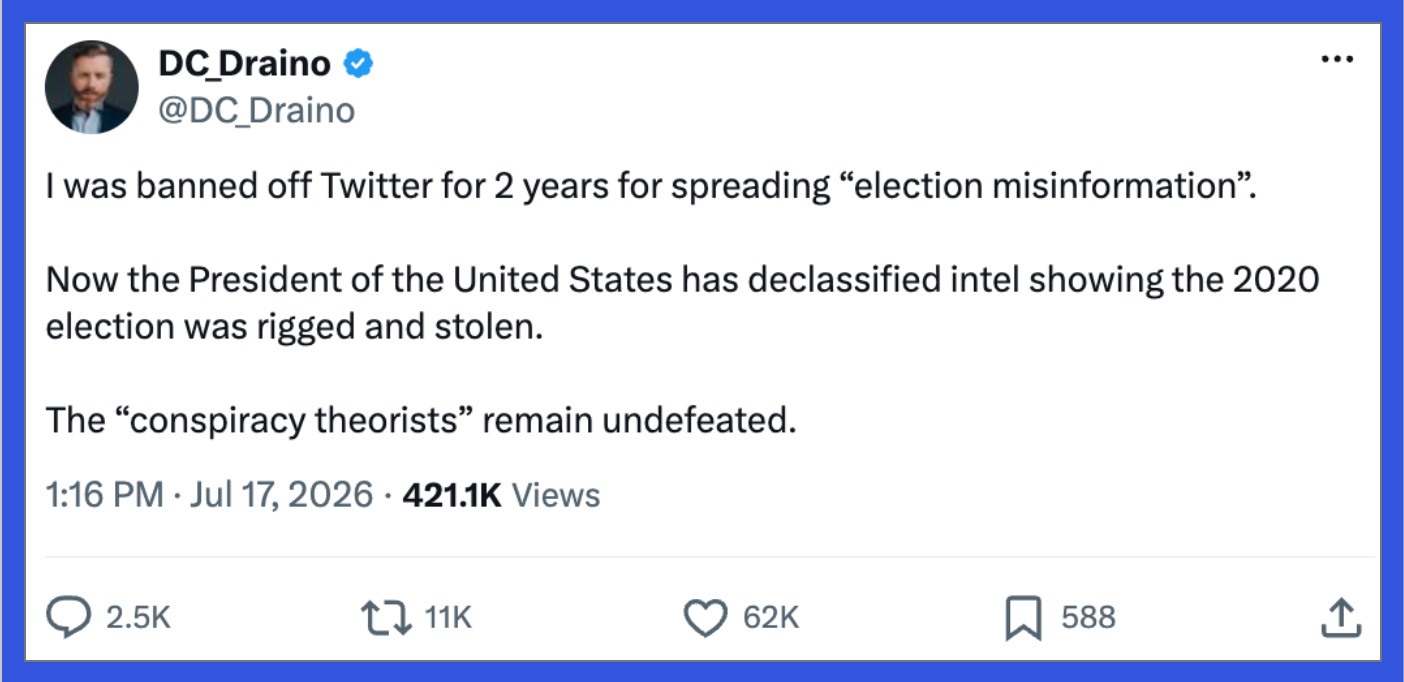 Conservative commentator Rogan O’Handley falsely claims that “the 2020 election was rigged and stolen” following Trump’s July 16 address. Source: X user @DC_Draino
What’s happening: In a primetime address on July 16, 2026, President Donald Trump returned to his longtime and long-debunked claim that “significant evidence of fraud has been detected” in the 2020 election. This narrative has never disappeared from social media in the five-and-a-half years since the November 2020 vote. But Trump’s speech gave it a big new boost.
Context: While Trump did not repeat his claim that he won the 2020 election, he said during a 25-minute address delivered from the East Room of the White House that the election was “left vulnerable to being rigged and stolen.” Trump, who lost to Democrat Joe Biden in the 2020 race, added that “we can never watch a stolen election again.”
-
Citing newly declassified documents, the president also argued that intelligence agencies covered up the extent of Chinese interference in the 2020 election and suggested that China surreptitiously obtained voting information on 220 million Americans.
A closer look: Over the five days after Trump’s speech, there were 609,000 posts on X that claimed the 2020 election was rigged or stolen, collectively garnering 77.7 million views, according to a social media analytics tool used by NewsGuard. That represents a 214 percent increase in similar posts made in the five days leading up to Trump’s address (when the topic of his speech had already been the subject of news reports) and a 575 percent increase in such posts during the five days before that, compared to the five days after the speech.
The number of individual accounts advancing “stolen election” claims increased by 295 percent from the 10-day period before the speech to the five-day period after the speech, from 55,100 to 218,000.
-
Conservative commentator Nick Sortor posted on July 16, “President Trump reveals the CIA, FBI, and NSA KNEW in 2020 that China was attempting to manufacture FAKE BALLOTS to have Joe Biden elected. … They KNEW the 2020 election was at risk of being stolen.” The post garnered 1.7 million views and 81,000 likes.
-
Another conservative commentator, Rogan O’Handley, posted on July 17: “I was banned off Twitter [now X] for 2 years for spreading ‘election misinformation’. Now the President of the United States has declassified intel showing the 2020 election was rigged and stolen. The ‘conspiracy theorists’ remain undefeated.” The post received 421,000 views and 61,000 likes.
Sortor and O’Handley did not respond to direct messages seeking comment.
Actually: Top election officials in all 50 states affirmed the integrity of the 2020 election, and multiple state and federal investigations and court cases reached the same conclusion. And as NewsGuard reported on Friday, the Trump administration’s newly released documents do not prove that widespread fraud occurred, and indeed, several documents suggest the opposite.
For example, a January 2020 memo from the National Intelligence Council that was among a tranche of documents released by the White House stated that “vote tabulation systems would be difficult to manipulate on a wide enough scale to compromise election results.”
-
The memo noted two key safeguards against widespread fraud: that local election systems “are not connected to the Internet or to each other,” and that “postelection audits and paper trails very likely would uncover such an effort.”
Additionally, Trump accused China of carrying out an “illicit acquisition of 220 million U.S. voter files.”
-
However, voter registration information is publicly available across the United States. Election security expert Ryan Macias told PolitiFact: “Just because they have voter registration data does not mean that state or local voter registration databases or infrastructure have been breached. This data is information that can be legally purchased by certain members of the public.”
Dig deeper with NewsGuard AI:
Try NewsGuard AI.

Learn more about Reality Check’s Premium Membership here.
Help wanted! Have you seen fishy claims about the 2020 U.S. election? Pass along examples to [email protected] and we’ll investigate. Help us fight the good fight!
In Case You Missed It … A Voter Guide to Trump’s Election Claims
In his primetime White House address, President Trump made other claims suggesting that U.S. elections are corrupt, insecure, and highly vulnerable to fraud, citing the newly released documents described above.
It was a lot to take in and sort out. For a special edition of Reality Check, NewsGuard sifted through Trump’s accusations and examined his purported evidence. In the report linked below, we debunked three false claims advanced by the president, showed how the White House address played into broader baseless narratives about election fraud that we have previously debunked, and explained the true focus of Chinese foreign interference efforts.
Read the full report here.
This newsletter was edited by Sofia Rubinson and Eric Effron.
You find, we report: Let your fellow Reality Check readers know about false claims you run across online. Our analysts debunk false claims before any others 80% of the time, but we can’t catch everything. If you find what looks like a false claim, let us know. We’ll investigate and report back in Reality Check.
Reality Check is produced by co-CEOs Steven Brill and Gordon Crovitz, and the NewsGuard team.
We launched Reality Check to shed light on the false claims spreading online, how they spread, and the forces behind them. Each day, we aim to bring you the story behind your news feed and help you stay informed about the false claims circulating in the news. Support our work by becoming a premium member.
Have feedback? Send us an email: [email protected].