Texas' new lawsuit against OpenAI could serve as a template for other states and countries to litigate against AI companies and push them to prioritize safety | Edition #338
By Luiza Jarovsky, PhD
Published: 2026-10-25
URL: https://www.luizasnewsletter.com/p/a-flood-of-lawsuits-could-help-make
\“Snow Storm: Steam-Boat off a Harbor's Mouth,” by J.M.W. Turner, 1842 (oil on canvas, modified)\
Two days ago, Texas filed a lawsuit against OpenAI and Sam Altman under the state's Deceptive Trade Practices Act, a consumer protection law.
In the lawsuit, the state's attorney general argues that OpenAI engaged in false, misleading, and deceptive practices while conducting its business, including:
- Failing to warn of ChatGPT’s dangers;
- Designing, offering, and maintaining a dangerous online product easily accessible to children without parental consent;
- Designing, offering, and maintaining a dangerous online product where harmful information such as tips on eating disorders, self-harm, and mass murder is readily available, including to young children;
- Designing, offering, and maintaining a dangerous online product that includes features that promote compulsive, prolonged, and unhealthy use, including by children;
- Designing, offering, and maintaining a dangerous product without adequate safety testing;
- Designing, offering, and maintaining a dangerous product capable of ignoring human direction and instead performing in an unexpected and unauthorized fashion;
- Designing, offering, and maintaining a product that promotes self-harm to users while falsely representing its safety;
- Designing, offering, and maintaining a product that functions unreliably while falsely representing that reliability;
- Designing, offering, and maintaining a product that falsely represents itself as having human emotions and characteristics to earn the trust and further engagement of its users.
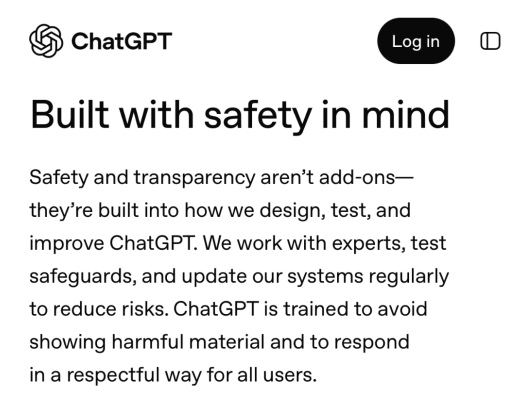
It refers, for example, to earlier promises of safety, such as the message shown on the login screen below, and then points to recent AI incidents, including the Hugging Face one, as examples of the product's dangers.
Texas is not the only U.S. state suing OpenAI. Florida sued it in June, and Arizona, Idaho, and Montana filed their lawsuits on October 14th.
This is happening in parallel with various other suicide and mental health harm lawsuits filed by victims' families, such as in the Adam Raine case, dozens of copyright lawsuits against AI companies over the lack of consent and compensation to authors, and various other lawsuits over product safety and consumer protection issues.
The U.S. Federal Trade Commission has also been investigating AI companies. As Lina Khan, a former FTC chair, wrote two days ago, the FTC could sue AI companies if, for example, it identifies “unfair or deceptive” practices or if they fail to follow basic security protocols.
Skeptics who say lawsuits will not lead to meaningful outcomes are wrong: lawsuits are already shaping the future of AI.
For example, a copyright lawsuit has already led to the biggest settlement in U.S. copyright history, forcing Anthropic to pay $1.5 billion in compensation to book authors.
It has also encouraged AI companies, platforms, and authors to reach licensing deals that would enable AI training while still respecting copyright laws.
Various lawsuits against CharacterAI over teenager suicide, product safety, and mental health harm have led to the company recently filing for bankruptcy.
And I am confident that more positive outcomes will continue to come.
-
My main message in today's newsletter is the following:
If you are bothered by AI companies’ safety practices, recent incidents and where AI seems to be heading, or any personal harm you may have already suffered, you can engage, mobilize, and use legal means to shape AI's present and future.
Contact your congressional representative or NGOs focused on consumer protection, share your concerns, and support a legal claim.
Regardless of the complexity of the AI alignment problem (which, by the way, we might never solve), AIs are not legal entities; companies are.
As legal entities offering products and services to society, those companies must abide by the law if they want to continue existing.
They cannot offer products and services that endanger the public; if they do, they can and should be held liable.
Maximum safety should be their priority, as it is with countless products such as home appliances, cars, and planes.
If they admit it is not possible to provide safe AI products and services, they should not be allowed to offer them.
There is no magic, mystery, or doubt: the law exists to protect society against harm. If a company wants to exist, it must abide by society's rules.
And I want each and every one of you reading this to remember that people like Sam Altman and Dario Amodei should not have any more rights or power over the future than anyone else.
Also, you are not powerless: even if you are not inside an AI lab, the law exists to protect you, and legal means exist to hold companies accountable if they act in ways that pose danger.