The new standard on AI quality management systems has been published in the Official Journal of the European Union. Here’s what companies need to know | Edition #335
By Luiza Jarovsky, PhD
Published: 2026-10-14
URL: https://www.luizasnewsletter.com/p/the-eus-first-ai-standard-is-here

\“Liberty Leading the People” by Eugène Delacroix, 1830 (oil on canvas, modified)\
The standard EN 18286:2026, “Artificial intelligence - Quality management system for EU AI Act regulatory purposes,” specifies requirements and provides guidance for defining, implementing, and maintaining a quality management system for organizations that provide high-risk AI systems.
The European standardization organizations CEN and CENELEC had already published the details of this harmonized standard earlier, but the European Commission still had to formally assess whether it met the AI Act’s intended objectives and legal requirements.
That assessment has now been completed, as this standard was published today in the Official Journal of the EU. See the image below, with my highlights:
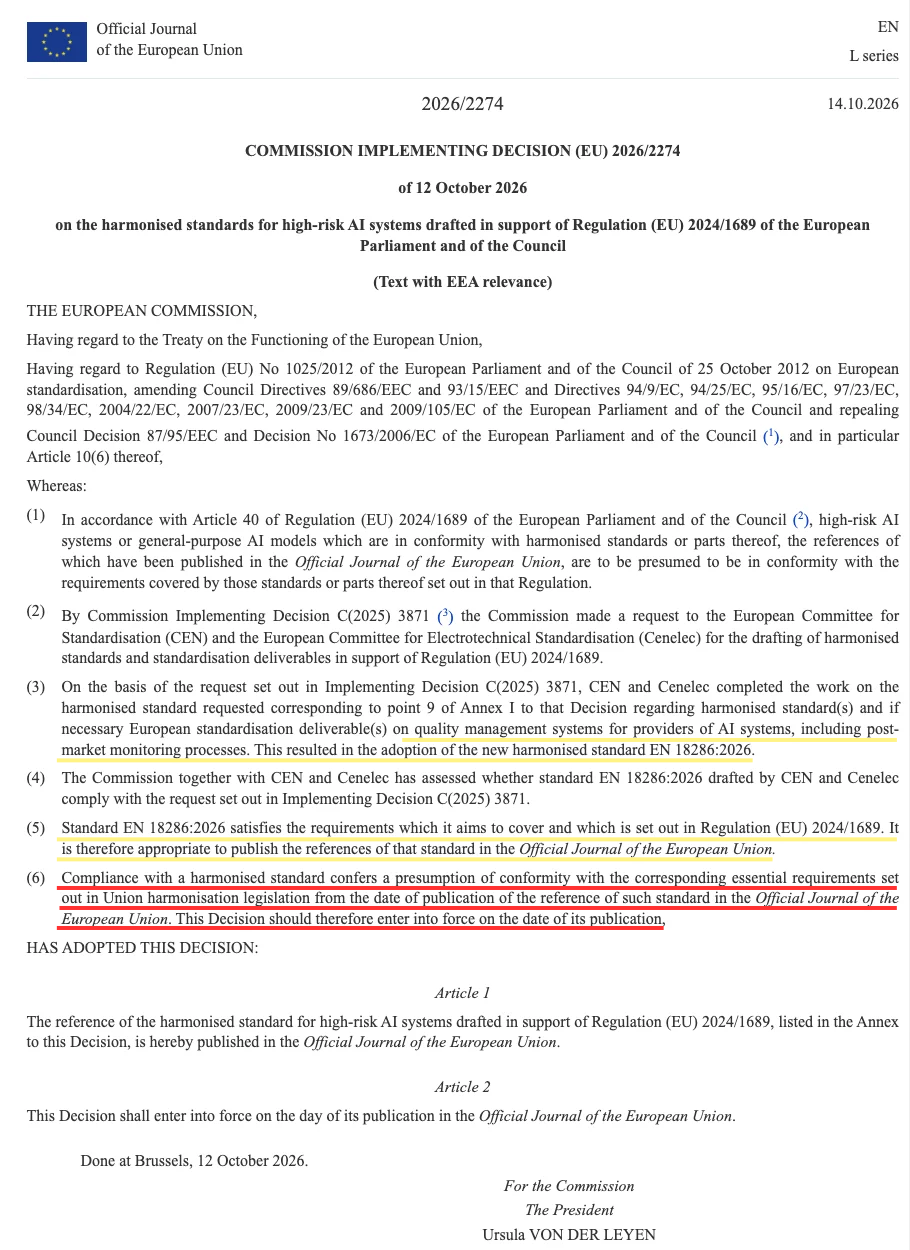
In practice, companies can apply this standard and benefit from a presumption of conformity with the EU AI Act’s quality management system requirements, as established in Article 17(1) points “a” through “m.”
Here’s what the article says:
Article 17: Quality Management System
1. Providers of high-risk AI systems shall put a quality management system in place that ensures compliance with this Regulation. That system shall be documented in a systematic and orderly manner in the form of written policies, procedures and instructions, and shall include at least the following aspects:
(a) a strategy for regulatory compliance, including compliance with conformity assessment procedures and procedures for the management of modifications to the high-risk AI system;
(b) techniques, procedures and systematic actions to be used for the design, design control and design verification of the high-risk AI system;
(c) techniques, procedures and systematic actions to be used for the development, quality control and quality assurance of the high-risk AI system;
(d) examination, test and validation procedures to be carried out before, during and after the development of the high-risk AI system, and the frequency with which they have to be carried out;
(e) technical specifications, including standards, to be applied and, where the relevant harmonised standards are not applied in full or do not cover all of the relevant requirements set out in Section 2, the means to be used to ensure that the high-risk AI system complies with those requirements;
(f) systems and procedures for data management, including data acquisition, data collection, data analysis, data labelling, data storage, data filtration, data mining, data aggregation, data retention and any other operation regarding the data that is performed before and for the purpose of the placing on the market or the putting into service of high-risk AI systems;
(g) the risk management system referred to in Article 9;
(h) the setting-up, implementation and maintenance of a post-market monitoring system, in accordance with Article 72;
(i) procedures related to the reporting of a serious incident in accordance with Article 73;
(j) the handling of communication with national competent authorities, other relevant authorities, including those providing or supporting the access to data, notified bodies, other operators, customers or other interested parties;
(k) systems and procedures for record-keeping of all relevant documentation and information;
(l) resource management, including security-of-supply related measures;
(m) an accountability framework setting out the responsibilities of the management and other staff with regard to all the aspects listed in this paragraph.
As a reminder, this article will come into force on December 2, 2027 for high-risk AI systems under Annex III and on August 2, 2028 for high-risk AI systems under Annex I, according to Article 113(c)
This is the first European standard on AI to be published in the EU Official Journal. Additional standards covering the following areas are also expected to be published:
- risk management
- governance and quality of datasets
- record keeping
- transparency
- human oversight
- accuracy
- robustness
- cybersecurity
- quality management
- conformity assessment
This is great news for everyone. The EU AI Act's standards are voluntary, but they will help increase legal certainty, foster innovation, standardize legal requirements, and accelerate compliance.
However, the challenges in AI are only beginning, and every company developing or deploying AI should focus on strengthening its AI governance and safety practices.
I will keep you posted.