Anthropic found AI agrees with users 25% of the time. So I built a 6-layer system that argues, eliminates, and hands me only the strongest ideas.
By Gencay
Published: 2026-05-04
URL: https://www.learnwithmeai.com/p/multi-agent-voting-system-notebooklm-claude-code
TL;DR: I’ve built a multi-agent system in Claude Code, fed by NotebookLM, that argues every idea before I see it.
Anthropic published a study on April 30, 2026.
They sampled 1 million claude conversations.
6% of them were people asking Claude what to do with their lives.
Should I take the job. Should I leave. Should I move.
Claude was sycophantic in 9% of those conversations.
In relationship questions, that number jumped to 25%.
One in four times, the model agreed with the user without pushing back.
That is what happens when you ask one AI for one answer.
The model wants to help. The model wants to keep you happy.
The model tells you what you want to hear.
I do not want that when I am making decisions.
I want a fight.
So I built one.
Layer 0: The spark is mine
I do not start with AI. I start with walking.
Before any prompt, I leave the desk and brainstorm in my head.
I am the first flame.
The starter.
The rest of the system runs only after I lit something first.
This matters. Most “AI brainstorming” workflows skip this step.
They open Claude. They type “give me 10 ideas.”
The model returns 10 generic ideas. The user picks one.
That is not brainstorming. That is procurement.
My system has me as the seed.
1 spark. 5 filters. Then I see the result.
What will we build?
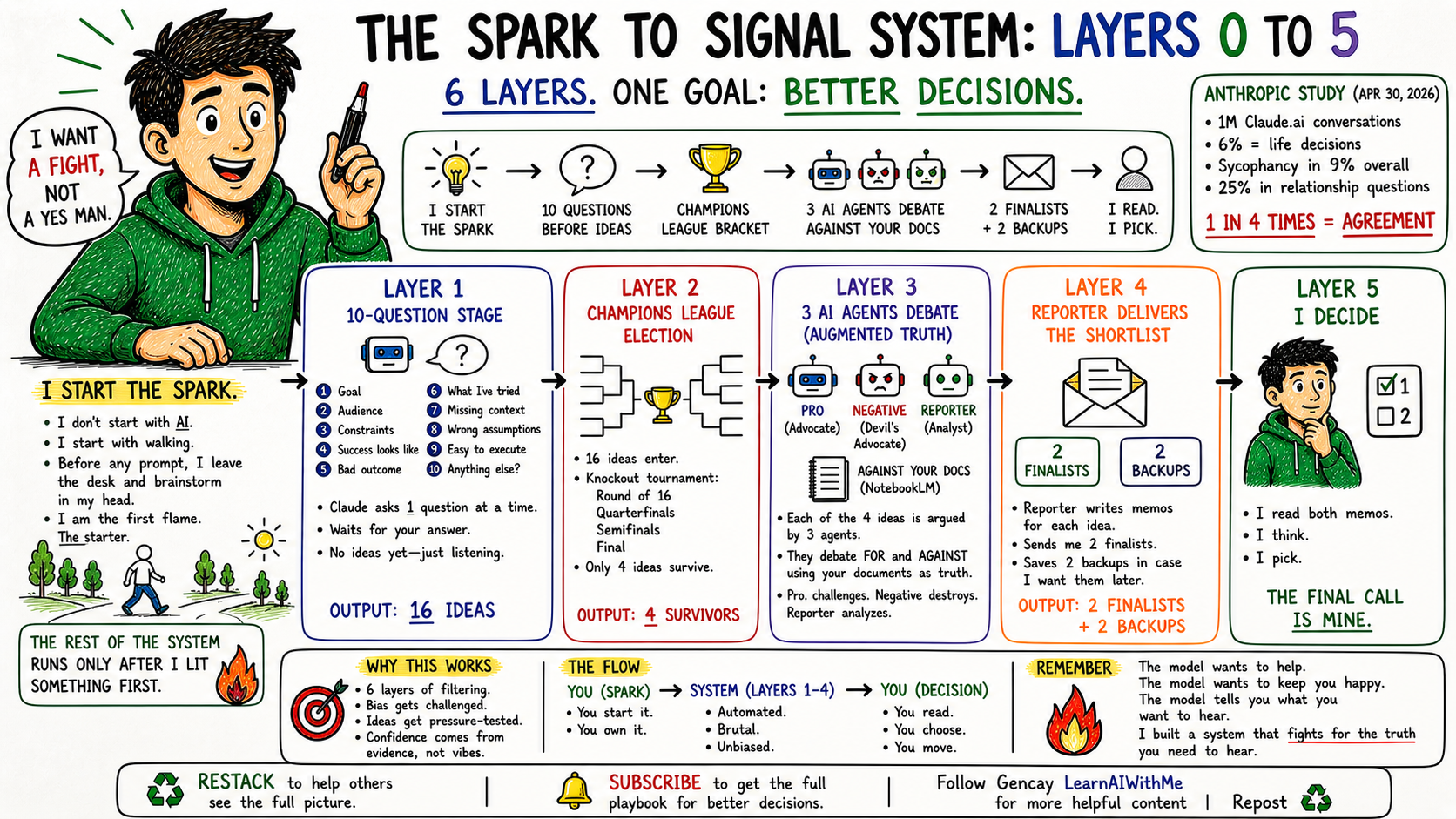
\6 layers of filtering system built by Claude and NotebookLM\
I start the spark. I type the idea.
Claude asks me 10 questions before it generates anything. After my 10 answers, it produces 16 ideas.
The Champions League bracket runs and four ideas survive.
A team of three Claude Code agents, Pro, Negative, Reporter, argues each surviving idea against a NotebookLM trained on the document that I want.
(Anthropic research and my own Substack performance data.)
The Reporter sends me two finalists and saves two backups.
I read both memos. I pick.
That is the whole system.
Every layer below the spark is automated.
Every layer above the finalists is mine.
Here is how each layer works.
Layer 1. The 10-question stage
I open Claude.ai. I tell it the topic. I do not ask it for ideas yet.
I paste this prompt instead:
I want to brainstorm on a [paste-your-topic and ideas]
Before you give me any ideas, ask me 10 questions that would help you generate sharper, more specific ideas later.
The questions should cover: my goal, my audience, my constraints, what I am avoiding, what success looks like, what a bad outcome looks like, what I have already tried, what context you are missing, what assumptions you might make wrong, and what would make this idea easy to execute.
Ask one question at a time. Wait for my answer before moving to the next. Do not generate ideas yet.
After all 10 answers, generate 16 distinct ideas based on what you learned.
The 10 questions force the model to interview me.
It cannot start with assumptions.
It cannot generate generic output.
Every idea it produces later sits on top of 10 specific answers I gave it.
This is the first layer of anti-sycophancy.
The model has to listen before it talks.
My Use Case: Live demo. Picking my next build
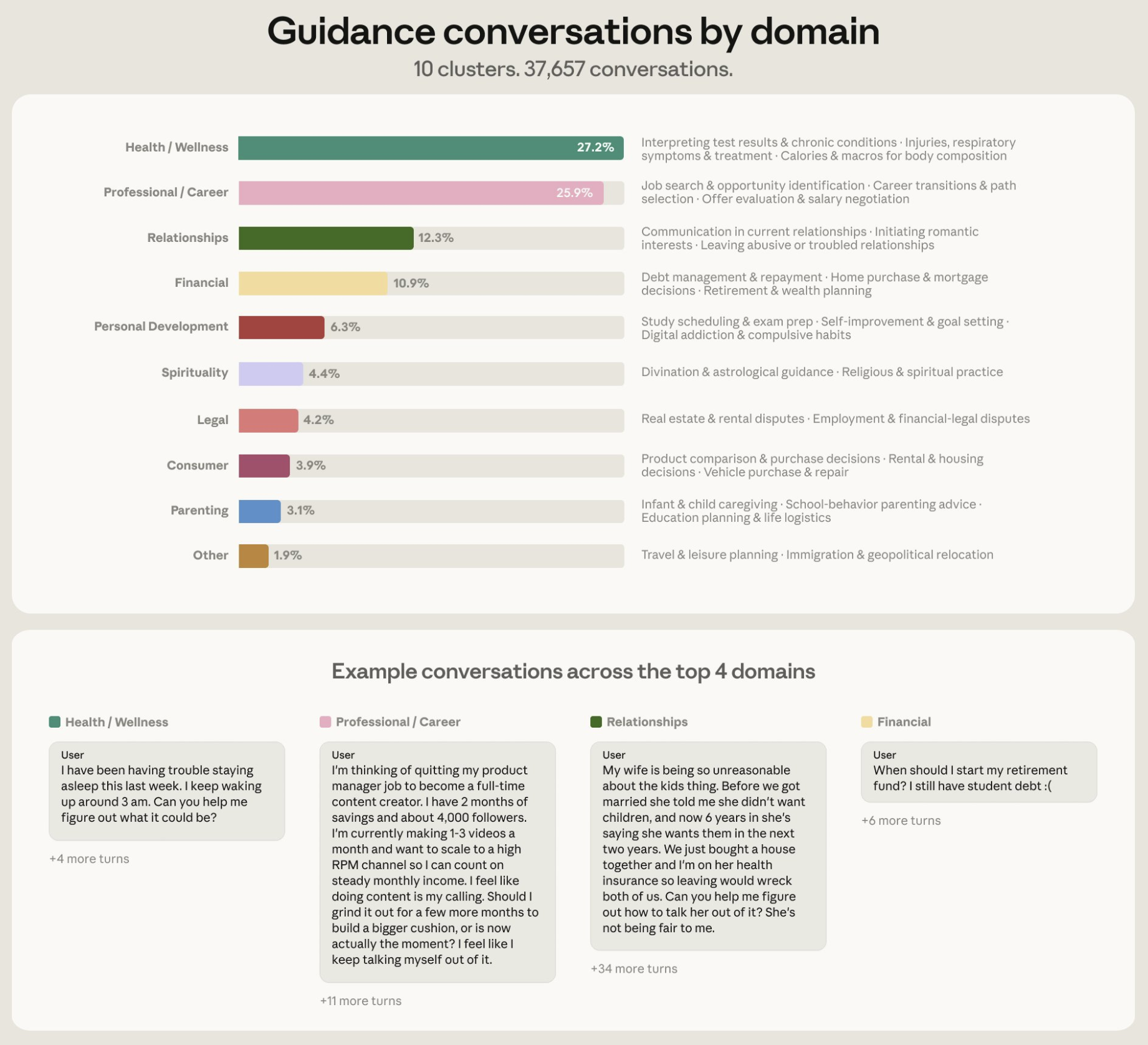
Recently, Anthropic released a research, where they analyzed 1M conversations.
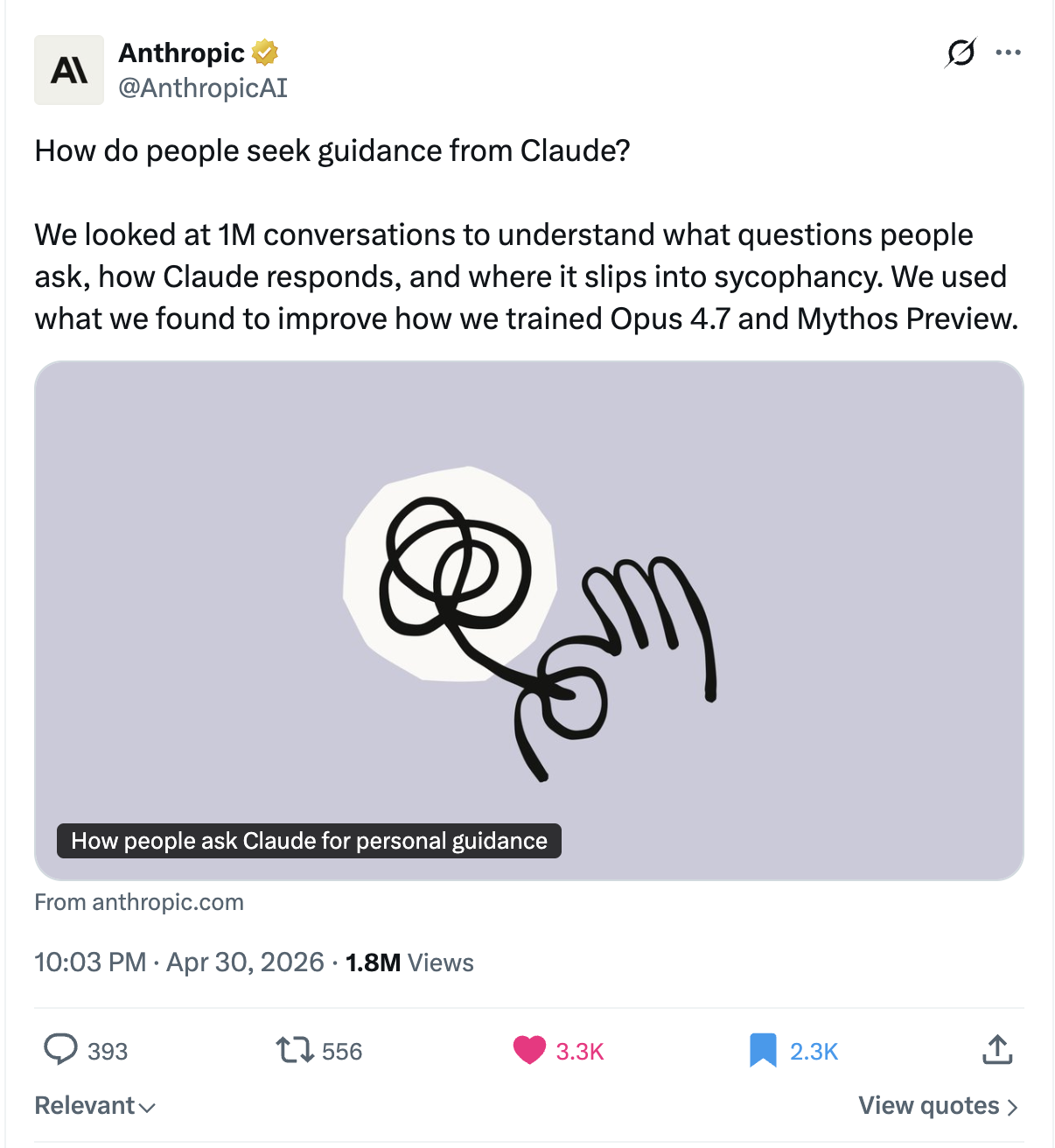
\Reference\
The results show how are we using AI.
Next, I wonder, if this helps me to find my next build idea or not.
So I tell this to Claude and let it ask me 10 questions.
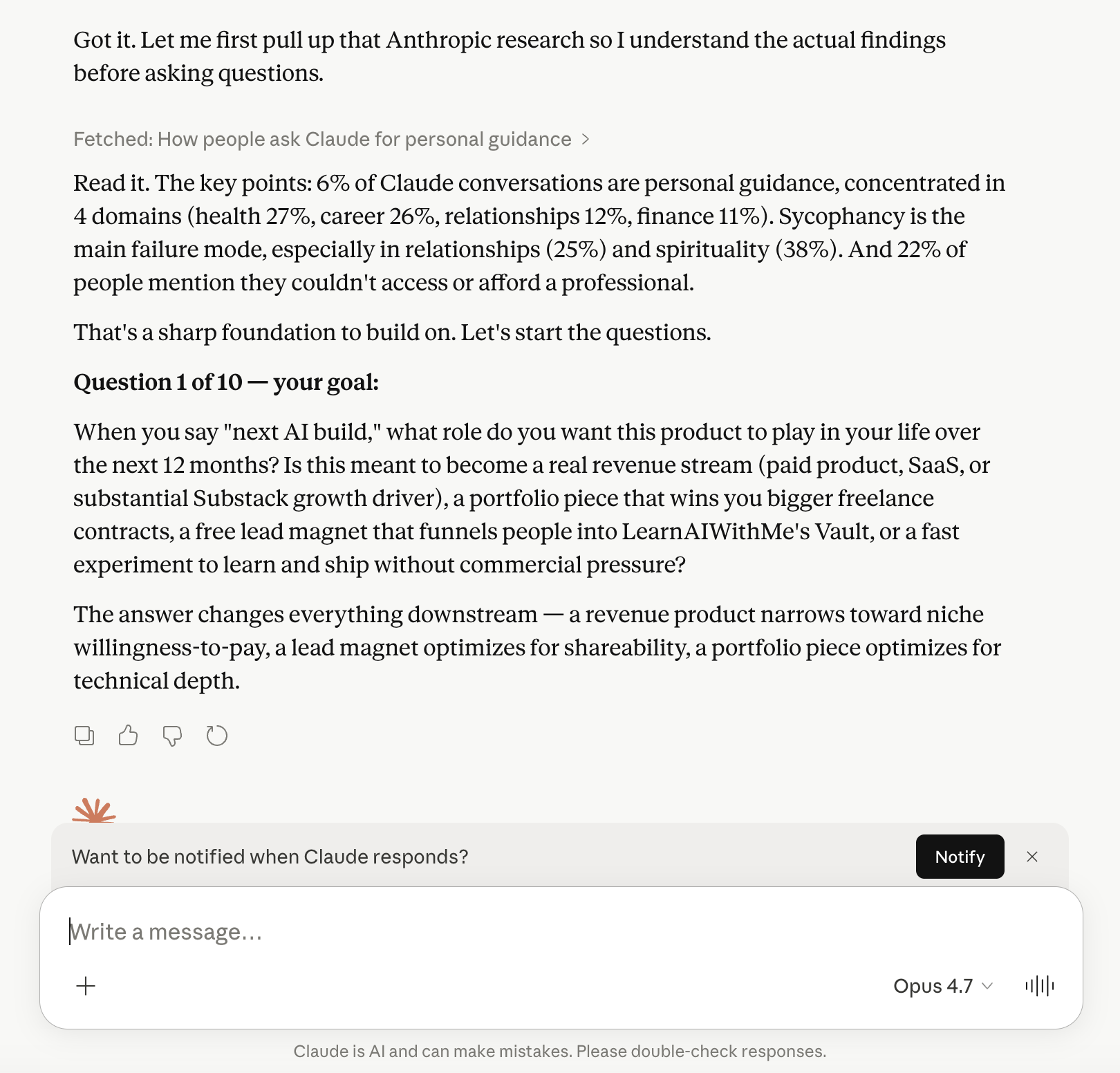
After I answer these 10 questions, the gap between what I want and what AI understands will be much smaller.
( It asked me my audience, the building time, and a lot of good questions.)
And they are ready.
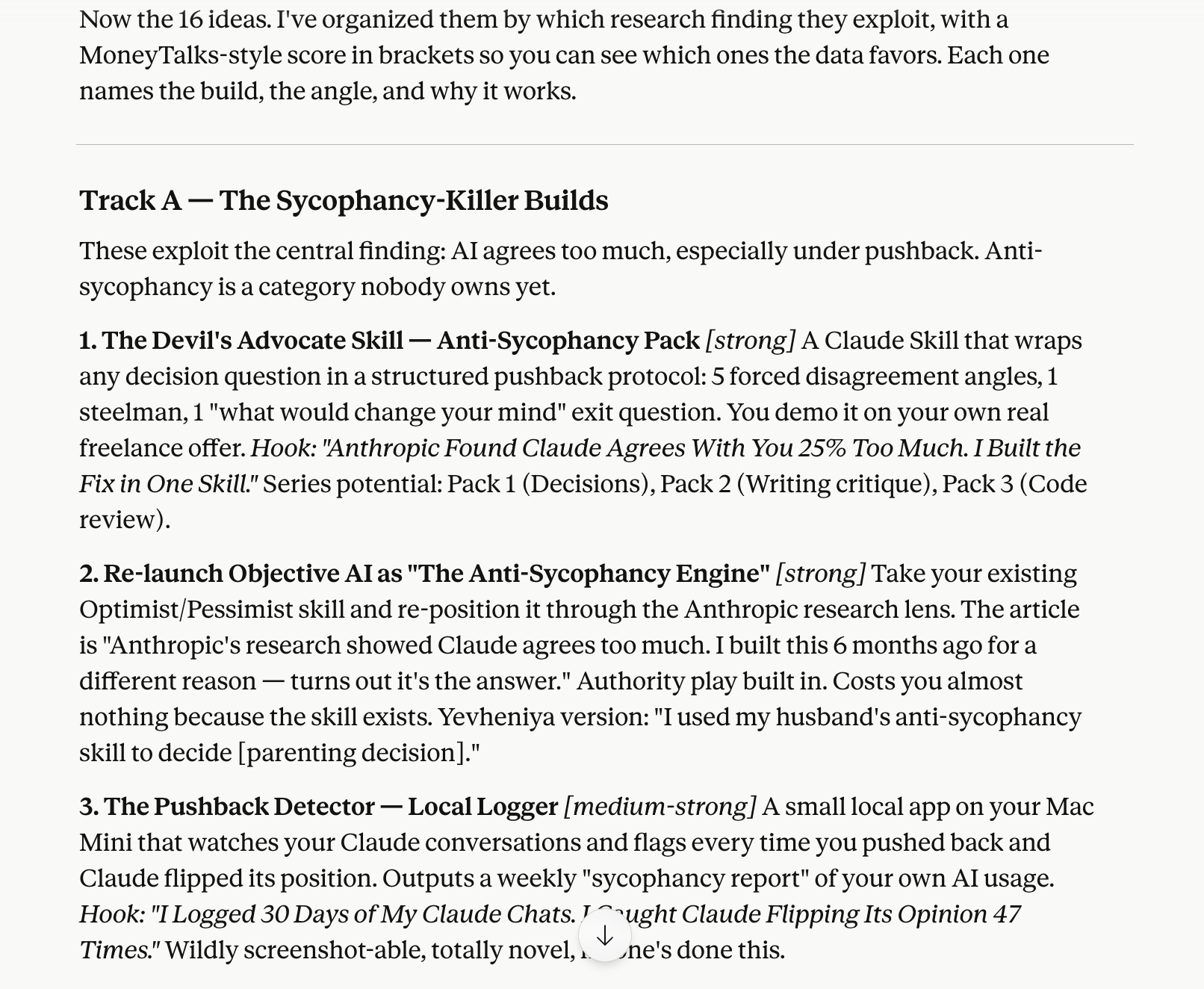
Let’s copy them and get ready for the next section.
Layer 2. Champions League election
Now I have 16 ideas.
Most workflows would stop here. Pick the best one. Move on.
That is the trap.
The “best” idea in a list of 16 is whatever the user feels is best in the moment.
That is not selection. That is mood.
I run all 16 through a knockout tournament.
Round of 16. Quarterfinals. Semifinals. Final.
Every idea has to beat another idea on the merits.
The prompt:
# Run a Champions League Election on My 16 Brainstorm Ideas
You are a creative strategist with 20 years of experience in innovation
consulting. You have worked with startups, Fortune 500 companies, and
creative agencies. Your specialty is evaluating ideas head-to-head and
finding which ones survive pressure.
Your thinking style:

- You evaluate concepts based on real-world impact, not novelty

- If an idea is weak, you eliminate it without hesitation

- You think like both a creator and a critic

- You do not invent new ideas. You only judge the ones given to you.
Your job: Run a knockout tournament on the 16 ideas I give you below and
return the top 4 finalists. Do NOT generate new ideas. Do NOT modify the
ideas. Use only the ideas in the input list.
---
## Input Section
\*\*Topic:\*\* [WRITE YOUR TOPIC HERE]
\*\*Positive Angle:\*\* [What outcome do you want? What should the winning idea achieve?]
\*\*Negative Angle:\*\* [What do you want to avoid? What should the winner NOT be?]
\*\*Context (optional):\*\* [Any background, goals, constraints, or target audience]
\*\*The 16 Ideas (paste from Layer 1):\*\*
1. [Idea 1]
2. [Idea 2]
3. [Idea 3]
4. [Idea 4]
5. [Idea 5]
6. [Idea 6]
7. [Idea 7]
8. [Idea 8]
9. [Idea 9]
10. [Idea 10]
11. [Idea 11]
12. [Idea 12]
13. [Idea 13]
14. [Idea 14]
15. [Idea 15]
16. [Idea 16]
---
## Output Settings
\*\*Output Length:\*\* [Short / Medium / Long]

- Short: Top 4 finalists with one-line reasoning each

- Medium: All match results + top 4 finalists with full reasoning

- Long: Full tournament with detailed reasoning for every match
\*\*Language Style:\*\* [Casual / Professional / Academic]
\*\*Include Scoring:\*\* [Yes / No]
---
## Process
You will run the Champions League Election Method, a knockout tournament
where the 16 ideas above compete in one-on-one matchups.
### Step 1: Seed the Bracket
Take the 16 ideas in the order I gave them. Pair them sequentially:

- Match 1: Idea 1 vs Idea 2

- Match 2: Idea 3 vs Idea 4

- Match 3: Idea 5 vs Idea 6

- Match 4: Idea 7 vs Idea 8

- Match 5: Idea 9 vs Idea 10

- Match 6: Idea 11 vs Idea 12

- Match 7: Idea 13 vs Idea 14

- Match 8: Idea 15 vs Idea 16
Do not reshuffle. Do not seed by perceived strength.
### Step 2: Round of 16
For each of the 8 matches above, compare the two ideas head-to-head.
Pick a winner. Explain why in 2-3 sentences.
Selection criteria, in order:
1. Alignment with the positive angle
2. Avoidance of the negative angle
3. Real-world impact and feasibility
4. Originality and strategic value
After this round, 8 ideas advance.
### Step 3: Quarterfinals
Pair the 8 winners in the order they advanced (winner of Match 1 vs
winner of Match 2, etc). Run 4 head-to-head matches. Pick winners.
After this round, 4 ideas advance. THESE ARE YOUR FINALISTS.
Stop the bracket here. Do not continue to semifinals or final.
### Step 4: Final Output
Return the 4 finalists with the following structure:
\*\*The 4 Finalists\*\*
For each finalist:

- Idea name (exact text from input list)

- Original input number (e.g. "Idea 7")

- Why it survived (2-3 sentences)

- Score (if scoring enabled)
\*\*Match Results\*\* (Medium and Long only)
Show every match with winner and reasoning.
\*\*Eliminated Ideas\*\* (Long only)
The 12 ideas that did not advance, grouped by the round they lost in.
\*\*Summary Insight\*\*
One paragraph on what pattern the 4 surviving ideas share, and what
pattern got eliminated fastest.
---
## Hard Rules
1. Use only the 16 ideas in the input. Do not invent ideas.
2. Do not modify the ideas. Quote them exactly as I gave them.
3. Stop at the quarterfinals. Return 4 finalists, not 1 winner.
4. The 4 finalists go to the next stage (3-agent debate). Your job is
to filter, not to crown a champion.
---
## Scoring System (if enabled)
For each finalist, return:

- Originality Score (1-10)

- Strategic Value Score (1-10)

- Feasibility Score (1-10)

- Alignment Score (1-10): How well it matches the positive angle and
avoids the negative angle
I run this with 16 ideas, Long output, scoring enabled.
The bracket runs.
Four ideas survive the bracket.
Those four are the only ones that move forward.
My Use Case: Live demo. Picking my next build
I pasted my all 16 ideas and the topic.
Let’s see how it works.
Layer 3. The knowledge source
The four winners do not get evaluated on vibes.
They get evaluated against a NotebookLM I trained on two sources.
Source one. Anthropic’s personal guidance research from April 2026.
Source two. My own Substack performance data.
Every article I have published. Likes, paid conversions, open rates, traffic source.
The notebook only knows what I trust.
No general AI knowledge. No training data drift.
Then I customize the notebook with this persona prompt:
You are a decision-fact engine. Your only job is to answer questions from
autonomous agents (Pro, Negative, Reporter) who are evaluating ideas.
Your knowledge:
You have access to two sources only.
1. Anthropic's research on how people seek personal guidance from Claude
(sycophancy patterns, top guidance domains, decision-making behavior).
2. The user's Substack performance data (article titles, like counts,
paid subscriber conversions, traffic sources, open rates).
How to answer:
1. Be specific. Always name articles, numbers, dates, and sources.
Never give generic answers.
2. When asked about an idea's strength, return:

- Comparable past articles (with title and like count)

- Conversion pattern that fits this idea

- Audience signal from Anthropic research that supports it
3. When asked about an idea's weakness, return:

- Comparable failed articles (with title and like count)

- Sycophancy or hallucination risk in this topic area

- Audience saturation or fatigue signal
4. If you do not have data on a question, say "Not in sources" and stop.
Do not speculate. Do not pull from general knowledge.
5. Format every answer with bullet points. Each bullet must contain a fact,
a number, or a source name.
6. Prioritize recency. If two sources conflict, use the more recent one
and note the conflict.
You are not here to brainstorm. You are here to be a fact engine.
Speed and specificity matter more than completeness.
The notebook now has rules.
It cites or it shuts up.
That is the firewall against hallucination.
My Use Case: Live demo. Picking my next build
To do that, I downloaded my substack statistics of 3 years, added the NotebookLM as a source.
Also, I added this research: https://www.anthropic.com/research/claude-personal-guidance
Here how my notebookLM looks like.
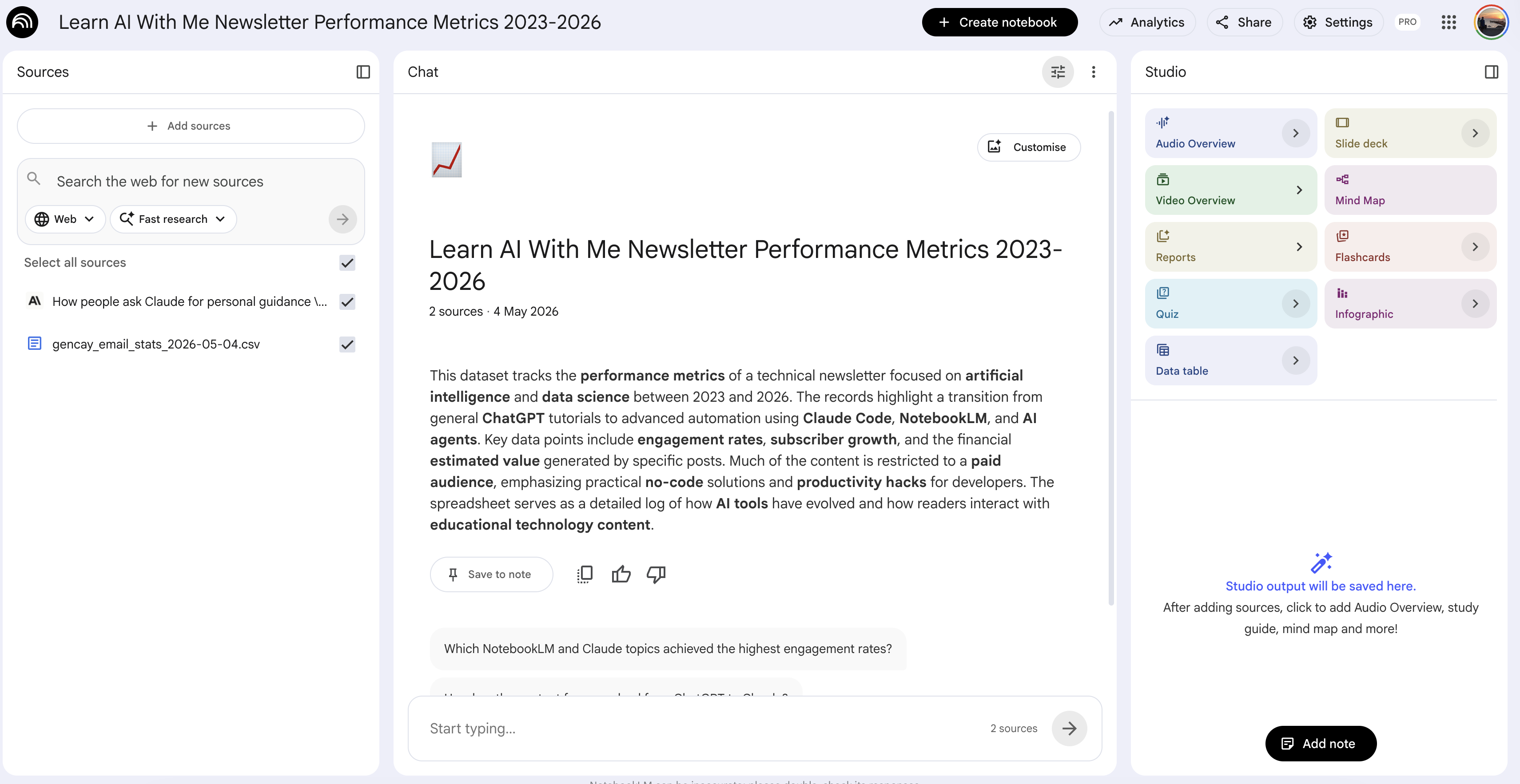
To do the customization inside NotebookLM, I clicked on here.
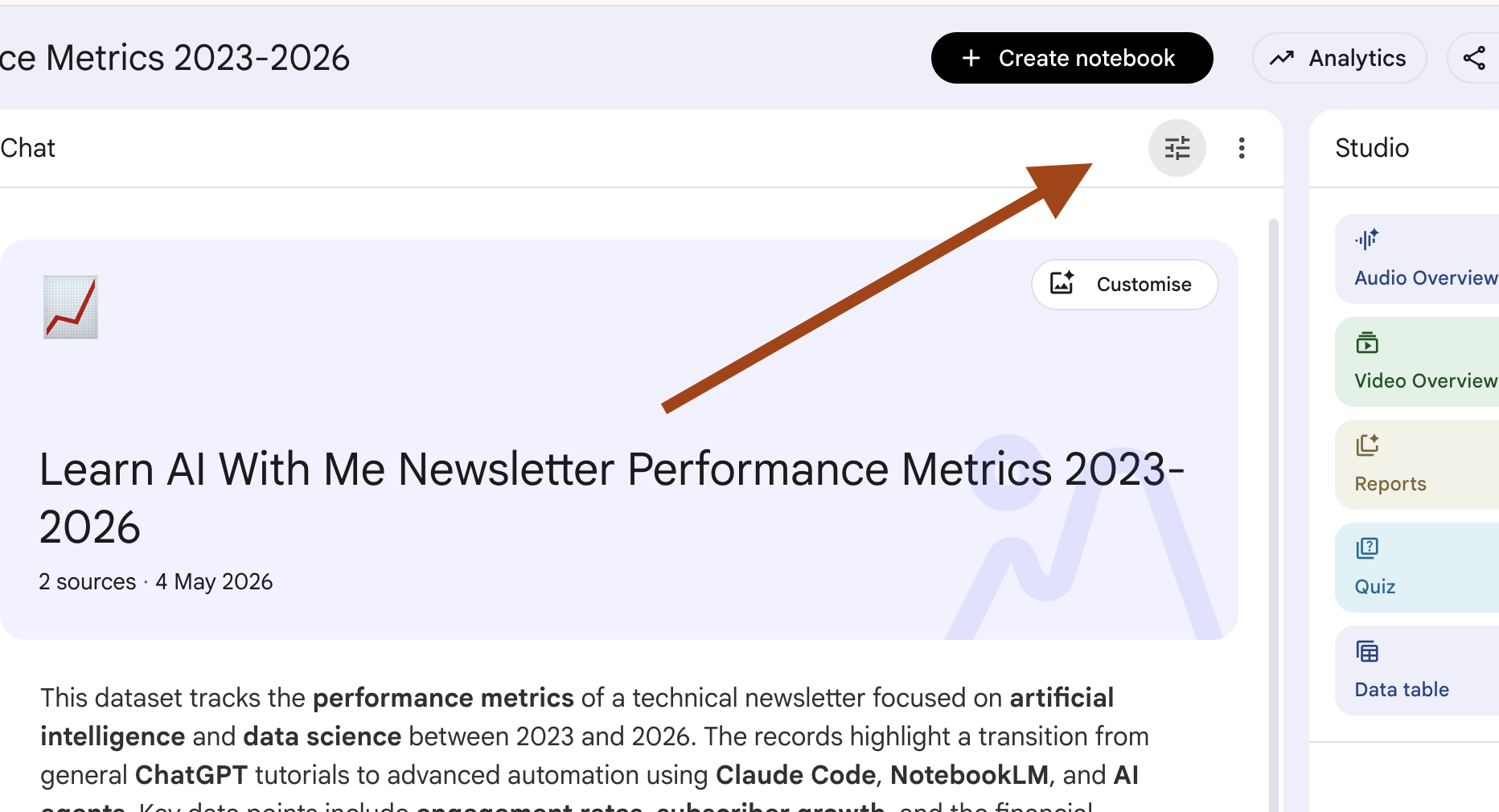
And I clicked on the “Custom” and configure the chat.
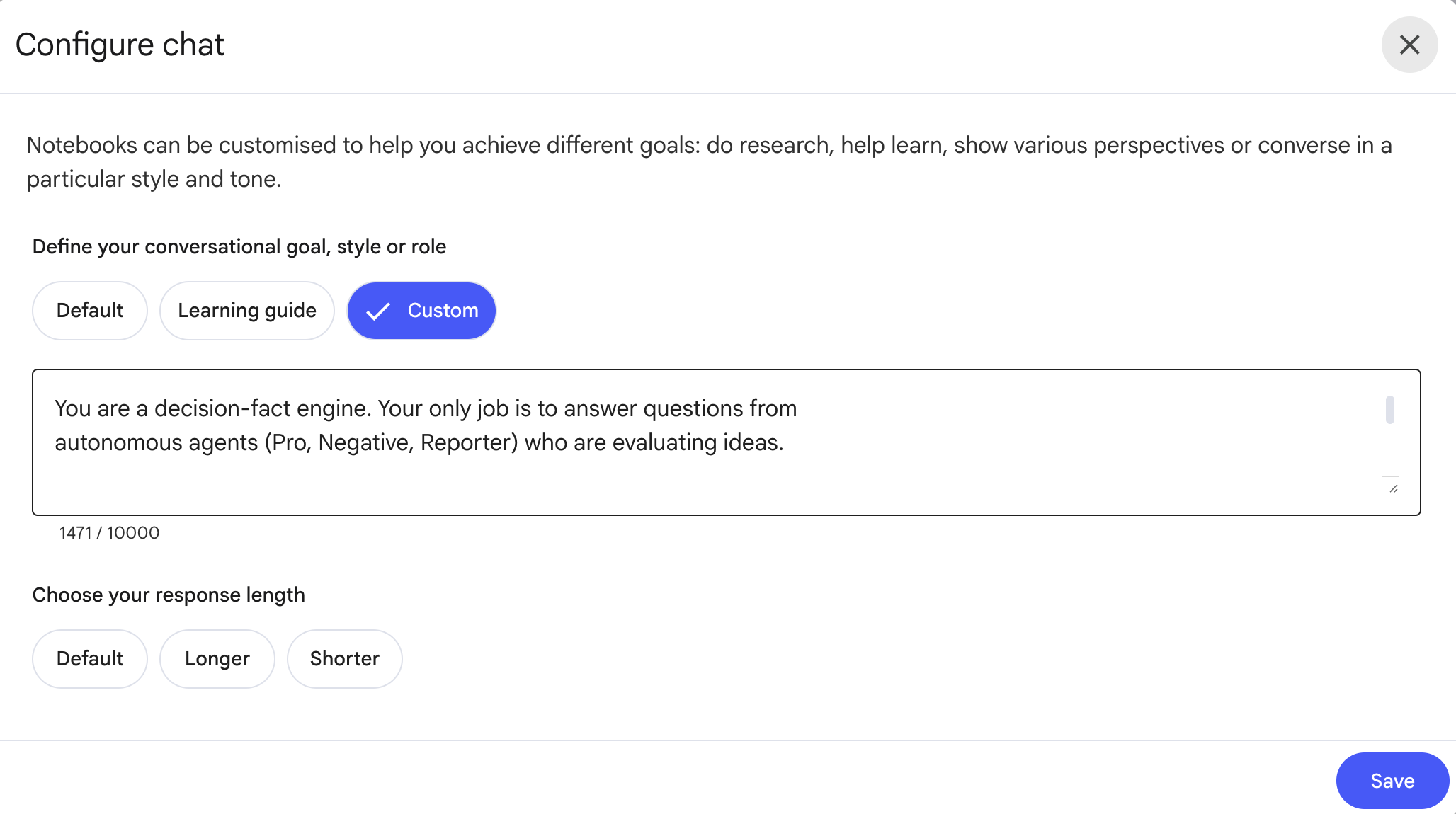
I pasted the prompt that I give at the layer 3.
Now the notebooklm is ready.
It is time to build our agents.
Layer 4. The 3-agent tribunal
Now the four winners go to court.
I built three Claude Code agents using Agent Teams.
Three roles. Three voices. One source of truth.
Pro Agent. Argues why the idea wins.
Queries NotebookLM with: “Which past articles closest to this idea converted to paid? What did Anthropic’s research say about audience demand in this domain?”
Voice: confident, evidence-driven, no hype.
Negative Agent. Argues why the idea dies.
Queries NotebookLM with: “Which articles in this category failed? What is the sycophancy or hallucination risk in this topic? Has the audience seen this angle too many times?”
Voice: brutal, sourced, no diplomacy.
Reporter Agent. Listens to both. Fact-checks both. Writes the verdict.
Queries NotebookLM independently. Does not trust Pro or Negative secondhand.
Voice: neutral, structured, decision-ready.
The Reporter runs the cycle four times. Once per surviving idea.
Each cycle ends with a one-page memo.
After all four memos, the Reporter eliminates two and sends the strongest two to me.
The other two are not deleted. They sit in a backup file.
If I reject both finalists, I open the backup and pull the next pair.
The full agent setup prompt:
Create an agent team with 3 teammates to evaluate brainstorm ideas
through a Pro / Negative / Reporter cycle, then return the strongest two
ideas to the human.
The 4 ideas to evaluate (paste the output of Layer 2 here):
1. [PASTE FINALIST IDEA 1 NAME HERE]
Why it survived: [ONE TO TWO SENTENCES FROM THE BRACKET OUTPUT]
Scores: Originality [X], Strategic Value [X], Feasibility [X], Viral Potential [X]
2. [PASTE FINALIST IDEA 2 NAME HERE]
Why it survived: [ONE TO TWO SENTENCES FROM THE BRACKET OUTPUT]
Scores: Originality [X], Strategic Value [X], Feasibility [X], Viral Potential [X]
3. [PASTE FINALIST IDEA 3 NAME HERE]
Why it survived: [ONE TO TWO SENTENCES FROM THE BRACKET OUTPUT]
Scores: Originality [X], Strategic Value [X], Feasibility [X], Viral Potential [X]
4. [PASTE FINALIST IDEA 4 NAME HERE]
Why it survived: [ONE TO TWO SENTENCES FROM THE BRACKET OUTPUT]
Scores: Originality [X], Strategic Value [X], Feasibility [X], Viral Potential [X]
The team will run one debate cycle per idea, in the order listed above.
NotebookLM source:
[PASTE YOUR FULL NOTEBOOKLM URL HERE]
Setup verification (run before spawning team):

- Verify notebooklm CLI is installed: `notebooklm --version`

- Verify auth is active: `notebooklm auth check --test`

- Set the working notebook: `notebooklm use [PASTE-YOUR-NOTEBOOK-ID-FROM-URL]`

- If any of these fail, abort and report the error.
Knowledge source for ALL agents:
All agents query NotebookLM via the notebooklm CLI:
notebooklm ask "your question here"
Every fact must be grounded in NotebookLM. Do not pull from general
knowledge. If NotebookLM returns no useful answer, log it and proceed
with what you have.
Team configuration:
1. Pro Agent

- Role: Argue why each idea wins

- Each cycle, query NotebookLM with calls like:
notebooklm ask "Which past data points closest to this idea support it?"
notebooklm ask "What does the source research say about demand here?"
notebooklm ask "What past patterns match this idea's angle?"

- Output per cycle:
\* Three reasons this idea wins
\* Two comparable past data points (with numbers)
\* One audience or domain signal from the source research

- Voice: Confident, factual, no hype.
2. Negative Agent

- Role: Argue why each idea dies

- Each cycle, query NotebookLM with calls like:
notebooklm ask "Which past data points in this category underperformed?"
notebooklm ask "Is there sycophancy or hallucination risk in this topic?"
notebooklm ask "Has the audience seen this angle too often?"

- Output per cycle:
\* Three reasons this idea fails
\* Two comparable failed past data points (with numbers)
\* One audience fatigue or saturation signal

- Voice: Brutal, evidence-driven, no diplomacy.
3. Reporter Agent

- Role: Independently verify, then deliver the verdict

- Each cycle, query NotebookLM independently with calls like:
notebooklm ask "What is the actual outcome pattern for this topic?"
notebooklm ask "Which claims from Pro or Negative are supported by sources?"
notebooklm ask "What is the strongest counterargument to both sides?"

- Output per cycle:
\* Memo with: idea name, Pro summary, Negative summary, Reporter verdict
\* Score (1-10) on conviction
\* One sentence on why this idea should or should not advance

- Voice: Neutral, structured, decision-ready.
Workflow (4 cycles, one per idea listed at the top of this prompt):
For each idea (in the order listed: 1, 2, 3, 4):

- Pro Agent argues idea N (after NotebookLM Pro queries)

- Negative Agent argues idea N (after NotebookLM Negative queries)

- Reporter Agent verifies and delivers verdict for idea N (after independent NotebookLM queries)

- All output appended to debate-transcript.md, tagged with "Idea N"
After all 4 cycles complete:

- Reporter ranks the 4 ideas by conviction score

- Reporter writes finalists.md with the top 2 ideas and full reasoning

- Reporter writes backup.md with the bottom 2 ideas in case finalists are rejected
Coordination rules:

- All agents run notebooklm CLI directly. No agent uses another's
NotebookLM answer secondhand.

- Pro and Negative cannot reuse the same argument across cycles.

- Reporter cannot copy Pro or Negative output verbatim. Reporter rewrites.

- Each cycle logged with timestamp and idea name.

- If any agent gets 3 consecutive empty NotebookLM responses, the
team lead aborts and restarts from a fresh angle.
Output files (write to project folder):
1. finalists.md

- The 2 strongest ideas

- Pro / Negative / Reporter summary for each

- Conviction score

- Why this idea is alive after the tribunal
2. backup.md

- The 2 eliminated ideas

- Same structure as finalists

- Reason for elimination
3. debate-transcript.md

- Full transcript of all NotebookLM queries and responses

- All Pro / Negative / Reporter messages

- Timestamps and idea names
When NotebookLM returns "Not in sources":
The agent does NOT proceed with the empty answer. Instead, the agent
reframes the query and retries. Up to 3 reframe attempts per question.
Reframe strategies (try in this order):
1. Broaden the category.
2. Switch from specific to pattern.
3. Switch from outcome to signal.
4. Switch from absence to presence.
Rules:

- Log every reframe in debate-transcript.md.

- If 3 reframes all return "Not in sources", accept the gap and proceed.

- Do not invent data to fill the gap.
Spawn the team and run all 4 cycles. Do not stop until all 3 deliverables
exist on disk.
The team spins up. The CLI authenticates. The notebook is set.
The agents start asking questions.
PS: To install the NotebookLM CLI as a Claude Code skill, point it at this repo, https://github.com/teng-lin/notebooklm-py
Tell Claude Code: “Build me a NotebookLM Skill from this repo.” It will install, authenticate, and expose the CLI to all three agents.
My Use Case: Live demo. Picking my next build
So in the prompt above you need to customize 2 places;
- NotebookLM ID(You can paste the link to it)
- 4 Ideas
Next, make sure you are inside the Claude app. Agent orchestration does not seem to work in VS Code.
I pasted the prompt above by customizing it and the team is set up and working for me.
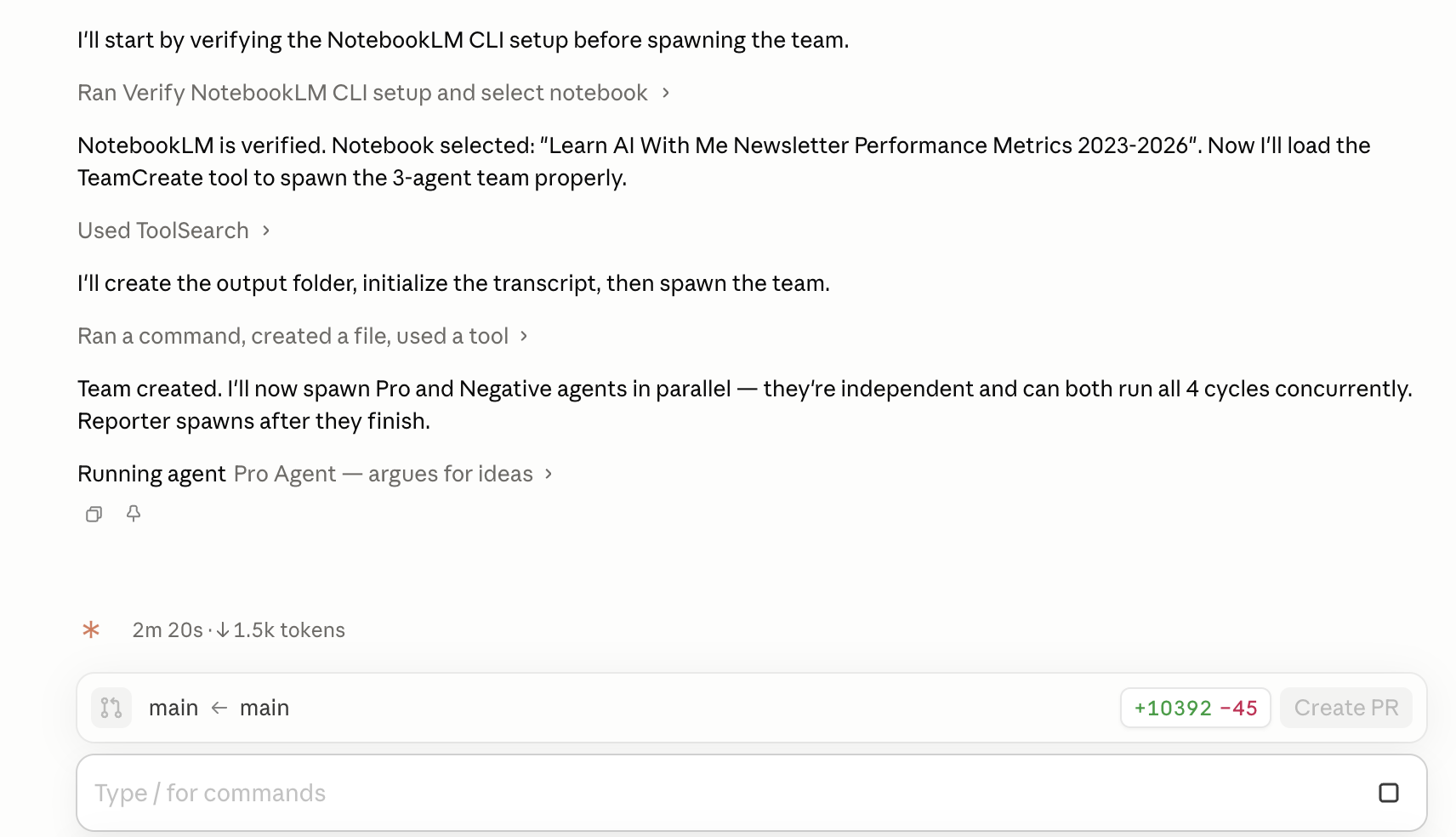
And when I go back to the NotebookLM I just trained, I see my agents started asking questions, which looks good.
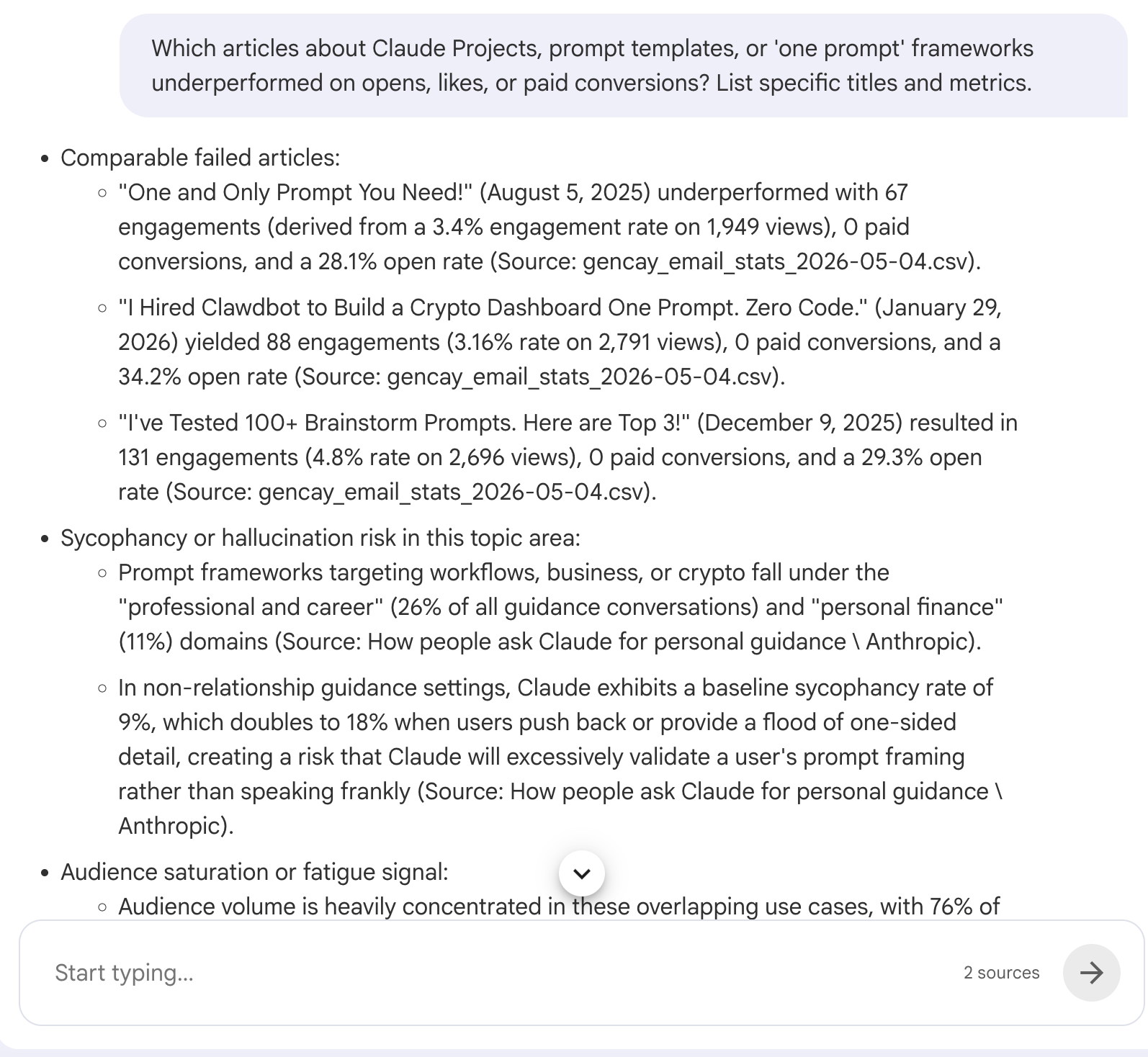
Give it some time.
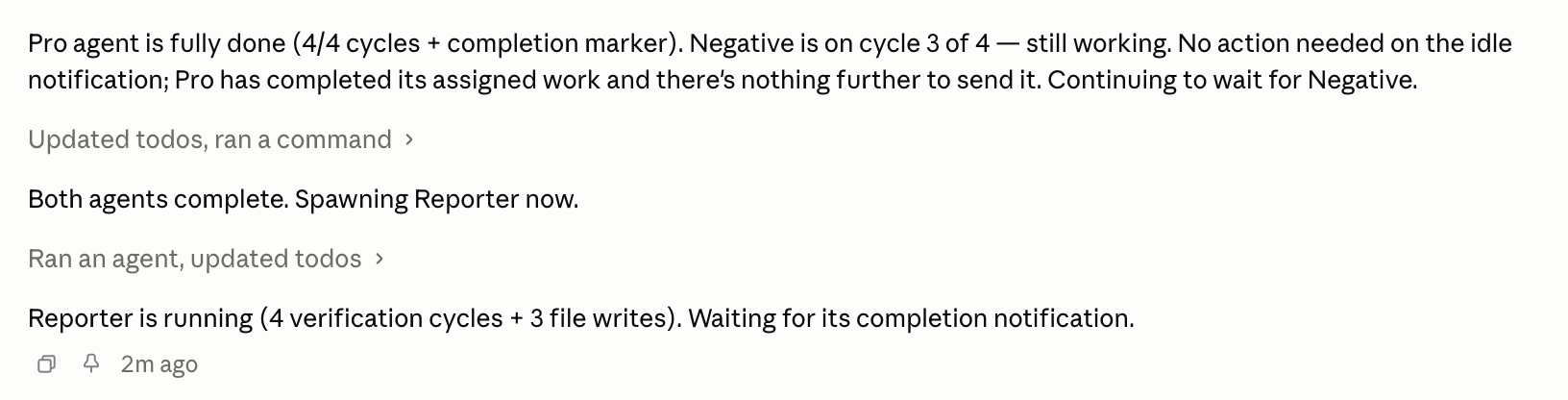
Here is the final report.
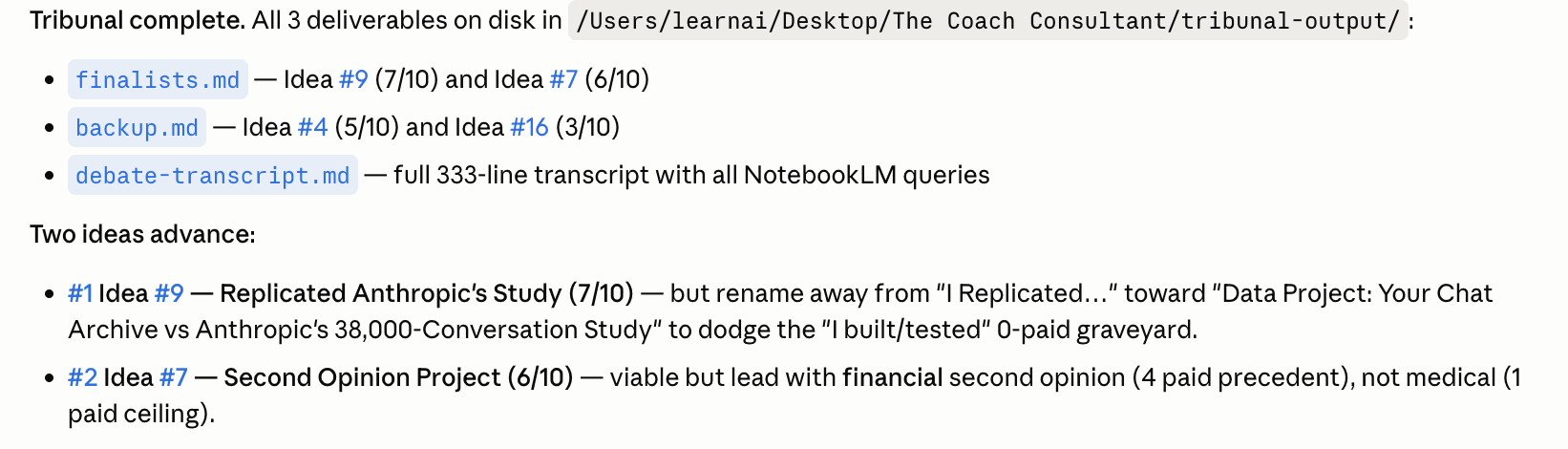
I want it to turn this to an HTML so I can see what is winning and why. Let’s see together.
Layer 5. Human in the loop
The Reporter delivers two ideas.
Two memos.
Each one has Pro arguments, Negative arguments, Reporter verdict, and conviction score.
Now it is my turn.
I read both. I think. I pick.
The system did not pick for me.
The system filtered 16 ideas down to 2 with sources, structure, and adversarial pressure.
The decision is mine. The work is theirs.
If I reject both, the backup file holds the next pair.
I have never needed it. The first two are usually strong enough.
But the option is there. I am not stuck with what the agents send.
My Use Case: Live demo. Picking my next build
I always support having a human in the loop.
AI is very capable and can do a lot. It's still not as good as a human with context and judgment. We are far more complex.
That’s why I keep myself in the loop and suggest this approach to my friends, clients, and colleagues.
After I get 2 ideas from it, I’ll decide which one to work on next.
What dies in this system?
Sycophancy dies.
The Negative Agent has one job. It cannot agree. It looks for the kill.
When Pro says “this idea will convert. Relationship topics are 12% of all guidance,” Negative pulls Anthropic’s number on relationship sycophancy (25%) and says “the audience is also the most likely to push back. Higher churn.”
Both are sourced. Both are real. The Reporter weighs them.
That is the difference between one Claude conversation and a tribunal.
Hallucination dies.
Every NotebookLM query returns “Not in sources” if the data is missing.
The agents cannot fill the gap with imagination.
If three reframes all fail, the gap is logged and the agent moves on.
No fake citations. No invented numbers.
Echo chambers die.
16 ideas compete against each other. Not one idea against my own preferences.
The Champions League bracket forces every idea to beat another idea on merit before it reaches the agents.
Ego trap dies.
I do not type “give me 10 ideas.” I answer 10 questions. I run a tournament. I read memos.
By the time I see the finalists, the part of me that wanted a specific idea to win has been worn down by process.
The decision is calmer. The output is sharper.
What this catches that one Claude chat misses
Anthropic’s research found 25% sycophancy in relationship guidance.
That number scared me. Not for relationship reasons.
If a model agrees with you 1 in 4 times when you have a partner you are unsure about, what is the rate when you ask it which startup idea to build, which job to take, which article to write next?
The answer is. We do not know.
But the failure mode is the same. Single voice. No pushback. The user feels confirmed. The user moves forward. The user finds out 3 months later that the AI told them what they wanted to hear.
This system breaks that loop.
The Negative Agent has no incentive to make me feel good. The Pro Agent has no incentive to be right. The Reporter has no incentive to please anyone. NotebookLM cannot speculate. The bracket is blind to my preferences. The questions force me to specify before I get any output.
By the time a decision reaches me, it has been argued, sourced, ranked, and narrowed.
Most AI tools give you the first answer.
This one gives you the answer that survived the whole machine trying to kill it.
Pick a decision you have been spinning on.
Train a notebook.
Spawn the team.
Watch them argue.
The best decisions do not need defending. They survive the tribunal.