3 prompts to predict the future.
By Gencay
Published: 2025-10-07
URL: https://www.learnwithmeai.com/p/back-to-the-future-with-prompting

Most people ask ChatGPT about today. I ask about tomorrow.
Here’s why that matters: today is known; the future is not. The questions you ask about what’s already happened keep you reactive. The questions you ask about what’s coming make you strategic.
But ChatGPT can’t predict the future, and that’s not the point. What it can do is model patterns, surface weak signals, and stress-test your decisions against scenarios you haven’t considered yet.
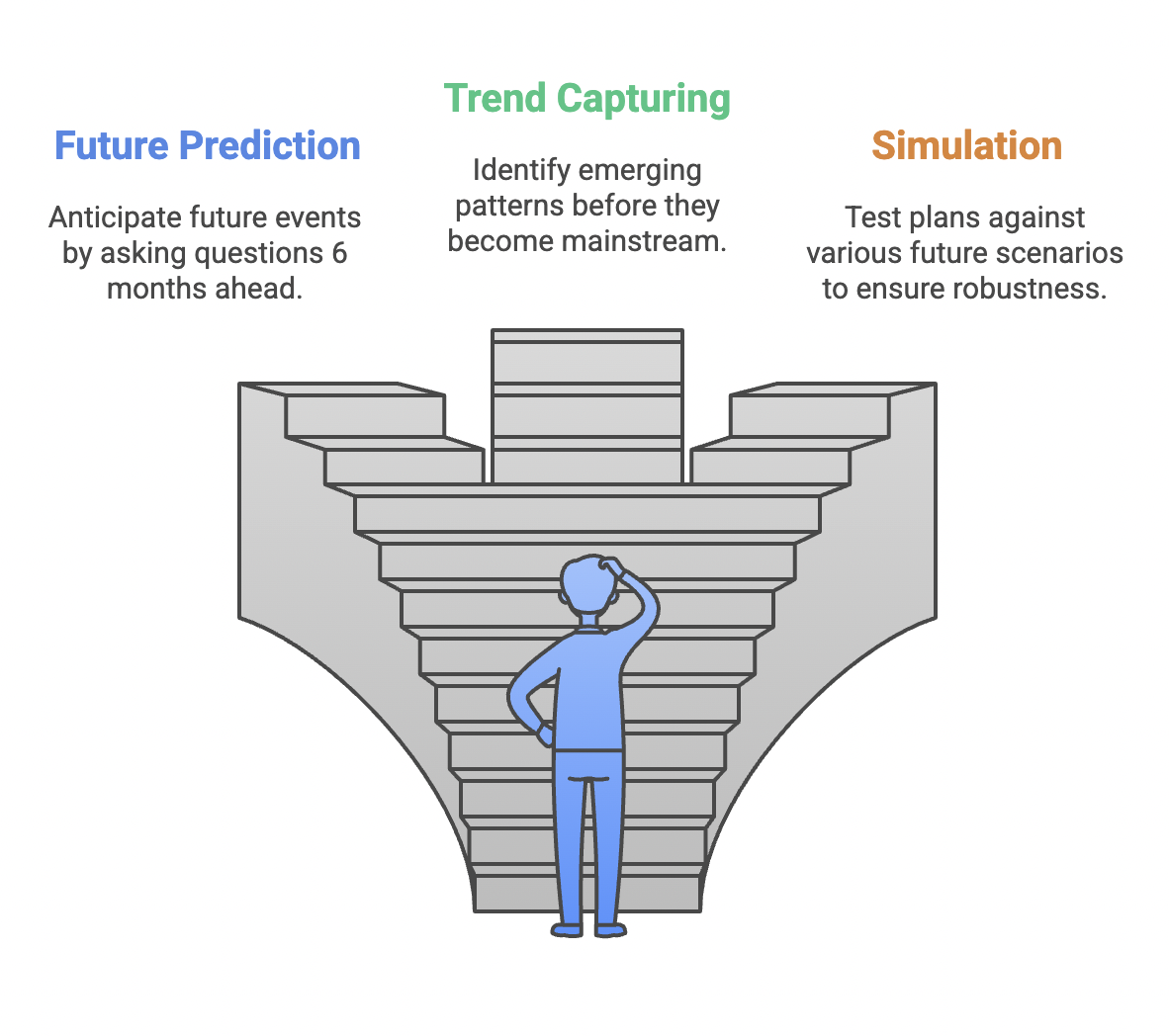
In this article, we’ll test 3 techniques that turn ChatGPT into a strategic thinking partner:
- Future Prediction: Ask questions 6 months ahead
- Trend Capturing: Spot emerging patterns before they’re obvious
- Simulation : Stress-test your plans against future scenarios
Each technique includes a copy-paste prompt and a test method so you can customize it for your needs and start using it today.
All three prompts are also available in gDrive for the paid subscribers.
What do we offer to the paid subscribers?
Paid subscribers get more than articles; projects with code, custom GPTs, and prompts designed after thousands of hours of experience.
- Last week’s project: Data Project 6: I Analyzed 77,108 NYC Real Estate Sales.
- Last week’s topic: While You’re Using GPT-5, The Game Changed: Meet the Claude Sonnet 4.5!
- Last week’s AI Pulse:Weekly AI Pulse #110, California Just Changed AI Forever!
1. Future Prediction
Most people ask ChatGPT: “What’s happening in AI right now?”
I ask: “It’s April 2026. What just happened?”
This small shift forces your brain out of reactive mode and into strategic positioning.
But here’s the key: you need current data to model the future accurately.
You’re not asking it to predict the future; you’re asking it to synthesize current signals and think from the future, then work backward to today.
Quick Overview:
- Ask ChatGPT questions from 6 months ahead
- Forces you to think strategically, not reactively
- Helps you position before trends hit
- Uses real-time web data to ground future modeling
- Example: “It’s April 2026. What happened in AI this year?”
Prompt Template
First, browse the web and gather the latest information about [YOUR TOPIC/INDUSTRY] as of [TODAY’S DATE]. Look for recent trends, announcements, shifts, and emerging patterns.
Then, step into the future: It’s [TARGET DATE - 6 months from now]. You’re looking back at the biggest shifts in [YOUR TOPIC/INDUSTRY] over the past year. Based on the current data you just gathered AND broader patterns you know, what are the 3 most significant changes that happened between [TODAY’S DATE] and [TARGET DATE]?
Based on those changes, what should I be doing today to prepare or position myself?
Customize
[TARGET DATE]→ 6 months from now (e.g., April 2026)
[YOUR TOPIC/INDUSTRY]→ AI development, SaaS business, content creation, etc.
[TODAY’S DATE]→ Current date (e.g., October 2025)
Use case
First, browse the web and gather the latest information about AI development and adoption as of October 7, 2025. Look for recent model releases, company announcements, regulatory shifts, and emerging patterns.
Then, step into the future: It’s April 2026. You’re looking back at the biggest shifts in AI over the past year. Based on the current data you just gathered AND broader patterns you know, what are the 3 most significant changes that happened between October 2025 and April 2026? Which companies or technologies won? Which fell behind?
Based on those changes, what should I be doing today to position myself strategically?
Let’s test it with ChatGPT-5. Here are the test results.
Here is the TL;DR of the test results.
🔹 Fast-Forward to April 2026
- Assistants Became Platforms
- ChatGPT App Store, Gemini for Home, and Copilot Pages matured.
- Winners: OpenAI, Microsoft, Google.
- Losers: standalone agent startups without data or reach.
- Compute Diversified
- NVIDIA still leads, AMD became a real alternative.
- On-device AI (Apple, Gemini Home) expanded; edge computing rose.
- Compliance Got Real
- EU AI Act enforcement began.
- Companies need audit-ready evaluation and safety systems.
🔹 What You Should Do Now
- Build on Rising Platforms — ship small ChatGPT Store apps and Slack/Claude or Copilot templates; publish case studies.
- Make Compliance a Feature — offer EU AI Act checklists, YAML policies, and transparency guides.
- Benchmark Compute Options — compare NVIDIA, AMD, and on-device costs; share results publicly.
- Own the “Assistant as OS” Narrative — start a weekly Assistant Playbooks column.
- Show Credibility — add evaluation and safety metrics to your posts.
- Form Partnerships — secure 1–2 pilot clients, document measurable outcomes, and turn them into case studies.
2. Trend Capturing
Trends don’t appear suddenly - they start as weak signals that most people ignore.
By the time a trend is obvious, it’s already too late to position yourself early. The advantage goes to those who spot patterns before they become mainstream conversations.
This technique uses ChatGPT to scan for emerging patterns that aren’t being widely discussed yet. You’re not looking for what’s already trending - you’re looking for what’s about to trend.
The key here is combining real-time web data with pattern recognition. ChatGPT gathers current signals, then identifies which ones have momentum building beneath the surface.
Quick Overview:
- Spot weak signals before they become obvious trends
- Ask ChatGPT to surface emerging patterns people aren’t discussing yet
- Focus on momentum, not just novelty
- Uses real-time data to identify what’s gaining traction
- Example: “What AI patterns are emerging that most people haven’t noticed?”
Prompt Template
First, browse the web and gather recent information about [YOUR TOPIC/INDUSTRY] as of [TODAY’S DATE]. Look for emerging discussions, new approaches, early-stage projects, and under-the-radar developments.
Then, analyze what you found: What are 5 emerging patterns in [YOUR TOPIC/INDUSTRY] that most people aren’t discussing yet? For each pattern, assess: Which one has the most momentum based on current signals? What would early positioning look like for someone who acts on this now?
Customize:
[YOUR TOPIC/INDUSTRY]→ AI tools, SaaS trends, content strategies, etc.
[TODAY’S DATE]→ October 7, 2025
Use Case
First, browse the web and gather recent information about AI development, tools, and adoption patterns as of October 7, 2025. Look for emerging discussions, new frameworks, early-stage startups, and under-the-radar developments.
Then, analyze what you found: What are 5 emerging patterns in AI that most people aren’t discussing yet? For each pattern, assess: Which one has the most momentum based on current signals? What would early positioning look like for someone who wants to be ahead of this trend?
Let’s test it with Claude 4.5 Sonnet.
⚡ TL;DR
Five under-the-radar AI trends are emerging:
1️⃣ Physical AI - robots with embodied intelligence
2️⃣ Agentic Workflow Orchestration - multi-agent systems that self-coordinate
3️⃣ Small Language Models at the Edge - compact on-device AI
4️⃣ Synthetic Data Generation - AI-generated training data
5️⃣ World Models - AI with internal 3D spatial understanding
3. Simulation
Most decisions are made with optimism. We think about what could go right, not what could go wrong.
But the best strategists do the opposite - they stress-test their plans before committing. This is called a “pre-mortem”: imagining your decision has already failed, then working backward to understand why.
This technique uses ChatGPT to simulate future scenarios where your plan faces obstacles. You’re not looking for validation - you’re looking for blindspots you can’t see from inside your own perspective.
The key is using real-time context about your industry or decision, then asking ChatGPT to model multiple futures - some where things go well, others where they don’t. This helps you prepare for risks you wouldn’t have considered otherwise.
Quick Overview:
- Test your decisions against future scenarios before you commit
- Identify risks and obstacles you can’t see yet
- Think of it as “pre-mortem” analysis - what could go wrong?
- Uses real-time data to ground scenarios in reality
- Example: “I’m launching X. Fast-forward 6 months - what went wrong?”
Prompt Template:
First, browse the web and gather current information about [YOUR TOPIC/INDUSTRY/DECISION CONTEXT] as of [TODAY’S DATE]. Look for market conditions, competitive landscape, regulatory environment, and recent failures or challenges others have faced.
Then, simulate the future: I’m planning to [YOUR DECISION/PROJECT/STRATEGY]. Fast-forward 6 months to [TARGET DATE]. What are 3 scenarios where this could fail or face major obstacles? For each scenario, explain what went wrong and what I should prepare for today to handle or prevent it.
Customize:
[YOUR TOPIC/INDUSTRY/DECISION CONTEXT]→ AI product launch, content strategy, business pivot, etc.
[YOUR DECISION/PROJECT/STRATEGY]→ Specific action you’re planning
[TODAY’S DATE]→ October 7, 2025
[TARGET DATE]→ April 2026 (6 months ahead)
Use Case
First, browse the web and gather current information about AI product launches and adoption challenges as of October 7, 2025. Look for recent failures, user resistance patterns, regulatory issues, and competitive dynamics.
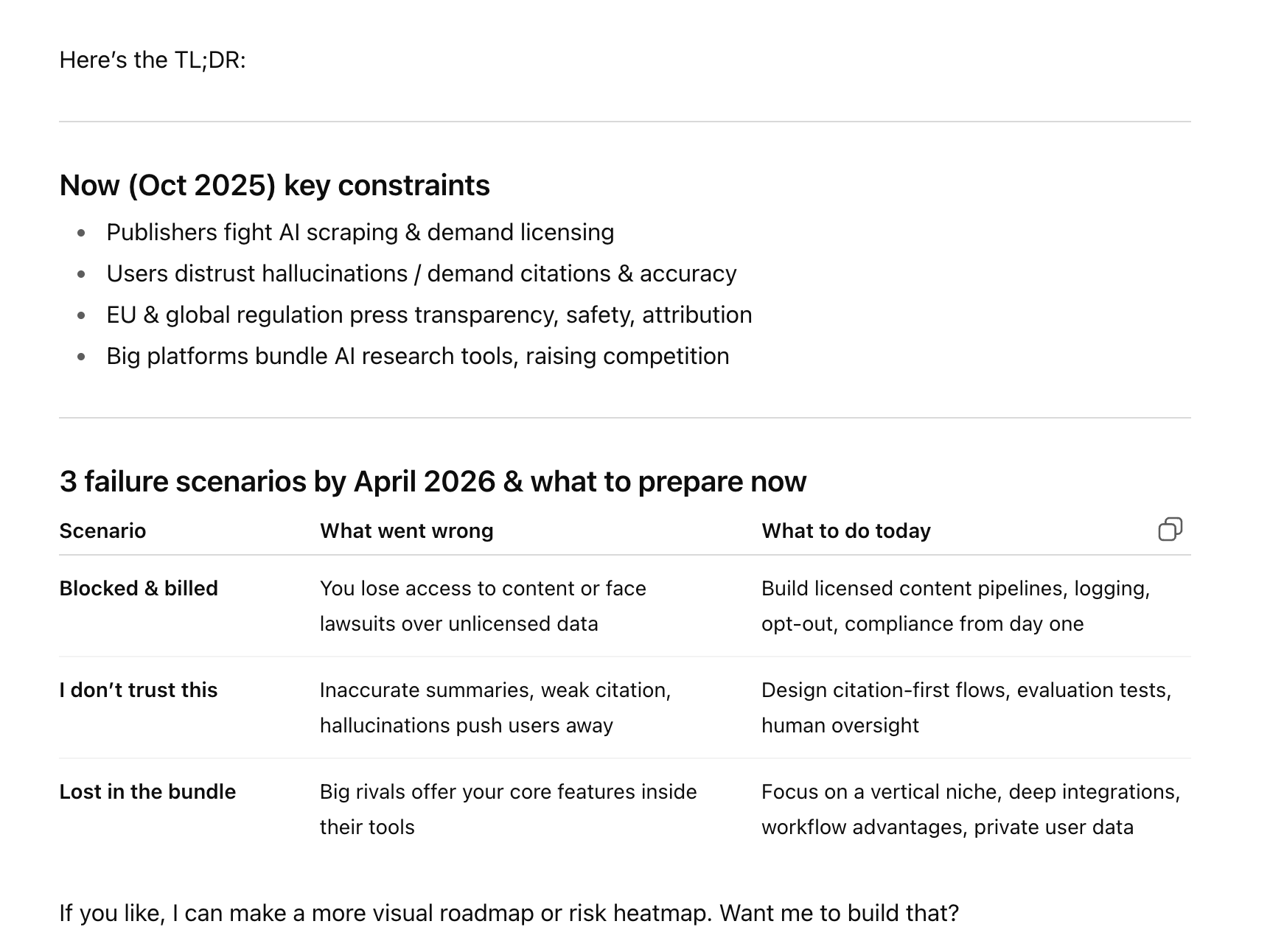
Then, simulate the future: I’m planning to launch an AI-powered newsletter tool that helps writers automate research. Fast-forward 6 months to April 2026. What are 3 scenarios where this could fail or face major obstacles? For each scenario, explain what went wrong and what I should prepare for today to handle or prevent it.
Let’s test it with GPT-5.
Let’s see the shorter summary.
Final Thoughts
ChatGPT can’t see the future, but it can model patterns, surface weak signals, and stress-test your thinking. The difference between reactive and strategic isn’t access to better information - it’s asking better questions.
Start with one technique this week. Pick the one that feels most useful for a decision you’re facing right now. Run the prompt, sit with the output, and adjust your plan based on what surfaces.
The future belongs to those who ask better questions today.