Real-Life Statistical Misconceptions Every AI Enthusiast Must Know.
By Gencay
Published: 2025-08-21
URL: https://www.learnwithmeai.com/p/if-you-want-to-learn-statistics-without
You think statistics is about memorizing formulas and calculating standard deviations. Wrong!
Statistics is truly about understanding why everyday things might fool your brain. It's about identifying trends that influence your choices without you realizing it.
Understanding statistical intuition separates AI enthusiasts from experts, and these beginner concepts are your starting point.
Today, I'll show you four situations where your intuition completely fails you. Each one will make you question what you thought you knew about probability and decision-making.
No formulas. No Greek letters. Just mind-bending examples that will change how you see the world.
By the end of this article, you'll understand why casinos always win, why that "lucky streak" in basketball isn't luck.
Example 1: The Birthday Paradox - When Math Breaks Your Brain

\Photo byAdi GoldsteinonUnsplash\
Let’s say you have 30 people in your classroom. What are the odds that two people share the same birthday? Your brain probably thinks "30 people, 365 days... maybe 10%?
Plot twist: It's actually 70%.
Yes, you read that right. In a room of just 30 people, there's a 7 in 10 chance that two people celebrate their birthday on the same day.
This isn't magic. This is math being ruthless with your intuition.
Here's Why Your Brain Failed You.
This theorem works by first computing the probability that everybody has different birthdays, then subtracting it from 1 (the complement probability).
- The first person can have any birthday (365/365), but each new person has fewer available days (364/365, 363/365, 362/365...)
- When events need to happen together, we multiply their probabilities - like stacking events.
- The probability of everyone having different birthdays is 0.293, so we subtract from 1: (1-0.293 = 0.707 = 70%)
Here is the graph that visualizes these statistics.
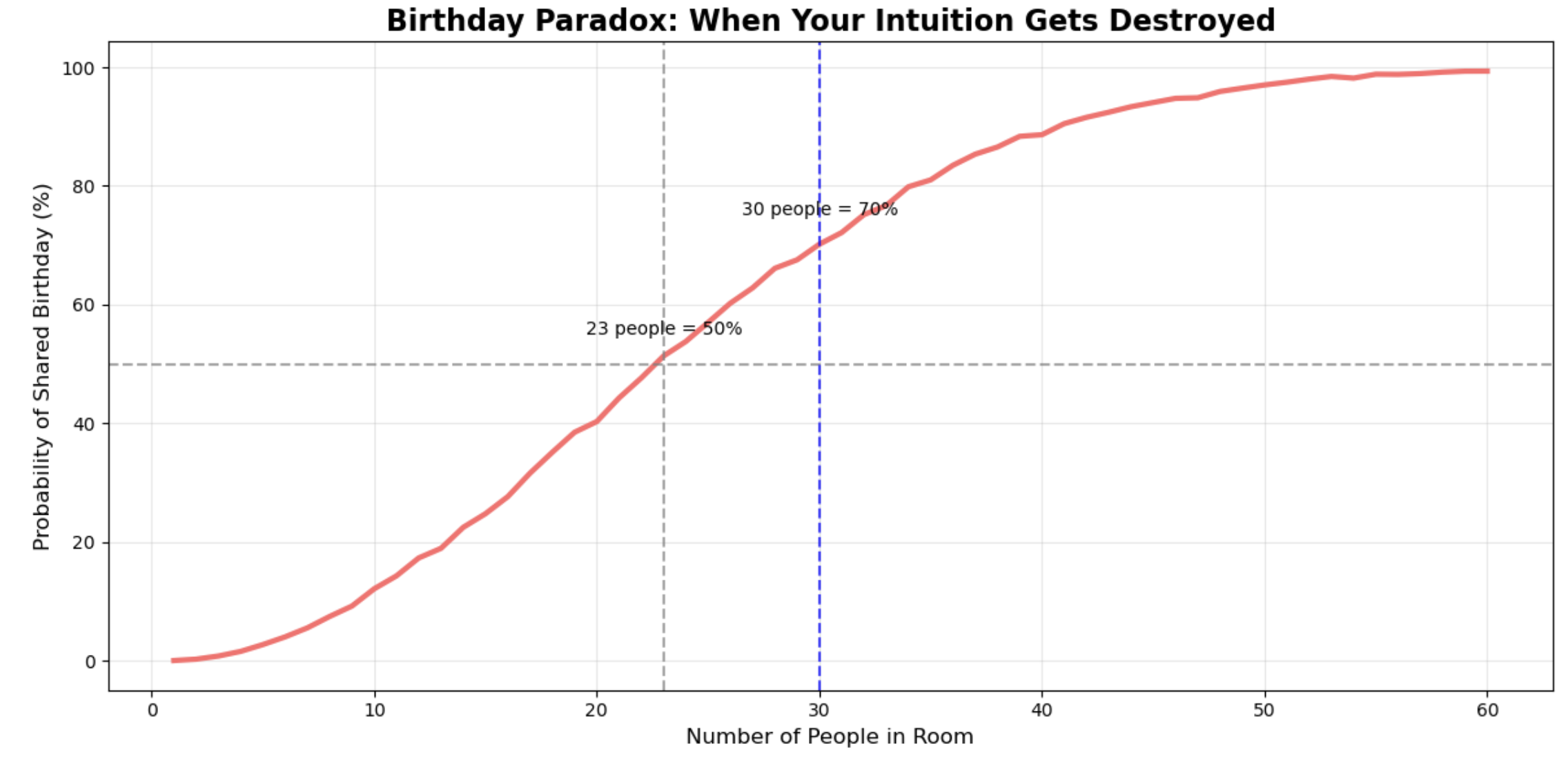
So, if your classroom has 60 people, the probability is almost 100%, which is amazing, right?
Example 2: The Monty Hall Problem - Why Switching Doors Doubles Your Chances

\Photo byNorbert LevajsicsonUnsplash\
You're on a game show. Three doors are in front of you.
- Behind one door: a brand new car.
- Behind the other two: goats.
You pick Door #1.
The host (who knows what's behind each door) opens Door #3, revealing a goat. Now he asks: "Do you want to switch to Door #2, or stick with Door #1?"
Your brain says: "It doesn't matter. 50-50 chance either way."
Mathematics says: "Switch, you fool! You'll win twice as often."
Wait, what?
Here's Why Your Brain Got Played:
TLDR: Your original choice had a 1/3 chance of being right. That means the other two doors combined had a 2/3 chance. When the host eliminates one wrong door, all that 2/3 probability transfers to the remaining door.
- Door #1 (your pick): Still 1/3 chance - nothing changed
- Door #2 (the switch): Now has 2/3 chance - it inherited the probability from Door #3
- The host's action gave you information, changing the game entirely.
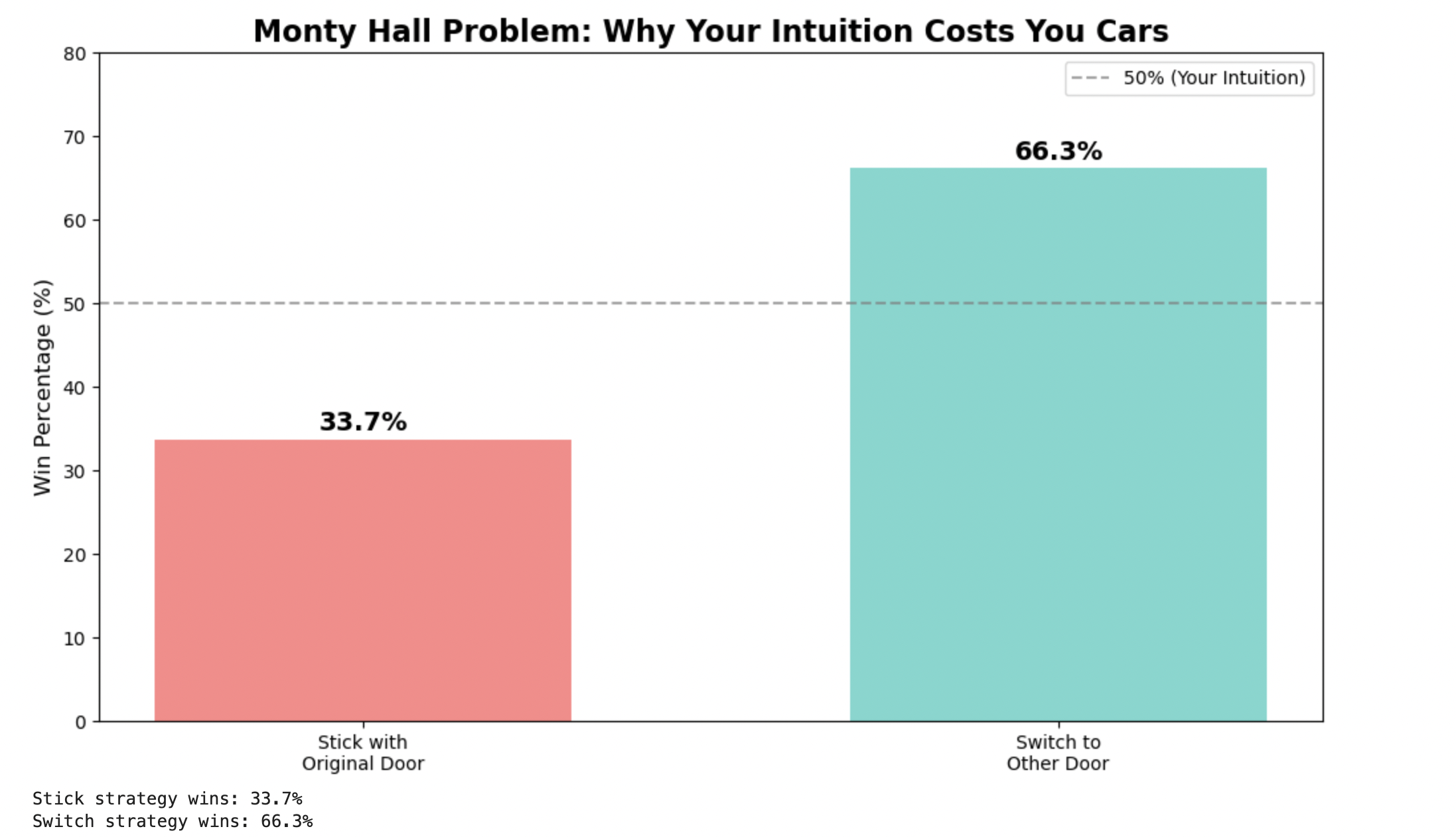
The brutal truth: Switching wins ~67% of the time. Sticking wins ~33%.
Your intuition failed because it ignored the host's knowledge. The host isn't random - he's giving you information that changes everything.
This is why casinos love intuitive gamblers.
Example 3: The Hot Hand Fallacy - Why "Being On Fire" Is Just Your Brain Playing Tricks

\Photo byMarkus SpiskeonUnsplash\
Your friend just made five basketball shots in a row. He's "on fire!" He's "in the zone!"
Obviously, his next shot is going in, too, right?
Your brain screams: "Hell yes! He's hot! Bet on him!"
Statistics whispers: "Each shot is still 50-50, you beautiful fool."
This cognitive bias ruins gamblers, traders, and fantasy basketball players every single day.
Here's Why "Streaks" Are Illusions:
TLDR: Past independent events don't influence future independent events. Your brain sees patterns in randomness because it's evolutionarily wired to find connections for survival. But math doesn't care about your pattern-seeking brain.
- Each basketball shot has the same probability regardless of previous shots
- Random sequences naturally create "streaks" - they're not special, they're inevitable
- Your brain remembers the streaks and forgets the misses (confirmation bias)
The brutal reality: Even in completely random data, you'll see "hot streaks" everywhere. And the shot after a hot streak? Still 50-50.
Casinos make billions because your brain can't accept that randomness looks streaky. That "lucky machine" isn't lucky - you just noticed its random hot streak.
Your brain evolved to find patterns for survival. Math doesn't care about your survival instincts.
What You Just Learned:
These aren't just fun party tricks. These are the fundamental ways your brain gets hijacked by probability every single day:
- Birthday Paradox: Your intuition about rare events is completely broken.
- Monty Hall: Additional information changes everything, even when it seems irrelevant.
- Hot Hand Fallacy: Random patterns look meaningful to your pattern-seeking brain.
Statistics isn't about formulas. It's about understanding why your gut feeling is wrong 70% of the time.
The next time someone shows you data, ask yourself: "What is this number actually measuring? And what is it NOT measuring?
If you like this one, please show your support by liking it, so you will see similar articles in the future. Thanks for reading this one!