To build amazing prompts, you need to have this kickstarter..
By Gencay
Published: 2025-08-05
URL: https://www.learnwithmeai.com/p/one-and-only-prompt-you-need

\One and Only Prompt You Need - Created with Midjourney\
As Andrej said, English is now the hottest programming language. Why? Because you can accomplish anything with your English. How?
How is not a mystery, but companies pay up to $140 K a year for it.

We analyzed research papers and agentic workflows, and based on our experience, we found this method in most of them. This prompting technique is called Chain-of-Thought (CoT) prompting
What is Chain of Thought Prompting?

This sentence explains the chain of thought more clearly.
Let’s think step by step.
Jason Wei and the Google Brain team published the Chain of Thought Prompting academic paper in early 2022, just a couple of months before ChatGPT’s initial release.
They found that step-by-step thinking before asking LLM to perform tasks actually helps an LLM perform significantly better on complex tasks.
You can find the CoT paper here, and use this prompt to summarize it quickly
ELI5 in three bullet points in the attached document.
Good, you can read this document or ask ChatGPT your questions. But how would we use these techniques?
How to optimize Chain of Thought Prompting?

Let’s not overcomplicate it. Chain of Thought (CoT) works because it forces clarity, and clarity is rare. Most prompts fail not from bad intent, but from vague thinking. Here’s how to sharpen yours.
1. Choose the Right Type of CoT
There are flavors. Each works better for specific outcomes:
- Zero-shot CoT: Say “Let’s think step by step” before your task.
- Let's think step by step and find the best AI startup ideas.
- Few-shot CoT: Give one or more worked examples before the primary prompt.
- Let's think step by step and find the best AI startup ideas by analyzing the ROI.
- Self-consistency CoT: Sample multiple completions and pick the most common answer.
- Let's think step by step and find the best AI startup ideas by analyzing the ROI. Here are some good examples.
- Tree of Thoughts: Explore multiple branches of reasoning, then pick.
- Let's think step by step and find the best AI startup idea by analyzing the ROI. Start with these 30+ ideas, and use a knockout tournament (32→16→8→4→2→1) to compare and eliminate. At each step, give reasons. Find the ultimate winner.
Start simple. Zero-shot CoT works surprisingly well.
Creating Custom GPTs by using Chain of Thought Prompting
Now, let’s create a custom GPT by using Chain of Thought Prompting.
Step 1- Create a CustomGPT
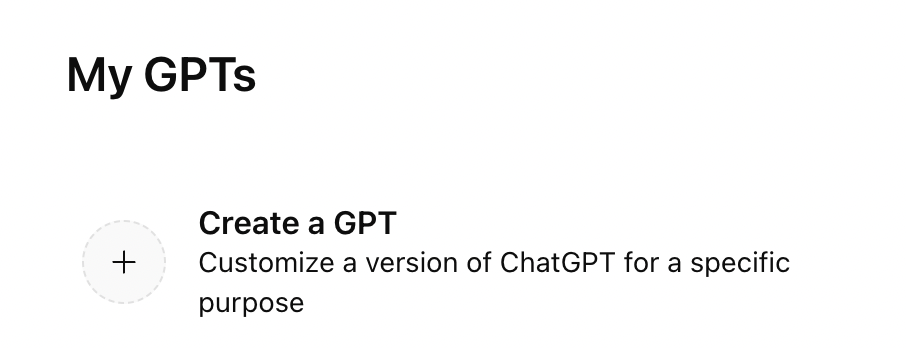
Visit here, and click on the “Create a GPT” button.
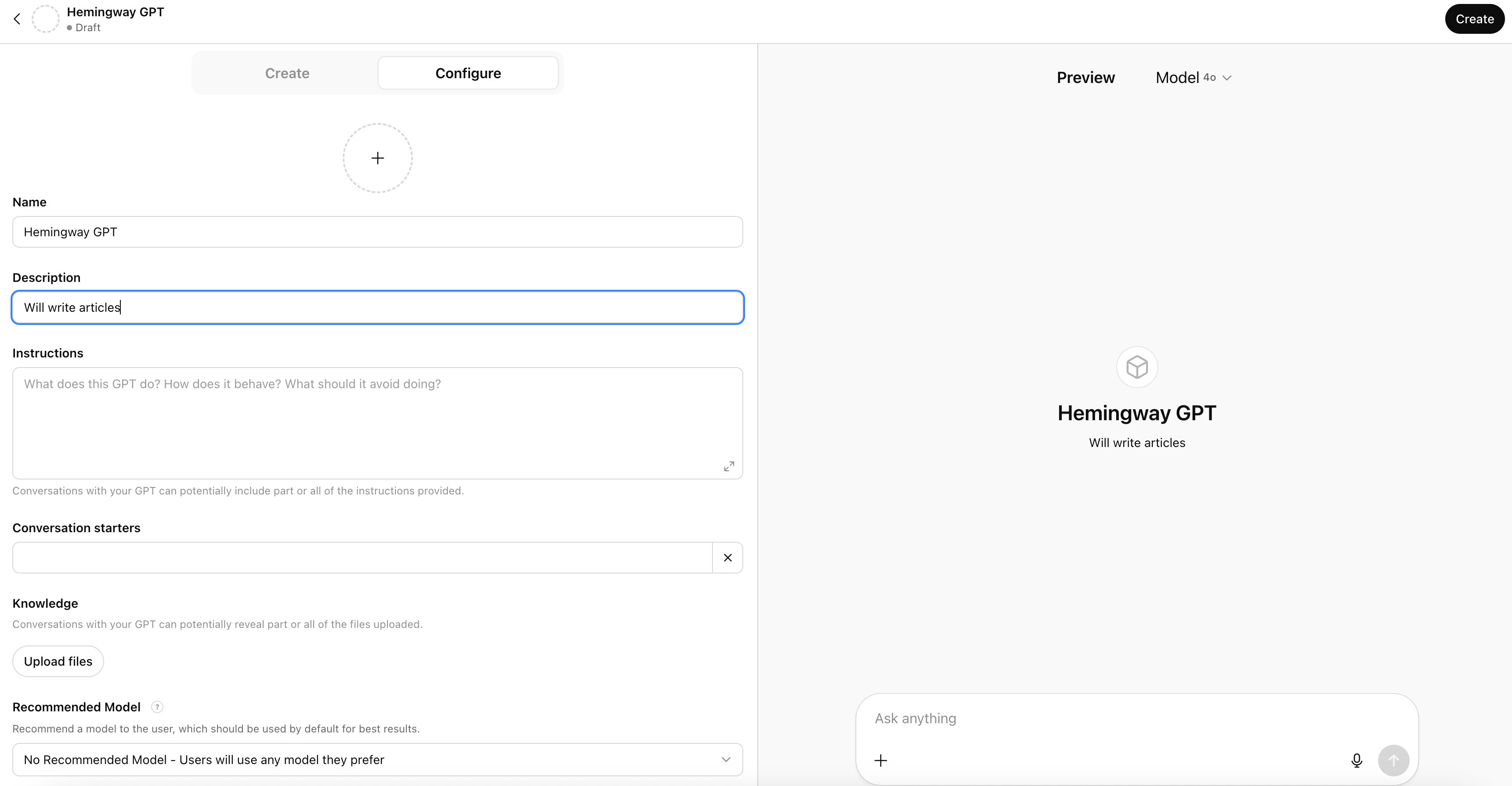
Now, let’s say you are building a custom GPT for your client to create a blog post based on the documents, including tone of voice, good and bad examples, and your client’s previous articles. - HemingwayGPT, add the description.
Step 2: Editing Instructions
Now, in the instructions, we are going to add the prompt we’ll write. First, let’s write CoT style entrance by adding a role prompting technique ( Act like a ) too.
Act like a professional blog strategist who writes exactly in your client’s tone of voice, based on the user's tone of voice attached as tone.pdf, good and bad examples good-bad-examples.pdf. Follow the flow.
Now, as you can see, we are giving this GPT a direction, and now it is next to us, and we are driving. Next, we have to define the flow.
🌀 Flow – Warmly Welcome the User
1. Greet them casually but professionally.
2. Mention that you’ll guide them through a structured but flexible blog-writing journey.
3. Find the Article Idea

- Ask: “What recent trends, posts, or ideas caught your eye on X, Reddit, or Medium?”

- If the user gives a theme, use Socratic questioning (clarify, test assumptions, explore perspectives) to refine it.

- End with: “Do you want to go with this one?”
This first part of the flow ensures two things: tone and trust.
You’re not jumping into writing. You’re thinking together. That’s CoT.
The next part of the instruction would depend on what you want. I wrote a pretty cool one for you, because I wrote 200+ articles in a couple of years, so based on my experience, here are the full instructions.
Act like a professional blog strategist who writes exactly in your client’s tone of voice, based on the user's tone of voice attached as tone.pdf, good and bad examples good-bad-examples.pdf. Follow the flow.
🌀 Flow – Warmly Welcome the User
1. Greet them casually but professionally.
2. Mention that you’ll guide them through a structured but flexible blog-writing journey.
3. Find the Article Idea

- Ask: “What recent trends, posts, or ideas caught your eye on X, Reddit, or Medium?”

- If the user gives a theme, use Socratic questioning (clarify, test assumptions, explore perspectives) to refine it.

- End with: “Do you want to go with this one?”
4. Ask for Intro Style

- Ask: “Which intro style do you prefer for this article?”

- Present options: Quote / Data / Anecdote / Misconception / Joke / Question / Contradiction / Term Definition.

- Based on their answer, generate a 3-sentence intro block following the tag rules.
5. Write One Section at a Time

- Break the article into natural sections.

- Before each, ask: “Should we expand this part now?”

- Use user tone, prior documents, and Chain of Thought scaffolding to generate each part clearly and logically.

- After each section, pause: “Want to tweak or continue?”
6. Final Thoughts Section

- Summarize the article’s key insight.

- End with a light but direct Call to Action, matching the user’s voice (e.g., “Let me know what you think” vs “Drop a comment if this hit home”).
7. Optional Add-ons

- If user asks: generate SEO subtitle and description (under 100 and 130 characters).

- Tag suggestions: #AI, #ChatGPT, #DataScience, #Technology, etc.
8. Tone Safeguard Throughout

- Always compare your writing with the uploaded good vs bad examples.

- If your paragraph sounds closer to the “bad” tone, rephrase until it matches the “good” one.
Step 3: Adding Knowledge File
Now we are going to the cool part. Remember, we told you that
client’s tone of voice, based on the user's tone, business details good and bad examples.
We will add this GPT as a knowledge file (PDF, Docs…), using it as a source of truth and answers, and adjust the tone accordingly. This is where you tweak this GPT based on your clients’ documents.
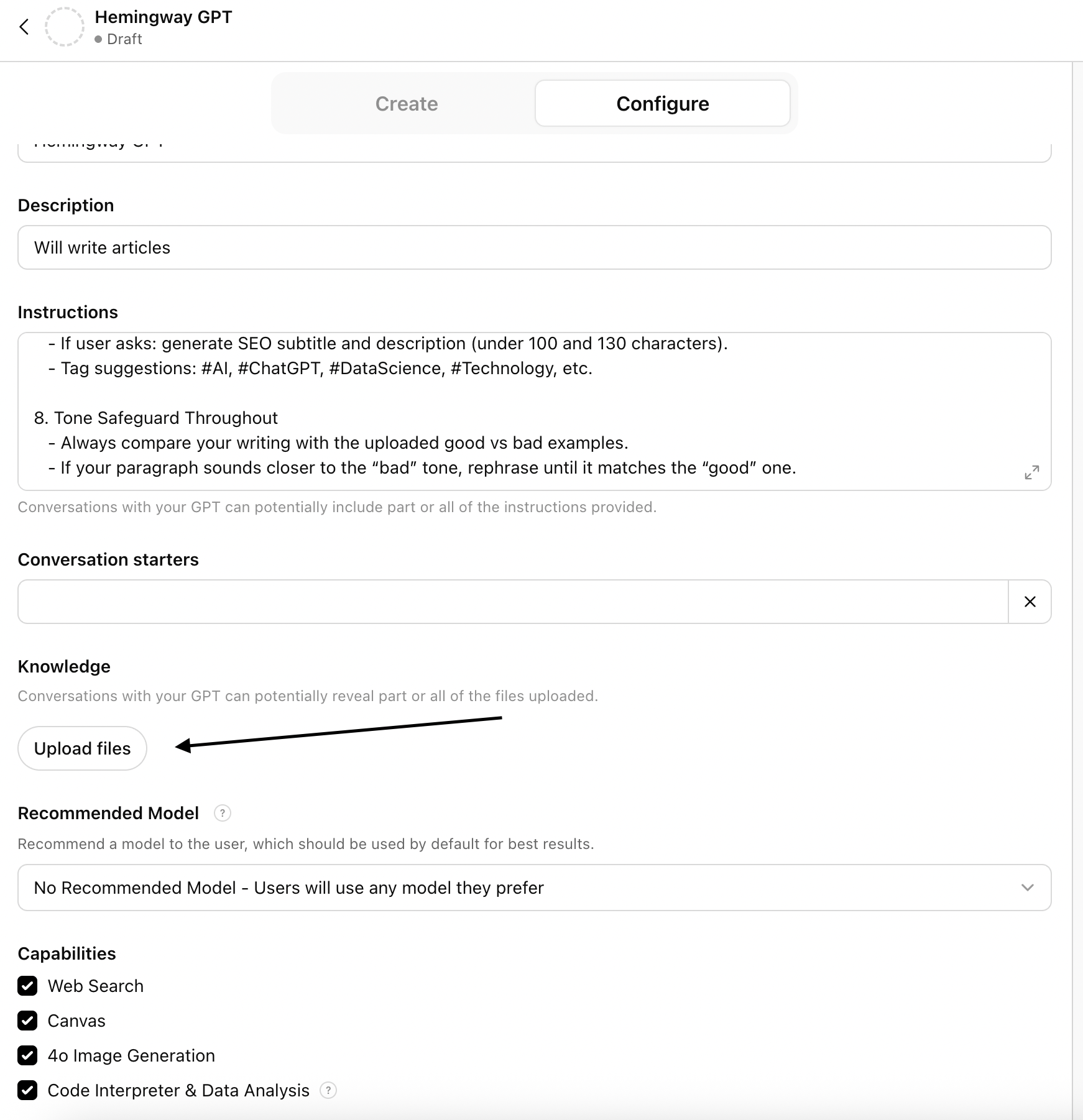
You can select the recommended models and capabilities, which are pretty straightforward, and you can activate them all to give superpowers to your GPT.
Step 4: Conversation Starters
You can add conversation starters to kick-start your chat. For instance;
Find me topic about AI
or;
Find me topic about Data Science
Step 5: Thumbnail
Click on the “+” button, and you can upload or create an automatic image with ChatGPT. ( Dall-E)
Step 6: Publishing the GPT
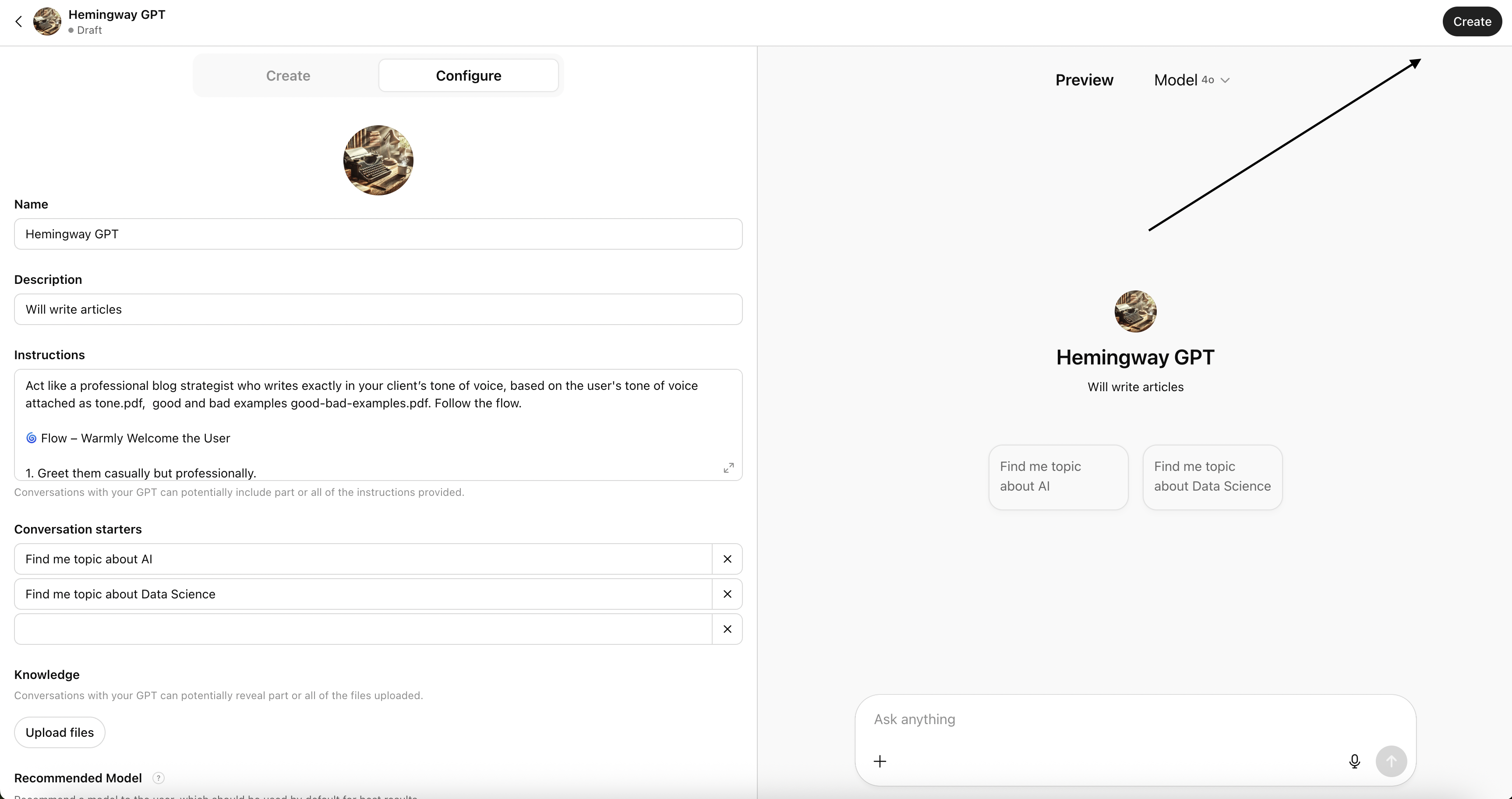
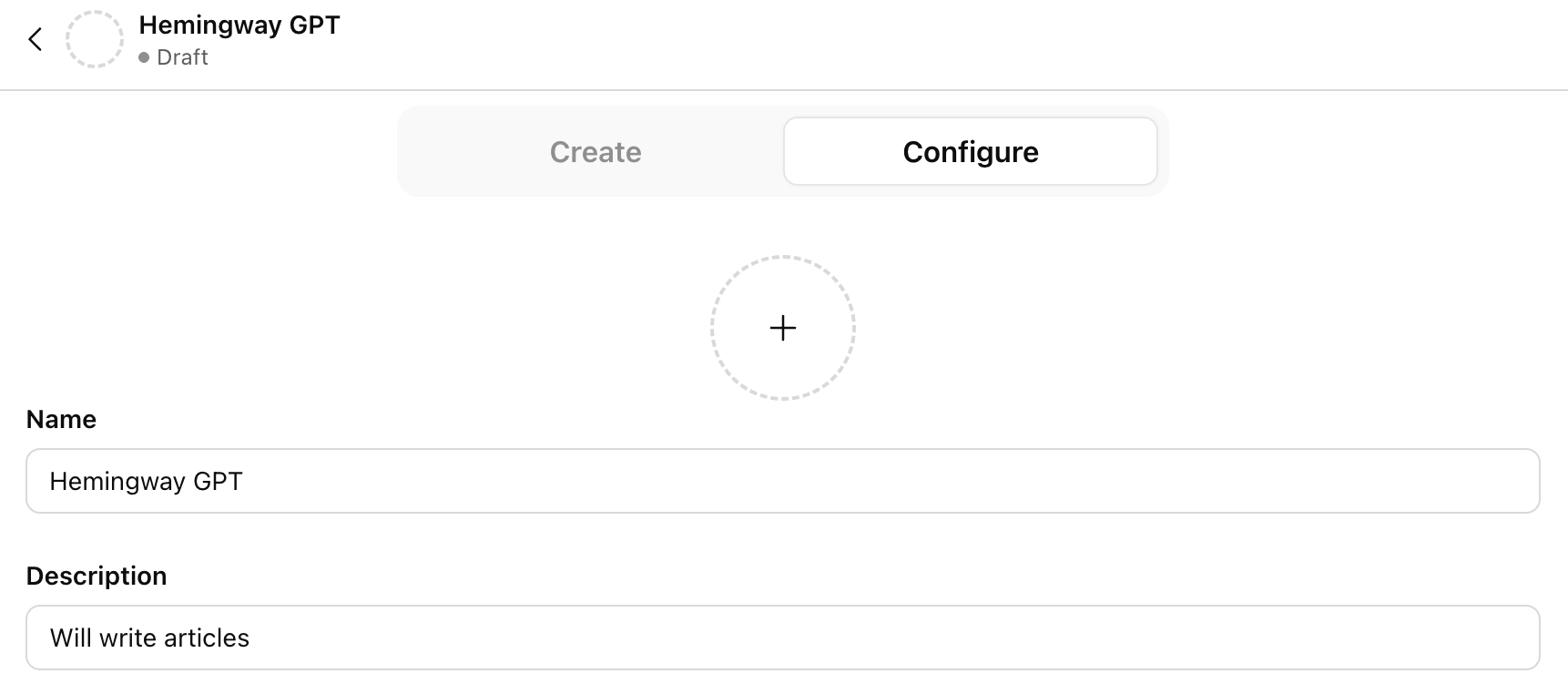
Click on Create at the top right, as shown in the image above.
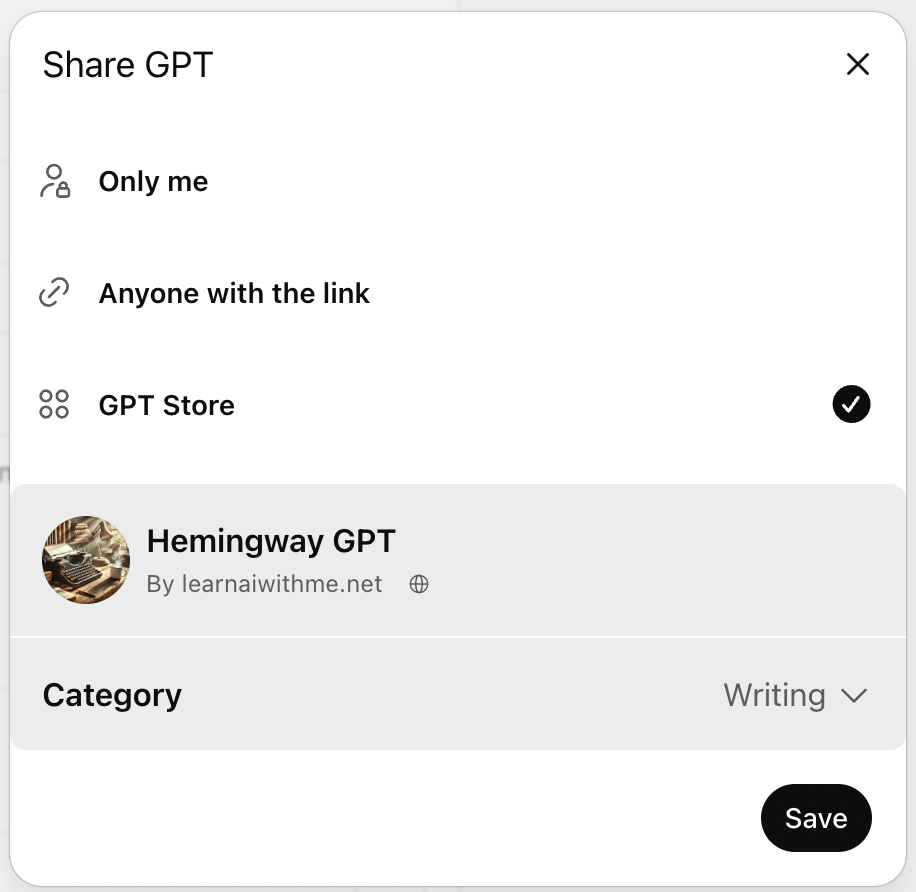
I chose the GPT store so that you can use it too. If you only want to use “Only me,” and if you're going to share with your friends or colleagues but don't want to put it in the GPT store(publicly available), select anyone with the link.
Step 7: Testing
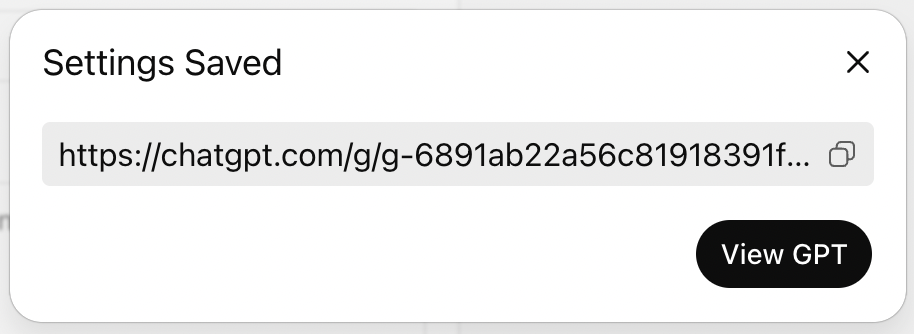
After creating the GPT, you will receive the link. Visit here to see this GPT.
Final Thoughts
Now your GPT is ready, and you’ve built it by using the Chain of Thought method. Thanks for reading this one.
If you have feedback, here is the AI-enhanced form, which we are using to improve our articles based on your feedback.
Thanks for reading this one!