A simple and practical guide to CUDA concepts that AI engineers actually need.
By Dr. Ashish Bamania
Published: 2026-10-25
URL: https://www.intoai.pub/p/10-cuda-concepts-every-ai-engineer
“This lesson helps you master basic CUDA concepts from the ground up without getting overwhelmed.”
CUDA is NVIDIA’s parallel computing platform and programming model for writing programs that run on NVIDIA GPUs.
While learning CUDA well is a completely different venture, understanding these 10 CUDA concepts will help you become a strong AI engineer who can optimize LLM training and inference performance.
Let’s begin!
1. Host, Device, and Kernels
In CUDA terminology, the CPU is the Host, and its memory is Host memory. Similarly, the GPU is the Device, and its memory is called the Device memory.
A CUDA program consists of:
-
Host code that runs on the CPU
-
Device code that runs on the GPU
Kernels are functions in the device code that run in parallel across many threads on the GPU. Starting a kernel is called “launching” the kernel.
In PyTorch, many operations on CUDA tensors, such as element-wise operations, convolutions, and matrix multiplication, run as GPU kernels.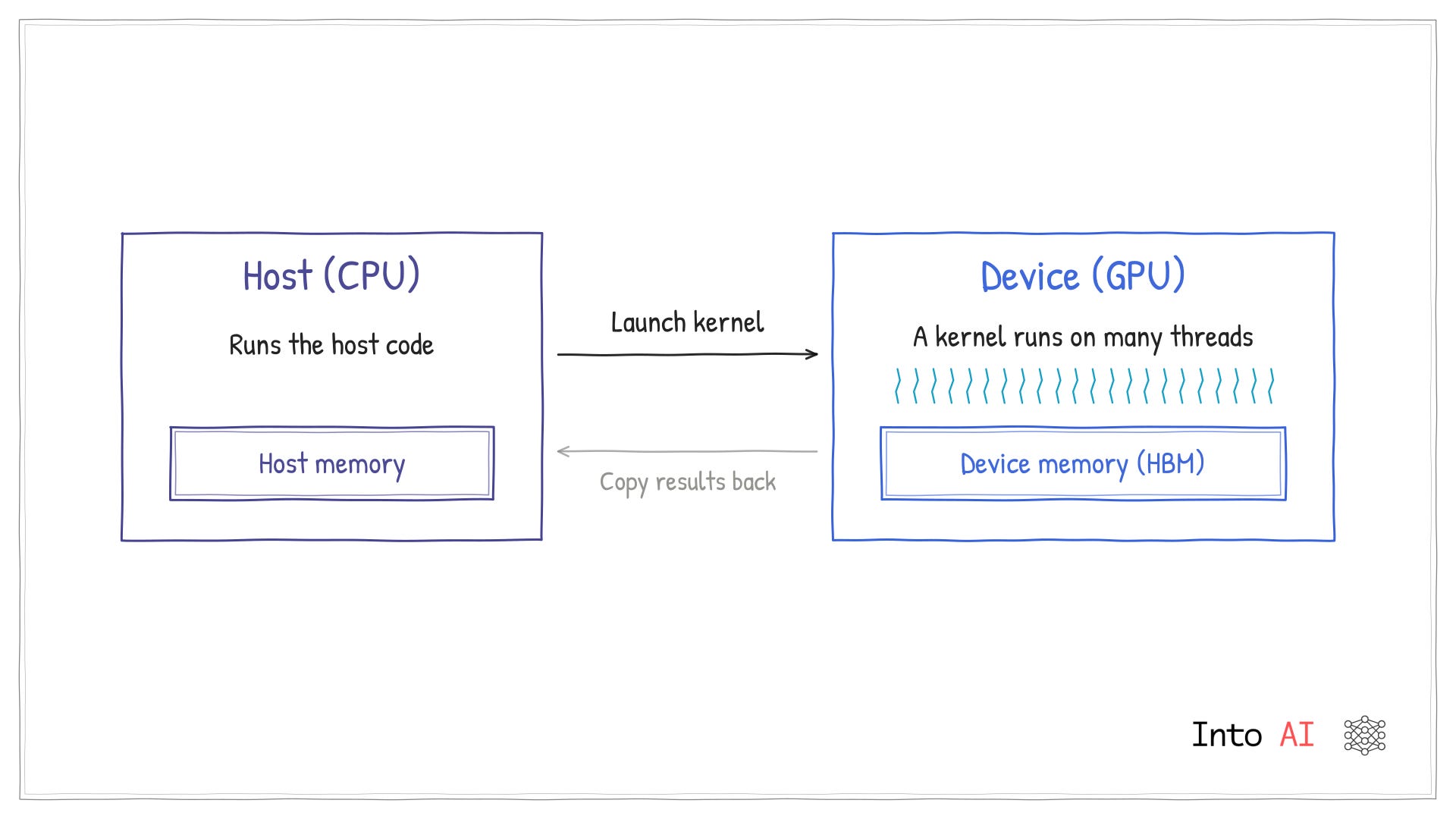
2. Thread organization
A Thread is the most basic unit of work execution in the CUDA programming model. Each thread has its own registers, and register data is private to each thread.
Threads are grouped into Blocks, and blocks form a Grid. A grid is what is launched with a kernel launch.
Threads in a block are assigned to a single streaming multiprocessor (SM), and they share data using the SM’s shared memory.
Choosing the right block and grid dimensions is one of the most important considerations when writing an efficient kernel.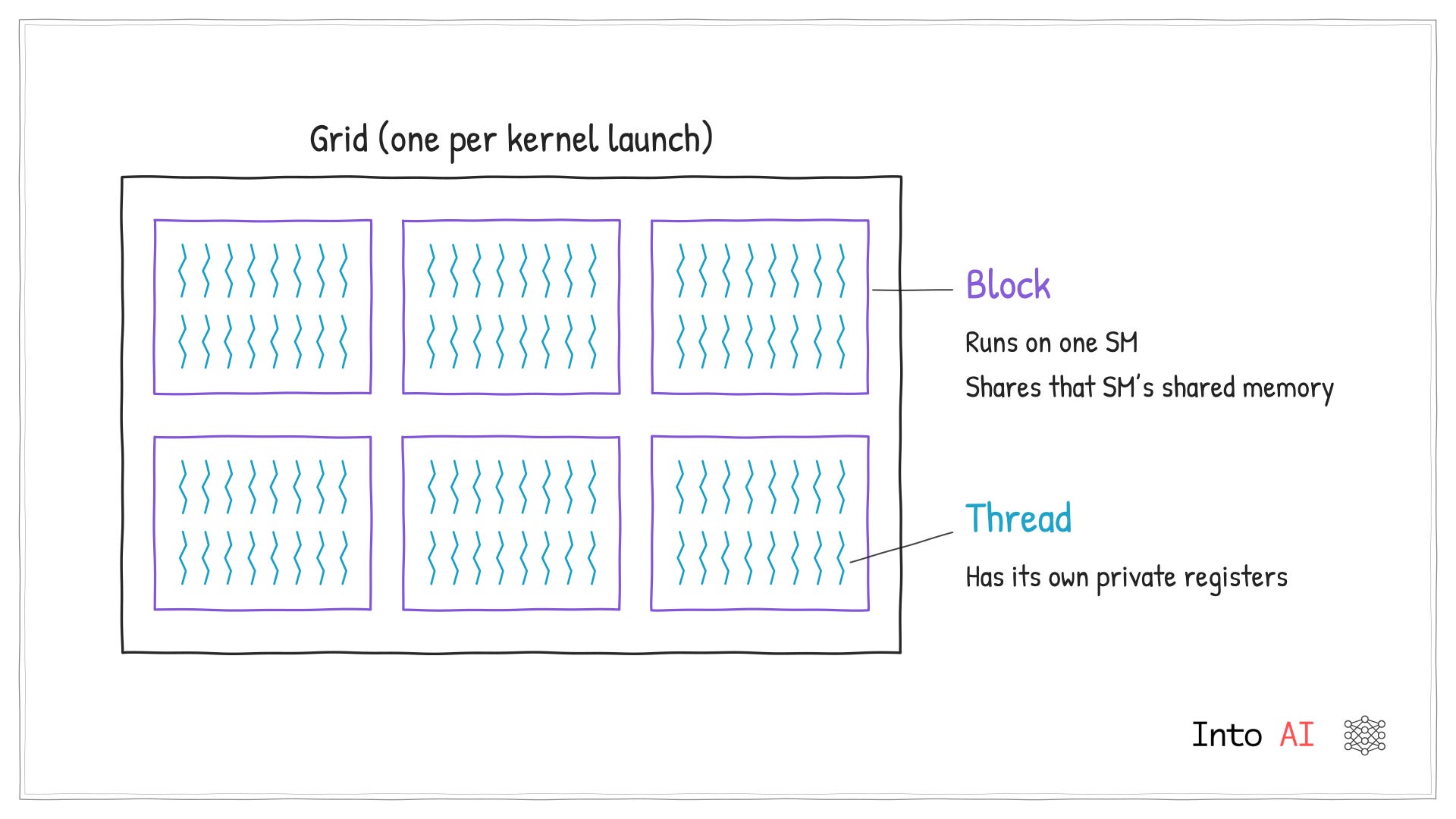
3. Warp & the SIMT execution model
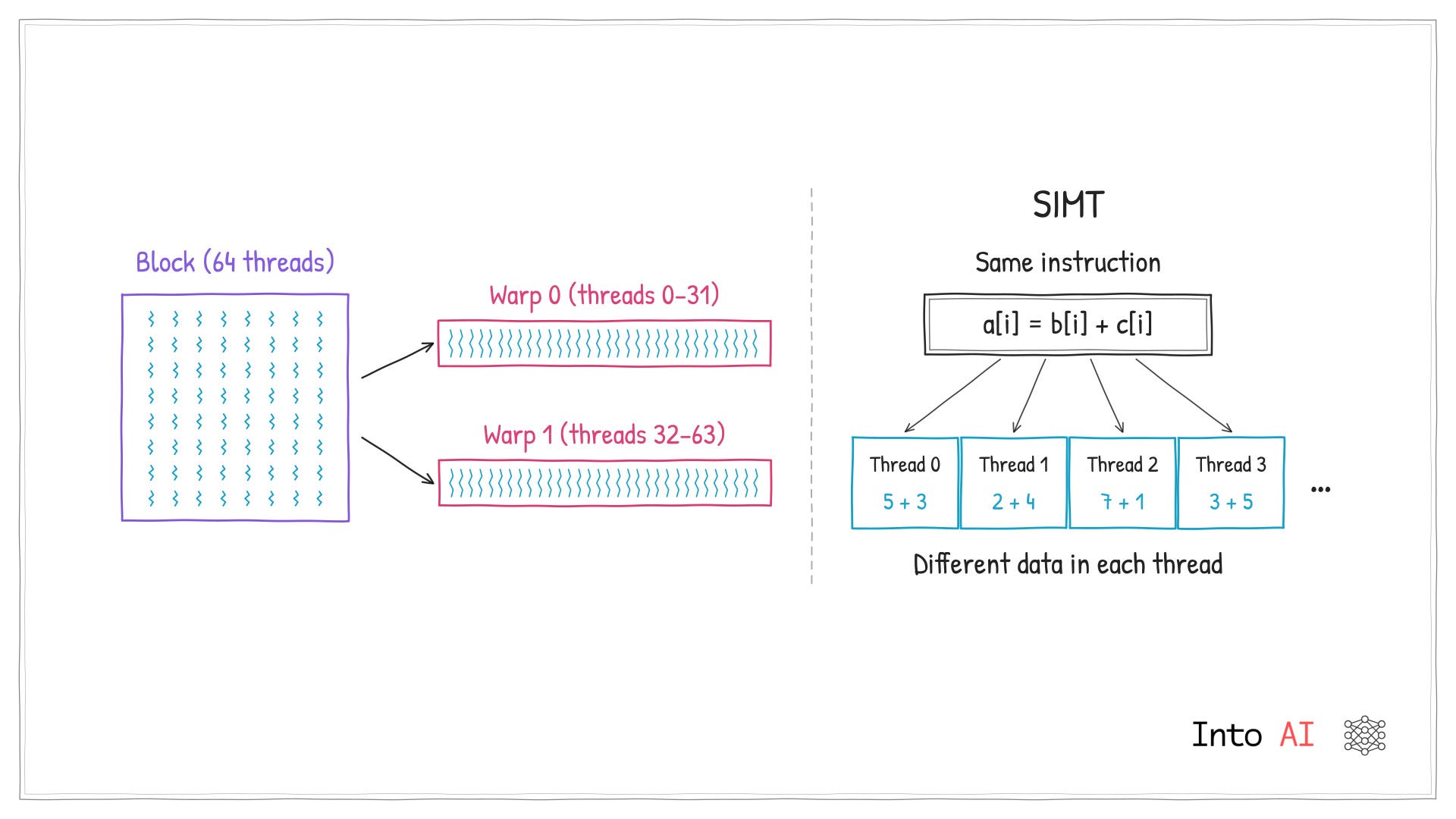
Threads within a block do not run on their own. Instead, when a block is assigned to an SM, its threads are grouped into Warps of 32 consecutive threads each.
The GPU cores in an SM then execute a warp using the SIMT (Single Instruction, Multiple Threads) model. This means all 32 threads in a warp execute the exact same instruction in parallel but on different data (except when there is Warp divergence, which we will discuss soon).
A Warp is the actual fundamental unit of hardware execution and scheduling on an NVIDIA GPU.