Baseten CEO Tuhin Srivastava on inference as AI’s “final market.”
By Mario Gabriele
Published: 2026-11-17
URL: https://www.generalist.com/p/why-inference-is-harder-than-you
“If AI is going to eat the world, all that’s going to matter is how that AI is run. And even in a world where there is AGI, the only thing left to do will be inference: to run the intelligence itself.” – Tuhin Srivastava, Co-founder and CEO of Baseten
Tuhin Srivastava is the Co-founder and CEO of Baseten, a company building infrastructure for training and inference. When an AI model runs in production (responding to a user, powering an app, making a decision), Baseten is one of the companies that makes that happen reliably, quickly, and at scale. The company counts Abridge, Cursor, and OpenEvidence among its customers, spans 20 clouds and 90 regions, and was most recently valued at $13 billion following a $1.5 billion funding round.
Tuhin sees inference as AI’s “final market”: as AI spreads through the economy, the cost of running intelligence grows with it. Baseten’s breakout began when it discarded three years of other product work in roughly six weeks to focus on an inference engine it had been giving away.
In this conversation, we explore why inference has become one of the most consequential and least understood markets in AI, what it actually takes to run a model in production at scale, and why the compute squeeze may be the single largest constraint on AI growth right now. We also examine the customer journey from closed models to custom fine-tuned deployments, the concept of owned intelligence, and why Tuhin believes luck accounts for roughly 90% of startup success, while insisting that the 10% skill is still indispensable.
Listen on YouTube • Spotify • Apple Podcasts
From my notebook
- “Inference is the final market” is a great provocation. If AI takes over more of the economy, then the inference opportunity could grow to a truly ludicrous size. Tuhin’s back-of-the-napkin estimate: about $2 trillion of inference spend by 2030.
- Off by 4X. Baseten’s January 2025 forecast versus year-end actuals was off by four times, and its forecasts have been wrong every year since 2023. It’s fascinating to me how difficult it is for even extremely sharp, knowledgeable humans to adjust to exponentials.
- The hyperscalers’ blind spots are organizational. Inference bridges compute, networking, observability, and workflow primitives that live in four different internal teams. A customer using a hyperscaler is effectively dealing with four different organizations at once, not just one.
- “Owned intelligence” as a thesis (and possible customer moat). This is a theme I hear from an increasing number of companies. Deploy open-weight models, generate production data, capture feedback signals, post-train custom models, redeploy, repeat. The idea is that companies that close that loop accumulate compounding advantages.
- Lessons from hospitality. Tuhin referenced Danny Meyer’s full service philosophy as a hiring lens. Alongside things like intellectual curiosity, Baseten looks for a high-end hospitality mindset. Teammates should talk to customers every day and go the extra mile. That leads to deep relationships, with one Baseten employee recently attending a customer’s wedding!
Tuhin’s bookshelf
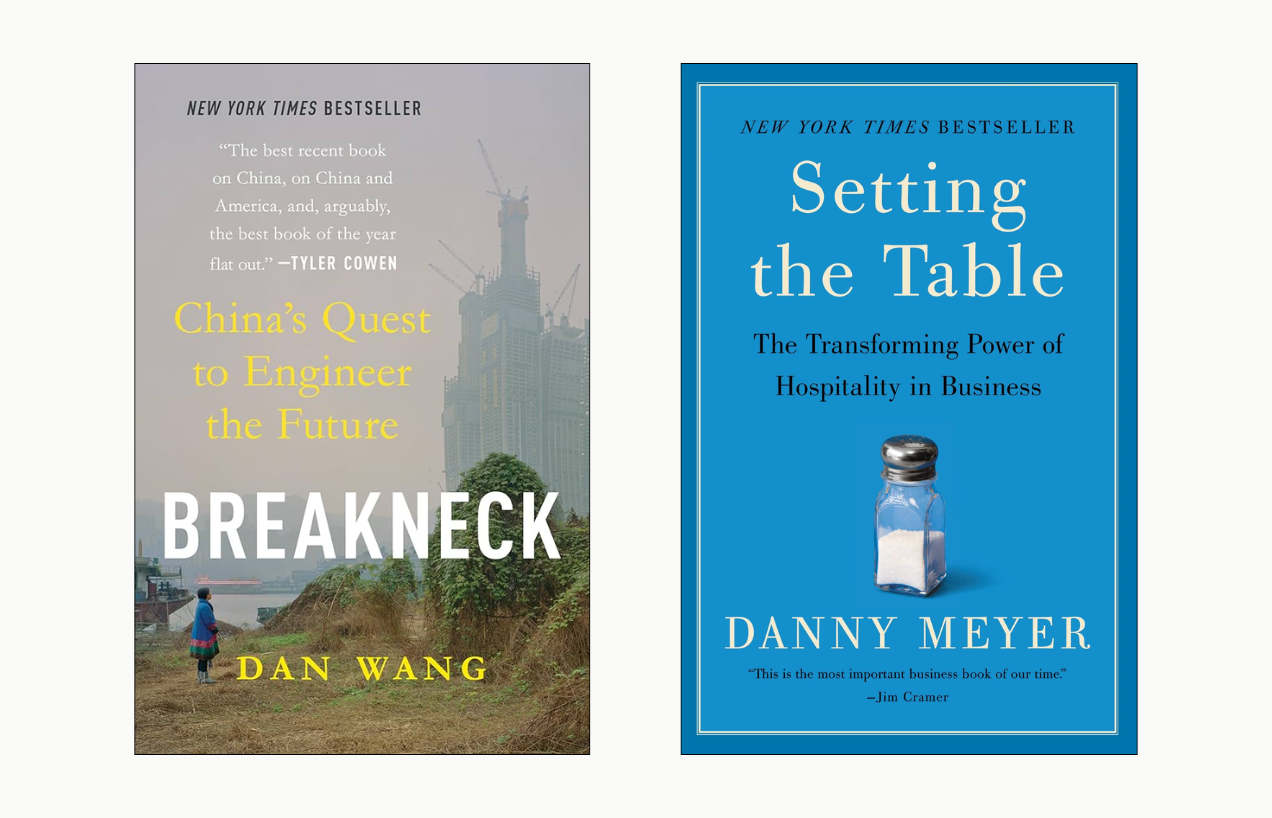
When I asked Tuhin what book he’d assign to everyone, he named Breakneck. As mentioned above, he also pointed to Danny Meyer’s book about Union Square Cafe, Setting the Table.
Tangents
What I’m reading, watching, and into this week:
- Few people outside of the UK seem to have heard of Taskmaster). It is one of the most fun shows you could hope to watch, and its latest season is no exception
- An idea I have been having that I think I will write a piece on soon is the trend towards intensive, personal surveillance. AI relies on context to do its best work and as it becomes more capable, the right amount of context for it may be: everything. That might lead to some really strange behaviors that effectively amount to state-style surveillance of yourself (e.g. tracking your movement through cameras, recording your every word, and so on.)
—Mario
Every timestamp
(00:00) Intro
(02:06) What Baseten is building and how it began
(04:47) Finding balance in a fast-growing startup
(06:45) Why inference is the “final market”
(08:34) Tuhin’s path to founding Baseten
(12:06) What Australia gets right
(13:43) The opportunity Baseten found in inference
(20:34) How customers use Baseten
(29:00) Managing compute across clouds
(30:40) The compute crunch
(32:11) Financing inference at scale
(35:40) Why inference is hard to build in-house
(36:41) Who Baseten wants to hire
(39:46) Hard work and skill vs. luck
(42:20) Final meditations
Resources
- Baseten: <https://www.baseten.co>
- Sierra: <https://sierra.ai>
- Coinbase: <https://www.coinbase.com>
- No Priors Ep 56 | With Baseten CEO and Co-Founder Tuhin Srivastava: <https://www.youtube.com/watch?v=oe3OSlsf4YA>
- Etched: <https://www.etched.com>
- Cerebras: <https://www.cerebras.ai>
- NVIDIA Groq 3 LPX: <https://www.nvidia.com/en-us/data-center/lpx>
- Unreasonable Hospitality: The Remarkable Power of Giving People More Than They Expect: <https://www.amazon.com/Unreasonable-Hospitality-Remarkable-Giving-People/dp/0593418573>
- Blackbird VC: <https://www.blackbird.vc>
- Greylock: <https://greylock.com>
- Conviction: <https://www.conviction.com>
Where to find Tuhin
LinkedIn: <https://www.linkedin.com/in/tuhin-srivastava>
Subscribe to the show
I’d love it if you’d subscribe and share the show. Your support makes all the difference as we try to bring more curious minds into the conversation.
Production and marketing by penname.co. For inquiries about sponsoring the podcast, email [email protected].
Transcript
Tuhin Srivastava: Even in a world where there is AGI, the only thing left to do will be inference.
Jensen Huang: AI now has to think. In order to think, it has to inference.
Tuhin Srivastava: Inference, in a lot of ways, I think it’s maybe like one of the most like misunderstood markets in the world. GPUs fail all the time. Chips fail all the time. In a market where the demand is growing exponentially, there’s so much complexity. Baseten provides performant, reliable infrastructure for training and inference for the fastest-growing AI companies in the world.
We are critical path. If Baseten’s down, a lot of our businesses aren’t working.
Mario Gabriele: Why doesn’t every company just figure out how to wire inference better and better themselves and optimize that?
Tuhin Srivastava: It’s hard to get capacity at a big scale. It’s kind of impossible to get capacity at a small scale. And then I think the complexity of the software and the actual running this at scale is quite high. There’s opportunities to compete with hyperscalers and beat hyperscalers when you are bridging multiple of their different services.
Mario Gabriele: If you had unlimited resources and no operational constraints, what is an experiment you’d like to run?
Tuhin Srivastava: I’d love to run—
Mario Gabriele: Every industry has a cost of goods. Retail has materials, shelves and trucks. Software has servers. For AI, it’s inference, the work of running a model every time someone asks a question. As AI takes over more of the economy, that line item grows with it. Tuhin Srivastava thinks inference may prove to be the final market measured in the tens of trillions.
He also thinks it’s badly misunderstood, because most people have no idea how complicated it is to serve a model quickly, reliably and at scale. Tuhin is the co-founder and CEO of Baseten, which does exactly that for companies like Abridge, Cursor, and OpenEvidence across 20 different clouds. In June, a $1.5 billion round valued the company at $13 billion.
Today, we discuss Baseten’s insane growth, why companies may end up running dozens of specialized models and the brutal supply crunch in compute. I’m Mario, and this is The Generalist.
All right, let’s get into it. I’m super excited about this. Um, Tuhin, maybe just to start, we can start super simply for folks that haven’t heard of Baseten, how would you describe what you’re building?
Tuhin Srivastava: Yeah. Um, Baseten provides performant, reliable infrastructure for training and inference for the fastest-growing AI companies in the world.
Mario Gabriele: What I love about your story is that you’re sort of on this absolute burner of a trajectory at the moment, but it wasn’t always that way. Sort of the first few years of the company, you had to endure a slower start. Uh, when you started back in, I think it was 2019. Yeah. How would you have described what you were trying to do at that point?
Tuhin Srivastava: At the time? Yeah. So when we started the company, it was pretty straightforward. We, we were thinking about—me and my two co-founders, Amir and Phil. We were hanging out in, you know, all kind of without a job at the time. We’d done a bunch of stuff around machine learning and we’re like, oh, like, where can machine learning be used in X, Y, and Z way?
And then we realized that we didn’t really have any idea about how you could—like, what is like the, the right way to use machine learning or how machine learning will work in any one application. But we should build a tools company to kind of—a picks-and-shovels business to kind of enable the whole lifting machine learning trend.
Um, and so that’s kind of what we, what we thought about. What the, the thesis back then was a bunch of people were training models, and these models looked very different then than, than they do now. Let us give you all the scaffolding you need to turn those models into value. To, to look back at those moments, you have to think about a few different things.
So one, it was data scientists, not engineers back then. Um, which is interesting. Um, it was internal tools, primarily not production, because these were small models being used for stuff like fraud and classification, recommendations. And so there were the three things: that’s data scientists, not engineers.
Small models, not big models. Internal tools, not production. And we’re building for that different world to some extent.
Mario Gabriele: Were there sort of changes to that product vision that you had to make to, to sort of skate to where the world took you?
Tuhin Srivastava: Yes and no. I think like we, we had always built serving—what we now call inference—as part of that thing. When you were serving models on CPUs and GPUs, inference was kind of trivial. And so even though we had this inference engine, we kind of gave it away for free being like, “Oh, this commodity, no one cares.”.
And so what actually ended up happening was turns out when you have big models and big GPUs at a high scale, in production, serving is actually incredibly difficult. And so we had all this other scaffolding that we’d built besides this, and then we just kind of cut that out and focus on this one piece, which was the serving infrastructure.
Mario Gabriele: During those years of sort of, uh, you know, more of a grind, how did you maintain your equanimity as a founder? Were you tempted to sort of, I don’t know, make a big pivot at some point or shut it down or do something else? You know, you were going through the COVID boom, I’m sure, of seeing tons of companies just ripping and raising.
Yeah. And it took longer for your wave to arrive.
Tuhin Srivastava: Yeah. Look, I don’t think, you know, we had, you know, unbounded confidence in the—in this idea that we were pursuing. It wasn’t that challenging either, to kind of focus because it felt early and things were changing enough and we were never out of ideas. And then more importantly, like the team was small, was really fun.
I was, you know, we’re just hanging out with our mates and having a good time to some extent. Yeah.
Mario Gabriele: Well, one of your investors told me you’re a big runner. Is that right?
Tuhin Srivastava: No. Not really, I run. Who told you that?
Mario Gabriele: Niki from Blackbird.
Tuhin Srivastava: No, that’s not true. Um, that’s a—yeah, I run here and there. But it’s not any core part of my identity. It’s not. It’s not that. Okay. Yeah.
Mario Gabriele: What is the way that you, like, find the place for your brain to, like, take a rest or reset or come up with new ideas? You know, some people maybe that is running.
Tuhin Srivastava: I mean, look, I think what maybe something that’s interesting is that I actually live in LA and not San Francisco. And that provides like a really good, you know, breakdown of, of working. You know, still, you know, there’s always work, but it’s also just, you know, it’s something different and takes you out of kind of this environment.
Mario Gabriele: Yes.
Tuhin Srivastava: Um, to some extent I think besides that, I don’t know, cooking, you know, hanging out with friends. You know, I would like to think that I have, you know, enough of a, um, enough balance beyond work. But work is predominantly where I think that it’s just very challenging, I’d say, in this environment when things are changing so fast, to really find balance.
Mario Gabriele: Yes. Has it just been, I imagine, starting in late 2022, it’s as if like, you know, a starter pistol went off and you’ve just been in a flat-out sprint since then?
Tuhin Srivastava: Yeah, I feel like probably like Q2 of ’23. Like, that’s probably like when, like things really started changing. I just—it just started becoming like, you know, it’s interesting looking at a revenue forecast for the end of the year, like halfway through the year. Mhm. And like ’23, we were completely off. ’24, we were completely off. ’25, we were completely off. ’26, it looks like we’re going to be completely off. No, we were definitely completely off. And so it’s like everything just kind of like it couldn’t go any faster—it couldn’t go any faster.
Mario Gabriele: When you say completely off, are you off by like, an order of magnitude, or like a 2×, 3×? Like, do you get better at forecasting that, or do you get surprised each time? A little bit.
Tuhin Srivastava: Until now, I think we’ve been pretty surprised each time that it’s like, hey, this market is just bigger than ever. Inference is, you know, the final market to some extent. Yeah. No, it’s, it’s off by a lot. Like I think I’ll—if I compare our Jan forecast in ’25 to our end—to what we actually finished with, we were off by 4×.
Mario Gabriele: Wow.
Tuhin Srivastava: Yeah.
Mario Gabriele: When you say inference is the final market, I’ve heard you say that before. I really like love the framing of it, but I don’t know what it means.
Tuhin Srivastava: What?
Mario Gabriele: It sounds—it sounds very cool. Yeah, but what does that mean?
Tuhin Srivastava: Yeah, well, it means nothing. No. I’m joking. The, um, what we are somewhat alluding to there is that if AI is going to eat the world, you know it—all that’s going to matter is where that—you know, how that AI is run.
Mario Gabriele: I see.
Tuhin Srivastava: And, you know, like and even in a world where there is, you know, AGI, yeah, the only thing left to do will be, will be inference too.
Mario Gabriele: Yeah, to optimize, to run the way this works.
Tuhin Srivastava: To, to run the intelligence itself.
Mario Gabriele: I see, yeah. Okay. That makes sense. Actually, I think that—
Tuhin Srivastava: Maybe that’s—
Mario Gabriele: I think that’s pretty good. Yeah. At what point did you realize, hey, this like, you know, all of this stuff, we’ve built this one little piece here is the part that is the company. And, you know, it needs to be the whole focus. And we can, we can get rid of all of these other, you know, primitives that we built for data scientists or whatever else. Was that like the—
Tuhin Srivastava: It was really quick. It was like, you know, I say like December ’22. Actually, it was just like—
Mario Gabriele: Oh, already?
Tuhin Srivastava: Yeah. It was like, I think the story we had there, we had this early customer and they came to us and they’re like, oh, we have this fine-tuned Stable Diffusion model that we want to run. And we’re like, cool.
Um, and they’re like, oh, we’re gonna need a lot of GPUs, but like, “Yeah, sure you will.” Um, and then it ended up like, you know, getting posted on Hacker News and taking off and we kind of scaled with it. We’re like, oh, this is probably the thing that will be necessary. And I think we probably made those changes like really in like six weeks where we kind of like took three years of stuff we’ve been building, threw it away and we’re like, let’s, let’s, let’s do this thing only.
Mario Gabriele: Wow. And this was Riffusion, right?
Tuhin Srivastava: Yeah. Yeah. Okay. Yeah.
Mario Gabriele: Um. Very cool.
Tuhin Srivastava: Which has since been acquired by—became Producer—and it’s been since been acquired by Google.
Mario Gabriele: Yes. Right. Uh, taking a step back, like, you know, when you look back at your, your upbringing, your background, like, were you, were you building things from an early age? Was this, like, you know, always in the DNA to be an entrepreneur or something you came to later?
Tuhin Srivastava: No, honestly, like, really, like how I—we got to start off was I was working in finance. I ended up somehow working in technology. Like I hated working in finance at the time. And I moved to Boston doing some research stuff, using machine learning for, um, some neuromuscular disease research, which led to a startup that was coming out of that research lab.
I got into tech, and then in 2012, I moved to San Francisco, got involved in early-stage technology, started working at the company Gumroad, which is like an e-commerce platform. At the time, I was really like, I really liked early-stage and it wasn’t even like, oh, like, I need to be a founder or I need to be an entrepreneur.
Like, it wasn’t that at all. It was very much just like, oh, this sounds fun. I can go work with a small group of people that I really like. And yeah, so like the first company we started was actually in 2014, I want to say. So Phil and I—who’s my co-founder of Baseten as well, one of my co-founders at Baseten—we started a company. We worked on those other companies for about five years.
And then we got to Baseten.
Mario Gabriele: You know, if entrepreneurship maybe wasn’t sort of something that you had as a mental model in those early days, when you look back at yourself as, you know, kid and adolescent, whatever, whatever, are there sort of traits or things you were doing that you’re like, “Hmm, that was maybe my early way of, I don’t know, building conviction or being sort of someone who brings things into the world”?
Like, where did you see that in yourself? Maybe sports, I don’t know.
Tuhin Srivastava: I wish there was a romantic answer here, but there really isn’t. Like, you know, I worked in, like, I think most of my life was pretty boring. Like, you know, I grew up in a really, um, normal household. I grew up in Australia. Um, I went to school and I studied electrical engineering. I jumped around a bit, you know, I went to work in finance because everyone else did.
It was 2009 when I graduated. And you, you know, you were, uh, that’s where you worked in finance or consulting. Yeah, I went to work in finance. And then, like, I kind of just—it was, I’d say it was not—it was non-linear, but not extraordinary.
Mario Gabriele: Yes, I see.
Tuhin Srivastava: By, by, by any means.
Mario Gabriele: Yeah. You had a—clearly, you know, as you narrate the different jumps you made, clearly you were willing to make some, some unusual jumps. You know, like, you know, two years in finance to then like, you know, disease and all of these sorts of things. You know, you mentioned obviously growing up in Australia, now that you’ve spent so much time in America, what do you think the best parts of the Australian personality are versus the American personality?
Like, what’s the best parts of those cultures?
Tuhin Srivastava: Yeah. I don’t know. Australia is pretty great. Have you been to Australia?
Mario Gabriele: I never have.
Tuhin Srivastava: No. Yeah. It’s awesome. Um, what’s the best part of Australia? I think part of the best part of Australia is probably a few things, which is one, um, we don’t—as a culture, you’re taught to not take yourself too seriously. And in fact, if you do take yourself seriously, people kind of just point at you and say, “Shut up, mate.”
Like, yeah, yeah, no. Yeah. Um, that’s also probably there’s a downside to this as well. Yes. That’s the better part of it. The second part of it is, I don’t know, if you go to Sydney, it’s just fundamentally a lovely place. Um. It is. It’s warm. People seem happy. People play a lot of sport. And so I think just that there is a sense of balance in people’s lives, a lifestyle.
I don’t have that balance myself right now. And I think the third one is probably just around, like there’s this idea of not self-optimizing. I don’t want to say it’s like the opposite of capitalism, but it’s, it’s different at least where you’re kind of just like, you know, you’re not like this. It’s like there’s a name for it.
It’s called tall poppy syndrome. And it’s like, you’re not exceptional.
Mario Gabriele: Yes. Right.
Tuhin Srivastava: Um, don’t optimize for the outliers. Again, like, I think but I think there’s like the downside of that, which is that probably to some extent it cuts off the ends of the curve. And so you don’t get outliers. But the upside of that is like everyone’s kind of, you know, contributing back to the median and the mean, which I think is a really nice thing, because it just means that, like, life in Sydney is very good.
Like, it’s very good for a lot of people.
Mario Gabriele: Well, let’s talk a bit more about inference. I think for folks that maybe haven’t, you know, spent a lot of time in this space, they might think, why isn’t this already very well served by the big cloud providers? Yeah. Like, you know, it’s not obvious if you haven’t thought about it. Like what? Why is there this opportunity for Baseten so clearly?
Tuhin Srivastava: So I think what’s interesting is that you got to—like, a good way, I think a good lens to think about this is to think about it through who are the obvious people who would solve this problem? And I think, I think you’re right, which is like it’s like hyperscalers and there’s like 2 or 3 different reasons why they haven’t solved it. I think the first one is it’s a fundamentally new workload.
And, you know, and the AI workload and the AI workload’s actually broken into both training and, and inference. And these are fundamentally different types of the same workload. I think it took people a while to understand, um, that’s one. And the second one, why the server is like—is like the market is moving very, very fast.
So you need to serve the needs of customers with really, really short turnaround times. And that’s kind of just antithetical to how some of these large clouds work. So a good example of this is like if you work with hyperscalers, you know, they have a commitment model where you have to make reservations, a commitment over a long period of time.
Yes. Negotiating around these commitments can take months, especially at some sort of high scale. Yeah. I mean, now think about go back to like the world that we live in, where there’s new models every single week. Our customers are usually thinking, like, they, they work on the order of days, if not hours. And now when you put those two things together, there’s a fundamental misalignment between the two.
I think the third one, from a hyperscalers perspective, is like, I think this is not my thought. This is, um, Shardul at Index’s thought. Actually, there’s opportunities to compete with hyperscalers and beat hyperscalers, um, when you are kind of, um, bridging multiple of their different services.
And so, um, and what that means is that if you think about what does inference pertain to? Well, there’s a lot going on there where you need obviously compute. So you need compute. You need like all sorts of network optimizations. Um, you need a ton of observability. And then you need a bunch of workflow. And all four of those things, to some extent, the flavor of them that applies to inference is somewhat unique, somewhat unique.
So you can’t just like, you know, the observability for inference is not just the same observability you need for the rest of your software stack.
Mario Gabriele: So the sort of primitives for these other hyperscalers, they don’t necessarily have all of this pre-built in the way that you need.
Tuhin Srivastava: Exactly. And so—but inference as we sell it, as we, as we serve it to our customers, it actually bridges all four of these and if not more. And that becomes—and within hyperscalers, usually these things—usually these things are served by different teams in different orgs even. And to now, for the customer to solve that, they’re now dealing with four different organizations at the hyperscale, not just one. And that’s where the opportunity to compete with hyperscalers. And I think inference fits exactly into this category.
Mario Gabriele: Yes.
Tuhin Srivastava: It’s not just a feature that they can add to EC2 and be like, that’s, that’s what it is. I think the other set of competitors are like neoclouds. Yeah, I’d say, which is, you know, you know, and we partner with a lot of these folks. But I think one thing that was mistakenly assumed was that whoever, you know, because you did training, you could do inference or how hard could inference be? And I think that has been dispelled since then. It’s just not—you can’t just apply the same stack. It needs a fundamentally new stack.
Mario Gabriele: In the long term, though, do you expect that the best neoclouds will compete here? And frankly, like the best inference players will start to— You know, I, I think.
Tuhin Srivastava: I think, I think it all converges, I think. Why wouldn’t you? Right. Yeah. Like if you’re a neocloud, you’re like, okay. Well, this seems like the stickier part of the stack.
Mario Gabriele: Yes.
Tuhin Srivastava: Um, this seems the thing that, that grows somewhat linearly with usage. And if you are us, you’re probably thinking—or if you’re an inference company, you’re probably thinking, well, I need control of my own destiny to some extent.
Mario Gabriele: Yes.
Tuhin Srivastava: Um, and there is obviously points of margins to explore. Yeah. There as well, in the fullness of time. Yeah. So, yeah, I think so, probably. But I think like I think the, the other way, which is maybe the less zero-sum way to think about it in which we, we, we, we think about it, which is, look AI spend is probably going to be—you take some, you know, random consulting report.
Um, but let’s call it like $5 trillion of spend in 2030. Made up number. But yeah, what is a lot of trillions of dollars spent? Okay, what is the inference? Inference is the COGS of AI. So it’s like that’s good. So let’s assume these application layers—AI application spend—um, run at 50% gross margin. Let’s call it 60% gross margin.
So let’s be, let’s be, let’s be conservative, okay? So that’s about—that means at about there’s like $2 trillion of inference spend. Yeah. Inference spend.
Mario Gabriele: Yeah.
Tuhin Srivastava: Now think—then think about, like, AWS. AWS, from what I understand. And we can, we can double check this. Maybe there can be a little footnote. I mean, thinking it’s like it’s like a few hundred billion dollars of, um, a revenue, uh, maybe a bit more now. And if you think about them and that’s probably going to—I think if I’ve read—if that, if it was to go public by itself as a spin-off company, it’d probably be $2 to $3 trillion in market cap. So we’re seeing about 10× that opportunity or market cap. Yeah. In the fullness of time. And so in my mind, yes, there’s like, you know, everyone’s going to want a piece of this pie.
And I think, you know, obviously we are a market leader, um, in inference, um, at this point. But the pie’s really big. And I think what you’re going to end up with is if you, if you think about that, that, you know, um, $20 trillion of market cap that’s going to be inference. And, you know, maybe you can argue that 80% of that will be the labs, the labs.
So let’s say 20% left. So that’s $4 trillion in market cap. Yeah, that’s a lot that could probably support, you know, three trillion-dollar companies.
Mario Gabriele: Yeah, totally.
Tuhin Srivastava: I mean definitely can. And you know, another ten you know, $50 billion company.
Mario Gabriele: Yeah.
Tuhin Srivastava: So I think what you’re going to end up having is just a lot of companies supporting different flavors of inference. And I think, um, different flavors of inference. And then I think, um, yeah. And I think that’s kind of like that’s the favorable way that I like to think about it, which is like, hey, this pie is just going to be so massive.
Mario Gabriele: Yes. Totally. Yeah. It doesn’t feel like this is going to be zero-sum at all. It’s more just, yeah, how, how the game maybe plays out at these different levels. Yeah. Clearly a big part of sort of the demand here is the demand for specialized models. And yeah, the different ways that people are using that maybe to, to, to get even a layer more detailed, can you sort of give me maybe a customer story of how someone is using, uh, Baseten?
And you know what that process looks like a little bit?
Tuhin Srivastava: I think all customers look like they’re on the same type of journey, but, but really, like, what it looks like is everyone starts with closed models. And using closed models kind of was easy. You know, you had two. You kind of like three options. Probably two. Yeah. At a given time. They’ve all kind of converged upon the same API.
And so you choose one, maybe you choose the other and you probably fail over between the two.
Mario Gabriele: Yes.
Tuhin Srivastava: Like when you get rate-limited on one you use the other one. Cool. That’s how, that’s how most people are using it. Like a year ago.
Mario Gabriele: Yeah, totally.
Tuhin Srivastava: I think about some messages I got from our customers being like, oh, do you, do you have anything that would like support, like the routing layer a year ago between, um, closed models?
Mario Gabriele: Oh, interesting.
Tuhin Srivastava: Um, about 12 months ago, but about 12 months. Okay. So you’re using closed—closed models. Great.
Mario Gabriele: Yes.
Tuhin Srivastava: You suddenly discover open models. And I think this has obviously changed over the last 18 months.
Mario Gabriele: Yes.
Tuhin Srivastava: It’s 18 months. But, you know, 18 months ago there was DeepSeek V3, which was the first time people were like, “An open-weight model was actually really good.” And you’re like, yeah, they’re actually fantastic. But over the last like six months, what you have seen is some like, you know, week after week, just launch after launch of these models coming from 6 or 7 different players.
Mario Gabriele: Yes.
Tuhin Srivastava: Um, all kind of progressively better and also getting better at the same time. And maybe just to cap off at that point, if you look back at last week and you know, I don’t want to date this, but let’s go last week GLM 5.3 released—GLM 5.3, frontier. Like, you know, you know, it’s not—it’s not the best open-source model.
Yeah. It is competing at the frontier. You know it is indistinguishable and even better than the closed frontier.
Mario Gabriele: You really think so? I haven’t I haven’t used it myself.
Tuhin Srivastava: But I mean, you can go look at the benchmarks.
Mario Gabriele: But it’s hard to sometimes totally tell just for the benchmark.
Tuhin Srivastava: But it’s the way our customers are using it.
Mario Gabriele: What are they saying?
Tuhin Srivastava: The same. They’re like—
Mario Gabriele: It’s close enough.
Tuhin Srivastava: It’s close enough. Call it the frontier.
Mario Gabriele: Yeah.
Tuhin Srivastava: So it’s like, okay, so everyone’s using closed models a year ago. Everyone’s now thinking about open-weight models, it’s like, oh, maybe we can augment it. And it’s basically augmenting some of their usage between closed and open. And then that same routing stuff they were using before, they’re using it here.
It’s pretty rudimentary still. Yes. You go to your favorite inference provider, which is obviously Baseten. You route between them now. So that’s the second step of the journey. Now these customers are using closed—open-weight models. Not in any fancy way. Just like they’re like, hey, I have another option now which is cheaper.
Yeah you can use that in a couple ways. You can either use it as like a, like a multi-tenant API, which is, you know, it’s kind of a common endpoint. It’s hard to guarantee SLAs on multi-tenant APIs because there’s the noisy neighbors problem. You—maybe you run into that, or maybe you start to think, hey, actually, I want to run this model in a very, very specific way.
That’s not an option you used to have with closed model. With open models, you might say, hey, actually, I’ve got Kimi K3. I want to use it half of the time. I want to use it for like a throughput-optimized version. And the other time I want to use it for like a latency-sensitive version. It’s like I need custom deployments.
And so that’s where we have like dedicated deployments. So we have like model APIs, which is the shared APIs. And you have like dedicated deployments. Cool. So now you, you know, you have, you have all these different ways of using these, but now these are starting to generate a lot of data.
And now you’re like, hey, I’ve actually got this perfect combination of what are the customer’s inputs, so—and therefore the prompt to the model. I’ve got the model output. And as a customer you probably have some user signal about what is good and what is bad.
Mario Gabriele: Yes.
Tuhin Srivastava: So then you start to think about post-training, and you start to think about these open-weight models that I can post-train against some utility function which represents the, the customer user signal in your model. And I can hillclimb against that.
Mario Gabriele: Yes.
Tuhin Srivastava: So now you know you go through this training. We have a product called Loops for doing post-training. Basically, you end up with a model that is custom, that is yours, that is fitted to your data and you start running that in production. So now you have kind of like four different types of models. It’s even closed to vanilla open to dedicated open to customized open. And then you really end up with this way where you’re like, okay. And now I have many models. How do I route my traffic?
Mario Gabriele: Yes.
Tuhin Srivastava: Between them. And that’s why, you know, with a lot of customers, we’re even helping them train routers, which is like, how do I—
Mario Gabriele: Help the next.
Tuhin Srivastava: Right. How do I do that? And like, you know, I kind of painted this as a linear journey. Yeah. But the extent to which there are loops between these little, all these things like that is the holy grail, right?
Mario Gabriele: Yes.
Tuhin Srivastava: Which is that you have models that are produced that are being used in production and that are producing data that you are then using to retrain those models and then run them in production again. And the extent to which you can set up those loops, that is the extent to which you have continual learning unlocked inside your customer.
And that’s really like what we are selling to our customers, which is like when you, when you think in and if you go and look at like a lot of the narrative of last six months about owned intelligence, about owned intelligence.
Mario Gabriele: Yep.
Tuhin Srivastava: A lot of it’s been around, “Hey, what is the compounding advantage that, um, companies have?”
Mario Gabriele: Yes.
Tuhin Srivastava: And the compounding advantage that companies have is that they have proprietary data. They have, um, the workflows that power, um, their user experiences. They have customer feedback that is just theirs. So these are things that are just theirs. And then you have the model improvements that all three of these things can power.
Um, and that is that, that, that circular thing, continual learning piece that I’m talking about, which is like the extent that you can plug that into that continual learning, continual learning loop and have that accumulated inside your company is the extent to which you have owned intelligence. And that’s really how our customers are thinking about this.
Mario Gabriele: Yes. Well, I really love the way you laid that out. I feel like that was one of the best explanations I’ve had of, of that loop in a way. When you think about the, you know, the fourth category there, the sort of, you know, your own owned model piece, the, you know, customized model, what do you expect that to look like in a few years from now?
Is it going to be the case that every company has ten specialized models, 100 to 1,000? Like, it’s—you can imagine?
Tuhin Srivastava: I think so. I don’t know about every company, I think.
Mario Gabriele: But a reasonable size.
Tuhin Srivastava: You know, a bunch of companies that are running a lot of AI, which is going to, I think, be most, most companies. I can think of three data points right now just off the top of my head, which is like, if you go look at Sierra, which is Bret Taylor’s, um, the CEO of the company that he founded with Clay. Um, that’s what kind of agentic customer support experience is like. I think he tweeted out that, hey, they used 15 open and closed—closed models in production. That’s one.
The second one is Brian Armstrong. Brian Armstrong, um, tweeted out recently, um, that they’ve been able to exponentially grow token usage while keeping cost flat, which I think is a function of, you know, some combination of intelligent routing and increased inputs and outputs and like figuring out that there’s many models can serve the purpose.
Mario Gabriele: Yes.
Tuhin Srivastava: And then to, to swing all the way back to like a large enterprise. So you have an AI-native company in Sierra, you have a digital-native company in Coinbase. But I think most people consider that an enterprise. But then think about a company like AT&T, what they just said, hey, we’re publicly, publicly staking our future on open models to save costs and to protect the proprietary data.
Mario Gabriele: Oh, interesting.
Tuhin Srivastava: And I think like that is probably like that is today. Yeah. And that’s three different flavors of companies, you know, like and I think it encompasses most of most of the world like companies that matters, which is very fast growing AI companies, very large technology companies.
Mario Gabriele: Yes.
Tuhin Srivastava: Um, and just the enterprise.
Mario Gabriele: Yes.
Tuhin Srivastava: And to me, like if you think about that, like I think most of the companies, most companies, like projecting forward a few years, start to think about not just frontier models and, and then equating that with closed-source models and models from the three labs. Instead, I think everyone starts to think about things as a portfolio of models.
You have closed models from the labs. You have the open frontier, and then you have post-trained models where you’re matching your tasks to the like, to a long tail of models, and then you’re getting really good at routing between them.
Mario Gabriele: You know, the other sort of piece of this puzzle that we’ve alluded to maybe a little bit already, is, is the compute part of this question. You have a sort of front-row seat to a lot of this, maybe to start like what is the sort of state of play for Baseten in terms of, you know, clusters and clouds that you have to sort of be across?
Tuhin Srivastava: Yeah, yeah. Look, that’s, that’s like a fundamental thesis that we have is this idea of like heterogeneous compute, like we think of Baseten with three layers, with a heterogeneous compute layer, then it’s a core inference layer. Then it’s all the primitives that add value and kind of make Baseten stickier for our customers. And so we can add more—add value.
The heterogeneous compute layer assumes that we’re going to get compute from a bunch of different places. Today we work with 20 different clouds in 90 different regions. And one of our core pieces of technology is being able to put—MCM, we’ve talked about a lot in public, is the ability to scale across these clouds, and that’s a necessity for us.
In the compute-constrained world, which is like, hey, like we have, you know, we’re obviously open for business and we have compute for our customers. But, you know, um, we need flexibility in terms of where that comes from, where we can stand it up and how we can span across it. And like one thing that we can do really well, which has a lot of benefits, like for the end user beyond just capacity, is stitch it all together and kind of make it look like one virtual cluster.
And you know, those benefits for our customers are reliability. And the fact that, hey, if one region is down or one cluster is down, we can always route you elsewhere. Yes, we give you geographical optionality if you have data residency requirements. And also we can just like serve inference from very, very close to where your end users are, which again cuts down on latency.
Mario Gabriele: In terms of the available supply right now, like how tight is that squeeze feeling? I think I heard you say, on maybe the No Priors podcast that you were sort of constantly at mid-90s utilization. Um, yeah. Yeah, that was maybe a few months ago. How does that feel?
Tuhin Srivastava: Well, it’s just as tight, if not worse. You know, it’s very tight. You have to be creative.
Mario Gabriele: What does that mean?
Tuhin Srivastava: Well, you know, you have to start to think about where things can come from. You need to start to think—think about different margin dynamics. Like where can you get, um, like emergency capacity? You know, I think Anthropic has talked about this, um, really publicly as well. Um, I think Krishna on a podcast had this about how, you know, you’re constantly thinking about what is the long-term forecast, and we build towards a long-term forecast and then we bridge towards that with short-term capacity.
Um, and so is it constrained? Yeah, 100%. Do we have, like—and is it tight? I mean, I think it’s very clear from the outside that to everyone that is very tight. And, you know, inference is kind of taking the world by storm, which is fantastic. But if we’re not flexible—like, that is our business of being flexible and, and helping our customers not have to deal with this.
Mario Gabriele: Is it to the point where your growth gets pulled back by it at all? Like, is there a version where if you had access to ten times the compute—
Tuhin Srivastava: Like there’s unlimited, there’s—this is an unlimited market. Yeah. Like, you know, you know, it’s like a truly infinite market. There is.
Mario Gabriele: So that’s the biggest brake essentially at the moment. Yeah. What did the arrangements look like in terms of buying compute at this point? Are you buying several years out from now?
Tuhin Srivastava: It’s such a complex planning exercise. Yeah. Like yes, yes and no. Right. Like everything looks slightly different. But you know, term is a big piece. Like, you know, you’re, you’re committing usually months beforehand. But there are variables. You play with price, length, like, like how do you want to finance it?
All these things.
Mario Gabriele: You know, we’re starting to see these neo-chip companies come to the fore. You have, you know, folks like Etched, obviously Cerebras a little further along. How does that sort of play into this equation?
Tuhin Srivastava: Yeah, it’s very exciting, right? Because like in with inference, you want a bunch of different chip types and like, you know, um, you see that with like LPUs and, you know, some of the stuff that, um, NVIDIA, um, just announced, um, I think it’s called LPX, uh, which is post-Groq acquisition. Inference is an interesting workload.
And I think there’s like lots of optimizations to make. And I think all these new technologies add new dimensions to it. I think the reality is, is that NVIDIA has such a, um, amazing position. Um, and they’re operating at such scale that, you know, that is the best—that is the best supply in the world. Like right now.
And like it is your best chance of getting chips is through NVIDIA. Yeah. Just because like, the supply chain is so scaled up.
Mario Gabriele: As you start to like, you know, continue to have to scale up that supply, how do the different financial requirements change for your business? Do you start to have to build up a big debt practice or, you know, I could imagine lots of different ways of, of getting, you know, the oxygen into the system that you need.
Tuhin Srivastava: Oh, totally. I mean, I don’t know about a big debt practice, but, you know, one of the very interesting things about inference is like inference, in a lot of ways, I think it’s maybe like one of the most, like misunderstood markets in the world, because people think you just take vLLM, which is an open-source framework.
You slap it on some GPUs and you call it a day. In a supply-constrained market, operating at large scale with what I would call quite flaky technology, which is, um, you know, GPUs fail all the time. Um, chips fail all the time and running at very high utilization. Um, in a market where the demand is growing exponentially.
There’s so much complexity at every layer of this. And then when you add the fact that, you know, there was CapEx involved and whether that means, you know, through building data centers yourself or whether that means through, you know, like if you are looking at a couple of billion dollars, um, of compute expenditure, um, over a given period in today’s market, that probably requires about, you know, a five-year term and a 30% prepayment.
So, you know, play that out pretty quickly. So let’s say you wanted to do this $10 billion of spend over five years. Let’s call it $5 billion with 30% prepay. That’s $1.5 billion of prepay you have to do.
Mario Gabriele: Yeah.
Tuhin Srivastava: Yeah. Like yes. So the answer to your question is yes. Like there’s a lot of complexity into how you finance decisions. How do you think about them? Yes. And I think that’s like another thing that factors into like the complexity of building an inference business.
Mario Gabriele: This is where the two years at Macquarie doing infrastructure.
Tuhin Srivastava: Project financing.
Mario Gabriele: And ended up being really helpful at the end. Right. That was probably painful two years, but, um, it’s come back around in a way. Right?
Tuhin Srivastava: Yeah. No. Like, I think it’s really interesting because a lot of these actually look very much like project finance deals.
Mario Gabriele: Yeah.
Tuhin Srivastava: Um, and, you know, it very much. And funnily enough, a lot of my old bosses now are in the data center world.
Mario Gabriele: So that totally makes sense. Oh, yeah. You mentioned that, like, people don’t appreciate the complexity here. Is that sort of, you know, the ultimate defense against the, you know, the maybe too facile argument that one could make that, hey, software is being solved. Why doesn’t, you know, every company just figure out how to wire inference better and better themselves and optimize that? Because it’s just extremely hard.
Tuhin Srivastava: Like, I think it’s hard to get capacity at a big scale. It’s kind of impossible to get capacity on a small scale, you know? And so it’s like, you know, we, we, you know, to some extent, you’re trying to make that job easier for our customers. And then I think the complexity of the software and the actual running this at scale gets quite high.
And I think one way to think about this is like, go look at the companies that are doing well in inference, and think how incredibly technical those teams are.
Mario Gabriele: Yes.
Tuhin Srivastava: Not that SaaS companies aren’t, aren’t, you know, um, challenging in this way, but like, it’s not like, hey, you can—anyone can pick it up and start building this next week.
Mario Gabriele: Yeah. Not everything is equally challenging or challenging.
Tuhin Srivastava: Yeah.
Mario Gabriele: Um, yeah. I’d love to talk a little bit about sort of how you think about building your company. I think you’ve talked before about the fact that, you know, it’s not helpful to say that, you know, we look for smart, hardworking people because, you know, everyone looks for that. Yeah.
Tuhin Srivastava: What I want, I want not smart and lazy.
Mario Gabriele: Lazy people. That’s the dream.
Tuhin Srivastava: That’s the dream.
Mario Gabriele: Yeah. What do you care about? And how do you find it?
Tuhin Srivastava: Yeah. Um, look, I think we care about, like, a few things. A few, um, things, which is like, are you intellectually curious? That matters a lot. Um, can you move very fast? Can you work for, like, you know, like, I think part of our job is to be very fast, because that’s the way the market evolves. I think the biggest one—
And like, look, if you’re smart and hardworking and you’re technical and we obviously have things that we want experts in that way. But I think one thing that’s really, really hard to teach is just this, like, you know, customer, customer service mindset. Like, we think of ourselves as, you know, if we think about, um, Danny Meyer’s book, um, about, about Union Square Cafe.
Yeah. You know, a lot of it’s just about like this full-service mindset. We are critical path to most of our companies’ businesses to, to some extent. Like if Baseten’s down, a lot of our customers’, like, businesses aren’t working. I think you obviously need to be an amazing software vendor. Um, but that goes without saying.
I think beyond that, it’s like, you know, we want our company customers to think about us as extensions of their own teams and a lot of that, um, how we show up, how we respond to incidents, how we build relationships, you know, when we’re not in a renewal period. Mhm. You know like we would never do a QBR with a customer because you know we are talking to them every day.
Mario Gabriele: Yeah.
Tuhin Srivastava: Like that. That’s unnecessary. Like we’re doing a business review every day. We know what’s, what’s hurting you. Yes, we know what’s—where you need help. And you know, really start to build relationships over like, over time. And I think that’s, you know, that part of hiring is like it’s hard to screen for, but it is a core way we do business.
And then I think beyond that, the biggest thing is like, you know, take, you know, at the end of the day, like, you know, we’re just building software. Yes, we are powering amazing use cases. And, you know, we’re going to build the best software actually possible. And like this is we’re going to build as many nines of reliability as humanly possible.
But yeah, but I think it’s like, hey, you know, just understand and also just understand that, you know, we are you know, the core part here is to have a good time as well.
Mario Gabriele: Mhm.
Tuhin Srivastava: And enjoy yourself. And like I think that ends up with the best thing for the company but probably end up with the best thing for the customer as well.
Mario Gabriele: You mentioned the Danny Meyer book. Uh, there’s another one that comes to mind. I wonder if you’ve read it called Unreasonable Hospitality. Yeah, yeah, I thought that was, like, really interesting the way that they framed that. And yeah, it feels like the same philosophy.
Tuhin Srivastava: In many ways. You know, one of our teammates went to one of our customers’ weddings like ten days ago.
Mario Gabriele: Wow.
Tuhin Srivastava: Yeah. I don’t think you can do that unless you’re really, you know, building strong relationships.
Mario Gabriele: You’ve also said before, I think that, uh, you think success is really 90% luck and about 10% skill. Do you think that’s really about the right split?
Tuhin Srivastava: Some people would get upset at me for saying that, um—
Mario Gabriele: I don’t get upset. You know, I think you’re—I think you might be. There’s something that you’re right about there.
Tuhin Srivastava: I mean, I mean, I think people I think everyone, like so many people, work very hard, you know, and actually, Niki, um, Niki from Blackbird said this years ago, which is like, everything is hard. So you may as well pick as, like, as big a market and as ambitious a project as you can, because it’s just as hard to, to build that at times than it is.
Yeah.
Mario Gabriele: It’s very hard to, to run a cafe extremely well.
Tuhin Srivastava: Right. Exactly. And so like. And to me, the extent to which what you pick, yeah, is the right thing at the right time. Um, that’s probably is a lot of luck and like, I think, um, you know, there’s, there’s enough you know, I think most things are, are, you know, opportunities come about because the market shows up at the right time.
Like, I couldn’t manufacture inference becoming the largest market. Yes, at this time. Um, and then obviously execution is a big part of it. So what I would say is like that 10% skill is necessary, though, like the whole thing falls. Like, so maybe the thing that like the, the part that is wrong—it’s like I think they equally both are necessary, but the majority is, you know, one part of it’s way more in your control, which is the, which is like the, the skill and hard work piece.
Mario Gabriele: Yeah. Well, you mentioned inference becoming a market as one example. Where else do you think you’ve gotten luckiest?
Tuhin Srivastava: Most of the people I work with, to be honest, like we like to, you know, such a fantastic place, I think. Obviously my co-founders are amazing, but, you know, entire team. You know, everyone on the team worked so hard and they care. They care about the customers so much. I think we’re very lucky to have found a lot of those people.
I’m very lucky to work with, um, Sarah from Greylock. Oh, sorry. From Conviction. She used to be at— Yeah, she used to be at Greylock before this. And now she’s at Conviction. Um, Sarah was at Greylock when she invested in Baseten seven years ago. And, you know, we work with—I still chat with her, you know, multiple times a day.
Oh, wow. And she’s very involved with the business. And we’ve been very lucky there. Um, and then I think a lot of the people we’ve hired, you know, I think, um, some of the earliest people like working with Pankaj as a co-founder and, you know, like Emily has been around, we’ve had a relationship with these people for 15 years.
And then even recently, people like Danny, who’s our president, is amazing. I think it’s just the people.
Mario Gabriele: I always like to wrap with a, you know, a thought experiment or two. If you had unlimited resources and no operational constraints, what is an experiment you’d like to run?
Tuhin Srivastava: I think we’d want to train a very, very large model. Um, you know, I think, you know, I think that’s going to—it doesn’t make sense for us at this moment to do that. We will. Who knows? But whether it was where I was going. But I think that’s one which we had no constraint. And obviously we have a lot of constraint and the biggest constraints in our compute is that our customers need that compute more than we do.
You know, there’s, there’s plenty of models right now. Yes. What does—what doesn’t exist enough of is a really amazing infrastructure to run those in production. That’s where our focus should be. I think we, you know, think about training and models. Interesting. Just because like I think it is so challenging and it’s just a new—it’s a new skill that we don’t have.
Mario Gabriele: If you could assign a book to everyone on Earth to read, what would you want to give people?
Tuhin Srivastava: I can’t, I can’t remember the name of the book, but it’s a really good book, which really explains kind of like how the Chinese, um, government has promoted technological innovation—breaking—
Mario Gabriele: Breakneck.
Tuhin Srivastava: Breakneck.
Mario Gabriele: And—
Tuhin Srivastava: Breakneck’s a good book. Yeah. And I think Breakneck is a very important book. Yeah. In the context of today and like how the world is evolving. Yes. I think everyone, everyone should read that.
Mario Gabriele: Well, Tuhin, thank you so very much. This was a lot of fun.
Tuhin Srivastava: Yeah. I mean, thanks for having me.
Mario Gabriele: That’s it. Thank you for listening to this episode of The Generalist Podcast. Please subscribe on Apple Podcasts, Spotify, or your preferred podcast app. Ratings and reviews help others discover these discussions, so if you enjoyed the conversation, I’d be grateful if you could take a moment to leave one.
For all past episodes and more, visit us at The Generalist Substack.
See you next time as we continue to explore the future.